PUBLISHER: Global Market Insights Inc. | PRODUCT CODE: 2061409

PUBLISHER: Global Market Insights Inc. | PRODUCT CODE: 2061409
Residential Solar PV Module Market Opportunity, Growth Drivers, Industry Trend Analysis, and Forecast 2026 - 2035
The Global Residential Solar PV Module Market reached USD 64.2 billion in 2025 and is estimated to grow at a CAGR of 11% to reach USD 179 billion by 2035.
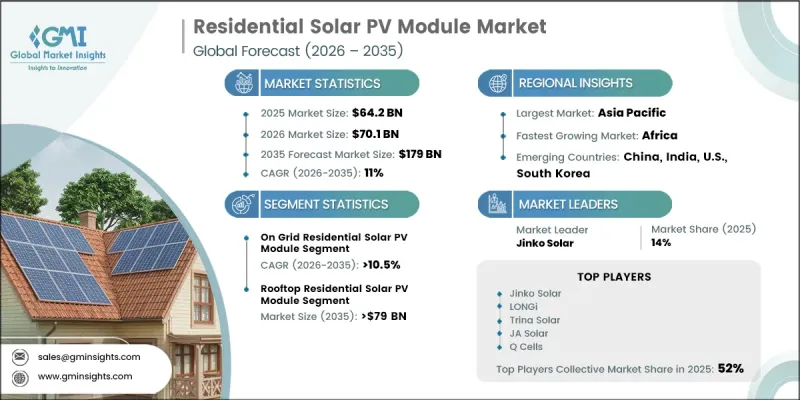
Residential solar PV modules are rooftop-installed systems designed to convert sunlight into electricity, enabling homeowners to generate clean and sustainable energy directly at their properties. Growing technological advancements and continuous research activities are improving module efficiency while steadily reducing manufacturing and installation costs, making solar systems increasingly affordable for residential users. Rising awareness regarding renewable energy adoption, energy security, and long-term electricity savings is further accelerating market demand. Governments, regulatory authorities, and institutions are also implementing supportive initiatives and clean energy programs to encourage wider residential solar deployment. Increasing installation of solar PV systems is helping households reduce dependence on conventional electricity sources and lower monthly energy expenses, making these systems an attractive long-term investment. In addition, rising financial support from organizations and institutions aimed at expanding solar adoption, coupled with ambitious clean energy targets across emerging economies, is creating strong growth opportunities for the residential solar PV module industry.
| Market Scope | |
|---|---|
| Start Year | 2025 |
| Forecast Year | 2026-2035 |
| Start Value | $64.2 Billion |
| Forecast Value | $179 Billion |
| CAGR | 11% |
The on-grid residential solar PV module market is anticipated to grow at a CAGR of 10.5% through 2035. Rising electricity demand across residential sectors, especially during high-consumption periods, is encouraging greater deployment of on-grid solar systems. Increasing integration of renewable energy technologies into residential infrastructure and the growing focus on sustainability are positively influencing market expansion. Government regulations and incentive programs promoting solar infrastructure development and reducing dependence on conventional power generation sources are also supporting industry growth. Furthermore, rising investments in strengthening the supply chain for solar components and raw materials are contributing to stable market development and increased project deployment across residential sectors.
The rooftop residential solar PV module market is expected to reach USD 79 billion by 2035. Favorable financial incentives, policy support, and renewable energy initiatives introduced by multiple economies are encouraging higher investments in rooftop solar installations and clean electricity generation. Increasing consumer interest in energy-efficient residential solutions and the growing shift toward sustainable power generation are further driving market demand. In addition, rooftop solar systems are gaining popularity due to their ability to optimize unused residential space while delivering long-term electricity cost savings.
U.S. Residential Solar PV Module Market is projected to reach USD 9.1 billion by 2035, supported by rising electricity prices, expanding installer networks, and growing adoption of integrated energy storage systems. Increasing deployment of battery-supported residential solar installations is contributing to higher demand for solar PV modules as homeowners seek improved energy reliability and greater control over electricity consumption. Growing consumer preference for sustainable energy technologies and the increasing emphasis on reducing utility expenses are also strengthening market growth across the country.
Key participants operating in the Global Residential Solar PV Module Industry include Adani Solar, CHINT Group, Canadian Solar, First Solar, Indosolar, JA SOLAR Technology, JinkoSolar, LG Electronics, LONGi, Maxeon Solar Technologies, Meyer Burger Technology, Motech Industries Inc., Oxford PV, Q Cells, REC Group, Renesola, Risen Energy, Solar Frontier, SunPower Corporation, Solaria Corporation, Shunfeng International Clean Energy, Trina Solar, VIKRAM SOLAR LTD, and Yingli Solar. Companies operating in the residential solar PV module market are adopting several strategic initiatives to strengthen their market position and expand their global footprint. Industry participants are heavily investing in research and development activities to improve module efficiency, durability, and energy conversion performance while lowering overall production costs. Many companies are also focusing on expanding manufacturing capacities and enhancing supply chain capabilities to meet growing global demand. Strategic collaborations with installers, distributors, and renewable energy providers are helping manufacturers improve market penetration and customer reach. In addition, businesses are introducing advanced rooftop solar solutions integrated with battery storage and smart energy management technologies to enhance residential energy independence.
Table of Contents
Chapter 1 Methodology & Scope
- 1.1 Research design
- 1.2 Quality commitment
- 1.2.1 GMI AI policy & data integrity commitment
- 1.2.1.1 Source consistency protocol
- 1.2.1 GMI AI policy & data integrity commitment
- 1.3 Research trail & confidence scoring
- 1.3.1 Research trail components
- 1.3.2 Scoring components
- 1.4 Data collection
- 1.4.1 Partial list of primary sources
- 1.5 Data mining sources
- 1.5.1 Paid sources
- 1.5.1.1 Sources, by region
- 1.5.1 Paid sources
- 1.6 Base estimates and calculations
- 1.6.1 Base year calculation for any one approach
- 1.7 Forecast model
- 1.8 Research transparency addendum
- 1.8.1 Source attribution framework
- 1.8.2 Quality assurance metrics
- 1.8.3 Our commitment to trust
- 1.9 Market definitions
Chapter 2 Executive Summary
- 2.1 Industry 360-degree synopsis, 2022 - 2035
- 2.2 Business trends
- 2.3 Mounting trends
- 2.4 Connectivity trends
- 2.5 Technology trends
- 2.6 Regional trends
Chapter 3 Industry Insights
- 3.1 Industry ecosystem
- 3.1.1 Raw Material Suppliers
- 3.1.2 Component Manufacturers
- 3.1.3 Module Manufacturers
- 3.1.4 Distributors & System Integrators
- 3.1.5 End Users & Project Developers
- 3.2 Regulatory landscape
- 3.2.1 Net Metering Policies & NEM 3.0 Impact
- 3.2.2 Federal Tax Credits & ITC Extension
- 3.2.3 State-Level Incentive Programs
- 3.2.4 Grid Interconnection Standards
- 3.3 Industry impact forces
- 3.3.1 Growth drivers
- 3.3.2 Industry pitfalls & challenges
- 3.4 Growth potential analysis
- 3.5 Porter's analysis
- 3.5.1 Bargaining power of suppliers
- 3.5.2 Bargaining power of buyers
- 3.5.3 Threat of new entrants
- 3.5.4 Threat of substitutes
- 3.6 PESTEL analysis
- 3.6.1 Political factors
- 3.6.2 Economic factors
- 3.6.3 Social factors
- 3.6.4 Technological factors
- 3.6.5 Legal factors
- 3.6.6 Environmental factors
- 3.7 Technology and innovation landscape
- 3.7.1 Bifacial Module Technologies
- 3.7.2 PERC & TOPCon Cell Architectures
- 3.7.3 Heterojunction (HJT) Technologies
- 3.7.4 Tandem & Multi-Junction Developments
- 3.8 Cost structure analysis
- 3.9 Price trend analysis (Driven by Primary Research)
- 3.9.1 Historical price trend analysis
- 3.9.2 Pricing strategy by player type
- 3.10 Trade data analysis (Driven by Primary Research)
- 3.10.1 Import/export value trends
- 3.10.2 Key trade corridors & tariff impact
- 3.11 Production capacity & utilization (Driven by Primary Research)
- 3.11.1 Production capacity by country
- 3.11.2 Utilization rates and expansion pipeline
- 3.12 Impact of AI & generative AI on the market [SOLUTION CORE]
- 3.12.1 Predictive maintenance & fault detection
- 3.12.2 Grid optimization & load forecasting
- 3.12.3 Digital twin simulation & testing
- 3.12.4 Risks, limitations & regulatory considerations
- 3.13 Emerging opportunities & trends
- 3.13.1 Digitalization & IoT integration
- 3.13.2 Investment analysis and future outlook
Chapter 4 Competitive landscape, 2026
- 4.1 Introduction
- 4.2 Company market share analysis, by region, 2025
- 4.2.1 North America
- 4.2.2 Europe
- 4.2.3 Asia Pacific
- 4.2.4 Middle East
- 4.2.5 Africa
- 4.2.6 Latin America
- 4.3 Competitive analysis of major market players
- 4.4 Competitive positioning matrix
- 4.5 Key developments
- 4.5.1 Mergers & acquisitions
- 4.5.2 Partnerships & collaborations
- 4.5.3 New product launches
- 4.5.4 Expansion plans & funding
- 4.6 Company tier benchmarking
- 4.6.1 Tier classification criteria & qualifying thresholds
- 4.6.2 Tier positioning matrix by revenue, geography & innovation
Chapter 5 Market Size and Forecast, By Connectivity, 2022 - 2035 (USD Billion & MW)
- 5.1 Key trends
- 5.2 On Grid
- 5.3 Off Grid
Chapter 6 Market Size and Forecast, By Mounting, 2022 - 2035 (USD Billion & MW)
- 6.1 Key trends
- 6.2 Ground Mounted
- 6.3 Roof Top
Chapter 7 Market Size and Forecast, By Technology, 2022 - 2035 (USD Billion & MW)
- 7.1 Key trends
- 7.2 Monocrystalline
- 7.2.1 PERC
- 7.2.2 TopCon
- 7.2.3 HJT
- 7.2.4 IBC
- 7.3 Polycrystalline
- 7.4 Thin film
- 7.4.1 Cadmium Telluride (CdTe)
- 7.4.2 Amorphous Silicon (a-Si)
- 7.4.3 CIGS (Copper Indium Gallium Selenide)
Chapter 8 Market Size and Forecast, By Region, 2022 - 2035 (USD Billion & MW)
- 8.1 Key trends
- 8.2 North America
- 8.2.1 U.S
- 8.2.2 Canada
- 8.2.3 Mexico
- 8.3 Europe
- 8.3.1 Austria
- 8.3.2 Norway
- 8.3.3 Denmark
- 8.3.4 Finland
- 8.3.5 France
- 8.3.6 Germany
- 8.3.7 Italy
- 8.3.8 Switzerland
- 8.3.9 Spain
- 8.3.10 Sweden
- 8.3.11 UK
- 8.3.12 Netherlands
- 8.3.13 Poland
- 8.3.14 Belgium
- 8.3.15 Ireland
- 8.3.16 Baltics
- 8.3.17 Portugal
- 8.4 Asia Pacific
- 8.4.1 China
- 8.4.2 Australia
- 8.4.3 India
- 8.4.4 Japan
- 8.4.5 South Korea
- 8.4.6 Thailand
- 8.4.7 Philippines
- 8.4.8 Vietnam
- 8.4.9 Malaysia
- 8.4.10 Singapore
- 8.5 Middle East
- 8.5.1 Israel
- 8.5.2 Saudi Arabia
- 8.5.3 UAE
- 8.5.4 Jordan
- 8.5.5 Oman
- 8.5.6 Kuwait
- 8.5.7 Turkey
- 8.6 Africa
- 8.6.1 South Africa
- 8.6.2 Egypt
- 8.6.3 Algeria
- 8.6.4 Nigeria
- 8.6.5 Morocco
- 8.7 Latin America
- 8.7.1 Brazil
- 8.7.2 Chile
- 8.7.3 Argentina
- 8.7.4 Peru
Chapter 9 Company Profiles
- 9.1 Adani Solar
- 9.2 CHINT Group
- 9.3 Canadian Solar
- 9.4 First Solar
- 9.5 Indosolar
- 9.6 JA SOLAR Technology
- 9.7 JinkoSolar
- 9.8 LG Electronics
- 9.9 LONGi
- 9.10 Maxeon Solar Technologies
- 9.11 Meyer Burger Technology
- 9.12 Motech Industries Inc.
- 9.13 Oxford PV
- 9.14 Q Cells
- 9.15 REC Group
- 9.16 Renesola
- 9.17 Risen Energy
- 9.18 Solar Frontier
- 9.19 SunPower Corporation
- 9.20 Solaria Corporation
- 9.21 Shunfeng International Clean Energy
- 9.22 Trina Solar
- 9.23 VIKRAM SOLAR LTD
- 9.24 Yingli Solar

