PUBLISHER: Global Market Insights Inc. | PRODUCT CODE: 2061476

PUBLISHER: Global Market Insights Inc. | PRODUCT CODE: 2061476
Thin Film Battery Market Opportunity, Growth Drivers, Industry Trend Analysis, and Forecast 2026 - 2035
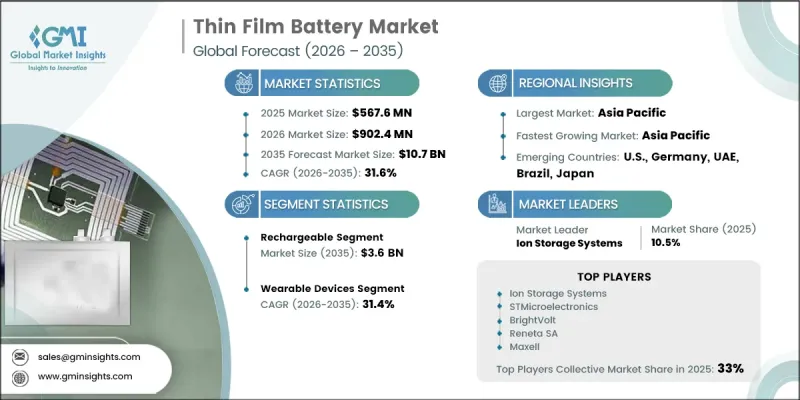
The Global Thin Film Battery Market was valued at USD 567.6 million in 2025 and is estimated to grow at a CAGR of 31.6% to reach USD 10.7 billion by 2035.
The industry is advancing rapidly as manufacturers intensify efforts to enhance energy density, overall efficiency, and cost-effectiveness. Thin film batteries are increasingly being adopted due to their ultra-lightweight structure, flexibility, and ability to fit into compact and unconventional device architectures. Key technological progress in solid-state configurations and flexible battery designs is enabling broader application across advanced electronics ecosystems. Growing deployment in connected technologies is further reinforcing the shift toward miniaturized power solutions.
| Market Scope | |
|---|---|
| Start Year | 2025 |
| Forecast Year | 2026-2035 |
| Start Value | $567.6 Million |
| Forecast Value | $10.7 Billion |
| CAGR | 31.6% |
Rising penetration of wearable technology and Internet of Things ecosystems is a major catalyst shaping market expansion. These applications require highly compact yet durable energy storage systems capable of functioning within small, curved, and space-constrained device formats. Thin film batteries are well-suited for use in smart wearable electronics and compact healthcare monitoring devices due to their high energy density and adaptable structure. As interconnected devices continue to expand globally, demand for advanced power storage technologies is accelerating, opening new growth avenues across consumer electronics and smart device ecosystems.
The rechargeable segment is projected to reach USD 3.6 billion by 2035, driven by increasing demand for compact, high-performance, and long-duration energy storage solutions across wearables, connected devices, and healthcare technologies. Rechargeable thin film batteries are gaining traction across multiple end-use sectors due to their lightweight architecture, enhanced flexibility, and improved energy density compared to conventional battery systems. Ongoing advancements in solid-state chemistry and flexible energy storage design are further supporting innovation and adoption across the segment.
The wearable devices segment is anticipated to grow at a CAGR of 31.4% through 2035. Strong demand for lightweight, flexible, and long-lasting energy sources is accelerating growth in this category. Devices such as smartwatches, fitness trackers, and health monitoring systems require compact batteries capable of delivering consistent performance within small or curved device structures. Thin film batteries offer the required flexibility, durability, and energy efficiency, making them highly suitable for next-generation wearable applications.
U.S. Thin Film Battery Market is expected to reach USD 3.1 billion by 2035. Growth in the country is driven by rising demand for compact and efficient power solutions across consumer electronics, healthcare technologies, and industrial applications. Increasing adoption of solid-state and flexible battery technologies is strengthening their use in small-format devices such as wearable electronics and medical sensors. Expanding deployment of connected devices and IoT-enabled systems is further contributing to rising demand for advanced thin film energy storage solutions in the U.S. market landscape.
Key companies operating in the Global Thin Film Battery Industry include BrightVolt, Cymbet, Enfucell, Excellatron Solid State LLC, Ilika, Imprint Energy, Ion Storage Systems, ITEN, Jenax, Johnson Energy Storage, Maxell, Ltd., Molex, NEC Corporation, Prieto Battery, Renata SA, STMicroelectronics, and VARTA AG. Companies in the thin film battery market are strengthening their position through aggressive investment in R&D focused on next-generation solid-state chemistries and ultra-thin flexible architectures. They are prioritizing improvements in energy density, cycle life, and miniaturization to align with evolving requirements in wearables and IoT devices. Strategic partnerships with electronics manufacturers and OEMs help accelerate integration into commercial products. Firms are also expanding pilot production lines to scale manufacturing efficiency while reducing unit costs. In parallel, many players are securing intellectual property portfolios to protect innovation in materials science and battery design. Another key approach involves targeting high-growth application areas such as healthcare monitoring and connected devices, where demand for compact power solutions is rising.
Table of Contents
Chapter 1 Methodology & Scope
- 1.1 Research approach
- 1.2 Quality commitments
- 1.2.1 GMI AI policy & data integrity commitment
- 1.2.1.1 Source consistency protocol
- 1.2.1 GMI AI policy & data integrity commitment
- 1.3 Research trail & confidence scoring
- 1.3.1 Research trail components
- 1.3.2 Scoring components
- 1.4 Data collection
- 1.4.1 Partial list of primary sources
- 1.5 Data mining sources
- 1.5.1 Paid sources
- 1.5.1.1 Sources, by region
- 1.5.1 Paid sources
- 1.6 Base estimates and calculations
- 1.6.1 Base year calculation for any one approach
- 1.7 Market estimates & forecasts parameters
- 1.8 Forecast model
- 1.8.1 Quantified market impact analysis
- 1.8.1.1 Mathematical impact of growth parameters on forecast
- 1.8.1 Quantified market impact analysis
- 1.9 Research transparency addendum
- 1.9.1 Source attribution framework
- 1.9.2 Quality assurance metrics
- 1.9.3 Our commitment to trust
- 1.10 Market definitions
Chapter 2 Executive Summary
- 2.1 Industry synopsis, 2022 - 2035
- 2.1.1 Business trends
- 2.1.2 Product trends
- 2.1.3 Application trends
- 2.1.4 Regional trends
Chapter 3 Industry Insights
- 3.1 Industry ecosystem analysis
- 3.1.1 Raw material availability & sourcing analysis
- 3.1.2 Manufacturing capacity assessment
- 3.1.3 Supply chain resilience & risk factors
- 3.1.4 Distribution network analysis
- 3.2 Regulatory landscape
- 3.3 Industry impact forces
- 3.3.1 Growth drivers
- 3.3.2 Industry pitfalls & challenges
- 3.4 Growth potential analysis
- 3.5 Porter's analysis
- 3.5.1 Bargaining power of suppliers
- 3.5.2 Bargaining power of buyers
- 3.5.3 Threat of new entrants
- 3.5.4 Threat of substitutes
- 3.6 PESTEL analysis
- 3.6.1 Political factors
- 3.6.2 Economic factors
- 3.6.3 Social factors
- 3.6.4 Technological factors
- 3.6.5 Legal factors
- 3.6.6 Environmental factors
- 3.7 Capacity & production landscape (Driven by Primary Research)
- 3.7.1 Capacity by key producer (Driven by Primary Research)
- 3.7.2 Capacity utilization rates & expansion pipelines (Driven by Primary Research)
- 3.8 Impact of AI & Generative AI on the market (Core Solution)
- 3.8.1 AI-Driven production optimization (Core Solution)
- 3.8.2 Predictive maintenance & fault detection (Core Solution)
- 3.9 Emerging opportunities & trends
- 3.10 Investment analysis & future prospects
- 3.11 Sustainability initiatives & industry 4.0 integration
Chapter 4 Competitive Landscape, 2026
- 4.1 Introduction
- 4.2 Company market share analysis, by region, 2025
- 4.2.1 North America
- 4.2.2 Europe
- 4.2.3 Asia Pacific
- 4.3 Key developments
- 4.3.1 Key partnerships & collaborations
- 4.3.2 Major M&A activities
- 4.3.3 Product innovations & launches
- 4.3.4 Market expansion strategies
- 4.4 Competitive positioning matrix
Chapter 5 Market Size and Forecast, By Product, 2022 - 2035 (USD Million)
- 5.1 Key trends
- 5.2 Rechargeable
- 5.3 Non rechargeable
Chapter 6 Market Size and Forecast, By Application, 2022 - 2035 (USD Million)
- 6.1 Key trends
- 6.2 Wearable devices
- 6.3 Medical
- 6.4 Smart cards
- 6.5 Consumer products
- 6.6 Others
Chapter 7 Market Size and Forecast, By Region, 2022 - 2035 (USD Million)
- 7.1 Key trends
- 7.2 North America
- 7.2.1 U.S.
- 7.2.2 Canada
- 7.2.3 Mexico
- 7.3 Europe
- 7.3.1 Germany
- 7.3.2 UK
- 7.3.3 France
- 7.3.4 Italy
- 7.3.5 Spain
- 7.3.6 Austria
- 7.3.7 Sweden
- 7.4 Asia Pacific
- 7.4.1 China
- 7.4.2 Japan
- 7.4.3 South Korea
- 7.4.4 India
- 7.4.5 Australia
- 7.5 Rest of World
- 7.5.1 Brazil
- 7.5.2 UAE
- 7.5.3 Saudi Arabia
Chapter 8 Company Profiles
- 8.1 BrightVolt
- 8.2 Cymbet
- 8.3 Enfucell
- 8.4 Excellatron Solid State LLC
- 8.5 Ilika
- 8.6 Imprint Energy
- 8.7 Ion Storage Systems
- 8.8 ITEN
- 8.9 Jenax
- 8.10 Johnson Energy Storage
- 8.11 Maxell, Ltd.
- 8.12 Molex
- 8.13 NEC Corporation
- 8.14 Prieto Battery
- 8.15 Renata SA
- 8.16 STMicroelectronics
- 8.17 VARTA AG

