PUBLISHER: Global Market Insights Inc. | PRODUCT CODE: 2071280

PUBLISHER: Global Market Insights Inc. | PRODUCT CODE: 2071280
Rechargeable Thin Film Battery Market Opportunity, Growth Drivers, Industry Trend Analysis, and Forecast 2026 - 2035
The Global Rechargeable Thin Film Battery Market was valued at USD 200.5 million in 2025 and is estimated to grow at a CAGR of 30.7% to reach USD 3.5 billion by 2035.
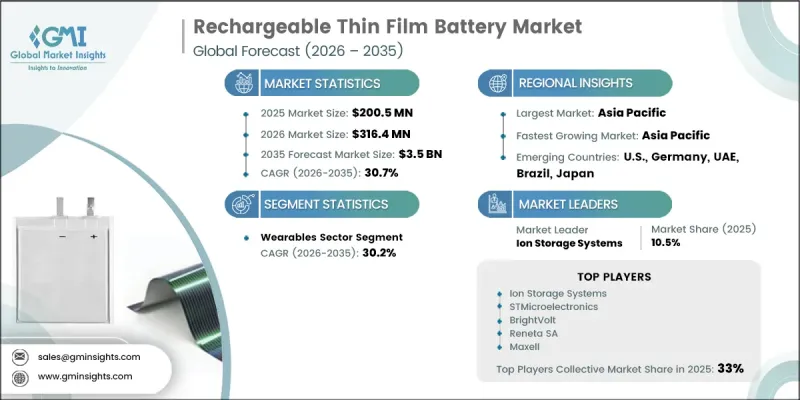
Strong market growth is being driven by rising demand for compact, lightweight, and high-efficiency energy storage solutions across modern electronic applications. Increasing adoption in wearable devices, medical equipment, smart cards, and connected IoT ecosystems is significantly accelerating market penetration. These batteries are increasingly preferred due to their ability to deliver stable performance, long operational life, and suitability for ultra-thin device architectures. Continuous advancements in solid-state chemistry, nanostructured materials, and micro-scale fabrication techniques are further enhancing energy density, charging speed, and overall reliability. At the same time, growing emphasis on sustainability and eco-friendly energy storage is encouraging the shift toward solid-state thin film technologies that eliminate liquid electrolytes and reduce environmental risks. Integration of intelligent manufacturing systems and data-driven production processes is also improving efficiency and scalability. Overall, the market is evolving rapidly as industries prioritize miniaturization, performance optimization, and sustainable energy solutions in next-generation electronic devices.
| Market Scope | |
|---|---|
| Start Year | 2025 |
| Forecast Year | 2026-2035 |
| Start Value | $200.5 Million |
| Forecast Value | $3.5 Billion |
| CAGR | 30.7% |
The wearables segment is expected to reach a CAGR of 30.2% through 2035, driven by increasing integration of compact energy storage solutions in next-generation wearable technologies. Demand is rising as manufacturers prioritize lightweight, flexible, and high-performance batteries for continuously evolving wearable ecosystems. Improved energy density, fast charging capability, and enhanced durability are strengthening their suitability for advanced wearable applications. Growing focus on health monitoring, fitness tracking, and connected personal devices is further reinforcing segment expansion.
United States Rechargeable Thin Film Battery Market is projected to reach USD 1.02 billion by 2035. Market growth in the country is being supported by rising demand for compact energy storage systems across advanced electronics, healthcare devices, and connected technologies. Strong emphasis on research and development is enabling domestic manufacturers to develop high-performance battery solutions with improved safety and efficiency. Expansion of IoT-enabled devices, smart identification systems, and next-generation medical implants is further contributing to market development. Increasing transition toward sustainable and environmentally responsible energy storage technologies is also accelerating the adoption of solid-state thin film batteries across various industries.
Key companies operating in the Global Rechargeable Thin Film Battery Market include Cymbet, VARTA AG, Ilika, STMicroelectronics, Maxell, Ltd., BrightVolt, Enfucell, Excellatron Solid State LLC, Imprint Energy, Ion Storage Systems, ITEN, Jenax, Johnson Energy Storage, Molex, NEC Corporation, Prieto Battery, and Renata SA. Companies in the rechargeable thin film battery market are focusing on advanced material innovation, strategic partnerships, and manufacturing scalability to strengthen their competitive position. A primary strategy involves investing heavily in research and development to enhance energy density, charging speed, and overall battery durability. Manufacturers are increasingly adopting solid-state and nanotechnology-based approaches to improve performance and safety. Expansion of production capabilities through automation and micro-fabrication technologies is helping reduce costs and improve output consistency. Firms are also collaborating with electronics, healthcare, and IoT device manufacturers to integrate thin film batteries into next-generation products. Geographic expansion into high-growth technology markets is further supporting revenue growth.
Table of Contents
Chapter 1 Methodology & Scope
- 1.1 Research approach
- 1.2 Quality commitments
- 1.2.1 GMI AI policy & data integrity commitment
- 1.2.1.1 Source consistency protocol
- 1.2.1 GMI AI policy & data integrity commitment
- 1.3 Research trail & confidence scoring
- 1.3.1 Research trail components
- 1.3.2 Scoring components
- 1.4 Data collection
- 1.4.1 Partial list of primary sources
- 1.5 Data mining sources
- 1.5.1 Paid sources
- 1.5.1.1 Sources, by region
- 1.5.1 Paid sources
- 1.6 Base estimates and calculations
- 1.6.1 Base year calculation for any one approach
- 1.7 Market estimates & forecasts parameters
- 1.8 Forecast model
- 1.8.1 Quantified market impact analysis
- 1.8.1.1 Mathematical impact of growth parameters on forecast
- 1.8.1 Quantified market impact analysis
- 1.9 Research transparency addendum
- 1.9.1 Source attribution framework
- 1.9.2 Quality assurance metrics
- 1.9.3 Our commitment to trust
- 1.10 Market definitions
Chapter 2 Executive Summary
- 2.1 Industry synopsis, 2022 - 2035
- 2.1.1 Business trends
- 2.1.2 Application trends
- 2.1.3 Regional trends
Chapter 3 Industry Insights
- 3.1 Industry ecosystem analysis
- 3.1.1 Raw material availability & sourcing analysis
- 3.1.2 Manufacturing capacity assessment
- 3.1.3 Supply chain resilience & risk factors
- 3.1.4 Distribution network analysis
- 3.2 Regulatory landscape
- 3.3 Industry impact forces
- 3.3.1 Growth drivers
- 3.3.2 Industry pitfalls & challenges
- 3.4 Growth potential analysis
- 3.5 Porter's analysis
- 3.5.1 Bargaining power of suppliers
- 3.5.2 Bargaining power of buyers
- 3.5.3 Threat of new entrants
- 3.5.4 Threat of substitutes
- 3.6 PESTEL analysis
- 3.6.1 Political factors
- 3.6.2 Economic factors
- 3.6.3 Social factors
- 3.6.4 Technological factors
- 3.6.5 Legal factors
- 3.6.6 Environmental factors
- 3.7 Capacity & production landscape (Driven by Primary Research)
- 3.7.1 Capacity by key producer (Driven by Primary Research)
- 3.7.2 Capacity utilization rates & expansion pipelines (Driven by Primary Research)
- 3.8 Impact of AI & Generative AI on the market (Core Solution)
- 3.8.1 AI-Driven production optimization (Core Solution)
- 3.8.2 Predictive maintenance & fault detection (Core Solution)
- 3.9 Emerging opportunities & trends
- 3.10 Investment analysis & future prospects
- 3.11 Sustainability initiatives & industry 4.0 integration
Chapter 4 Competitive Landscape, 2026
- 4.1 Introduction
- 4.2 Company market share analysis, by region, 2025
- 4.2.1 North America
- 4.2.2 Europe
- 4.2.3 Asia Pacific
- 4.3 Key developments
- 4.3.1 Key partnerships & collaborations
- 4.3.2 Major M&A activities
- 4.3.3 Product innovations & launches
- 4.3.4 Market expansion strategies
- 4.4 Competitive positioning matrix
Chapter 5 Market Size and Forecast, By Application, 2022 - 2035 (USD Million)
- 5.1 Key trends
- 5.2 Wearable devices
- 5.3 Medical
- 5.4 Smart cards
- 5.5 Consumer products
- 5.6 Others
Chapter 6 Market Size and Forecast, By Region, 2022 - 2035 (USD Million)
- 6.1 Key trends
- 6.2 North America
- 6.2.1 U.S.
- 6.2.2 Canada
- 6.2.3 Mexico
- 6.3 Europe
- 6.3.1 Germany
- 6.3.2 UK
- 6.3.3 France
- 6.3.4 Italy
- 6.3.5 Spain
- 6.3.6 Austria
- 6.3.7 Sweden
- 6.4 Asia Pacific
- 6.4.1 China
- 6.4.2 Japan
- 6.4.3 South Korea
- 6.4.4 India
- 6.4.5 Australia
- 6.5 Rest of World
- 6.5.1 Brazil
- 6.5.2 UAE
- 6.5.3 Saudi Arabia
Chapter 7 Company Profiles
- 7.1 BrightVolt
- 7.2 Cymbet
- 7.3 Enfucell
- 7.4 Excellatron Solid State LLC
- 7.5 Ilika
- 7.6 Imprint Energy
- 7.7 Ion Storage Systems
- 7.8 ITEN
- 7.9 Jenax
- 7.10 Johnson Energy Storage
- 7.11 Maxell, Ltd.
- 7.12 Molex
- 7.13 NEC Corporation
- 7.14 Prieto Battery
- 7.15 Renata SA
- 7.16 STMicroelectronics
- 7.17 VARTA AG

