PUBLISHER: Global Market Insights Inc. | PRODUCT CODE: 2071162

PUBLISHER: Global Market Insights Inc. | PRODUCT CODE: 2071162
Passenger EV Repair Service Market Opportunity, Growth Drivers, Industry Trend Analysis, and Forecast 2026 - 2035
The Global Passenger EV Repair Service Market was valued at USD 12.7 billion in 2025 and is estimated to grow at a CAGR of 24.6% to reach USD 126.4 billion by 2035.
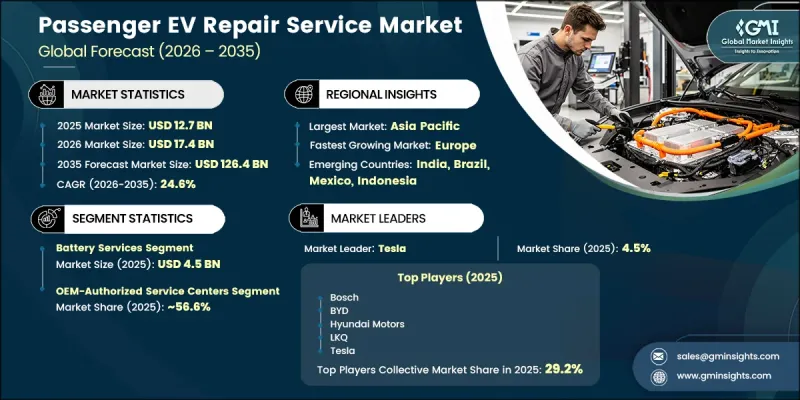
The market is experiencing rapid expansion as the global electric vehicle fleet continues to grow and vehicle owners increasingly require specialized maintenance and repair services. Industry dynamics are evolving as OEM-certified service providers, independent repair facilities, mobile service operators, and battery refurbishment businesses compete to address rising demand. Independent service providers are steadily increasing their share of repair activity, particularly in regions where authorized service networks have limited geographic coverage. Competitive pricing remains a major factor supporting this shift, as many independent operators can offer specialized EV repair and battery-related services at lower labor costs than manufacturer-affiliated facilities. Battery refurbishment and lifecycle extension services are emerging as a significant growth opportunity within the passenger EV repair service market. The ability to restore battery performance and extend asset utilization is improving repair economics while creating additional revenue streams across the value chain. However, establishing a fully equipped EV repair facility requires substantial investment in high-voltage safety systems, battery handling equipment, diagnostic technologies, software platforms, and technician certification programs. Depending on facility size, service capacity, and location, initial capital requirements typically range between USD 500,000 and USD 2 million.
| Market Scope | |
|---|---|
| Start Year | 2025 |
| Forecast Year | 2026-2035 |
| Start Value | $12.7 Billion |
| Forecast Value | $126.4 Billion |
| CAGR | 24.6% |
The battery services segment generated USD 4.5 billion in 2025, accounting for 35.3% of share. The segment's leading position reflects the critical importance of battery systems within electric vehicles, as battery packs account for a substantial portion of overall vehicle value. The technical complexity, safety requirements, and performance implications associated with battery maintenance, diagnostics, repair, and replacement create a consistent demand for specialized service offerings. As electric vehicle adoption continues to increase, battery-related services are expected to remain a primary source of revenue across the repair ecosystem.
OEM-authorized service centers held 56.6% share in 2025, making them the largest service channel. Their market leadership is supported by direct access to proprietary diagnostic platforms, manufacturer-approved replacement parts, software calibration tools, and specialized technician training programs. These capabilities enable authorized service providers to deliver advanced repair, diagnostic, and system optimization services that are often unavailable through non-affiliated repair facilities. As vehicle software integration becomes increasingly sophisticated, OEM-authorized networks are expected to maintain a strong position within the market.
North American Passenger EV Repair Service Market generated USD 2.4 billion in 2025. Regional market growth is supported by a high concentration of electric vehicle ownership, expanding charging infrastructure, and increasing consumer adoption of EV technology. Demand for repair and maintenance services is particularly strong in regions with large electric vehicle populations, creating favorable conditions for network expansion among both authorized and independent service providers. Continued growth in vehicle registrations and advancements in EV technology are expected to support long-term market development across North America.
Major companies operating in the global passenger EV repair service market include Tesla, Robert Bosch, BYD Auto, LKQ, Hyundai Motor, ZF Aftermarket, Cox Automotive, AutoNation, Volkswagen, General Motors, Ford, BMW, and Mercedes-Benz. Companies operating in the passenger EV repair service market are implementing a range of strategic initiatives to strengthen their competitive position and expand market share. Leading market participants are investing heavily in technician training programs, advanced diagnostic technologies, and specialized battery repair capabilities to address the growing complexity of electric vehicles. Many companies are expanding service networks through partnerships, acquisitions, and franchise models to improve geographic coverage and customer accessibility. Investments in battery refurbishment, remanufacturing, and lifecycle management services are also becoming a major strategic priority as organizations seek new revenue opportunities.
Table of Contents
Chapter 1 Methodology
- 1.1 Research approach
- 1.2 Quality Commitments
- 1.2.1 GMI AI policy & data integrity commitment
- 1.3 Research Trail & Confidence Scoring
- 1.3.1 Research Trail Components
- 1.3.2 Scoring Components
- 1.4 Data Collection
- 1.5 Data mining sources
- 1.5.1 Paid sources
- 1.6 Base estimates and calculations
- 1.6.1 Base year calculation
- 1.7 Forecast model
- 1.7.1 Quantified market impact analysis
- 1.8 Research transparency addendum
- 1.8.1 Source attribution framework
- 1.8.2 Quality assurance metrics
- 1.8.3 Our commitment to trust
Chapter 2 Executive Summary
- 2.1 Industry 360° synopsis
- 2.2 Key market trends
- 2.2.1 Regional
- 2.2.2 Service
- 2.2.3 Service Provider
- 2.2.4 Vehicle
- 2.2.5 Customer
- 2.3 TAM analysis, 2026-2035
- 2.4 CXO perspectives: Strategic imperatives
Chapter 3 Industry Insights
- 3.1 Industry ecosystem analysis
- 3.1.1 Supplier landscape
- 3.1.2 Profit margin
- 3.1.3 Cost structure
- 3.1.4 Value addition at each stage
- 3.1.5 Factor affecting the value chain
- 3.1.6 Disruptions
- 3.2 Industry impact forces
- 3.2.1 Growth drivers
- 3.2.1.1 Rapid Global EV Fleet Expansion & Aging Parc
- 3.2.1.2 Zero-Emission Vehicle Mandates & Government Incentives
- 3.2.1.3 Growth of Independent EV Service Networks
- 3.2.1.4 Battery Second-Life & Remanufacturing Opportunities
- 3.2.2 Industry pitfalls and challenges
- 3.2.2.1 Substantial Capital Investment Requirements for Equipment
- 3.2.2.2 High Battery Replacement Costs & Complex Logistics
- 3.2.3 Market opportunities
- 3.2.3.1 Mobile & On-Demand Service Model Proliferation
- 3.2.3.2 Value-Added Services (Charging Infrastructure, Software Updates)
- 3.2.3.3 Expansion into Emerging EV Markets
- 3.2.1 Growth drivers
- 3.3 Technology and innovation landscape
- 3.3.1 Current technological trends
- 3.3.1.1 Advanced EV Diagnostic Scanners
- 3.3.1.2 Battery Management System (BMS) Diagnostic Tools
- 3.3.1.3 High-Voltage Battery Testing & Balancing Equipment
- 3.3.2 Emerging technologies
- 3.3.2.1 AI-Powered Predictive Maintenance Platforms
- 3.3.2.2 Digital Twin-Based Vehicle Health Monitoring
- 3.3.2.3 Remote Over-the-Air (OTA) Repair and Diagnostics
- 3.3.1 Current technological trends
- 3.4 Growth potential analysis
- 3.5 Regulatory landscape
- 3.5.1 North America
- 3.5.1.1 US - OSHA (Occupational Safety and Health Administration)
- 3.5.1.2 US - EPA (Environmental Protection Agency)
- 3.5.1.3 Canada - Transport Canada
- 3.5.2 Europe
- 3.5.2.1 EU - European Commission
- 3.5.2.2 Germany - KBA (Kraftfahrt-Bundesamt)
- 3.5.3 Asia Pacific
- 3.5.3.1 China - MIIT (Ministry of Industry and Information Technology)
- 3.5.3.2 India - MoRTH (Ministry of Road Transport and Highways)
- 3.5.4 LATAM
- 3.5.4.1 Brazil - CONTRAN
- 3.5.4.2 Mexico - SICT (Secretaria de Infraestructura, Comunicaciones y Transportes)
- 3.5.5 MEA
- 3.5.5.1 UAE - ESMA (Emirates Authority for Standardization and Metrology)
- 3.5.5.2 Saudi Arabia - Saudi Standards, Metrology and Quality Organization
- 3.5.1 North America
- 3.6 Porter's analysis
- 3.7 PESTEL analysis
- 3.8 Cost breakdown analysis
- 3.9 Patent analysis (Driven by Primary Research)
- 3.10 Sustainability and environmental aspects
- 3.10.1 Sustainable Practices
- 3.10.2 Waste Reduction Strategies
- 3.10.3 Energy Efficiency in Production
- 3.10.4 Eco-friendly Initiatives
- 3.10.5 Carbon Footprint Considerations
- 3.11 Impact of AI & generative AI on the market
- 3.11.1 AI-driven disruption of existing business models
- 3.11.2 GenAI use cases & adoption roadmap by segment
- 3.11.3 Risks, limitations & regulatory considerations
- 3.12 Mobile EV Repair & On-Demand Service Models
- 3.13 Forecast assumptions & scenario analysis (Driven by Primary Research)
- 3.13.1 Base Case- Key Macro & Industry Variables Driving CAGR
- 3.13.2 Optimistic Scenarios- Favorable macro and industry tailwinds
- 3.13.3 Pessimistic Scenario - Macroeconomic slowdown or industry headwinds
Chapter 4 Competitive Landscape, 2025
- 4.1 Introduction
- 4.2 Company market share analysis
- 4.2.1 North America
- 4.2.2 Europe
- 4.2.3 Asia Pacific
- 4.2.4 LATAM
- 4.2.5 MEA
- 4.3 Competitive analysis of major market players
- 4.4 Competitive positioning matrix
- 4.5 Key developments
- 4.5.1 Mergers & acquisitions
- 4.5.2 Partnerships & collaborations
- 4.5.3 New product launches
- 4.5.4 Expansion plans and funding
- 4.6 Company tier benchmarking
- 4.6.1 Tier classification criteria & qualifying thresholds
- 4.6.2 Tier positioning matrix by revenue, geography & innovation
Chapter 5 Market Estimates and Forecast, By Service, 2022 - 2035 ($ Mn)
- 5.1 Key trends
- 5.2 Battery Services
- 5.2.1 Battery diagnostics
- 5.2.2 Battery pack repair/replacement
- 5.2.3 Thermal management system repair
- 5.2.4 Others
- 5.3 Mechanical Services
- 5.3.1 Brake systems
- 5.3.2 Wheel alignment
- 5.3.3 Tire replacement
- 5.3.4 HVAC servicing
- 5.3.5 Others
- 5.4 Software & Diagnostics
- 5.5 Exterior Services
- 5.6 Structural Services
- 5.7 Others
Chapter 6 Market Estimates and Forecast, By Service Provider, 2022 - 2035 ($ Mn)
- 6.1 Key trends
- 6.2 OEM Authorized Service Centers
- 6.3 Franchise General Repair Shops
- 6.4 Independent Repair Shops
- 6.5 Mobile EV Service Providers
Chapter 7 Market Estimates and Forecast, By Vehicle, 2022 - 2035 ($ Mn)
- 7.1 Key trends
- 7.2 BEV
- 7.3 PHEV
- 7.4 FCEV
- 7.5 HEV
Chapter 8 Market Estimates and Forecast, By Customer, 2022 - 2035 ($ Mn)
- 8.1 Key trends
- 8.2 Individual/Private
- 8.3 Commercial/Fleet Operators
Chapter 9 Market Estimates & Forecast, By Region, 2022 - 2035 ($Mn)
- 9.1 Key trends
- 9.2 North America
- 9.2.1 US
- 9.2.2 Canada
- 9.3 Europe
- 9.3.1 Germany
- 9.3.2 UK
- 9.3.3 France
- 9.3.4 Italy
- 9.3.5 Spain
- 9.3.6 Poland
- 9.3.7 Norway
- 9.3.8 Netherlands
- 9.4 Asia Pacific
- 9.4.1 China
- 9.4.2 India
- 9.4.3 Japan
- 9.4.4 South Korea
- 9.4.5 Australia
- 9.4.6 Indonesia
- 9.4.7 Thailand
- 9.4.8 Vietnam
- 9.5 Latin America
- 9.5.1 Brazil
- 9.5.2 Mexico
- 9.5.3 Argentina
- 9.6 MEA
- 9.6.1 South Africa
- 9.6.2 Saudi Arabia
- 9.6.3 UAE
Chapter 10 Company Profiles
- 10.1 Global players
- 10.1.1 Tesla
- 10.1.2 Robert Bosch
- 10.1.3 BYD Auto
- 10.1.4 LKQ
- 10.1.5 Hyundai Motor
- 10.1.6 ZF Aftermarket
- 10.1.7 Cox Automotive
- 10.1.8 AutoNation
- 10.1.9 Volkswagen
- 10.1.10 General Motors
- 10.1.11 Ford
- 10.1.12 BMW
- 10.1.13 Mercedes-Benz
- 10.2 Regional players
- 10.2.1 NIO Service
- 10.2.2 XPeng
- 10.2.3 Li Auto
- 10.2.4 Tata Motors
- 10.2.5 Renault EV Service
- 10.3 Emerging players
- 10.3.1 Rivian Automotive
- 10.3.2 Lucid Motors

