PUBLISHER: Global Market Insights Inc. | PRODUCT CODE: 2071197

PUBLISHER: Global Market Insights Inc. | PRODUCT CODE: 2071197
LFP and LMFP Cathode Market Opportunity, Growth Drivers, Industry Trend Analysis, and Forecast 2026 - 2035
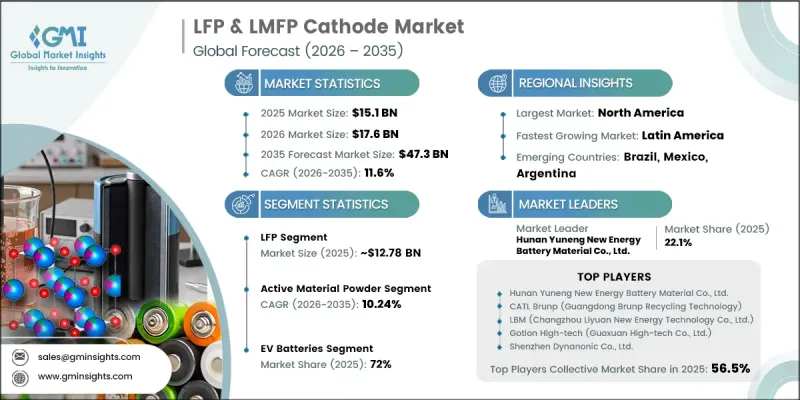
The Global LFP & LMFP Cathode Market was valued at USD 15.1 billion in 2025 and is estimated to grow at a CAGR of 11.6% to reach USD 47.3 billion by 2035.
Growth across the LFP & LMFP cathode industry is driven by a structural shift away from cobalt-dependent chemistries, influenced by cost optimization pressures, supply chain vulnerability concerns, and stricter battery safety expectations. Lithium iron phosphate (LFP) and manganese-enhanced lithium manganese iron phosphate (LMFP) chemistries are increasingly positioned as preferred solutions for large-format energy storage and electric mobility applications. Adoption is further reinforced by long-term procurement strategies, with OEMs and battery manufacturers increasingly locking in multi-year supply agreements centered on iron-phosphate-based cathode materials. This reflects a broader effort to secure stable input costs and reduce exposure to geopolitical risks associated with cobalt sourcing. Demand growth is also being shaped by the scalability of LFP production ecosystems, particularly in Asia, where established manufacturing clusters and mature processing expertise support high-volume output. As electrification trends continue to accelerate across transportation and energy infrastructure sectors, LFP and LMFP chemistries are expected to remain central to global battery supply chains.
| Market Scope | |
|---|---|
| Start Year | 2025 |
| Forecast Year | 2026-2035 |
| Start Value | $15.1 Billion |
| Forecast Value | $47.3 Billion |
| CAGR | 11.6% |
LFP technology accounted for 82.2% share in 2025, representing about USD 12.78 billion, attributed to its early commercialization, well-established production processes, and extensive integration across large-scale battery manufacturing ecosystems. Chemistry benefits from mature industrial capabilities and widespread adoption across established battery supply networks, enabling consistent large-volume production. Strong operational reliability and long cycle life further reinforce its dominance across multiple end-use applications within the global cathode market.
The EV batteries segment held a 72% share in 2025. LFP and LMFP cathodes are widely utilized in electric mobility applications where safety performance, cost efficiency, and long operational life are critical considerations. Their deployment is particularly strong in mass-market electric vehicles, commercial transportation fleets, and entry-level mobility solutions, where energy density trade-offs are balanced by affordability and durability advantages.
North America LFP & LMFP Cathode Market is expected to grow at a CAGR of 11.37% from 2026 to 2035. Growth in the United States is influenced by policy-driven manufacturing incentives designed to accelerate domestic battery production capacity and strengthen supply chain localization. These regulatory frameworks encourage investments in cathode material production and support the expansion of localized battery value chains across the region.
Major companies operating in the Global LFP & LMFP cathode market include CATL Brunp (Guangdong Brunp Recycling Technology), Hunan Yuneng New Energy Battery Material Co., Ltd., Gotion High-tech (Guoxuan High-tech Co., Ltd.), LBM (Changzhou Liyuan New Energy Technology Co., Ltd.), Shenzhen Dynanonic Co., Ltd., Chongqing Terui Battery Materials Co., Ltd., Epsilon Advanced Materials Pvt. Ltd., IBU-tec Advanced Materials AG, IBUvolt Battery Materials GmbH, Mitra Chem, Sparkz Inc., HCM, Integrals Power Ltd., and Western CAM. Companies operating in the LFP & LMFP cathode market are focusing on strengthening their competitive position through capacity expansion, vertical integration, and long-term supply agreements with battery manufacturers and automotive OEMs. Significant investments are being directed toward scaling production facilities to meet rising demand from electric vehicle and energy storage applications. Firms are also prioritizing technological advancements aimed at improving energy density, cycle life, and material efficiency to enhance product performance. Strategic partnerships and joint ventures are increasingly being used to secure raw material supply chains and reduce exposure to price volatility.
Table of Contents
Chapter 1 Methodology & Scope
- 1.1 Market scope and definition
- 1.2 Research design
- 1.2.1 Research approach
- 1.2.2 Data collection methods
- 1.3 Data mining sources
- 1.3.1 Global
- 1.3.2 Regional/Country
- 1.4 Base estimates and calculations
- 1.4.1 Base year calculation
- 1.4.2 Key trends for market estimation
- 1.5 Primary research and validation
- 1.5.1 Primary sources
- 1.6 Forecast model
- 1.7 Research assumptions and limitations
Chapter 2 Executive Summary
- 2.1 Industry 360° synopsis
- 2.2 Key market trends
- 2.2.1 Product Type
- 2.2.2 Form
- 2.2.3 Application
- 2.2.4 Regional
- 2.3 TAM Analysis, 2026-2035
- 2.4 CXO perspectives: Strategic imperatives
- 2.5 Future outlook and strategic recommendations
Chapter 3 Industry Insights
- 3.1 Industry ecosystem analysis
- 3.1.1 Supplier landscape
- 3.1.2 Profit margin
- 3.1.3 Value addition at each stage
- 3.1.4 Factor affecting the value chain
- 3.1.5 Disruptions
- 3.2 Industry impact forces
- 3.2.1 Growth drivers
- 3.2.1.1 Rising electric vehicle adoption worldwide
- 3.2.1.2 Increasing demand for energy storage solutions
- 3.2.1.3 Cost advantages over nickel-based chemistries
- 3.2.2 Industry pitfalls and challenges
- 3.2.2.1 Lower energy density than alternative chemistries
- 3.2.2.2 Raw material price fluctuations and volatility
- 3.2.3 Market opportunities
- 3.2.3.1 Expansion of LMFP for higher energy density
- 3.2.3.2 Growth in stationary energy storage installations
- 3.2.3.3 Localization of battery material supply chains
- 3.2.1 Growth drivers
- 3.3 Growth potential analysis
- 3.4 Regulatory landscape
- 3.4.1 North America
- 3.4.2 Europe
- 3.4.3 Asia Pacific
- 3.4.4 Latin America
- 3.4.5 Middle East & Africa
- 3.5 Porter's analysis
- 3.6 PESTEL analysis
- 3.7 Technology and innovation landscape
- 3.7.1 Current technological trends
- 3.7.2 Emerging technologies
- 3.8 Price trends
- 3.8.1 By region
- 3.8.2 By product type
- 3.9 Future market trends
- 3.10 Patent landscape
- 3.11 Trade statistics (HS code)
- 3.11.1 Major importing countries
- 3.11.2 Major exporting countries
- 3.12 Sustainability and environmental aspects
- 3.12.1 Sustainable practices
- 3.12.2 Waste reduction strategies
- 3.12.3 Energy efficiency in production
- 3.12.4 Eco-friendly initiatives
- 3.13 Carbon footprint consideration
Chapter 4 Competitive Landscape, 2025
- 4.1 Introduction
- 4.2 Company market share analysis
- 4.2.1 By region
- 4.2.1.1 North America
- 4.2.1.2 Europe
- 4.2.1.3 Asia Pacific
- 4.2.1.4 LATAM
- 4.2.1.5 MEA
- 4.2.1 By region
- 4.3 Company matrix analysis
- 4.4 Competitive analysis of major market players
- 4.5 Competitive positioning matrix
- 4.6 Key developments
- 4.6.1 Mergers & acquisitions
- 4.6.2 Partnerships & collaborations
- 4.6.3 New product launches
- 4.6.4 Expansion plans
Chapter 5 Market Estimates and Forecast, By Product Type, 2022-2035 (USD Million) (Kilo Tons)
- 5.1 Key trends
- 5.2 LFP
- 5.3 LMFP
Chapter 6 Market Estimates and Forecast, By Form, 2022-2035 (USD Million) (Kilo Tons)
- 6.1 Key trends
- 6.2 Active material powder
- 6.3 Coated electrode
Chapter 7 Market Estimates and Forecast, By Application, 2022-2035 (USD Million) (Kilo Tons)
- 7.1 Key trends
- 7.2 EV batteries
- 7.3 ESS
- 7.4 Consumer electronics
- 7.5 Others
Chapter 8 Market Estimates and Forecast, By Region, 2022-2035 (USD Million) (Kilo Tons)
- 8.1 Key trends
- 8.2 North America
- 8.2.1 U.S.
- 8.2.2 Canada
- 8.3 Europe
- 8.3.1 Germany
- 8.3.2 UK
- 8.3.3 France
- 8.3.4 Spain
- 8.3.5 Italy
- 8.3.6 Rest of Europe
- 8.4 Asia Pacific
- 8.4.1 China
- 8.4.2 India
- 8.4.3 Japan
- 8.4.4 Australia
- 8.4.5 South Korea
- 8.4.6 Rest of Asia Pacific
- 8.5 Latin America
- 8.5.1 Brazil
- 8.5.2 Mexico
- 8.5.3 Argentina
- 8.5.4 Rest of Latin America
- 8.6 Middle East and Africa
- 8.6.1 Saudi Arabia
- 8.6.2 South Africa
- 8.6.3 UAE
- 8.6.4 Rest of Middle East and Africa
Chapter 9 Company Profiles
- 9.1 Hunan Yuneng New Energy Battery Material Co., Ltd.
- 9.2 CATL Brunp (Guangdong Brunp Recycling Technology)
- 9.3 LBM (Changzhou Liyuan New Energy Technology Co. Ltd.)
- 9.4 Gotion High-tech (Guoxuan High-tech Co., Ltd.)
- 9.5 Shenzhen Dynanonic Co., Ltd.
- 9.6 Chongqing Terui Battery Materials Co., Ltd.
- 9.7 Epsilon Advanced Materials Pvt. Ltd.
- 9.8 IBUvolt Battery Materials GmbH
- 9.9 IBU-tec Advanced Materials AG
- 9.10 HCM
- 9.11 Mitra Chem
- 9.12 Sparkz Inc.
- 9.13 Integrals Power Ltd.
- 9.14 Western CAM

