PUBLISHER: Mordor Intelligence | PRODUCT CODE: 2124111

PUBLISHER: Mordor Intelligence | PRODUCT CODE: 2124111
Cathode Materials - Market Share Analysis, Industry Trends & Statistics, Growth Forecasts (2026 - 2031)
According to Mordor Intelligence, the cathode materials market size was valued at 3.91 Million tons in 2025 and is estimated to grow from 4.85 Million tons in 2026 to reach 14.32 Million tons by 2031, at a CAGR of 24.15% during the forecast period (2026-2031).
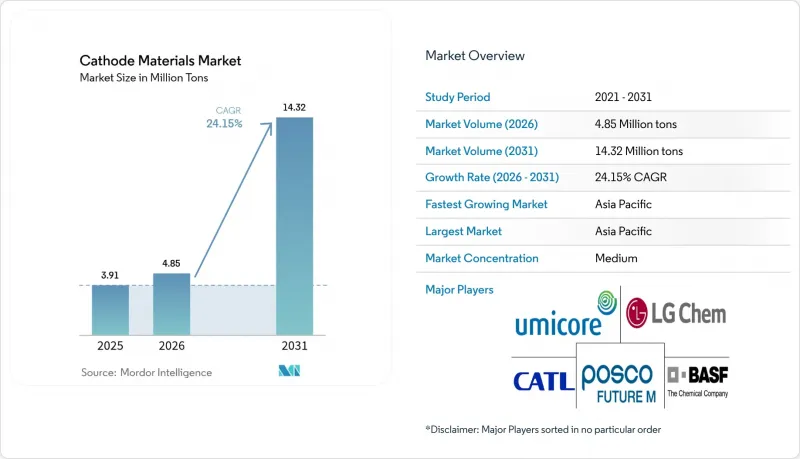
This report is Segmented by Material (Lithium Iron Phosphate, Lithium Cobalt Oxide, Lithium Manganese Oxide, and More), Battery Type (Lithium-Ion, Lead-Acid, Sodium-Ion, and Flow Batteries), End-User Industry (Automotive, Consumer Electronics, and More), and Geography (Asia-Pacific, North America, Europe, South America, and Middle-East and Africa). The Market Forecasts are Provided in Terms of Volume (Tons).
Global Cathode Materials Market Trends and Insights
Surging EV Production Volumes
Global electric-vehicle output climbed to 13.8 million units in 2025 and is predicted to exceed 22 million by 2028, a trajectory that lifts cathode demand because every 60 kWh pack embeds 8-12 kg of active material. BYD plans to double 2024 volumes by manufacturing 4 million plug-ins in 2026, underscoring scale expansion across Asia. The switch to larger-format cells such as CATL's Qilin increases cathode loading per vehicle by thickening electrode coatings. Fleet electrification adds another layer, illustrated by UPS ordering 10,000 LFP-powered delivery vans in 2025. Commercial-vehicle duty cycles favor LFP longevity, providing counter-cyclical stability for the cathode materials market.
Government Incentives and Emissions Regulations
Section 45X of the U.S. Inflation Reduction Act grants USD 10 per kilowatt-hour for domestic cells and USD 45 for modules, triggering 18 U.S. gigafactory announcements totaling 550 GWh of capacity. In Europe, the Battery Regulation mandates carbon-footprint declarations by 2027 and tightens thresholds by 2030, advantaging cathode plants tied to renewable power such as Umicore's Nysa site, which sources 80% wind energy. China extended new-energy vehicle purchase-tax exemptions to 2027, sustaining demand in the world's largest EV arena. India's USD 2.4 billion Production-Linked Incentive for advanced cells lures Reliance Industries and Rajesh Exports, positioning South Asia as a new pole of cathode consumption.
Supply-Chain Concentration in China
China refined 78% of global lithium hydroxide and 93% of manganese sulfate in 2024, exposing Western automakers to delivery risk when domestic suppliers reprioritize local needs. Ford postponed its F-150 Lightning extended-range launch by four months in 2024 after a Chinese precursor partner diverted shipments during a lithium shortage. U.S. defense assessments warn that a Taiwan Strait conflict could choke cathode flows, while European players like Volkswagen's PowerCo rely on China for 82% of NMC precursor. Building a 20 kt/yr precursor plant costs USD 150 million and 30 months, which slows diversification. Compliance with the Uyghur Forced Labor Prevention Act obliges automakers to trace multi-tier suppliers, adding administrative overhead.
Other drivers and restraints analyzed in the detailed report include:
- Battery-Pack Cost Decline from Scale Learning
- Localization of Cathode Supply Chains in US and EU
- Solid-State Batteries Lower Cathode Mass/kWh
For complete list of drivers and restraints, kindly check the Table Of Contents.
Segment Analysis
Lithium iron phosphate accounted for 41.10% of 2025 volume and is anticipated to expand at 24.97% through 2031, reflecting Tesla and BYD adoptions that eliminated cobalt and nickel from mass-market models. BYD's Blade pack narrowed the energy-density gap with NMC 622 to 15%, supporting broader acceptance. Premium brands still specify high-nickel NMC: BMW's Neue Klasse uses NMC 811 at 285 Wh/kg, positioning the chemistry where 500-km range is non-negotiable. Lithium-nickel-cobalt-aluminum holds niche but profitable ground in long-range packs, although sliding cobalt prices erode its margin advantage. Lead dioxide continues in starter batteries yet will cede share as 12-V lithium replacements scale. Sodium iron phosphate's slice will rise as sodium-ion cars launch in price-sensitive Asian markets, broadening the cathode materials market canvas.
Complete Report Scope:
- By Material
- Lithium Iron Phosphate
- Lithium Cobalt Oxide
- Lithium-Nickel Manganese Cobalt
- Lithium Manganese Oxide
- Lithium Nickel Cobalt Aluminium Oxide
- Lead Dioxide
- Other Materials (Sodium Iron Phosphate, Oxyhydroxide, and Graphite)
- By Battery Type
- Lithium-Ion
- Lead-Acid
- Sodium-ion
- Flow batteries
- By End-user Industry
- Automotive
- Consumer Electronics
- Power Tools
- Energy Storage
- Other End-user Industries (Medical Devices, Aerospace, etc)
- By Geography
- Asia-Pacific
- China
- Japan
- South Korea
- India
- Indonesia
- Vietnam
- Thailand
- Malaysia
- Rest of Asia-Pacific
- North America
- United States
- Canada
- Mexico
- Europe
- Germany
- United Kingdom
- France
- Italy
- Spain
- NORDIC Countries
- Turkey
- Russia
- Rest of Europe
- South America
- Brazil
- Argentina
- Rest of South America
- Middle-East and Africa
- Saudi Arabia
- South Africa
- Rest of Middle-East and Africa
- Asia-Pacific
Geography Analysis
Asia-Pacific commanded 79.10% of the market share in 2025 and is on a 26.34% CAGR trajectory to 2031, reflecting deep integration across mining, processing, and cell manufacturing. China anchors this ecosystem through cost advantages and proprietary process expertise, enabling sustained innovation velocity. South Korea and Japan provide complementary high-precision manufacturing and advanced material formulations, reinforcing regional dominance. Indonesia's USD 15 billion in smelting investment and Vietnam's decade-long tax holidays ensure Southeast Asia doubles as both precursor and assembly hub, reinforcing the cathode materials market's eastward gravity.
North America demand is also growing on the back of Section 45X credits that de-risk domestic plants. The United States production is supported by BASF Ohio and Albemarle Kings Mountain, with Canadian capacity tripling once POSCO FUTURE M and Talon Metals commission assets. Mexico's USD 2 billion influx from Ganfeng and Tianqi creates a near-shoring corridor that meets USMCA thresholds. These moves shrink delivery times and diversify the cathode materials market supply chain beyond Asia.
Europe is also rising as the European Battery Alliance bankrolls local output. Germany's production in 2024 climbed with BASF Schwarzheide and Umicore Nysa, while the U.K. rebooted via Tata Chemicals' 40,000 t/yr LFP project to serve JLR. South America's lithium-rich Chile and Argentina export hydroxide feeding 22,000 tons of cathode precursor, and Morocco's Bou-Azzer mine supplies cobalt sulfate to European sites. Middle-East and Africa hold lower share but own strategic raw materials that could reposition them as precursor exporters. Collectively, geographic diversification sustains the cathode materials market against regional shocks.
- BASF
- Contemporary Amperex Technology Co., Limited
- Ecopro BM
- Eramet (Sandouville)
- Guangxi CNGR Advanced Material
- Himadri Speciality Chemical Ltd
- Huayou Cobalt Co., Ltd.
- IBU-tec
- LANDF CORP
- LG Chem
- MITSUI MINING & SMELTING CO.,LTD.
- NICHIA CORPORATION
- Nippon Chemical Industrial Co., Ltd.
- POSCO FUTURE M
- Shenzhen Dynanonic Co., Ltd.
- Showa Denko Materials
- Sumitomo Metal Mining Co., Ltd.
- Targray
- Umicore
- XTC New Energy Materials
Additional Benefits:
- The market estimate (ME) sheet in Excel format
- 3 months of analyst support
TABLE OF CONTENTS
1 Introduction
- 1.1 Study Assumptions and Market Definition
- 1.2 Scope of the Study
2 Research Methodology
3 Executive Summary
4 Market Landscape
- 4.1 Market Overview
- 4.2 Market Drivers
- 4.2.1 Surging EV Production Volumes
- 4.2.2 Government Incentives and Emissions Regulations
- 4.2.3 Battery-Pack Cost Decline from Scale Learning
- 4.2.4 Localization of Cathode Supply Chains in US and EU
- 4.2.5 Sodium-Ion and LMFP Commercialization Expanding Demand
- 4.3 Market Restraints
- 4.3.1 Supply-Chain Concentration in China
- 4.3.2 Solid-State Batteries Lower Cathode Mass/kWh
- 4.3.3 Processing Hurdles for High-Mn Chemistries
- 4.4 Value Chain Analysis
- 4.5 Regulatory Landscape
- 4.6 Porter's Five Forces
- 4.6.1 Bargaining Power of Suppliers
- 4.6.2 Bargaining Power of Buyers
- 4.6.3 Threat of New Entrants
- 4.6.4 Threat of Substitutes
- 4.6.5 Degree of Competition
5 Market Size and Growth Forecasts (Volume)
- 5.1 By Material
- 5.1.1 Lithium Iron Phosphate
- 5.1.2 Lithium Cobalt Oxide
- 5.1.3 Lithium-Nickel Manganese Cobalt
- 5.1.4 Lithium Manganese Oxide
- 5.1.5 Lithium Nickel Cobalt Aluminium Oxide
- 5.1.6 Lead Dioxide
- 5.1.7 Other Materials (Sodium Iron Phosphate, Oxyhydroxide, and Graphite)
- 5.2 By Battery Type
- 5.2.1 Lithium-Ion
- 5.2.2 Lead-Acid
- 5.2.3 Sodium-ion
- 5.2.4 Flow batteries
- 5.3 By End-user Industry
- 5.3.1 Automotive
- 5.3.2 Consumer Electronics
- 5.3.3 Power Tools
- 5.3.4 Energy Storage
- 5.3.5 Other End-user Industries (Medical Devices, Aerospace, etc)
- 5.4 By Geography
- 5.4.1 Asia-Pacific
- 5.4.1.1 China
- 5.4.1.2 Japan
- 5.4.1.3 South Korea
- 5.4.1.4 India
- 5.4.1.5 Indonesia
- 5.4.1.6 Vietnam
- 5.4.1.7 Thailand
- 5.4.1.8 Malaysia
- 5.4.1.9 Rest of Asia-Pacific
- 5.4.2 North America
- 5.4.2.1 United States
- 5.4.2.2 Canada
- 5.4.2.3 Mexico
- 5.4.3 Europe
- 5.4.3.1 Germany
- 5.4.3.2 United Kingdom
- 5.4.3.3 France
- 5.4.3.4 Italy
- 5.4.3.5 Spain
- 5.4.3.6 NORDIC Countries
- 5.4.3.7 Turkey
- 5.4.3.8 Russia
- 5.4.3.9 Rest of Europe
- 5.4.4 South America
- 5.4.4.1 Brazil
- 5.4.4.2 Argentina
- 5.4.4.3 Rest of South America
- 5.4.5 Middle-East and Africa
- 5.4.5.1 Saudi Arabia
- 5.4.5.2 South Africa
- 5.4.5.3 Rest of Middle-East and Africa
- 5.4.1 Asia-Pacific
6 Competitive Landscape
- 6.1 Market Concentration
- 6.2 Strategic Moves
- 6.3 Market Share(%)/Ranking Analysis
- 6.4 Company Profiles (includes Global Overview, Market Overview, Core Segments, Financials, Strategic Information, Products and Services, Recent Developments)
- 6.4.1 BASF
- 6.4.2 Contemporary Amperex Technology Co., Limited
- 6.4.3 Ecopro BM
- 6.4.4 Eramet (Sandouville)
- 6.4.5 Guangxi CNGR Advanced Material
- 6.4.6 Himadri Speciality Chemical Ltd
- 6.4.7 Huayou Cobalt Co., Ltd.
- 6.4.8 IBU-tec
- 6.4.9 LANDF CORP
- 6.4.10 LG Chem
- 6.4.11 MITSUI MINING & SMELTING CO.,LTD.
- 6.4.12 NICHIA CORPORATION
- 6.4.13 Nippon Chemical Industrial Co., Ltd.
- 6.4.14 POSCO FUTURE M
- 6.4.15 Shenzhen Dynanonic Co., Ltd.
- 6.4.16 Showa Denko Materials
- 6.4.17 Sumitomo Metal Mining Co., Ltd.
- 6.4.18 Targray
- 6.4.19 Umicore
- 6.4.20 XTC New Energy Materials
7 Market Opportunities and Future Outlook
- 7.1 White-space and unmet-need assessment

