PUBLISHER: Global Market Insights Inc. | PRODUCT CODE: 2071200

PUBLISHER: Global Market Insights Inc. | PRODUCT CODE: 2071200
Climate Risk Management Market Opportunity, Growth Drivers, Industry Trend Analysis, and Forecast 2026 - 2035
The Global Climate Risk Management Market was valued at USD 7.4 billion in 2025 and is estimated to grow at a CAGR of 14.8% to reach USD 30.3 billion by 2035.
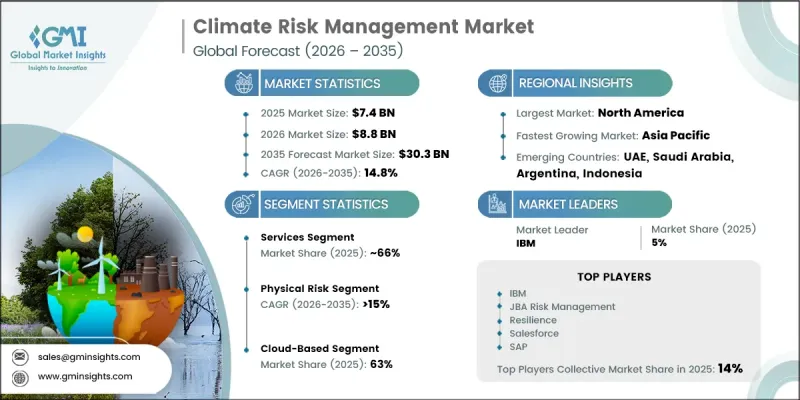
Market growth is driven by the increasing need for organizations to identify, evaluate, and mitigate climate-related risks that can affect long-term operational and financial performance. A major shift within the climate risk management market is the growing recognition that traditional historical loss datasets are no longer sufficient for accurately assessing future climate exposure. As a result, businesses, financial institutions, and public-sector organizations are increasingly adopting scenario-based and probabilistic modeling tools to improve forecasting accuracy and strengthen risk planning capabilities. Regulatory frameworks across multiple regions are also evolving from voluntary reporting practices toward mandatory compliance requirements, creating additional demand for advanced climate risk solutions. Technological advancements in artificial intelligence, machine learning, and climate data analytics are further enhancing the precision of climate risk assessments. Improved data collection capabilities and higher-resolution climate monitoring systems are enabling solution providers to deliver more detailed and actionable insights. These developments are positioning climate risk management as a critical component of enterprise resilience, regulatory compliance, and long-term strategic planning across industries worldwide.
| Market Scope | |
|---|---|
| Start Year | 2025 |
| Forecast Year | 2026-2035 |
| Start Value | $7.4 Billion |
| Forecast Value | $30.3 Billion |
| CAGR | 14.8% |
The Asia Pacific climate risk management market is emerging as the fastest-growing regional market, supported by increasing exposure to climate-related disruptions, rapid urban development, and growing awareness of environmental risk management. Organizations throughout the region are placing greater emphasis on climate resilience planning as the economic and operational consequences of changing climate conditions become more pronounced. Rising investments in climate intelligence platforms, predictive analytics, and risk assessment technologies are supporting strong market expansion across both public and private sectors. As governments and enterprises seek to strengthen adaptation strategies and improve long-term sustainability outcomes, demand for climate risk management solutions is expected to accelerate significantly throughout the region.
The services segment accounted for 66% share in 2025 and is anticipated to grow at a CAGR of 14% between 2026 and 2035. The segment's leadership reflects the complex nature of climate risk implementation projects, which often require specialized expertise and customized solutions. Organizations frequently rely on professional service providers for climate risk modeling, regulatory compliance support, scenario planning, risk assessment frameworks, and data integration activities. The growing need for tailored advisory and implementation services continues to reinforce the segment's dominant position within the market.
The physical risk segment held a 46% share and is projected to grow at a CAGR of 15% through 2035. Increasing climate-related disruptions are intensifying demand for physical risk assessment capabilities across industries. Businesses, infrastructure operators, and government agencies are increasingly utilizing advanced analytics and predictive intelligence tools to evaluate vulnerabilities, improve preparedness strategies, minimize operational disruptions, and support informed investment decisions. As organizations prioritize resilience and long-term asset protection, physical risk management remains a key focus area within the broader climate risk management industry.
United States Climate Risk Management Market held an 88% share, generating USD 2.4 billion in 2025. Growing economic losses associated with climate-related disruptions are increasing demand for sophisticated climate risk assessment and forecasting solutions across the country. Organizations are recognizing the importance of predictive climate intelligence for identifying potential vulnerabilities, protecting critical infrastructure, strengthening business continuity planning, and improving operational resilience. As climate-related uncertainties become a greater consideration in corporate decision-making, adoption of climate risk management technologies continues to expand across multiple sectors within the United States.
Leading companies operating in the global climate risk management market include IBM, SAP, Salesforce, JBA Risk Management, Resilience, First Street, and Fathom Global. Companies in the climate risk management market are implementing a range of strategies to strengthen their market position and expand their customer base. Major industry participants are investing heavily in artificial intelligence, machine learning, and advanced analytics to improve the accuracy and scalability of climate risk assessments. Strategic partnerships with financial institutions, government agencies, and sustainability organizations are helping companies broaden their market reach and enhance solution capabilities. Many providers are expanding their service portfolios by integrating climate intelligence, regulatory compliance tools, and scenario modeling platforms into comprehensive risk management ecosystems. Businesses are also focusing on product innovation, cloud-based deployment models, and real-time data integration to improve user experience and decision-making capabilities.
Table of Contents
Chapter 1 Methodology
- 1.1 Research approach
- 1.2 Quality Commitments
- 1.2.1 GMI AI policy & data integrity commitment
- 1.2.1.1 Source consistency protocol
- 1.2.1 GMI AI policy & data integrity commitment
- 1.3 Research Trail & Confidence Scoring
- 1.3.1 Research Trail Components
- 1.3.2 Scoring Components
- 1.4 Data Collection
- 1.4.1 Partial list of primary sources
- 1.5 Data mining sources
- 1.5.1 Paid sources
- 1.5.2 Sources, by region
- 1.6 Base estimates and calculations
- 1.6.1 Base year calculation
- 1.7 Forecast model
- 1.7.1 Quantified market impact analysis
- 1.7.1.1 Mathematical impact of growth parameters on forecast
- 1.7.1 Quantified market impact analysis
- 1.8 Research transparency addendum
- 1.8.1 Source attribution framework
- 1.8.2 Quality assurance metrics
- 1.8.3 Our commitment to trust
Chapter 2 Executive Summary
- 2.1 Industry 360° synopsis, 2022 - 2035
- 2.2 Key market trends
- 2.2.1 Solution
- 2.2.2 Risk
- 2.2.3 Deployment Mode
- 2.2.4 Application
- 2.2.5 Enterprise Size
- 2.2.6 End Use
- 2.3 TAM Analysis, 2026-2035
- 2.4 CXO perspectives: Strategic imperatives
Chapter 3 Industry Insights
- 3.1 Industry ecosystem analysis
- 3.1.1 Supplier landscape
- 3.1.2 Profit margin analysis
- 3.1.3 Cost structure
- 3.1.4 Value addition at each stage
- 3.1.5 Factor affecting the value chain
- 3.1.6 Disruptions
- 3.2 Industry impact forces
- 3.2.1 Growth drivers
- 3.2.1.1 Increasing frequency and intensity of extreme weather events amplifying risk exposure
- 3.2.1.2 Mounting regulatory pressure and mandatory climate disclosure requirements (TCFD, CSRD, Basel III)
- 3.2.1.3 Growing influence of ESG investors and institutional capital allocators
- 3.2.1.4 Advances in AI-powered climate modeling and scenario analytics
- 3.2.2 Industry pitfalls and challenges
- 3.2.2.1 Limited availability of high-quality, standardized climate data
- 3.2.2.2 High implementation costs and technical expertise requirements
- 3.2.3 Market opportunities
- 3.2.3.1 Growing demand for climate risk solutions in global financial services
- 3.2.3.2 Expansion of green infrastructure and climate-resilient supply chain management
- 3.2.3.3 Emerging market adoption driven by climate vulnerability and regulatory convergence
- 3.2.1 Growth drivers
- 3.3 Growth potential analysis
- 3.4 Regulatory landscape
- 3.4.1 North America
- 3.4.1.1 U.S. Securities and Exchange Commission (SEC) Climate Disclosure Requirements
- 3.4.1.2 Federal Reserve Climate Scenario Analysis Framework
- 3.4.1.3 Office of the Superintendent of Financial Institutions (OSFI) Guideline B-15 (Canada)
- 3.4.1.4 National Association of Insurance Commissioners (NAIC) Climate Risk Disclosure Survey
- 3.4.1.5 California Climate Corporate Data Accountability Act (SB 253)
- 3.4.2 Europe
- 3.4.2.1 Corporate Sustainability Reporting Directive (CSRD)
- 3.4.2.2 European Sustainability Reporting Standards (ESRS)
- 3.4.2.3 Sustainable Finance Disclosure Regulation (SFDR)
- 3.4.2.4 EU Taxonomy Regulation
- 3.4.2.5 European Banking Authority (EBA) ESG Risk Management Guidelines
- 3.4.3 Asia Pacific
- 3.4.3.1 China Environmental Information Disclosure Measures
- 3.4.3.2 China Green Finance Guidelines
- 3.4.3.3 India Business Responsibility and Sustainability Reporting (BRSR)
- 3.4.3.4 Monetary Authority of Singapore (MAS) Environmental Risk Management Guidelines
- 3.4.3.5 Japan Financial Services Agency (JFSA) Climate Disclosure Guidance
- 3.4.4 Latin America
- 3.4.4.1 Brazil Central Bank Climate and Environmental Risk Management Regulations
- 3.4.4.2 Brazilian Securities Commission (CVM) ESG Disclosure Requirements
- 3.4.4.3 Mexico Sustainable Taxonomy Framework
- 3.4.4.4 Mexico Banking and Securities Commission (CNBV) ESG Disclosure Guidelines
- 3.4.4.5 Chile Financial Market Commission (CMF) Climate Disclosure Requirements
- 3.4.5 Middle East & Africa
- 3.4.5.1 Saudi Green Initiative Sustainability Reporting Framework
- 3.4.5.2 Saudi Capital Market Authority (CMA) ESG Disclosure Guidelines
- 3.4.5.3 UAE Sustainable Finance Framework
- 3.4.5.4 South African Climate Change Bill and Climate Risk Reporting Initiatives
- 3.4.5.5 Johannesburg Stock Exchange (JSE) Sustainability and Climate Disclosure Guidance
- 3.4.1 North America
- 3.5 Porter's analysis
- 3.6 PESTEL analysis
- 3.7 Technology and innovation landscape
- 3.7.1 Current technological trends
- 3.7.2 Emerging technologies
- 3.8 Price analysis (Driven by Primary Research)
- 3.8.1 Historical Price Trend Analysis
- 3.8.2 Pricing Strategy by Player Type (Premium / Value / Cost-plus)
- 3.9 Cost breakdown analysis
- 3.10 Patent analysis (Driven by Primary Research)
- 3.11 Impact of AI & generative AI on the market
- 3.11.1 AI-driven disruption of existing business models
- 3.11.2 GenAI use cases & adoption roadmap by segment
- 3.11.3 Risks, limitations & regulatory considerations
- 3.12 Sustainability and environmental aspects
- 3.12.1 Sustainable practices
- 3.12.2 Waste reduction strategies
- 3.12.3 Energy efficiency in production
- 3.12.4 Eco-friendly Initiatives
- 3.12.5 Carbon footprint considerations
- 3.13 Forecast assumptions & scenario analysis (Driven by Primary Research)
- 3.13.1 Base Case - key macro & industry variables driving CAGR
- 3.13.2 Optimistic Scenarios - Favorable macro and industry tailwinds
- 3.13.3 Pessimistic Scenario - Macroeconomic slowdown or industry headwinds
Chapter 4 Competitive Landscape, 2025
- 4.1 Introduction
- 4.2 Company market share analysis
- 4.2.1 North America
- 4.2.2 Europe
- 4.2.3 Asia Pacific
- 4.2.4 LATAM
- 4.2.5 MEA
- 4.3 Competitive analysis of major market players
- 4.4 Competitive positioning matrix
- 4.5 Key developments
- 4.5.1 Mergers & acquisitions
- 4.5.2 Partnerships & collaborations
- 4.5.3 New Product Launches
- 4.5.4 Expansion Plans and funding
- 4.6 Company tier benchmarking
- 4.6.1 Tier classification criteria & qualifying thresholds
- 4.6.2 Tier positioning matrix by revenue, geography & innovation
Chapter 5 Market Estimates & Forecast, By Solution, 2022 - 2035 ($Mn)
- 5.1 Key trends
- 5.2 Software & Platforms
- 5.2.1 Risk Assessment & Scenario Analysis Platforms
- 5.2.2 Climate Risk Modeling Software
- 5.2.3 Regulatory Reporting & Compliance Platforms
- 5.2.4 Carbon Accounting & Emissions Tracking Software
- 5.2.5 Integrated Climate Risk Management Suites
- 5.3 Services
- 5.3.1 Data & Analytics Services
- 5.3.2 Professional & Consulting Services
- 5.3.2.1 Strategy & Advisory Services
- 5.3.2.2 Implementation & Integration Services
- 5.3.2.3 Training, Support & Managed Services
Chapter 6 Market Estimates & Forecast, By Risk, 2022 - 2035 ($Mn)
- 6.1 Key trends
- 6.2 Physical Risk
- 6.3 Transition Risk
- 6.4 Liability Risk
Chapter 7 Market Estimates & Forecast, By Deployment Mode, 2022 - 2035 ($Mn)
- 7.1 Key trends
- 7.2 Cloud-Based
- 7.3 On-Premises
- 7.4 Hybrid
Chapter 8 Market Estimates & Forecast, By Application, 2022 - 2035 ($Mn)
- 8.1 Key trends
- 8.2 Carbon Accounting & Emissions Management
- 8.3 Disaster Preparedness & Early Warning Systems
- 8.4 ESG & Sustainable Investment Risk Analysis
- 8.5 Weather & Agriculture Risk Management
- 8.6 Business & Investment Risk Management
- 8.7 Climate Litigation & Liability Risk Management
- 8.8 Regulatory Reporting & Compliance
- 8.9 Others
Chapter 9 Market Estimates & Forecast, By End Use, 2022 - 2035 ($Mn)
- 9.1 Key trends
- 9.2 BFSI
- 9.3 Energy & Utilities
- 9.4 Government & Public Sector
- 9.5 Real Estate & Infrastructure
- 9.6 Agriculture & Forestry
- 9.7 Manufacturing
- 9.8 Transportation & Logistics
- 9.9 Healthcare
- 9.10 Others
Chapter 10 Market Estimates & Forecast, By Enterprise Size, 2022 - 2035 ($Mn)
- 10.1 Key trends
- 10.2 Large Enterprises
- 10.3 SME
Chapter 11 Market Estimates & Forecast, By Region, 2022 - 2035 ($Mn, Units)
- 11.1 Key trends
- 11.2 North America
- 11.2.1 U.S.
- 11.2.2 Canada
- 11.3 Europe
- 11.3.1 UK
- 11.3.2 Germany
- 11.3.3 France
- 11.3.4 Italy
- 11.3.5 Spain
- 11.3.6 Russia
- 11.3.7 Nordics
- 11.4 Asia Pacific
- 11.4.1 China
- 11.4.2 India
- 11.4.3 Japan
- 11.4.4 South Korea
- 11.4.5 Southeast Asia
- 11.4.5.1 Indonesia
- 11.4.5.2 Malaysia
- 11.4.5.3 Singapore
- 11.4.5.4 Thailand
- 11.4.5.5 Vietnam
- 11.4.6 ANZ
- 11.5 Latin America
- 11.5.1 Brazil
- 11.5.2 Argentina
- 11.5.3 Mexico
- 11.6 MEA
- 11.6.1 UAE
- 11.6.2 Saudi Arabia
- 11.6.3 South Africa
Chapter 12 Company Profiles
- 12.1 Global Players
- 12.1.1 Fathom Global
- 12.1.2 First Street
- 12.1.3 IBM (Envizi)
- 12.1.4 JBA Risk Management
- 12.1.5 Jupiter Intelligence
- 12.1.6 Salesforce
- 12.1.7 SAP
- 12.1.8 XDI (Cross Dependency Initiative)
- 12.2 Regional Players
- 12.2.1 Climate X
- 12.2.2 ClimateAi
- 12.2.3 Mitiga Solutions
- 12.2.4 Resilience
- 12.2.5 RiskThinking.AI
- 12.2.6 StepChange
- 12.2.7 Sust Global
- 12.3 Emerging Players
- 12.3.1 Climafin
- 12.3.2 Correntics
- 12.3.3 Entelligent
- 12.3.4 Intensel
- 12.3.5 Vyzrd

