PUBLISHER: Global Market Insights Inc. | PRODUCT CODE: 2071205

PUBLISHER: Global Market Insights Inc. | PRODUCT CODE: 2071205
Asia Pacific Textile Home Decor Market Opportunity, Growth Drivers, Industry Trend Analysis, and Forecast 2026 - 2035
Asia Pacific Textile Home Decor Market was valued at USD 46.6 billion in 2025 and is estimated to grow at a CAGR of 6.2% to reach USD 85.4 billion by 2035.
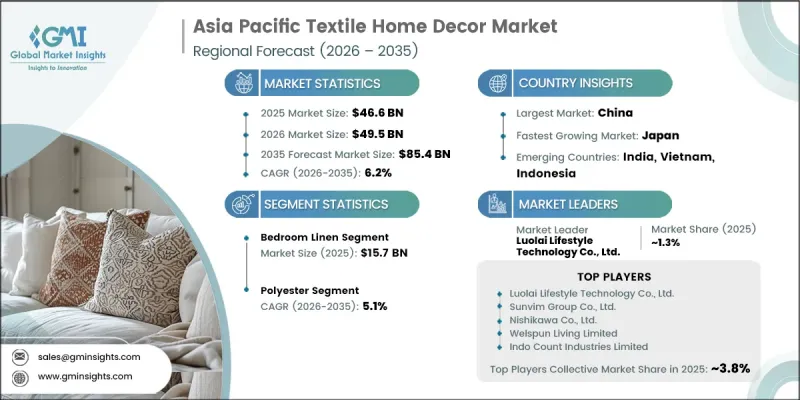
Strong growth across the market is driven by accelerating urban expansion and the continuous development of residential construction projects throughout the region. The growing movement of populations toward urban centers is creating sustained demand for modern housing developments, which is contributing to increased spending on home furnishing and decorative textile products. Consumers are placing greater emphasis on enhancing the appearance, comfort, and functionality of their living environments, resulting in higher demand for textile-based interior decor solutions. Expanding residential infrastructure in developing economies is generating new opportunities for decorative furnishing products across households. At the same time, improved access to products through organized retail networks and rapidly growing e-commerce platforms is supporting market penetration. Rising disposable incomes and evolving lifestyle preferences are further strengthening consumer spending on home decor and interior enhancement. Buyers are increasingly seeking stylish, comfortable, and personalized living spaces that reflect contemporary design preferences. Growing exposure to international interior design concepts through digital channels is also influencing purchasing decisions. In response, manufacturers are focusing on product innovation by introducing advanced fabric technologies, modern design aesthetics, and environmentally responsible materials that appeal to a broad consumer base across the Asia Pacific textile home decor market.
| Market Scope | |
|---|---|
| Start Year | 2025 |
| Forecast Year | 2026-2035 |
| Start Value | $46.6 Billion |
| Forecast Value | $85.4 Billion |
| CAGR | 6.2% |
The bedroom linen category accounted for USD 15.7 billion in 2025, supported by the fundamental role bedroom furnishings play in residential interiors, along with consistent replacement demand from consumers. The category continues to benefit from increasing consumer focus on comfort, visual appeal, and enhanced bedroom environments. Demand is rising for premium bedding solutions that combine high-quality materials with contemporary styling and improved softness. Consumers are increasingly favoring coordinated bedroom furnishing collections that align with evolving interior decoration trends and contribute to a refined living experience.
The polyester segment captured 37.4% share in 2025 and is forecast to grow at a CAGR of 5.1% from 2026 to 2035. The segment maintains a leading position due to the material's cost-effectiveness, durability, and ease of maintenance across numerous home furnishing applications. Polyester remains a preferred choice among manufacturers and consumers because it delivers long-lasting performance and retains its appearance over extended periods of use. Its adaptability to various textures, colors, and design patterns allows manufacturers to develop products that align with changing consumer preferences. The material's practical characteristics continue to support widespread adoption across multiple textile home decor categories throughout the region.
China Textile Home Decor Industry was valued at USD 21.4 billion in 2025. Market leadership is supported by a substantial residential consumer base and a well-established domestic textile manufacturing sector. Ongoing urban development, rising household purchasing power, and increasing interest in modern interior styling continue to stimulate market demand. Consumer spending on textile home decor products remains strong as residential construction activities and renovation projects expand across the country. The combination of manufacturing capabilities and growing consumer demand positions China as a key contributor to overall regional market growth.
Key companies operating in the Asia Pacific Textile Home Decor Market include Luolai Lifestyle Technology Co., Ltd., Welspun Living Limited, Trident Group, Indo Count Industries Limited, Nishikawa Co., Ltd., Himatsingka Seide Limited, Pacific Textiles Holdings Limited, Sunvim Group Co., Ltd., Nishat Chunian Limited, Fuanna Bedding and Furnishing Co., Ltd., D'Decor Home Fabrics Pvt. Ltd., Bombay Dyeing & Manufacturing Co. Ltd., Yihui Home Textile Co., Ltd., Maspar Industries Pvt. Ltd., Arvind Limited, Raymond Lifestyle Ltd., Stellar Home Fashions Ltd., Fabindia Limited, Story@Home, Sheridan Australia Pty Ltd., and Square Textiles PLC. Companies operating in the Asia Pacific textile home decor market are implementing several strategic initiatives to strengthen their market position and expand their customer base. Product innovation remains a major focus, with manufacturers developing premium-quality fabrics, sustainable materials, and trend-driven designs that cater to evolving consumer preferences. Many companies are broadening their product portfolios to address diverse style requirements and varying price segments. Strategic investments in digital commerce platforms are helping brands improve accessibility and enhance customer engagement across regional markets. Businesses are also strengthening distribution networks through partnerships with retailers and home furnishing outlets to increase market reach.
Table of Contents
Chapter 1 Methodology & Scope
- 1.1 Market scope and definition
- 1.2 Research design
- 1.2.1 Research approach
- 1.2.2 Data collection methods
- 1.3 Data mining sources
- 1.3.1 Global
- 1.3.2 Regional/Country
- 1.4 Base estimates and calculations
- 1.4.1 Base year calculation
- 1.4.2 Key trends for market estimation
- 1.5 Primary research and validation
- 1.5.1 Primary sources
- 1.6 Forecast model
- 1.7 Research assumptions and limitations
Chapter 2 Executive Summary
- 2.1 Industry 360° synopsis
- 2.2 Key market trends
- 2.2.1 Country
- 2.2.2 Product type
- 2.2.3 Material
- 2.2.4 Price range
- 2.2.5 Distribution channel
Chapter 3 Industry Insights
- 3.1 Industry ecosystem analysis
- 3.1.1 Supplier landscape
- 3.1.2 Profit margin
- 3.1.3 Value addition at each stage
- 3.1.4 Factor affecting the value chain
- 3.2 Industry impact forces
- 3.2.1 Growth drivers
- 3.2.1.1 Rapid urbanization and expansion of residential housing projects
- 3.2.1.2 Rising disposable income and changing consumer lifestyle preferences
- 3.2.1.3 Growth of e-commerce and organized home furnishing retail channels
- 3.2.2 Pitfalls & Challenges
- 3.2.2.1 Fluctuations in prices of cotton, polyester, and other textile raw materials
- 3.2.2.2 High competition from low-cost and unorganized local manufacturers
- 3.2.3 Opportunities
- 3.2.3.1 Growing demand for sustainable and eco-friendly home textile products
- 3.2.3.2 Expansion of hospitality, tourism, and commercial interior projects
- 3.2.1 Growth drivers
- 3.3 Growth potential analysis
- 3.4 Future market trends
- 3.5 Technology and innovation landscape
- 3.5.1 Current technological trends
- 3.5.2 Emerging technologies
- 3.6 Regulatory landscape
- 3.6.1 Standards and compliance requirements
- 3.6.2 Regional regulatory frameworks
- 3.6.3 Certification standards
- 3.7 Porter's analysis
- 3.8 PESTEL analysis
- 3.9 Pricing analysis (driven by primary research)
- 3.9.1 Historical price trend analysis (driven by primary research)
- 3.9.2 Pricing strategy by player type (premium / value / cost-plus) (driven by primary research)
- 3.10 Trade data analysis (driven by paid database)
- 3.10.1 Import/export volume and value trends (driven by paid database)
- 3.10.2 Key trade corridors and tariff impact (driven by paid database)
- 3.11 Impact of AI and generative AI on the market
- 3.11.1 AI-driven disruption of existing business models
- 3.11.2 GenAI use cases and adoption roadmap by segment
- 3.11.3 AI-powered design and pattern generation
- 3.11.4 Virtual home staging and visualization tools
- 3.11.5 Personalized product recommendations
- 3.11.6 Demand forecasting and inventory optimization
- 3.11.7 Risks, limitations, and regulatory considerations
- 3.12 Distribution infrastructure and channel penetration landscape (driven by primary research)
- 3.12.1 Channel coverage by region and format (modern vs. traditional trade) (driven by primary research)
- 3.12.2 Last-mile infrastructure gaps and emerging channel shifts (driven by primary research)
Chapter 4 Competitive Landscape, 2025
- 4.1 Introduction
- 4.2 Company market share analysis
- 4.2.1 By Country
- 4.2.1.1 China
- 4.2.1.2 Japan
- 4.2.1.3 India
- 4.2.1.4 South Korea
- 4.2.1.5 Australia
- 4.2.1.6 Philippines
- 4.2.1.7 Thailand
- 4.2.1.8 Vietnam
- 4.2.1 By Country
- 4.3 Company matrix analysis
- 4.4 Competitive analysis of major market players
- 4.5 Competitive positioning matrix
- 4.6 Key developments
- 4.6.1 Mergers & acquisitions
- 4.6.2 Partnerships & collaborations
- 4.6.3 New product launches
- 4.6.4 Expansion plans
Chapter 5 Market Estimates & Forecast, By Product Type, 2022 - 2035, (USD Billion) (Thousand Units)
- 5.1 Key trends
- 5.2 Bedroom linen
- 5.3 Carpets & floor coverings
- 5.4 Bathroom linen
- 5.5 Curtains & drapes
- 5.6 Kitchen linen
Chapter 6 Market Estimates & Forecast, By Material, 2022 - 2035, (USD Billion) (Thousand Units)
- 6.1 Key trends
- 6.2 Polyester
- 6.3 Cotton
- 6.4 Silk
- 6.5 Wool
- 6.6 Others
Chapter 7 Market Estimates & Forecast, By Price Range, 2022 - 2035, (USD Billion) (Thousand Units)
- 7.1 Key trends
- 7.2 Low
- 7.3 Medium
- 7.4 High
Chapter 8 Market Estimates & Forecast, By Distribution Channel, 2022 - 2035, (USD Billion) (Thousand Units)
- 8.1 Key trends
- 8.2 Offline
- 8.2.1 Supermarkets & hypermarkets
- 8.2.2 Specialty stores
- 8.2.3 Others
- 8.3 Online
Chapter 9 Market Estimates & Forecast, By Country, 2022 - 2035, (USD Billion) (Thousand Units)
- 9.1 Key trends
- 9.2 China
- 9.3 Japan
- 9.4 India
- 9.5 South Korea
- 9.6 Australia
- 9.7 Philippines
- 9.8 Thailand
- 9.9 Vietnam
Chapter 10 Company Profiles
- 10.1 Top Global Players
- 10.1.1 Luolai Lifestyle Technology Co., Ltd.
- 10.1.2 Welspun Living Limited
- 10.1.3 Trident Group
- 10.1.4 Indo Count Industries Limited
- 10.1.5 Nishikawa Co., Ltd.
- 10.1.6 Himatsingka Seide Limited
- 10.1.7 Pacific Textiles Holdings Limited
- 10.2 Regional Champions
- 10.2.1 Sunvim Group Co., Ltd.
- 10.2.2 Nishat Chunian Limited
- 10.2.3 Fuanna Bedding and Furnishing Co., Ltd.
- 10.2.4 D'Decor Home Fabrics Pvt. Ltd.
- 10.2.5 Bombay Dyeing & Manufacturing Co. Ltd.
- 10.2.6 Yihui Home Textile Co., Ltd.
- 10.2.7 Maspar Industries Pvt. Ltd.
- 10.3 Emerging & Specialized Players
- 10.3.1 Arvind Limited
- 10.3.2 Raymond Lifestyle Ltd.
- 10.3.3 Stellar Home Fashions Ltd.
- 10.3.4 Fabindia Limited
- 10.3.5 Story@Home
- 10.3.6 Sheridan Australia Pty Ltd.
- 10.3.7 Square Textiles PLC

