PUBLISHER: Mordor Intelligence | PRODUCT CODE: 2122968

PUBLISHER: Mordor Intelligence | PRODUCT CODE: 2122968
United States Home Decor - Market Share Analysis, Industry Trends & Statistics, Growth Forecasts (2026 - 2031)
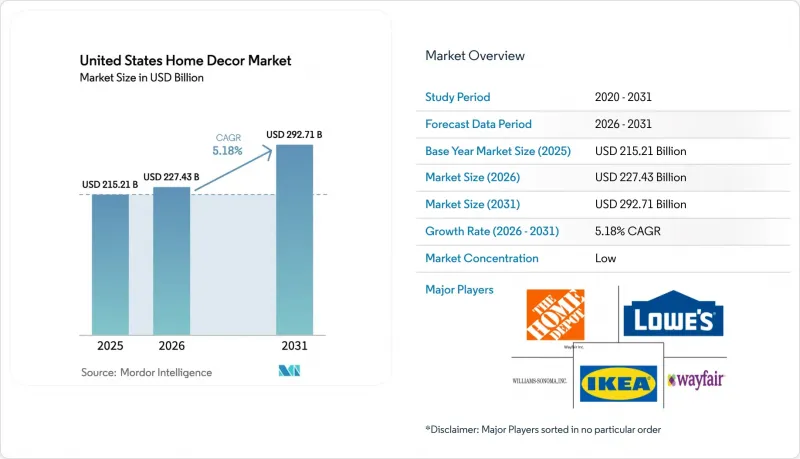
According to Mordor Intelligence, the United States home decor market is expected to increase from USD 215.21 billion in 2025 to USD 227.43 billion in 2026 and reach USD 292.71 billion by 2031, growing at a CAGR of 5.18% over 2026-2031.
This report is Segmented by Product Type (Furniture, Home Textiles, and More), Bymaterial (Wood, Metal, and More), Distribution Channel (Home-Improvement & Furniture Stores, Specialty Decor Stores, and More), Price Range (Mass, Premium/Luxury), Room (Living Room, Bedroom, and More), and Geography (Northeast, Midwest, and More). The Market Forecasts are Provided in Terms of Value (USD).
United States Home Decor Market Trends and Insights
Aging United States Housing Stock Supporting Renovation-Driven Decor Spending
The aging United States housing stock is a key driver of renovation-led spending in the home decor market. Housing starts finished 2024 on a strong upward trend, with single-family construction showing notable resilience, even as multifamily development remained mixed. The National Association of Home Builders reported that overall starts rose to a 1.50 million annualized pace in December, the highest level since early 2024. This increase was driven by resilience in single-family construction, which grew to just over 1 million units, even as multifamily development showed mixed results. For the full year 2024, total housing starts reached about 1.36 million units, slightly lower than the previous year, while single-family starts increased compared with 2023. Multifamily starts, however, ended the year down significantly, highlighting a shift in builder focus . Federal Reserve data shows that home purchases trigger significant increases in home-related outlays, with renovation, repairs, and furnishings representing the largest categories. Emotional and experiential factors also drive spending, as homeowners invest in projects that enhance satisfaction and comfort. Kitchen and other major home upgrades often spark complementary decor purchases, reinforcing overall market growth. Overall, both structural housing trends and consumer behaviour combine to maintain steady demand for home decor and renovation-led expenditures in the United States.
Expansion in Single-Family Housing Starts and Existing Home Sales
The growth in single-family housing starts and existing home sales continues to support demand for home Decor. Single-family housing starts registered 890,000 units at a seasonally adjusted annual rate in August 2025, with completions rising 6.7% month over month and 5.6% year over year, reflecting ongoing pipeline conversion even as new permits remain weak. Strong completions contribute to higher occupancy and create immediate furnishing and Decor needs as new homes are delivered. New home sales reached 800,000 units in August 2025, while the months' supply compressed to 7.4 months as builders used incentives to move inventory and sustain sales volume. The limited supply of available homes further stimulates demand for interior upgrades and Decor items. Rising single-family activity and healthy home sales reinforce opportunities for renovation, furnishing, and aesthetic enhancements. Homeowners and new buyers increasingly invest in decorating and personalizing their spaces, boosting overall market growth. This trend highlights the strong connection between housing activity and sustained expenditure in the U.S. home Decor sector . Existing home sales showed a modest improvement toward the end of the year, supported by some relief in mortgage rates, though overall activity remained below previous peaks. This trend shifts demand toward renovation and refresh cycles rather than complete home furnishing projects. Looking ahead, housing starts are expected to remain steady, providing a stable foundation for the home Decor market as household formation and new deliveries continue. For brands and retailers, this environment emphasizes opportunities to partner with builders and showcase staged model homes.
Fluctuating Lumber and Textile Costs Pressuring Margins
Volatile lumber and textile input costs create near-term pressures that affect pricing, assortment, and margins across the United States Home Decor market. Tariffs on building materials and related inputs can significantly increase project costs, impacting categories like cabinetry, flooring, and furniture tied to renovation activity. Import and export price trends in 2025 were mixed, with furniture-related imports rising while textiles and plastics saw modest declines, complicating vendor negotiations and retail pricing strategies. Policy changes and elevated tariff rates added uncertainty for buyers, prompting sourcing diversification and more complex logistics management. Premium brands with strong pricing power have been able to offset some of these pressures, while larger-scale operators leverage supplier terms and network efficiencies to absorb short-term cost spikes. The ability to manage input volatility effectively, as demonstrated by companies like Williams-Sonoma, highlights how vertical control and strategic channel mix can cushion the impact on margins.
Other drivers and restraints analyzed in the detailed report include:
- Remote Work Driving Increased Home Office Decor Investment
- Omnichannel and AR Shopping Enhancing the Customer Experience
- Higher Mortgage Rates Constraining Home Turnover and Spending
For complete list of drivers and restraints, kindly check the Table Of Contents.
Segment Analysis
Furniture commanded 39.36% of market size in 2025, while home office furnishings and Decor posted the fastest trajectory with an 11.87% CAGR projected through 2031 as hybrid work patterns persist. Consumers are increasingly investing in ergonomic chairs, adjustable desks, lighting, and sound management solutions to support flexible work routines and video calls at home. Telework has become a stable part of employment trends, sustaining demand for functional yet stylish home office infrastructure. Retailers are emphasizing multipurpose solutions such as modular shelving and cable-managed desks that integrate technology without compromising living space aesthetics. The market has adapted by balancing productivity essentials with decorative accents, boosting the popularity of curated bundles and room sets in both online and in-store experiences.
Home textiles continue to perform strongly, driven by regular refresh cycles and wellness-oriented features, while performance fabrics gain traction for their durability and comfort properties. Flooring and carpet demand shows mixed momentum as households prioritize materials that offer long-term resilience and easy maintenance. Wall Decor is experiencing a modest resurgence as homeowners seek personalization, with customization and made-to-order options helping differentiate retailers. Lighting is shifting toward smart, modular solutions that serve both task and ambient needs while optimizing energy use. Overall, the United States Home Decor market is increasingly focused on spaces that serve multiple functions, with home office furnishings leading the transformation.
Wood retained a 44.44% market share in 2025, supported by durability, repairability, and cross-style appeal, while sustainable and reclaimed wood posted a 10.29% CAGR outlook as certifications and responsible sourcing become stronger differentiators. Retailers have expanded certified assortments, and brands adopting rigorous sourcing and traceability standards are seeing measurable gains in consumer trust and market positioning. Initiatives such as increasing certified content in products and switching packaging to sustainable paper are becoming part of broader environmental strategies. Collaborations with international suppliers ensure the availability of certified wood for imported furniture, while niche manufacturers emphasize domestic and regional sourcing to appeal to sustainability-conscious buyers. Overall, certified and reclaimed wood are capturing a premium, while mass-market offerings balance affordability with responsible material choices.
Other materials, such as metal, textiles, glass, plastics, and stone, serve targeted purposes within home Decor assortments, meeting distinct functional and aesthetic needs. Metal benefits from recycled content and structural stability, although tariffs can influence costs and delivery timing. Textiles vary between organic fibres and advanced synthetics, with adoption influenced by household budgets and preference for premium features in bedding and upholstery. Recycled glass is popular in lighting and decorative tiles, while plastics and synthetics dominate outdoor and storage applications due to weather resistance and ease of maintenance. Stone and ceramic continue to stand out in premium spaces, and the market increasingly emphasizes durability, care guidance, and clearly labelled material claims to extend product life and enhance perceived value.
Complete Report Scope:
- By Product Type
- Furniture
- Home Textiles
- Flooring & Carpets
- Wall Decor (Paintings, Wallpapers)
- Lighting Fixtures
- Decorative Accessories (Vases, Candles, Clocks)
- By Material
- Wood
- Metal
- Textile
- Glass
- Plastic & Other Synthetics
- Stone & Ceramic
- By Distribution Channel
- Home-Improvement & Furniture Stores
- Specialty Decor Stores
- Supermarkets & Hypermarkets
- Online / E-commerce
- Others (Boutiques, Art Galleries)
- By Price Range
- Mass
- Premium / Luxury
- By Room
- Living Room
- Bedroom
- Kitchen & Dining
- Bathroom
- Home Office
- Outdoor & Patio
- By Geography
- Northeast
- Midwest
- Southeast
- Southwest
- West
List of Companies Covered in this Report:
- The Home Depot Inc.
- Lowe's Companies Inc.
- IKEA USA (Ingka Holding)
- Williams-Sonoma Inc.
- Wayfair Inc.
- Target Corporation
- TJX Companies (HomeGoods)
- Amazon.com Inc.
- Ashley Furniture Industries LLC
- Ethan Allen Interiors Inc.
- La-Z-Boy Inc.
- RH (Restoration Hardware)
- Crate & Barrel Holdings Inc.
- At Home Group Inc.
- Haverty Furniture Companies Inc.
- Bob's Discount Furniture LLC
- Lamps Plus Inc.
- Floor & Decor Holdings Inc.
- Mohawk Industries Inc.
- Pier 1 Imports Online LLC
Additional Benefits:
- The market estimate (ME) sheet in Excel format
- 3 months of analyst support
TABLE OF CONTENTS
1 Introduction
- 1.1 Study Assumptions & Market Definition
- 1.2 Scope of the Study
2 Research Methodology
3 Executive Summary
4 Market Landscape
- 4.1 Market Overview
- 4.2 Market Drivers
- 4.2.1 Aging United States Housing Stock Supporting Renovation-Driven Decor Spending
- 4.2.2 Expansion in Single-Family Housing Starts and Existing Home Sales
- 4.2.3 Remote Work Driving Increased Home Office Decor Investment
- 4.2.4 Social Media-Influenced Trends Accelerating Decor Purchase Cycles
- 4.2.5 Omnichannel and AR Shopping Enhancing the Customer Experience
- 4.2.6 Sustainability and Eco-Conscious Preferences Driving Green Decor Demand
- 4.3 Market Restraints
- 4.3.1 Fluctuating Lumber and Textile Costs Pressuring Margins
- 4.3.2 Higher Mortgage Rates Constraining Home Turnover and Spending
- 4.3.3 Supply Chain Bottlenecks Elevating Lead Times and Inventory Expenses
- 4.3.4 Rising Inflation Reducing Consumer Discretionary Purchases
- 4.4 Industry Value Chain Analysis
- 4.5 Porter's Five Forces Analysis
- 4.5.1 Threat of New Entrants
- 4.5.2 Bargaining Power of Suppliers
- 4.5.3 Bargaining Power of Buyers
- 4.5.4 Threat of Substitutes
- 4.5.5 Competitive Rivalry
- 4.6 Insights into the Latest Trends and Innovations in the Market
- 4.7 Insights on Recent Developments (New Product Launches, Strategic Initiatives, Investments, Partnerships, JVs, Expansion, M&As, etc.) in the Market
5 Market Size & Growth Forecasts (Value)
- 5.1 By Product Type
- 5.1.1 Furniture
- 5.1.2 Home Textiles
- 5.1.3 Flooring & Carpets
- 5.1.4 Wall Decor (Paintings, Wallpapers)
- 5.1.5 Lighting Fixtures
- 5.1.6 Decorative Accessories (Vases, Candles, Clocks)
- 5.2 By Material
- 5.2.1 Wood
- 5.2.2 Metal
- 5.2.3 Textile
- 5.2.4 Glass
- 5.2.5 Plastic & Other Synthetics
- 5.2.6 Stone & Ceramic
- 5.3 By Distribution Channel
- 5.3.1 Home-Improvement & Furniture Stores
- 5.3.2 Specialty Decor Stores
- 5.3.3 Supermarkets & Hypermarkets
- 5.3.4 Online / E-commerce
- 5.3.5 Others (Boutiques, Art Galleries)
- 5.4 By Price Range
- 5.4.1 Mass
- 5.4.2 Premium / Luxury
- 5.5 By Room
- 5.5.1 Living Room
- 5.5.2 Bedroom
- 5.5.3 Kitchen & Dining
- 5.5.4 Bathroom
- 5.5.5 Home Office
- 5.5.6 Outdoor & Patio
- 5.6 By Geography
- 5.6.1 Northeast
- 5.6.2 Midwest
- 5.6.3 Southeast
- 5.6.4 Southwest
- 5.6.5 West
6 Competitive Landscape
- 6.1 Market Concentration
- 6.2 Strategic Moves
- 6.3 Market Share Analysis
- 6.4 Company Profiles (includes Global level Overview, Market level overview, Core Segments, Financials as available, Strategic Information, Market Rank/Share for key companies, Products & Services, and Recent Developments)
- 6.4.1 The Home Depot Inc.
- 6.4.2 Lowe's Companies Inc.
- 6.4.3 IKEA USA (Ingka Holding)
- 6.4.4 Williams-Sonoma Inc.
- 6.4.5 Wayfair Inc.
- 6.4.6 Target Corporation
- 6.4.7 TJX Companies (HomeGoods)
- 6.4.8 Amazon.com Inc.
- 6.4.9 Ashley Furniture Industries LLC
- 6.4.10 Ethan Allen Interiors Inc.
- 6.4.11 La-Z-Boy Inc.
- 6.4.12 RH (Restoration Hardware)
- 6.4.13 Crate & Barrel Holdings Inc.
- 6.4.14 At Home Group Inc.
- 6.4.15 Haverty Furniture Companies Inc.
- 6.4.16 Bob's Discount Furniture LLC
- 6.4.17 Lamps Plus Inc.
- 6.4.18 Floor & Decor Holdings Inc.
- 6.4.19 Mohawk Industries Inc.
- 6.4.20 Pier 1 Imports Online LLC
7 Market Opportunities & Future Outlook
- 7.1 Growing demand for personalized and sustainable home decor solutions through digital and experiential retail channels

