PUBLISHER: Global Market Insights Inc. | PRODUCT CODE: 2071413

PUBLISHER: Global Market Insights Inc. | PRODUCT CODE: 2071413
Home Decor Market Opportunity, Growth Drivers, Industry Trend Analysis, and Forecast 2026 - 2035
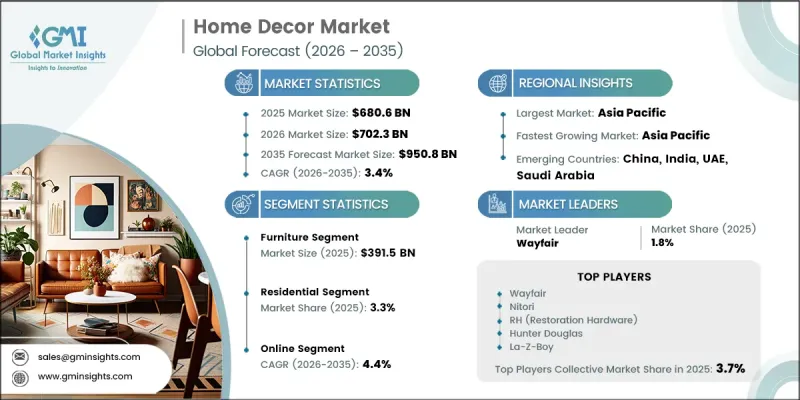
The Global Home Decor Market was valued at USD 680.6 billion in 2025 and is estimated to grow at a CAGR of 3.4% to reach USD 950.8 billion by 2035.
The market is witnessing steady expansion as consumer lifestyles evolve and spending patterns shift toward improving living spaces. Rising disposable incomes, rapid urban development, and growing interest in personalized interiors are collectively strengthening demand for home decoration products. Consumers are increasingly prioritizing stylish, functional, and aesthetically refined living environments, particularly as home renovation and remodeling activities continue to gain traction across developed economies. The market is also benefiting from continuous innovation in product design, materials, and smart-enabled decor solutions that align with modern connected living trends. Integration of technology into home furnishings, including lighting and furniture systems, is reshaping product offerings and enhancing user convenience. E-commerce platforms are playing a pivotal role in widening product accessibility and expanding brand reach across global markets. In addition, sustainability trends are gaining momentum, with eco-friendly materials and responsibly sourced decor products becoming increasingly important in purchasing decisions. Together, these factors are contributing to the stable long-term growth outlook of the global home decor market, supported by evolving consumer expectations and continuous innovation across the industry.
| Market Scope | |
|---|---|
| Start Year | 2025 |
| Forecast Year | 2026-2035 |
| Start Value | $680.6 Billion |
| Forecast Value | $950.8 Billion |
| CAGR | 3.4% |
The furniture segment accounted for USD 391.5 billion in 2025 and is projected to grow at a CAGR of 3.8% through 2035. This segment continues to dominate the home decor market due to rising consumer spending on interior enhancement and housing upgrades. Demand is strongly supported by ongoing urbanization and the increasing preference for space-efficient and modular furniture designs that suit modern living environments. Home improvement and renovation activities are further accelerating product adoption across both new and existing households. Additionally, sustainability considerations are influencing purchasing behavior, encouraging demand for environmentally responsible furniture solutions. Manufacturers focusing on eco-conscious materials and innovative designs are expected to benefit from sustained growth opportunities in this segment.
The residential segment held a 3.3% share in 2025. Growth in the residential category is being driven by increasing investment in home improvement activities and the rising trend of personalized living spaces. Urbanization continues to play a key role, encouraging consumers to upgrade and decorate their homes with modern and functional products. Greater availability of both value-oriented and premium decor solutions is further supporting widespread adoption across diverse consumer groups. The commercial segment is also expected to expand steadily, supported by ongoing development in hospitality, office, and retail infrastructure.
United States Home Decor Market captured 82% share in 2025, generating USD 162.1 billion. The country is expected to maintain strong growth throughout the forecast period, driven by rising consumer income levels and increasing interest in interior enhancement activities. Expanding urban populations and ongoing construction of residential properties are further supporting demand for home decor products. In addition, digital platforms and social media exposure to interior design trends are significantly influencing consumer purchasing behavior, encouraging greater investment in decorative and functional home improvement solutions.
Major companies operating in the Global Home Decor Market include Haworth, Hunter Douglas, La-Z-Boy, Mohawk Industries, RH (Restoration Hardware), Signify, Wayfair, Flexsteel, Flos, Kartell, Keter, Natuzzi, Nitori, Roche Bobois, Blu Dot, Hem, Joybird, Lulu and Georgia, Outer, Ruggable, and Sabai Design. Companies in the home decor market are adopting multiple strategies to strengthen their competitive position and expand market reach. Product innovation remains a key focus, with manufacturers introducing modern, multifunctional, and space-efficient designs aligned with evolving consumer preferences. Many companies are investing in sustainable materials and eco-friendly production processes to meet growing environmental expectations. Digital transformation is another major strategy, with brands expanding their presence across e-commerce platforms and leveraging digital marketing to improve customer engagement. Strategic collaborations with interior designers, real estate developers, and retail partners are helping companies enhance distribution networks and brand visibility. In addition, firms are focusing on customization, premium product offerings, and smart home integration to differentiate themselves in a competitive landscape and strengthen long-term market positioning.
Table of Contents
Chapter 1 Methodology and scope
- 1.1 Research approach
- 1.2 Quality Commitments
- 1.2.1 GMI AI policy & data integrity commitment
- 1.2.1.1 Source consistency protocol
- 1.2.1 GMI AI policy & data integrity commitment
- 1.3 Research Trail & Confidence Scoring
- 1.3.1 Research Trail Components
- 1.3.2 Scoring Components
- 1.4 Data Collection
- 1.4.1 Partial list of primary sources
- 1.5 Data mining sources
- 1.5.1 Paid sources
- 1.5.1.1 Sources, by region
- 1.5.1 Paid sources
- 1.6 Base estimates and calculations
- 1.6.1 Base year calculation for any one approach
- 1.7 Forecast model
- 1.7.1 Quantified market impact analysis
- 1.7.1.1 Mathematical impact of growth parameters on forecast
- 1.7.1 Quantified market impact analysis
- 1.8 Research transparency addendum
- 1.8.1 Source attribution framework
- 1.8.2 Quality assurance metrics
- 1.8.3 Our commitment to trust
Chapter 2 Executive summary
- 2.1 Industry 360° synopsis
- 2.2 Key market trends
- 2.2.1 Regional
- 2.2.2 Product Type
- 2.2.3 Usage
- 2.2.4 Price
- 2.2.5 End Users
- 2.2.6 Distribution Channel
Chapter 3 Industry insights
- 3.1 Industry ecosystem analysis
- 3.1.1 Supplier landscape
- 3.1.2 Profit margin
- 3.1.3 Value addition at each stage
- 3.1.4 Factor affecting the value chain
- 3.1.5 Disruptions
- 3.2 Industry impact forces
- 3.2.1 Growth drivers
- 3.2.2 Industry pitfalls & challenges
- 3.2.3 Opportunities
- 3.3 Growth potential analysis
- 3.4 Price trends
- 3.4.1 Historical price trend analysis
- 3.4.2 Pricing strategy by player type
- 3.5 Regulatory framework
- 3.5.1 Product safety standards & certifications
- 3.5.2 Environmental regulations & compliance
- 3.5.3 Import/export trade policies
- 3.5.4 Tariff landscape & trade barriers
- 3.5.5 Consumer protection laws
- 3.5.6 E-commerce regulations
- 3.6 Porter's five forces analysis
- 3.7 PESTEL analysis
- 3.8 Trade Data Analysis (Based on Paid Database) (HS code: 4420)
- 3.8.1 Import/export volume & value trends
- 3.8.2 Key trade corridors & tariff impact
- 3.9 Impact of AI & generative AI on the market
- 3.9.1 AI-driven disruption of traditional business models
- 3.9.2 GenAI use cases & adoption roadmap by customer segment
- 3.9.3 Risks, limitations & regulatory considerations
- 3.9.4 AI-enabled ecosystem integration
- 3.10 Future market trends
- 3.11 Technology and innovation landscape
- 3.11.1 Current technological trends
- 3.11.2 Emerging technologies
- 3.12 Consumer behavior analysis
- 3.12.1 Purchasing patterns
- 3.12.2 Preference analysis
- 3.12.3 Regional variations in consumer behavior
- 3.12.4 Impact of e-commerce on buying decisions
Chapter 4 Competitive landscape, 2025
- 4.1 Introduction
- 4.2 Company market share analysis
- 4.2.1 North America
- 4.2.2 Europe
- 4.2.3 Asia Pacific
- 4.2.4 Latin America
- 4.2.5 MEA
- 4.3 Company matrix analysis
- 4.4 Competitive analysis of major market players
- 4.5 Competitive positioning matrix
- 4.6 Key developments
- 4.6.1 Mergers & acquisitions
- 4.6.2 Partnerships & collaborations
- 4.6.3 New product launches
- 4.6.4 Expansion plans
Chapter 5 Market Estimates & Forecast, By Product Type, 2022 - 2035 ($Billion, Thousand Units)
- 5.1 Key trends
- 5.2 Furniture
- 5.2.1 Sofa set
- 5.2.2 Dining furniture
- 5.2.3 Others (wardrobes etc.)
- 5.3 Textiles
- 5.3.1 Bedroom linen
- 5.3.2 Bathroom linen
- 5.3.3 Carpets and floor coverings
- 5.3.4 Curtains and drapes
- 5.3.5 Others (kitchen linen etc.)
- 5.4 Candles
- 5.4.1 Floating candles
- 5.4.2 Scented candles
- 5.4.3 Container candles
- 5.4.4 Decorative candles
- 5.4.5 Others (soy candles etc.)
- 5.5 Lightning
- 5.5.1 Ceiling lights & chandeliers
- 5.5.2 Light bulbs & fittings
- 5.5.3 Others (portable lamps etc.)
- 5.6 Others (decorative accessories etc.)
Chapter 6 Market Estimates & Forecast, By Usage, 2022 - 2035 ($Billion, Thousand Units)
- 6.1 Key trends
- 6.2 Interior
- 6.3 Exterior
Chapter 7 Market Estimates & Forecast, By Price, 2022 - 2035 ($Billion, Thousand Units)
- 7.1 Key trends
- 7.2 Low (below USD 500)
- 7.3 Medium (USD 500 - USD 999)
- 7.4 High (USD 1,000 and above)
Chapter 8 Market Estimates & Forecast, By End Users, 2022 - 2035 ($Billion, Thousand Units)
- 8.1 Key trends
- 8.2 Residential
- 8.3 Commercial
- 8.3.1 Hotels
- 8.3.2 Restaurants
- 8.3.3 Offices
- 8.3.4 Retail spaces
- 8.3.5 Others (healthcare facilities etc.)
Chapter 9 Market Estimates & Forecast, By Distribution Channel, 2022 - 2035 ($Billion, Thousand Units)
- 9.1 Key trends
- 9.2 Online
- 9.2.1 E-commerce
- 9.2.2 Company websites
- 9.3 Offline
- 9.3.1 Supermarkets/hypermarket
- 9.3.2 Specialty retail stores
- 9.3.3 Others (independent retailer etc.)
Chapter 10 Market Estimates & Forecast, By Region, 2022 - 2035 ($Billion, Thousand Units)
- 10.1 Key trends
- 10.2 North America
- 10.2.1 U.S.
- 10.2.2 Canada
- 10.3 Europe
- 10.3.1 Germany
- 10.3.2 UK
- 10.3.3 France
- 10.3.4 Spain
- 10.3.5 Italy
- 10.3.6 Netherlands
- 10.4 Asia Pacific
- 10.4.1 China
- 10.4.2 Japan
- 10.4.3 India
- 10.4.4 Australia
- 10.4.5 South Korea
- 10.5 Latin America
- 10.5.1 Brazil
- 10.5.2 Mexico
- 10.5.3 Argentina
- 10.6 MEA
- 10.6.1 South Africa
- 10.6.2 Saudi Arabia
- 10.6.3 UAE
Chapter 11 Company Profiles
- 11.1 Global key players
- 11.1.1 Haworth
- 11.1.2 Hunter Douglas
- 11.1.3 La-Z-Boy
- 11.1.4 Mohawk Industries
- 11.1.5 RH (Restoration Hardware)
- 11.1.6 Signify
- 11.1.7 Wayfair
- 11.2 Regional players
- 11.2.1 Flexsteel
- 11.2.2 Flos
- 11.2.3 Kartell
- 11.2.4 Keter
- 11.2.5 Natuzzi
- 11.2.6 Nitori
- 11.2.7 Roche Bobois
- 11.3 Emerging/niche specialists
- 11.3.1 Blu Dot
- 11.3.2 Hem
- 11.3.3 Joybird
- 11.3.4 Lulu and Georgia
- 11.3.5 Outer
- 11.3.6 Ruggable
- 11.3.7 Sabai Design

