PUBLISHER: Global Market Insights Inc. | PRODUCT CODE: 2071237

PUBLISHER: Global Market Insights Inc. | PRODUCT CODE: 2071237
Bioenergy Market Opportunity, Growth Drivers, Industry Trend Analysis, and Forecast 2026 - 2035
The Global Bioenergy Market was valued at USD 151 billion in 2025 and is estimated to grow at a CAGR of 7.7% to reach USD 318 billion by 2035.
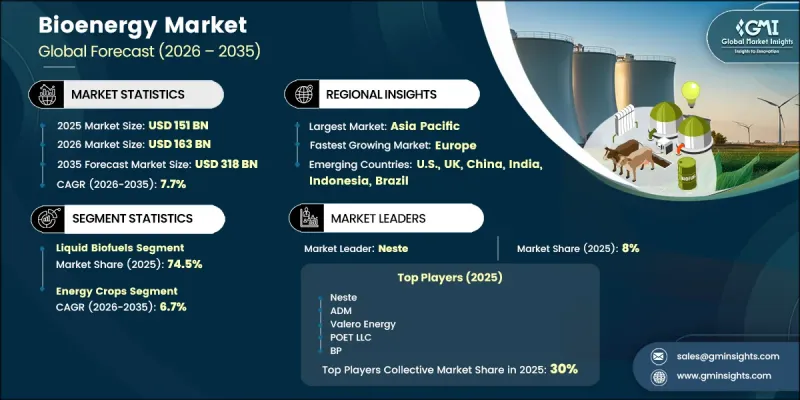
Market growth is driven by the ongoing shift from conventional biofuel production methods toward advanced and waste-based bioenergy technologies, a transformation that is influencing investment priorities, feedstock sourcing strategies, and competitive dynamics throughout the industry. Regional market performance varies considerably, with Asia Pacific maintaining the largest revenue share while Europe continues to demonstrate the strongest growth trajectory due to differing policy frameworks, sustainability initiatives, and resource availability. Long-term decarbonization objectives established by governments and corporations remain a major catalyst for industry expansion. Bioenergy occupies a unique position within the renewable energy landscape because it can deliver dispatchable electricity, industrial heat, and transportation fuels. In addition, the broad availability of biomass resources across multiple regions supports long-term market development. However, feedstock supply remains subject to seasonal fluctuations, geographic limitations, and competing end-use demands that can affect production economics. The increasing focus on sustainable resource utilization and land management practices continues to influence feedstock procurement strategies across the global bioenergy market.
| Market Scope | |
|---|---|
| Start Year | 2025 |
| Forecast Year | 2026-2035 |
| Start Value | $151 Billion |
| Forecast Value | $318 Billion |
| CAGR | 7.7% |
The liquid biofuels segment accounted for 74.5% share and is projected to grow at a CAGR of 8% through 2035. This category includes a diverse range of renewable fuel technologies that serve both established and emerging energy applications. The segment continues to benefit from increasing investments in advanced fuel production technologies, improved conversion efficiencies, and rising demand for lower-carbon transportation energy solutions. Among liquid biofuel categories, renewable fuel alternatives with enhanced sustainability profiles are expected to generate the strongest revenue growth opportunities during the forecast period.
The energy crops segment accounted for 51.1% share in 2025 and is anticipated to grow at a CAGR of 6.7% through 2035. The segment's leading position reflects the extensive development of dedicated feedstock cultivation and processing infrastructure that supports large-scale bioenergy production. Continued investments in agricultural productivity, feedstock optimization, and advanced biomass conversion technologies are expected to strengthen the segment's contribution to market growth. In addition, increasing efforts to improve feedstock yields and resource efficiency are supporting the long-term viability of energy crop-based bioenergy production.
North America Bioenergy Market held 22% share in 2025 and is projected to grow at a CAGR of 7% through 2035. The region remains a key contributor to global biofuel production and continues to attract significant investment across advanced renewable fuel technologies. Market participants throughout North America are increasingly differentiating themselves through lower carbon intensity profiles, enhanced sustainability performance, and operational efficiency improvements. Supportive regulatory frameworks, ongoing infrastructure investments, and growing demand for renewable energy solutions are expected to sustain regional market expansion over the coming years.
Major companies operating in the global bioenergy market include Neste, ADM, POET LLC, Drax Group, and Raizen. Companies active in the bioenergy market are implementing a range of strategic initiatives to strengthen their market position and expand their global footprint. Key strategies include increasing investments in advanced biofuel technologies, expanding production capacity, and enhancing feedstock diversification to improve supply security. Industry participants are also pursuing strategic partnerships, joint ventures, and long-term supply agreements to strengthen value chain integration and secure access to critical resources. Investments in research and development remain a priority as companies seek to improve conversion efficiency, reduce production costs, and develop next-generation renewable fuel solutions. Many organizations are further focusing on sustainability certifications, carbon reduction initiatives, and digital technologies to enhance operational performance.
Table of Contents
Chapter 1 Methodology & Scope
- 1.1 Research approach
- 1.2 Quality commitments
- 1.2.1 GMI AI policy & data integrity commitment
- 1.2.1.1 Source consistency protocol
- 1.2.1 GMI AI policy & data integrity commitment
- 1.3 Research trail & confidence scoring
- 1.3.1 Research trail components
- 1.3.2 Scoring components
- 1.4 Data collection
- 1.4.1 Partial list of primary sources
- 1.5 Data mining sources
- 1.5.1 Paid sources
- 1.5.1.1 Sources, by region
- 1.5.1 Paid sources
- 1.6 Base estimates and calculations
- 1.6.1 Base year calculation for any one approach
- 1.7 Market estimates & forecasts parameters
- 1.8 Forecast model
- 1.8.1 Quantified market impact analysis
- 1.8.1.1 Mathematical impact of growth parameters on forecast
- 1.8.1 Quantified market impact analysis
- 1.9 Research transparency addendum
- 1.9.1 Source attribution framework
- 1.9.2 Quality assurance metrics
- 1.9.3 Our commitment to trust
- 1.10 Market definitions
Chapter 2 Executive Summary
- 2.1 Industry synopsis, 2022 - 2035
- 2.1.1 Business trends
- 2.1.2 Type trends
- 2.1.3 Feedstock trends
- 2.1.4 Technology trends
- 2.1.5 Application trends
- 2.1.6 End use trends
- 2.1.7 Regional trends
Chapter 3 Industry Insights
- 3.1 Industry ecosystem analysis
- 3.1.1 Raw material availability & sourcing analysis
- 3.1.2 Production capacity assessment
- 3.1.3 Supply chain resilience & risk factors
- 3.1.4 Distribution network analysis
- 3.2 Regulatory landscape
- 3.3 Industry impact forces
- 3.3.1 Growth drivers
- 3.3.1.1 Decarbonization goals and net-zero targets
- 3.3.1.2 Abundant availability of biomass feedstock
- 3.3.1.3 Supportive policies, subsidies, and blending mandates
- 3.3.2 Industry pitfalls & challenges
- 3.3.2.1 High capital intensity and technology commercialization risk
- 3.3.1 Growth drivers
- 3.4 Growth potential analysis
- 3.5 Porter's analysis
- 3.5.1 Bargaining power of suppliers
- 3.5.2 Bargaining power of buyers
- 3.5.3 Threat of new entrants
- 3.5.4 Threat of substitutes
- 3.6 PESTEL analysis
- 3.6.1 Political factors
- 3.6.2 Economic factors
- 3.6.3 Social factors
- 3.6.4 Technological factors
- 3.6.5 Legal factors
- 3.6.6 Environmental factors
- 3.7 Price trend analysis (USD/EJ) (Driven by primary research)
- 3.7.1 By type
- 3.7.2 By region
- 3.8 Impact of AI & generative AI on the market
- 3.8.1 AI-Driven production optimization
- 3.8.2 Predictive maintenance & fault detection
- 3.9 Emerging opportunities & trends
- 3.10 Investment analysis & future prospects
- 3.11 Sustainability initiatives & industry 4.0 integration
Chapter 4 Competitive Landscape, 2026
- 4.1 Introduction
- 4.2 Company market share analysis, by region, 2025
- 4.2.1 North America
- 4.2.2 Europe
- 4.2.3 Asia Pacific
- 4.2.4 Middle East & Africa
- 4.2.5 Latin America
- 4.3 Key developments
- 4.3.1 Key partnerships & collaborations
- 4.3.2 Major M&A activities
- 4.3.3 Product innovations & launches
- 4.3.4 Market expansion strategies
- 4.4 Competitive positioning matrix
Chapter 5 Market Size and Forecast, By Type, 2022 - 2035 (EJ & USD Million)
- 5.1 Key trends
- 5.2 Liquid biofuels
- 5.3 Solid biomass
- 5.4 Biogas/biomethane
- 5.5 Others
Chapter 6 Market Size and Forecast, By Feedstock, 2022 - 2035 (EJ & USD Million)
- 6.1 Key trends
- 6.2 Energy crops
- 6.3 Forest residues
- 6.4 Agricultural residues
- 6.5 Organic waste
- 6.6 Others
Chapter 7 Market Size and Forecast, By Technology, 2022 - 2035 (EJ & USD Million)
- 7.1 Key trends
- 7.2 Thermochemical
- 7.3 Biochemical
- 7.4 Chemical processes
- 7.5 Others
Chapter 8 Market Size and Forecast, By Application, 2022 - 2035 (EJ & USD Million)
- 8.1 Key trends
- 8.2 Power generation
- 8.3 Heat generation
- 8.4 Transportation fuels
- 8.5 Combined heat & power
- 8.6 Others
Chapter 9 Market Size and Forecast, By End use, 2022 - 2035 (EJ & USD Million)
- 9.1 Key trends
- 9.2 Power utilities
- 9.3 Industrial
- 9.4 Residential
- 9.5 Commercial
- 9.6 Transportation
- 9.7 Others
Chapter 10 Market Size and Forecast, By Region, 2022 - 2035 (EJ & USD Million)
- 10.1 Key trends
- 10.2 North America
- 10.2.1 U.S.
- 10.2.2 Canada
- 10.2.3 Mexico
- 10.3 Europe
- 10.3.1 Germany
- 10.3.2 UK
- 10.3.3 France
- 10.3.4 Netherlands
- 10.3.5 Italy
- 10.4 Asia Pacific
- 10.4.1 China
- 10.4.2 India
- 10.4.3 Japan
- 10.4.4 Indonesia
- 10.4.5 Australia
- 10.5 Middle East & Africa
- 10.5.1 Saudi Arabia
- 10.5.2 UAE
- 10.5.3 South Africa
- 10.6 Latin America
- 10.6.1 Brazil
- 10.6.2 Argentina
Chapter 11 Company Profiles
- 11.1 ADM
- 11.2 Alto Ingredients
- 11.3 BP Bioenergy
- 11.4 Cargill
- 11.5 Chevron REG
- 11.6 CropEnergies
- 11.7 Drax Group
- 11.8 Enviva Inc.
- 11.9 Fortum
- 11.10 Green Plains
- 11.11 Neste
- 11.12 Orsted Group
- 11.13 Petrobras Biocombustivel
- 11.14 POET LLC
- 11.15 Raizen
- 11.16 RWE
- 11.17 TotalEnergies
- 11.18 Valero Energy
- 11.19 Verbio AG
- 11.20 Wilmar International

