PUBLISHER: Mordor Intelligence | PRODUCT CODE: 2123453

PUBLISHER: Mordor Intelligence | PRODUCT CODE: 2123453
Bioenergy - Market Share Analysis, Industry Trends & Statistics, Growth Forecasts (2026 - 2031)
According to Mordor Intelligence, bioenergy market size in 2026 is estimated at 164.78 gigawatt, growing from 2025 value of 157.5 gigawatt with 2031 projections showing 206.59 gigawatt, growing at 4.62% CAGR over 2026-2031.
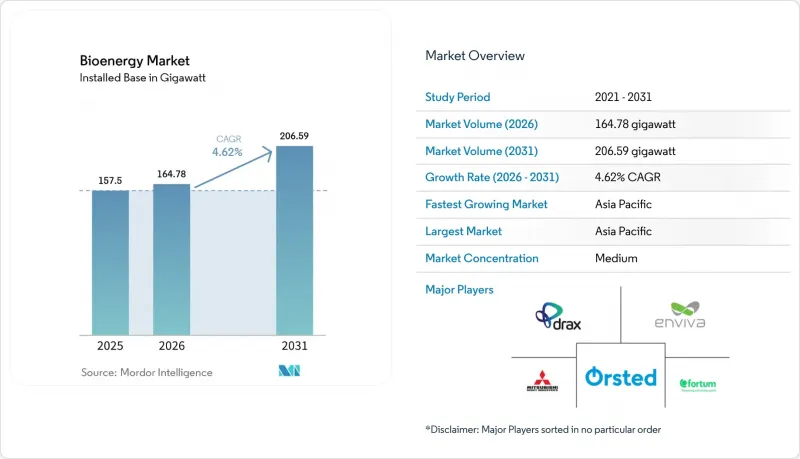
This report is Segmented by Type (Solid Biomass, Biogas, Renewable Waste, and Other Types), Feedstock (Agricultural Residues, Forestry Residues, and More), Technology (Combustion, Gasification, Anaerobic Digestion, and More), Application (Heat Generation, Transportation Fuel, and More), End-User (Power Utilities, Commercial and Industrial, and More), and Geography (North America, Europe, Asia-Pacific, and More).
Global Bioenergy Market Trends and Insights
Net-zero targets & renewable-energy mandates
Mandatory carbon-neutrality trajectories now cover more than 80% of global GDP, with the EU's 90% net-emissions-reduction goal for 2040, the US Inflation Reduction Act's funding tranches for advanced fuels, and India's 20% ethanol blending target converging to lift long-term demand. Broad-based mandates extend to ReFuelEU's 70% sustainable aviation fuel requirement by 2050 and the UK's 2% sustainable aviation fuel obligation from 2025. The resulting multi-sector pull allows the bioenergy market to tap into electricity, heating, and transport segments simultaneously. Strong offtake visibility enables developers to structure 15- to 20-year contracts and improve debt tenors. The cross-industry appeal remains a clear competitive edge where intermittent renewable sources struggle to shoulder firm-capacity obligations.
Abundant low-cost agricultural & forestry residues
The US Department of Energy's latest Billion-Ton Report shows that sustainable feedstock potential exceeds 1 billion t annually, dwarfing current consumption. India alone produces 180 million t of residues each year, with projected feedstock demand growth of 50% by 2030. Evolving geopolitics underline resource-risk asymmetry: Europe's wood-chip supply tightened after sanctions on Russian and Belarusian products, sending benchmark prices to multi-year highs. Consequently, proximity between feedstock clusters and processing hubs now dictates a meaningful share of total project cost. Companies licensing next-generation preprocessing systems to convert corn stover, rice straw, and palm residues into drop-in fuels illustrate how logistics-driven value creation often outranks absolute resource abundance.
High capital intensity & financing hurdles
A single advanced biorefinery can require more than USD 2 billion in equity and debt, making pre-FID capital stacking a multiyear process. Although long-term offtake agreements mitigate merchant-price risks, nascent credit-enhancement frameworks in many developing economies still restrict local-currency debt. Investment costs for combined heat-and-power biomass plants range between EUR 3,410 and EUR 5,970 per kW, significantly higher than those for gas-fired alternatives. Therefore, sponsors increasingly syndicate risk through joint ventures with utilities, EPCs, and feedstock aggregators. Large corporates now anchor equity rounds, but smaller developers continue to face sizable hurdles, especially when carbon-credit revenue is not yet bankable.
Other drivers and restraints analyzed in the detailed report include:
- Technology-driven LCOE decline for advanced bioenergy
- BECCS incentives & negative-emissions revenue streams
- Fragmented feedstock logistics & costs
For complete list of drivers and restraints, kindly check the Table Of Contents.
Segment Analysis
Solid biomass still does most of the heavy lifting, supplying 67.25% of global bioenergy in 2025 thanks to decades of investments in pellet mills, residue-handling equipment, and dependable combustion plants. A mature supply chain, from forestry by-products to purpose-grown crops, keeps fuel flowing in every major region. Yet the fastest mover right now is biogas. Backed by better anaerobic-digestion technology and tough new waste-recycling rules, biogas output is set to grow 10.1% a year through 2031. Germany's latest biomass program even singles out flexible biogas units so they can keep supporting the grid once their first subsidies expire. Municipal solid-waste gasification and landfill-gas capture add more momentum, while early-stage options, such as algae fuels, remain in the lab for now. Together, these shifts show the market tilting from simple burn-and-boil systems toward cleaner, higher-value processes that squeeze more out of every ton of organic material.
Wood chips and sawmill scraps dominate feedstock supply, giving forestry residues a 39.70% share in 2025. Long-standing harvest routines and pellet logistics make this stream reliable and price-competitive. Farm residues, however, are gaining ground the quickest, expanding at an annual rate of 8.55% as policies favor turning crop waste into energy rather than leaving it to rot or burn in the field. The U.S. Billion-Ton Report points to more than 1 billion tons of untapped biomass, much of it corn stalks, wheat straw, and rice husks, waiting to be collected. Dedicated energy crops and sorted municipal waste add diversity, though Europe's recent wood-chip shortage shows how geopolitics can rattle even well-established supply chains. That reality is pushing producers toward stricter certification and full traceability so buyers can trust both the origin and the sustainability of every load.
Complete Report Scope:
- By Type
- Solid Biomass
- Biogas
- Renewable Waste
- Other Types
- By Feedstock
- Agricultural Residues
- Forestry Residues
- Energy Crops
- Municipal Solid Waste
- By Technology
- Combustion
- Gasification
- Fast Pyrolysis
- Anaerobic Digestion
- Fermentation
- Other Technologies
- By Application
- Electricity Generation
- Heat Generation
- Transportation Fuel
- Combined Heat & Power (CHP)
- By End-user
- Power Utilities
- Commercial and Industrial
- Residential
- By Geography
- North America
- United States
- Canada
- Mexico
- Europe
- Germany
- France
- United Kingdom
- Italy
- Sweden
- Finland
- Rest of Europe
- Asia Pacific
- China
- India
- Japan
- South Korea
- ASEAN Countries
- Australia and New Zealand
- Rest of Asia Pacific
- South America
- Brazil
- Chile
- Colombia
- Uruguay
- Rest of South America
- Middle East and Africa
- South Africa
- Ethiopia
- Sudan
- Rest of Middle East and Africa
- North America
Geography Analysis
The Asia-Pacific region not only holds the largest regional share of 43.30% in 2025, but is also the fastest-growing, at a rate of 5.95% per year. India plans to triple biofuel use by the mid-2020s, backed by a vast pool of crop residues and clear government targets. China is rolling out full-suite biomass projects covering power, gas, and liquid fuels. Japan and South Korea rely more heavily on imports and advanced technologies, whereas Southeast Asia utilizes palm and rice waste for both domestic use and exports. The common thread is energy security: turning local waste into local energy while reducing the oil import bill.
Europe maintained a commanding 29.70% share of the bioenergy market in 2025, thanks to a decades-long alignment between climate ambition, feed-in tariffs, and sustainability criteria. Germany's new biomass package, France's capacity auctions, and the Netherlands' incoming BECCS subsidy exemplify cohesive policy frameworks that maintain investment momentum. Yet growth is moderating as land-use constraints take effect, wood-chip imports become more stringent, and competing ecological priorities challenge further large-scale forest harvesting. Market participants, therefore, pivot toward higher-value niches, including negative-emission power and industrial heat projects that optimize limited feedstock through high-efficiency conversion systems.
North America holds third place in terms of capacity, yet leads in advanced biofuel innovation. The United States accounts for the lion's share of global ethanol and renewable-diesel volumes, leveraging its corn and soy supply chains alongside federal production and blending credits. A growing pipeline of SAF projects positions the country to remain at the forefront of aviation-fuel decarbonization. Canada leverages vast forestry resources and provincial clean-fuel standards to attract large-scale gasification and RNG facilities, often in partnership with First Nations. Mexico's emerging mandates create opportunities for retrofitting sugarcane mills with bagasse cogeneration, although policy clarity will determine near-term pace.
- Mitsubishi Heavy Industries Ltd
- MVV Energie AG
- A2A SpA
- Hitachi Zosen Corp
- BTG Biomass Technology Group
- Babcock & Wilcox Volund AS
- Biomass Engineering Ltd
- ?rsted AS
- Enerkem
- Fortum Oyj
- Drax Group plc
- Enviva Inc.
- Veolia Environment SA
- Vattenfall AB
- Abengoa SA
- BIOENERGY DevCo
- Valmet Oyj
- Andritz AG
- Green Plains Inc.
- Anaergia Inc.
- Pacific BioEnergy Corp
Additional Benefits:
- The market estimate (ME) sheet in Excel format
- 3 months of analyst support
TABLE OF CONTENTS
1 Introduction
- 1.1 Study Assumptions & Market Definition
- 1.2 Scope of the Study
2 Research Methodology
3 Executive Summary
4 Market Landscape
- 4.1 Market Overview
- 4.2 Market Drivers
- 4.2.1 Net-zero targets & renewable energy mandates
- 4.2.2 Abundant low-cost agricultural & forestry residues
- 4.2.3 Technology-driven LCOE decline for advanced bioenergy
- 4.2.4 BECCS incentives & negative-emissions revenue streams
- 4.2.5 Industrial off-take demand for dispatchable green heat/power
- 4.2.6 Monetisation of biogenic-CO? credits
- 4.3 Market Restraints
- 4.3.1 High capital intensity & financing hurdles
- 4.3.2 Fragmented feed-stock logistics & costs
- 4.3.3 Stricter ILUC & sustainability criteria
- 4.3.4 Competing low-cost battery storage eroding baseload value
- 4.4 Supply-Chain Analysis
- 4.5 Regulatory Landscape
- 4.6 Technological Outlook & Innovations
- 4.7 Porter's Five Forces
- 4.7.1 Bargaining Power of Suppliers
- 4.7.2 Bargaining Power of Consumers
- 4.7.3 Threat of New Entrants
- 4.7.4 Threat of Substitutes
- 4.7.5 Intensity of Competitive Rivalry
5 Market Size & Growth Forecasts
- 5.1 By Type
- 5.1.1 Solid Biomass
- 5.1.2 Biogas
- 5.1.3 Renewable Waste
- 5.1.4 Other Types
- 5.2 By Feedstock
- 5.2.1 Agricultural Residues
- 5.2.2 Forestry Residues
- 5.2.3 Energy Crops
- 5.2.4 Municipal Solid Waste
- 5.3 By Technology
- 5.3.1 Combustion
- 5.3.2 Gasification
- 5.3.3 Fast Pyrolysis
- 5.3.4 Anaerobic Digestion
- 5.3.5 Fermentation
- 5.3.6 Other Technologies
- 5.4 By Application
- 5.4.1 Electricity Generation
- 5.4.2 Heat Generation
- 5.4.3 Transportation Fuel
- 5.4.4 Combined Heat & Power (CHP)
- 5.5 By End-user
- 5.5.1 Power Utilities
- 5.5.2 Commercial and Industrial
- 5.5.3 Residential
- 5.6 By Geography
- 5.6.1 North America
- 5.6.1.1 United States
- 5.6.1.2 Canada
- 5.6.1.3 Mexico
- 5.6.2 Europe
- 5.6.2.1 Germany
- 5.6.2.2 France
- 5.6.2.3 United Kingdom
- 5.6.2.4 Italy
- 5.6.2.5 Sweden
- 5.6.2.6 Finland
- 5.6.2.7 Rest of Europe
- 5.6.3 Asia Pacific
- 5.6.3.1 China
- 5.6.3.2 India
- 5.6.3.3 Japan
- 5.6.3.4 South Korea
- 5.6.3.5 ASEAN Countries
- 5.6.3.6 Australia and New Zealand
- 5.6.3.7 Rest of Asia Pacific
- 5.6.4 South America
- 5.6.4.1 Brazil
- 5.6.4.2 Chile
- 5.6.4.3 Colombia
- 5.6.4.4 Uruguay
- 5.6.4.5 Rest of South America
- 5.6.5 Middle East and Africa
- 5.6.5.1 South Africa
- 5.6.5.2 Ethiopia
- 5.6.5.3 Sudan
- 5.6.5.4 Rest of Middle East and Africa
- 5.6.1 North America
6 Competitive Landscape
- 6.1 Market Concentration
- 6.2 Strategic Moves (M&A, JVs, Funding, PPAs)
- 6.3 Market Share Analysis (Market Rank/Share for key companies)
- 6.4 Company Profiles (includes Global-level Overview, Market-level Overview, Core Segments, Financials, Strategic Information, Products & Services, Recent Developments)
- 6.4.1 Mitsubishi Heavy Industries Ltd
- 6.4.2 MVV Energie AG
- 6.4.3 A2A SpA
- 6.4.4 Hitachi Zosen Corp
- 6.4.5 BTG Biomass Technology Group
- 6.4.6 Babcock & Wilcox Volund AS
- 6.4.7 Biomass Engineering Ltd
- 6.4.8 ?rsted AS
- 6.4.9 Enerkem
- 6.4.10 Fortum Oyj
- 6.4.11 Drax Group plc
- 6.4.12 Enviva Inc.
- 6.4.13 Veolia Environment SA
- 6.4.14 Vattenfall AB
- 6.4.15 Abengoa SA
- 6.4.16 BIOENERGY DevCo
- 6.4.17 Valmet Oyj
- 6.4.18 Andritz AG
- 6.4.19 Green Plains Inc.
- 6.4.20 Anaergia Inc.
- 6.4.21 Pacific BioEnergy Corp
7 Market Opportunities & Future Outlook
- 7.1 White-space & Unmet-Need Assessment

