PUBLISHER: Global Market Insights Inc. | PRODUCT CODE: 2083042

PUBLISHER: Global Market Insights Inc. | PRODUCT CODE: 2083042
Seed Market Opportunity, Growth Drivers, Industry Trend Analysis, and Forecast 2026 - 2035
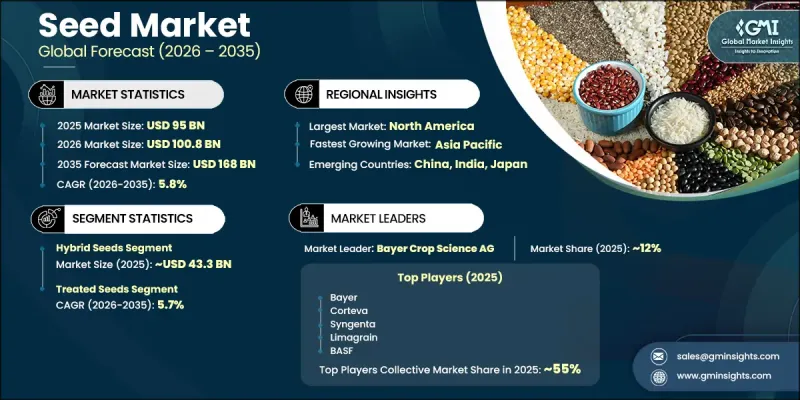
The Global Seed Market was valued at USD 95 billion in 2025 and is estimated to grow at a CAGR of 5.8% to reach USD 168 billion by 2035.
Market expansion is fueled by the growing integration of advanced genetics, biotechnology innovations, seed treatment technologies, and digital agricultural solutions into modern seed products. Seeds have become increasingly important as a strategic component of agricultural productivity, playing a critical role in improving crop performance, enhancing resource efficiency, and supporting long-term food production objectives. The industry is entering a period of transformation driven by advancements in genetic technologies, increasing commercialization of next-generation crop varieties, and broader adoption of high-performance seed solutions across both developed and emerging agricultural economies. Demand is also being supported by expanding efforts to improve agricultural output, strengthen food supply chains, and increase farm productivity. As governments and agricultural stakeholders place greater emphasis on food security and sustainable crop production, investments in advanced seed technologies continue to rise. These long-term structural trends are creating significant growth opportunities and reinforcing the importance of seeds as a foundational element within global agricultural systems.
| Market Scope | |
|---|---|
| Start Year | 2025 |
| Forecast Year | 2026-2035 |
| Start Value | $95 Billion |
| Forecast Value | $168 Billion |
| CAGR | 5.8% |
The genetically modified (GM) seeds segment accounted for 24.9% share in 2025 and is projected to grow at a CAGR of 5.7% throughout 2026-2035. While the segment already represents a substantial portion of industry revenue, growth is increasingly being driven by more advanced and technology-intensive seed offerings. Continued innovation in crop genetics, growing demand for improved agricultural productivity, and expanding acceptance of advanced seed technologies are expected to support segment development over the coming years.
The treated seeds segment held a 61.8% share in 2025. The segment is anticipated to grow at a CAGR of 5.7% through 2035. Strong demand is being driven by the ability of treated seeds to enhance crop establishment, improve seed performance, and provide additional protection during the early stages of plant development. The segment continues to benefit from increasing adoption of value-added seed solutions that help farmers maximize productivity and improve overall crop outcomes.
North America Seed Market held a 27.8% share, generating USD 26.4 billion in 2025. Growth in North America is driven primarily by increasing adoption of premium seed technologies, continuous product innovation, and the incorporation of advanced agricultural solutions into farming operations. Rather than relying on significant increases in cultivation volumes, market expansion is being supported by higher-value seed products and ongoing technological advancements within an already mature agricultural sector.
Major companies operating in the global seed market include Syngenta Group, Corteva Agriscience, Bayer Crop Science AG, KWS SAAT SE & Co. KGaA, Limagrain, Sakata Seed Corporation, DLF Seeds A/S, BASF SE, AgReliant Genetics LLC, Yuan Longping High-Tech Agriculture Co. Ltd., East-West Seed, Advanta Seeds, Rijk Zwaan, Enza Zaden, and Bejo Zaden B.V. Companies operating in the seed market are implementing a variety of strategic initiatives to strengthen their competitive positions and expand their global presence. Significant investments in research and development remain a key priority, with companies focusing on developing high-yielding, resilient, and technologically advanced seed varieties. Product innovation through enhanced genetics, biotechnology advancements, and improved seed treatment solutions continues to be a major growth strategy. Industry participants are also pursuing strategic partnerships, acquisitions, and collaborations to expand product portfolios and strengthen market access. Expanding geographic reach in emerging agricultural regions is another important focus area as companies seek new growth opportunities.
Table of Contents
Chapter 1 Methodology & Scope
- 1.1 Market scope and definition
- 1.2 Research design
- 1.2.1 Research approach
- 1.2.2 Data collection methods
- 1.3 Data mining sources
- 1.3.1 Global
- 1.3.2 Regional/Country
- 1.4 Base estimates and calculations
- 1.4.1 Base year calculation
- 1.4.2 Key trends for market estimation
- 1.5 Primary research and validation
- 1.5.1 Primary sources
- 1.6 Forecast model
- 1.7 Research assumptions and limitations
Chapter 2 Executive Summary
- 2.1 Industry 360° synopsis
- 2.2 Key market trends
- 2.2.1 Seed type
- 2.2.2 Trait category
- 2.2.3 Crop category
- 2.2.4 Treatment type
- 2.2.5 Regional
- 2.3 TAM Analysis, 2026-2035
- 2.4 CXO perspectives: Strategic imperatives
Chapter 3 Industry Insights
- 3.1 Industry ecosystem analysis
- 3.1.1 Supplier landscape
- 3.1.2 Profit margin
- 3.1.3 Value addition at each stage
- 3.1.4 Factor affecting the value chain
- 3.1.5 Disruptions
- 3.2 Industry impact forces
- 3.2.1 Growth drivers
- 3.2.2 Industry pitfalls and challenges
- 3.2.3 Market opportunities
- 3.3 Growth potential analysis
- 3.4 Regulatory landscape
- 3.4.1 North America
- 3.4.2 Europe
- 3.4.3 Asia Pacific
- 3.4.4 Latin America
- 3.4.5 Middle East & Africa
- 3.5 Porter's analysis
- 3.6 PESTEL analysis
- 3.7 Price trends
- 3.7.1 By region
- 3.7.2 By seed type
- 3.8 Future market trends
- 3.9 Technology and Innovation landscape
- 3.9.1 Current technological trends
- 3.9.2 Emerging technologies
- 3.10 Patent Landscape
- 3.11 Trade statistics (HS code)
- 3.11.1 Major importing countries
- 3.11.2 Major exporting countries
- 3.12 Sustainability and environmental aspects
- 3.12.1 Sustainable practices
- 3.12.2 Waste reduction strategies
- 3.12.3 Energy efficiency in production
- 3.12.4 Eco-friendly initiatives
- 3.13 Carbon footprint consideration
Chapter 4 Competitive Landscape, 2025
- 4.1 Introduction
- 4.2 Company market share analysis
- 4.2.1 By region
- 4.2.1.1 North America
- 4.2.1.2 Europe
- 4.2.1.3 Asia Pacific
- 4.2.1.4 LATAM
- 4.2.1.5 MEA
- 4.2.1 By region
- 4.3 Competitive analysis of major market players
- 4.4 Competitive positioning matrix
- 4.5 Key developments
- 4.5.1 Mergers & acquisitions
- 4.5.2 Partnerships & collaborations
- 4.5.3 New Product Launches
- 4.5.4 Expansion Plans
Chapter 5 Market Estimates and Forecast, By Seed Type, 2022-2035 (USD Billion) (Kilo Tons)
- 5.1 Key trends
- 5.2 Conventional seeds
- 5.3 Hybrid seeds
- 5.4 Gm seeds
Chapter 6 Market Estimates and Forecast, By Trait Category, 2022-2035 (USD Million) (Kilo Tons)
- 6.1 Key trends
- 6.2 Herbicide tolerance
- 6.3 Insect resistance
- 6.4 Stacked traits
- 6.5 Other traits
Chapter 7 Market Estimates and Forecast, By Crop Category, 2022-2035 (USD Million) (Kilo Tons)
- 7.1 Key trends
- 7.2 Cereals & grains
- 7.3 Oilseeds & pulses
- 7.4 Fruits & vegetables
- 7.5 Other crops
Chapter 8 Market Estimates and Forecast, By Treatment Type, 2022-2035 (USD Million) (Kilo Tons)
- 8.1 Key trends
- 8.2 Treated seeds
- 8.3 Untreated seeds
Chapter 9 Market Estimates and Forecast, By Region, 2022-2035 (USD Million) (Kilo Tons)
- 9.1 Key trends
- 9.2 North America
- 9.2.1 U.S.
- 9.2.2 Canada
- 9.3 Europe
- 9.3.1 Germany
- 9.3.2 UK
- 9.3.3 France
- 9.3.4 Spain
- 9.3.5 Italy
- 9.3.6 Rest of Europe
- 9.4 Asia Pacific
- 9.4.1 China
- 9.4.2 India
- 9.4.3 Japan
- 9.4.4 Australia
- 9.4.5 South Korea
- 9.4.6 Rest of Asia Pacific
- 9.5 Latin America
- 9.5.1 Brazil
- 9.5.2 Mexico
- 9.5.3 Argentina
- 9.5.4 Rest of Latin America
- 9.6 Middle East and Africa
- 9.6.1 Saudi Arabia
- 9.6.2 South Africa
- 9.6.3 UAE
- 9.6.4 Rest of Middle East and Africa
Chapter 10 Company Profiles
- 10.1 Bayer Crop Science AG
- 10.2 Corteva Agriscience
- 10.3 Syngenta Group
- 10.4 BASF SE
- 10.5 Limagrain
- 10.6 KWS SAAT SE & Co. KGaA
- 10.7 Yuan Longping High-Tech Agriculture Co. Ltd
- 10.8 DLF Seeds A/S
- 10.9 Rijk Zwaan
- 10.10 Sakata Seed Corporation
- 10.11 AgReliant Genetics LLC
- 10.12 Advanta Seeds
- 10.13 East-West Seed
- 10.14 Bejo Zaden B.V.
- 10.15 Enza Zaden

