PUBLISHER: Global Market Insights Inc. | PRODUCT CODE: 2083043

PUBLISHER: Global Market Insights Inc. | PRODUCT CODE: 2083043
RFID and NFC Tags for Food Market Opportunity, Growth Drivers, Industry Trend Analysis, and Forecast 2026 - 2035
The Global RFID and NFC Tags for Food Market was valued at USD 775 million in 2025 and is estimated to grow at a CAGR of 13.9% to reach USD 2.8 billion by 2035.
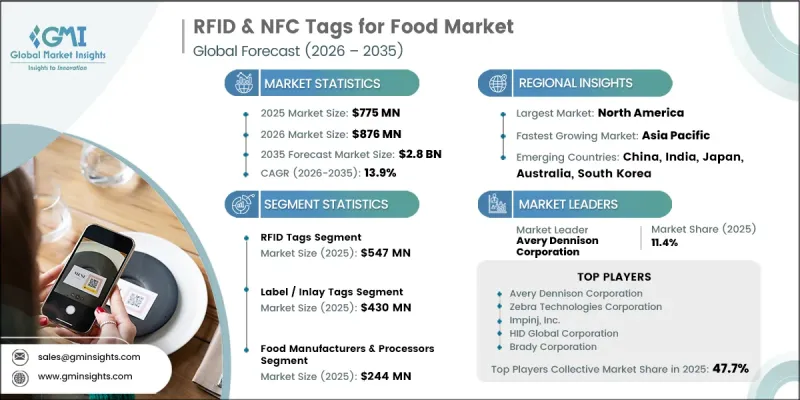
The market is gaining strong momentum as food manufacturers, retailers, and logistics providers increasingly adopt smart identification technologies to improve supply chain transparency, product tracking, and food safety management. RFID (Radio Frequency Identification) and NFC (Near Field Communication) tags are becoming essential digital labeling solutions that allow food-related information to be stored, accessed, and shared through wireless communication. These tags are integrated into food packaging to provide details related to product origin, production batches, shelf life, and handling requirements. RFID technology enables long-distance data capture through dedicated readers, while NFC technology supports short-range communication through compatible devices. The combined use of these technologies is improving supply chain visibility by allowing stakeholders to monitor product movement more efficiently. Increasing consumer demand for transparency, stronger food safety requirements, and the growing adoption of digital packaging solutions are further supporting market expansion.
| Market Scope | |
|---|---|
| Start Year | 2025 |
| Forecast Year | 2026-2035 |
| Start Value | $775 Million |
| Forecast Value | $2.8 Billion |
| CAGR | 13.9% |
RFID and NFC tags are increasingly incorporated into food packaging because they create a direct connection between physical products and digital information platforms. These technologies allow manufacturers, distributors, and retailers to monitor products throughout the supply chain with improved accuracy and efficiency. NFC-enabled packaging also enables consumers to access product information digitally, supporting greater confidence in food sourcing, quality standards, and safety practices. The growing focus on real-time tracking, inventory optimization, and reduced food waste is encouraging wider implementation of smart tagging solutions across the food industry.
The RFID tags segment accounted for USD 547 million in 2025. These tags are widely used for large-scale inventory tracking, automated supply chain management, and efficient distribution operations. Their ability to support extensive monitoring across complex logistics networks has increased their adoption in food transportation and storage applications. RFID solutions are increasingly being combined with sensor technologies to track environmental conditions such as temperature, humidity, and handling factors in real time. This integration supports improved quality management for temperature-sensitive food products and helps reduce losses by enabling early detection of potential supply chain issues.
The fresh produce segment generated USD 136 million in 2025. The adoption of RFID and NFC technologies across fresh produce, meat, poultry, seafood, and dairy categories is primarily driven by the need for improved freshness monitoring and product traceability. A growing number of companies are implementing sensor-enabled tags that provide continuous visibility into temperature conditions, humidity levels, and product handling processes. These advanced solutions enhance tracking capabilities, support faster response during product recalls, reduce spoilage, and help maintain consistent quality throughout cold chain operations.
North America RFID and NFC Tags for Food Market is projected to reach USD 892 million by 2035. The regional market is expanding due to rising demand for automated food supply chains, improved inventory visibility, and compliance with food safety requirements across retail and distribution networks. In the United States, adoption of RFID and NFC tagging solutions is accelerating across fresh food and packaged food categories as retailers invest in advanced digital systems, established cold chain networks, and enhanced traceability solutions. The increasing emphasis on efficient logistics management and transparent food handling practices is expected to further support regional growth.
Major players operating in the global RFID and NFC tags for food industry are Impinj, Inc., Avery Dennison Corporation, Wiliot Ltd., Zebra Technologies Corporation, HID Global Corporation, Brady Corporation, Identiv, Inc., Confidex Ltd. (now Beontag), Invengo Information Technology Co., Ltd., Lyngsoe Systems, and PragmatIC Semiconductor Ltd. Companies operating in the RFID and NFC tags for food market are focusing on technology development, strategic collaborations, product innovation, and expansion of application areas to strengthen their market position. Leading organizations are enhancing tag performance, developing sensor-integrated solutions, improving data management capabilities, and creating customized identification technologies for food supply chains. Businesses are also investing in partnerships with retailers, logistics providers, and food manufacturers to increase adoption across multiple applications.
Table of Contents
Chapter 1 Methodology & Scope
- 1.1 Market scope and definition
- 1.2 Research design
- 1.2.1 Research approach
- 1.2.2 Data collection methods
- 1.3 Data mining sources
- 1.3.1 Global
- 1.3.2 Regional/Country
- 1.4 Base estimates and calculations
- 1.4.1 Base year calculation
- 1.4.2 Key trends for market estimation
- 1.5 Primary research and validation
- 1.5.1 Primary sources
- 1.6 Forecast model
- 1.7 Research assumptions and limitations
Chapter 2 Executive Summary
- 2.1 Industry 360° synopsis
- 2.2 Key market trends
- 2.2.1 Tag Technology
- 2.2.2 Tag Form
- 2.2.3 Food Category
- 2.2.4 End User
- 2.2.5 Regional
- 2.3 TAM Analysis, 2026-2035
- 2.4 CXO perspectives: Strategic imperatives
- 2.5 Future outlook and strategic recommendations
Chapter 3 Industry Insights
- 3.1 Industry ecosystem analysis
- 3.1.1 Supplier landscape
- 3.1.2 Profit margin
- 3.1.3 Value addition at each stage
- 3.1.4 Factor affecting the value chain
- 3.1.5 Disruptions
- 3.2 Industry impact forces
- 3.2.1 Growth drivers
- 3.2.1.1 Rising need for food traceability
- 3.2.1.2 Demand for supply chain transparency
- 3.2.1.3 Growth in smart packaging adoption
- 3.2.2 Industry pitfalls and challenges
- 3.2.2.1 High initial implementation costs
- 3.2.2.2 Limited infrastructure in developing regions
- 3.2.3 Market opportunities
- 3.2.3.1 Integration with IoT-based food monitoring
- 3.2.3.2 Expansion in perishable goods tracking
- 3.2.3.3 Increased consumer engagement via NFC
- 3.2.1 Growth drivers
- 3.3 Growth potential analysis
- 3.4 Regulatory landscape
- 3.4.1 North America
- 3.4.2 Europe
- 3.4.3 Asia Pacific
- 3.4.4 Latin America
- 3.4.5 Middle East & Africa
- 3.5 Porter's analysis
- 3.6 PESTEL analysis
- 3.7 Technology and innovation landscape
- 3.7.1 Current technological trends
- 3.7.2 Emerging technologies
- 3.8 Price trends
- 3.8.1 By region
- 3.8.2 By tag technology
- 3.9 Future market trends
- 3.10 Patent landscape
- 3.11 Trade statistics (HS code)
- 3.11.1 Major importing countries
- 3.11.2 Major exporting countries
- 3.12 Sustainability and environmental aspects
- 3.12.1 Sustainable practices
- 3.12.2 Waste reduction strategies
- 3.12.3 Energy efficiency in production
- 3.12.4 Eco-friendly initiatives
- 3.13 Carbon footprint consideration
Chapter 4 Competitive Landscape, 2025
- 4.1 Introduction
- 4.2 Company market share analysis
- 4.2.1 By region
- 4.2.1.1 North America
- 4.2.1.2 Europe
- 4.2.1.3 Asia Pacific
- 4.2.1.4 LATAM
- 4.2.1.5 MEA
- 4.2.1 By region
- 4.3 Company matrix analysis
- 4.4 Competitive analysis of major market players
- 4.5 Competitive positioning matrix
- 4.6 Key developments
- 4.6.1 Mergers & acquisitions
- 4.6.2 Partnerships & collaborations
- 4.6.3 New product launches
- 4.6.4 Expansion plans
Chapter 5 Market Estimates and Forecast, By Tag Technology, 2022-2035 (USD Million) (Kilo Tons)
- 5.1 Key trends
- 5.2 RFID tags
- 5.2.1 Low Frequency (LF)
- 5.2.2 High Frequency (HF)
- 5.2.3 Ultra-High Frequency (UHF) / RAIN RFID
- 5.2.4 Active & Battery-Assisted Passive (BAP)
- 5.3 NFC tags
- 5.3.1 Passive
- 5.3.2 Active / Battery-Assisted
Chapter 6 Market Estimates and Forecast, By Tag Form, 2022-2035 (USD Million) (Kilo Tons)
- 6.1 Key trends
- 6.2 Label / Inlay tags
- 6.3 Hard / Encapsulated tags
- 6.4 Embedded / In-Mold tags
- 6.5 Others
Chapter 7 Market Estimates and Forecast, By Food Category, 2022-2035 (USD Million) (Kilo Tons)
- 7.1 Key trends
- 7.2 Fresh produce
- 7.3 Meat, poultry & seafood
- 7.4 Dairy products
- 7.5 Processed & packaged food
- 7.6 Beverages
- 7.7 Bakery & confectionery
- 7.8 Others
Chapter 8 Market Estimates and Forecast, By End User, 2022-2035 (USD Million) (Kilo Tons)
- 8.1 Key trends
- 8.2 Food manufacturers & processors
- 8.3 Retailers & supermarkets
- 8.4 Logistics & cold chain providers
- 8.5 Others
Chapter 9 Market Estimates and Forecast, By Region, 2022-2035 (USD Million) (Kilo Tons)
- 9.1 Key trends
- 9.2 North America
- 9.2.1 U.S.
- 9.2.2 Canada
- 9.3 Europe
- 9.3.1 Germany
- 9.3.2 UK
- 9.3.3 France
- 9.3.4 Spain
- 9.3.5 Italy
- 9.3.6 Rest of Europe
- 9.4 Asia Pacific
- 9.4.1 China
- 9.4.2 India
- 9.4.3 Japan
- 9.4.4 Australia
- 9.4.5 South Korea
- 9.4.6 Rest of Asia Pacific
- 9.5 Latin America
- 9.5.1 Brazil
- 9.5.2 Mexico
- 9.5.3 Argentina
- 9.5.4 Rest of Latin America
- 9.6 Middle East and Africa
- 9.6.1 Saudi Arabia
- 9.6.2 South Africa
- 9.6.3 UAE
- 9.6.4 Rest of Middle East and Africa
Chapter 10 Company Profiles
- 10.1 Avery Dennison Corporation
- 10.2 Zebra Technologies Corporation
- 10.3 Impinj, Inc.
- 10.4 HID Global Corporation
- 10.5 Brady Corporation
- 10.6 Confidex Ltd. (now Beontag)
- 10.7 Identiv, Inc.
- 10.8 Invengo Information Technology Co., Ltd.
- 10.9 Wiliot Ltd.
- 10.10 Lyngsoe Systems
- 10.11 PragmatIC Semiconductor Ltd.

