PUBLISHER: Global Market Insights Inc. | PRODUCT CODE: 2083060

PUBLISHER: Global Market Insights Inc. | PRODUCT CODE: 2083060
North America All-wheel Drive Tractors Market Opportunity, Growth Drivers, Industry Trend Analysis, and Forecast 2026 - 2035
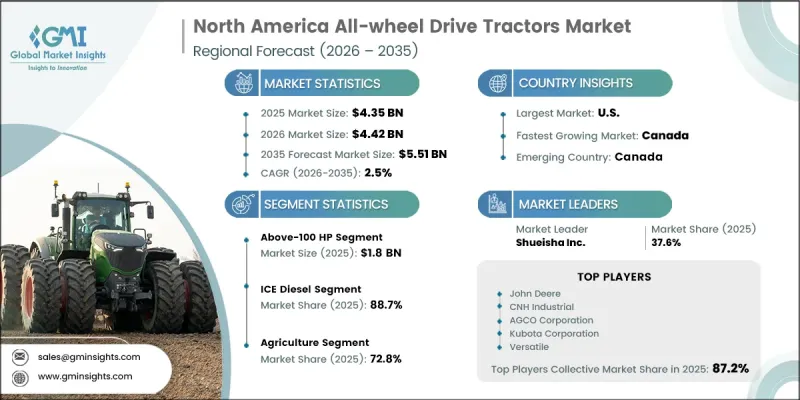
North America All-Wheel Drive (AWD) Tractors Market was valued at USD 4.35 billion in 2025 and is estimated to grow at a CAGR of 2.5% to reach USD 5.51 billion by 2035.
The market's steady growth reflects a mature agricultural equipment landscape in North America, where replacement-driven demand, evolving regulatory requirements for engine performance, and increasing preference for high-horsepower and precision-enabled machinery continue to shape investment patterns. Structural demand remains closely tied to agricultural consolidation trends, persistent labor shortages, and supportive policy frameworks that encourage mechanization across farming operations. As farm sizes expand, particularly across major agricultural belts in the United States and Canada, the need for high-capacity AWD tractors capable of handling intensive field operations continues to rise. The transition toward more industrialized farming systems is also accelerating the adoption of mechanized solutions, replacing labor-intensive practices with advanced equipment designed to improve productivity, efficiency, and operational scalability across diverse crop production environments.
| Market Scope | |
|---|---|
| Start Year | 2025 |
| Forecast Year | 2026-2035 |
| Start Value | $4.35 Billion |
| Forecast Value | $5.51 Billion |
| CAGR | 2.5% |
The above-100 HP category accounted for USD 1.8 billion, representing 41.4% share in 2025. Strong demand is driven by large-scale commercial farms that require powerful and efficient equipment to manage extensive acreage and optimize time-sensitive planting and harvesting cycles.
The diesel internal combustion engine (ICE) tractors segment held 88.7% share, generating USD 3.86 billion in 2025. This dominance is attributed to their high power output, operational efficiency, and suitability for continuous heavy-duty agricultural applications. Diesel-powered AWD tractors remain the primary choice across all horsepower ranges due to their superior energy density, quick refueling capability, and long operating range compared to alternative powertrains. Compliance with EPA Tier 4 Final standards has further shaped the segment through the integration of advanced emission control technologies, including diesel particulate filters, selective catalytic reduction systems, diesel oxidation catalysts, and exhaust gas recirculation systems.
United States All-Wheel Drive Tractors Market held an 81.1% share, generating USD 3.53 billion in 2025. Market strength in the United States is anchored by extensive row-crop farming activity across major agricultural regions, where large-scale farms frequently exceed 2,000 acres, driving strong demand for high-horsepower AWD tractor configurations designed to support productivity and operational efficiency.
Key companies operating in the North America All-Wheel Drive Tractors Market include John Deere, CNH Industrial, AGCO Corporation, Kubota Corporation, Claas, Mahindra & Mahindra, JCB, Yanmar Corporation, Versatile, Argo Tractors, SDF Group, Bobcat Company, Kioti Tractor, LS Tractor, Monarch Tractor, TYM Tractors, Solis Tractors, Zetor Tractors, Solectrac, Iseki & Co., and Landini. Companies operating in the North America All-Wheel Drive Tractors Market are focusing on product innovation, technological integration, and portfolio expansion to strengthen their market position. A key strategy involves the development of high-horsepower, fuel-efficient tractors equipped with advanced precision agriculture technologies to enhance productivity and operational accuracy. Manufacturers are increasingly investing in electrification research, hybrid powertrain systems, and emissions-compliant diesel technologies to align with evolving regulatory standards. Strategic partnerships with agricultural technology providers and farm equipment distributors are being used to expand market reach and improve after-sales support.
Table of Contents
Chapter 1 Methodology & Scope
- 1.1 Market scope and definition
- 1.2 Research design
- 1.2.1 Research approach
- 1.2.2 Data collection methods
- 1.3 Data mining sources
- 1.3.1 Global
- 1.3.2 Regional/Country
- 1.4 Base estimates and calculations
- 1.4.1 Base year calculation
- 1.4.2 Key trends for market estimation
- 1.5 Primary research and validation
- 1.5.1 Primary sources
- 1.6 Forecast model
- 1.7 Research assumptions and limitations
Chapter 2 Executive Summary
- 2.1 Industry 360° synopsis
- 2.2 Key market trends
- 2.2.1 Country
- 2.2.2 Product type
- 2.2.3 Propulsion
- 2.2.4 Application
- 2.2.5 Mode of operation
- 2.2.6 Distribution channel
Chapter 3 Industry Insights
- 3.1 Industry ecosystem analysis
- 3.1.1 Supplier landscape
- 3.1.2 Profit margin
- 3.1.3 Value addition at each stage
- 3.1.4 Factor affecting the value chain
- 3.2 Industry impact forces
- 3.2.1 Growth drivers
- 3.2.1.1 Increasing mechanization of agriculture across developed and emerging economies
- 3.2.1.2 Rising demand for high-performance tractors for heavy-duty farming applications
- 3.2.1.3 Growth of large-scale commercial farming and precision agriculture practices
- 3.2.2 Pitfalls & Challenges
- 3.2.2.1 High acquisition and maintenance costs of AWD tractors
- 3.2.2.2 Fluctuations in fuel prices and operational expenses
- 3.2.3 Opportunities
- 3.2.3.1 Growing adoption of autonomous and smart farming technologies
- 3.2.3.2 Rising demand for electric and hybrid agricultural machinery
- 3.2.1 Growth drivers
- 3.3 Growth potential analysis
- 3.4 Future market trends
- 3.5 Technology and innovation landscape
- 3.5.1 Current technological trends
- 3.5.2 Emerging technologies
- 3.6 Regulatory landscape
- 3.6.1 Standards and compliance requirements
- 3.6.2 Regional regulatory frameworks
- 3.6.3 Certification standards
- 3.7 Porter's analysis
- 3.8 PESTEL analysis
- 3.9 Pricing analysis (driven by primary research)
- 3.9.1 Historical price trend analysis (driven by primary research)
- 3.9.2 Pricing strategy by player type (premium / value / cost-plus) (driven by primary research)
- 3.9.3 Regional price variation analysis
- 3.10 Trade data analysis (global HS code- 870190) (driven by paid database)
- 3.10.1 Import/export volume and value trends (driven by paid database)
- 3.10.2 Key trade corridors and tariff impact (driven by paid database)
- 3.10.3 Country-level trade patterns
- 3.11 Impact of AI and generative AI on the market
- 3.11.1 AI-driven disruption of existing business models
- 3.11.2 GenAI use cases and adoption roadmap by segment
- 3.11.3 Risks, limitations and regulatory considerations
- 3.12 Capacity and production landscape (driven by primary research)
- 3.12.1 Installed capacity by region and key producer (driven by primary research)
- 3.12.2 Capacity utilization rates and expansion pipelines (driven by primary research)
Chapter 4 Competitive Landscape, 2025
- 4.1 Introduction
- 4.2 Company market share analysis
- 4.2.1 By Region
- 4.2.1.1 North America
- 4.2.1.2 Europe
- 4.2.1.3 Asia Pacific
- 4.2.1.4 Latin America
- 4.2.1.5 Middle East & Africa
- 4.2.1 By Region
- 4.3 Company matrix analysis
- 4.4 Competitive analysis of major market players
- 4.5 Competitive positioning matrix
- 4.6 Key developments
- 4.6.1 Mergers & acquisitions
- 4.6.2 Partnerships & collaborations
- 4.6.3 New product launches
- 4.6.4 Expansion plans
Chapter 5 Market Estimates & Forecast, By Product Type, 2022 - 2035, (USD Billion) (Thousand Units)
- 5.1 Key trends
- 5.2 Below 50 HP
- 5.3 50-100 HP
- 5.4 Above 100 HP
Chapter 6 Market Estimates & Forecast, By Propulsion, 2022 - 2035, (USD Billion) (Thousand Units)
- 6.1 Key trends
- 6.2 ICE (Diesel)
- 6.3 Hybrid
- 6.4 Electric (BEV)
Chapter 7 Market Estimates & Forecast, By Application, 2022 - 2035, (USD Billion) (Thousand Units)
- 7.1 Key trends
- 7.2 Agriculture
- 7.3 Construction
- 7.4 Forestry
- 7.5 Mining
- 7.6 Others
Chapter 8 Market Estimates & Forecast, By Operation Mode, 2022 - 2035, (USD Billion) (Thousand Units)
- 8.1 Key trends
- 8.2 Manual
- 8.3 Autonomous
Chapter 9 Market Estimates & Forecast, By Distribution Channel, 2022 - 2035, (USD Billion) (Thousand Units)
- 9.1 Key trends
- 9.2 Direct
- 9.3 Indirect
Chapter 10 Market Estimates & Forecast, By Region, 2022 - 2035, (USD Billion) (Thousand Units)
- 10.1 Key trends
- 10.2 U.S.
- 10.3 Canada
Chapter 11 Company Profiles
- 11.1 Top Global Players
- 11.1.1 John Deere
- 11.1.2 CNH Industrial
- 11.1.3 AGCO Corporation
- 11.1.4 Kubota Corporation
- 11.1.5 Mahindra & Mahindra
- 11.1.6 Claas
- 11.1.7 Yanmar Corporation
- 11.2 Regional Champions
- 11.2.1 Versatile
- 11.2.2 JCB
- 11.2.3 SDF Group
- 11.2.4 Argo Tractors
- 11.2.5 Bobcat Company
- 11.2.6 Kioti Tractor
- 11.2.7 Monarch Tractor
- 11.3 Emerging & Specialized Players
- 11.3.1 LS Tractor
- 11.3.2 Solis Tractors
- 11.3.3 TYM Tractors
- 11.3.4 Zetor Tractors
- 11.3.5 Iseki & Co.
- 11.3.6 Solectrac
- 11.3.7 Landini

