PUBLISHER: Mordor Intelligence | PRODUCT CODE: 2187311

PUBLISHER: Mordor Intelligence | PRODUCT CODE: 2187311
Tractor - Market Share Analysis, Industry Trends & Statistics, Growth Forecasts (2027 - 2032)
According to Mordor Intelligence, the tractor market size was valued at USD 95.03 billion in 2026 and estimated to grow from USD 100.6 billion in 2027 to reach USD 131.3 billion by 2032, at a CAGR of 5.47% during the forecast period (2027-2032).
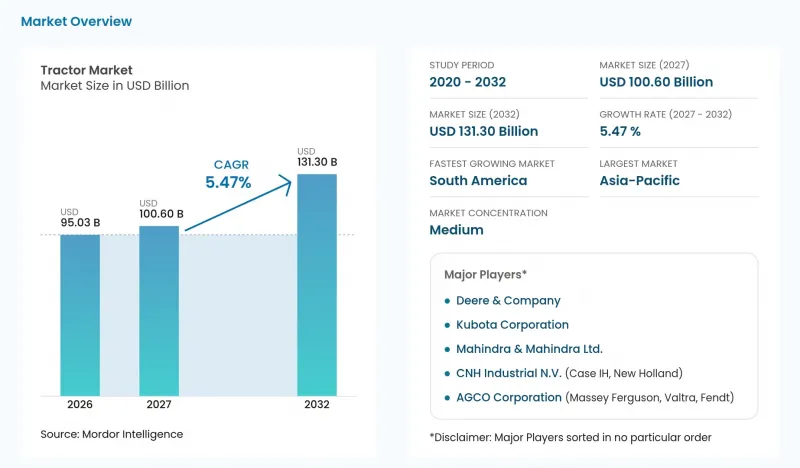
This report is segmented by Horsepower (40 - 100 HP, Above 100 HP, and more), Drive Type (Two-Wheel Drive and Four-/All-Wheel Drive), Propulsion Type (Diesel, Hybrid, and more), Application (Agriculture, Construction, and more), and Geography (Asia-Pacific, North America, and more). The market forecasts are provided in terms of value (USD), based on availability.
Global Tractor Market Trends and Insights
Rising Mechanization Demand in Emerging Economies
India's tractor industry recorded 1.16 million tractor sales in FY2026, up 23.5% from FY2025. In its March 2026 analysis of 5 manufacturers covering over 90% of industry volume, CRISIL Ratings attributed its estimated FY2026 increase primarily to GST rationalization. It said improved affordability supported first-time and replacement purchases, which it estimated at 35-40% and about 60-65% of domestic sales, respectively. CRISIL said tractors were increasingly seen as multi-utility assets for land preparation, haulage, irrigation, and transport. Versatility can strengthen the case for a tractor across both buyer populations by connecting the machine with multiple farm and transport tasks. The sales mix shows India's demand resting mostly on replacement of existing machines, with first-time buyers supplying a smaller but substantial 35-40%.
Government Subsidies and Low-Interest Ag-Credit Lines
Government-backed credit supports tractor demand by giving eligible agricultural buyers a defined route to equipment financing. Brazil's 2026/27 Moderfrota program finances tractor and implement purchases by rural producers and agricultural production cooperatives. Effective fixed annual rates are capped at 11.5% for Pronamp farmers and 12.5% for other eligible borrowers. Eligibility limits annual gross income or operating revenue, including the economic group, to BRL 45 million (USD 8.81 million). These parameters make financing terms predictable for qualifying buyers, strengthening the proposition for a purchase within the program's agricultural scope. For tractor suppliers, identifying eligible borrowers and their applicable rate becomes part of converting financing availability into equipment orders.
High Upfront Cost and Commodity-Price Volatility
High equipment prices become a stronger barrier when the crops financing a tractor purchase generate weaker returns. In its December 2025 outlook, Farm Credit Canada (FCC) projected Canadian new 100+ HP tractor unit sales to fall 5.6% in 2026 versus 2025. The lender linked tighter farm profitability to low commodity prices, high equipment prices, and geopolitical and trade uncertainty. This combination raises the burden on the future earnings expected to justify replacing a tractor. FCC's June 2026 assessment also linked declining crop prices, rising operating costs, and high equipment prices with reduced Canadian farm-equipment sales over several years. Capital recovery must therefore compete with operating expenses for the earnings available to finance a replacement machine.
Other drivers and restraints analyzed in the detailed report include:
- Escalating Farm-Labor Shortages in OECD and BRICS
- Rapid Adoption of Precision-Ag and Telematics Platforms
- Seasonal Income Dependence on Monsoon/Weather Cycles
For complete list of drivers and restraints, kindly check the Table Of Contents.
Segment Analysis
Tractors in the 40-100 HP range accounted for a 46.65% share of the tractor market size in 2026. In India, the narrower 41-50 HP band represented nearly two-thirds of tractor unit sales in FY2026. CRISIL Ratings' March 2026 retrospective linked shifts toward 41-50 HP models to October 2022 TREM-IV norms, which covered only tractors above 50 HP and allowed manufacturers a 6-month transition. Compliance costs raised prices above 50 HP while prices below 50 HP stayed largely unchanged. Because TREM-IV added compliance cost only above 50 HP, the 41-50 HP band's Indian sales position depended partly on the resulting price gap.
Tractors above 100 HP are the fastest-growing segment, with a forecast CAGR of 6.6% during 2027-2032. In Portugal, registrations for the narrower above-120-HP class rose 8% to 591 units in 2025, from 549 in 2024. The class also rose to 12% of Portugal's national tractor registrations in 2025 from 9% in 2024. The class gained registration share despite only 8% unit growth, implying that registrations at 120 HP or below fell and higher-power buyers gained ground in a shrinking Portuguese market.
Two-wheel drive (2WD) represented a 76.72% tractor market share in 2026, making it the largest segment. Preliminary member-company data from the Association of Equipment Manufacturers (AEM) recorded 133,877 US retail sales of 2WD farm tractors during January-September 2026. The total was 12.5% below January-September 2025, while the 86,030 tractors below 40 HP, down 14.2% year over year, made up most of it. US 2WD volume therefore moves mainly with sub-40 HP demand.
Four-/all-wheel drive (4WD/AWD) is the fastest-growing segment, with a forecast CAGR of 7.2% during 2027-2032. India cut tractor GST from 12% to 5% effective September 22, 2025, except for road tractors for semi-trailers above 1,800 cc, which were taxed at 18%. Carraro India reported that the GST reduction brought post-GST 4WD tractor prices close to pre-GST 2WD prices, accelerating the domestic shift toward 4WD. The component supplier also reported continuing growth in domestic 4WD axle demand in the quarter ended June 30, 2026. For manufacturers, India's opportunity extends from selling the configuration to securing the axle capacity needed to deliver it as adoption broadens.
Complete Report Scope:
- By Horsepower
- Below 40 HP
- 40 - 100 HP
- Above 100 HP
- By Drive Type
- Two-Wheel Drive (2WD)
- Four-/All-Wheel Drive (4WD/AWD)
- By Propulsion Type
- Diesel
- Battery-Electric
- Hybrid (Diesel-Electric)
- By Application
- Agriculture
- Construction
- Forestry
- Municipal & Grounds Maintenance
- Haulage & Logistics
- By Geography
- North America
- United States
- Canada
- Rest of North America
- South America
- Brazil
- Argentina
- Rest of South America
- Europe
- Germany
- United Kingdom
- France
- Italy
- Spain
- Russia
- Rest of Europe
- Asia-Pacific
- China
- India
- Japan
- South Korea
- Australia
- Rest of Asia-Pacific
- Middle-East and Africa
- United Arab Emirates
- Saudi Arabia
- Turkey
- Egypt
- South Africa
- Rest of Middle-East and Africa
- North America
Geography Analysis
Asia-Pacific held a 55.66% tractor market share in 2026, making it the largest geography. Swaraj Tractors, part of the Mahindra Group, reached cumulative production of 2.5 million tractors with its August 29, 2025 rollout in Mohali, Punjab, India. In August 2026, Escorts Kubota Ltd., Kubota Corporation's Indian subsidiary, began site preparation for a planned Uttar Pradesh plant intended to expand capacity for tractors and other products for India. Swaraj's cumulative output and Escorts Kubota's planned capacity place an established manufacturing base and further supply investment close to Indian tractor buyers.
South America is the fastest-growing geography, with a forecast CAGR of 6.55% during 2027-2032. Brazil's agricultural-machinery retail sales fell 3.6% to 49,800 units in 2025, and ANFAVEA's April 2026 assessment forecast a further 6.2% decline for 2026. That assessment also reported growth in low-power tractor sales associated with family farming and programs such as PRONAF Mais Alimentos. It described the program's interest rates as around 5%. The contrast makes family-farm financing the concrete entry point for Brazil's low-power tractor business within an adverse broader machinery outlook.
In North America, FCC's December 2025 outlook for 2026 identified Canadian livestock producers as potential tractor-upgrade buyers if cattle prices and revenues remained strong, making cattle returns a condition for replacement offers. In Europe, CLIMMAR, an agricultural-machinery dealers' and repairers' association, reported declining registrations across 13 member countries in 2025, led by France, Germany, and Italy with 33,251, 20,497, and 17,552 registrations, respectively. The leading national totals favor focused dealer coverage in France, Germany, and Italy, with the sample counting all tractor powers in Austria and Italy and at least 50 HP elsewhere. In Middle-East and Africa, Nigeria's Belarus Project, implemented with AfTrade DMCC and Belarusian support, delivered 2,000 tractors and 9,000 implements under federal mechanization policy in 2025. The Nigerian delivery links completed equipment supply to a federal mechanization program implemented with AfTrade DMCC.
- Deere & Company
- CNH Industrial N.V. (Case IH, New Holland)
- AGCO Corporation (Massey Ferguson, Valtra, Fendt)
- Mahindra & Mahindra Ltd.
- Kubota Corporation
- CLAAS KGaA mbH
- Escorts Kubota Ltd.
- TAFE Ltd.
- Sonalika (International Tractors Ltd.)
- SDF Group (Same Deutz-Fahr)
- Yanmar Agribusiness Co., Ltd.
- Argo Tractors S.p.A.
- LS Mtron Ltd.
- Daedong (Kioti)
- TYM Corporation
- Weichai Lovol Intelligent Agricultural Technology CO., LTD
- YTO Group Corp.
- XCMG Construction Machinery Co., Ltd.
- Zetor Tractors a.s.
- J C Bamford Excavators Ltd
Additional Benefits:
- The market estimate (ME) sheet in Excel format
- 3 months of analyst support
TABLE OF CONTENTS
1 INTRODUCTION
- 1.1 Study Assumptions and Market Definition
- 1.2 Scope of the Study
2 RESEARCH METHODOLOGY
3 EXECUTIVE SUMMARY
4 MARKET LANDSCAPE
- 4.1 Market Overview
- 4.2 Market Drivers
- 4.2.1 Rising Mechanization Demand in Emerging Economies
- 4.2.2 Government Subsidies and Low-Interest Ag-Credit Lines
- 4.2.3 Escalating Farm-Labor Shortages in OECD and BRICS
- 4.2.4 Rapid Adoption of Precision-Ag and Telematics Platforms
- 4.2.5 Commercialization of Battery-Electric Tractors and Trials of Fuel-Cell Tractors
- 4.2.6 Growth of Data-Driven Tractor-Rental Platforms
- 4.3 Market Restraints
- 4.3.1 High Upfront Cost and Commodity-Price Volatility
- 4.3.2 Seasonal Income Dependence on Monsoon/Weather Cycles
- 4.3.3 Electronics-Grade Chip Supply Bottlenecks
- 4.3.4 Localization and Content-Origin Rules in Trade Pacts
- 4.4 Industry Value Chain Analysis
- 4.5 Regulatory Landscape
- 4.6 Technological Outlook
- 4.7 Porter's Five Forces Analysis
- 4.7.1 Threat of New Entrants
- 4.7.2 Bargaining Power of Suppliers
- 4.7.3 Bargaining Power of Buyers
- 4.7.4 Threat of Substitutes
- 4.7.5 Competitive Rivalry
5 MARKET SIZE AND GROWTH FORECASTS (VALUE)
- 5.1 By Horsepower
- 5.1.1 Below 40 HP
- 5.1.2 40 - 100 HP
- 5.1.3 Above 100 HP
- 5.2 By Drive Type
- 5.2.1 Two-Wheel Drive (2WD)
- 5.2.2 Four-/All-Wheel Drive (4WD/AWD)
- 5.3 By Propulsion Type
- 5.3.1 Diesel
- 5.3.2 Battery-Electric
- 5.3.3 Hybrid (Diesel-Electric)
- 5.4 By Application
- 5.4.1 Agriculture
- 5.4.2 Construction
- 5.4.3 Forestry
- 5.4.4 Municipal & Grounds Maintenance
- 5.4.5 Haulage & Logistics
- 5.5 By Geography
- 5.5.1 North America
- 5.5.1.1 United States
- 5.5.1.2 Canada
- 5.5.1.3 Rest of North America
- 5.5.2 South America
- 5.5.2.1 Brazil
- 5.5.2.2 Argentina
- 5.5.2.3 Rest of South America
- 5.5.3 Europe
- 5.5.3.1 Germany
- 5.5.3.2 United Kingdom
- 5.5.3.3 France
- 5.5.3.4 Italy
- 5.5.3.5 Spain
- 5.5.3.6 Russia
- 5.5.3.7 Rest of Europe
- 5.5.4 Asia-Pacific
- 5.5.4.1 China
- 5.5.4.2 India
- 5.5.4.3 Japan
- 5.5.4.4 South Korea
- 5.5.4.5 Australia
- 5.5.4.6 Rest of Asia-Pacific
- 5.5.5 Middle-East and Africa
- 5.5.5.1 United Arab Emirates
- 5.5.5.2 Saudi Arabia
- 5.5.5.3 Turkey
- 5.5.5.4 Egypt
- 5.5.5.5 South Africa
- 5.5.5.6 Rest of Middle-East and Africa
- 5.5.1 North America
6 COMPETITIVE LANDSCAPE
- 6.1 Market Concentration
- 6.2 Strategic Moves
- 6.3 Market Share Analysis
- 6.4 Company Profiles (includes Global level Overview, Market level overview, Core Segments, Financials as available, Strategic Information, Market Rank/Share for key companies, Products and Services, and Recent Developments)
- 6.4.1 Deere & Company
- 6.4.2 CNH Industrial N.V. (Case IH, New Holland)
- 6.4.3 AGCO Corporation (Massey Ferguson, Valtra, Fendt)
- 6.4.4 Mahindra & Mahindra Ltd.
- 6.4.5 Kubota Corporation
- 6.4.6 CLAAS KGaA mbH
- 6.4.7 Escorts Kubota Ltd.
- 6.4.8 TAFE Ltd.
- 6.4.9 Sonalika (International Tractors Ltd.)
- 6.4.10 SDF Group (Same Deutz-Fahr)
- 6.4.11 Yanmar Agribusiness Co., Ltd.
- 6.4.12 Argo Tractors S.p.A.
- 6.4.13 LS Mtron Ltd.
- 6.4.14 Daedong (Kioti)
- 6.4.15 TYM Corporation
- 6.4.16 Weichai Lovol Intelligent Agricultural Technology CO., LTD
- 6.4.17 YTO Group Corp.
- 6.4.18 XCMG Construction Machinery Co., Ltd.
- 6.4.19 Zetor Tractors a.s.
- 6.4.20 J C Bamford Excavators Ltd
7 MARKET OPPORTUNITIES AND FUTURE OUTLOOK
- 7.1 White-Space and Unmet-Need Assessment

