PUBLISHER: Global Market Insights Inc. | PRODUCT CODE: 2083093

PUBLISHER: Global Market Insights Inc. | PRODUCT CODE: 2083093
North America Spray Foam Market Opportunity, Growth Drivers, Industry Trend Analysis, and Forecast 2026 - 2035
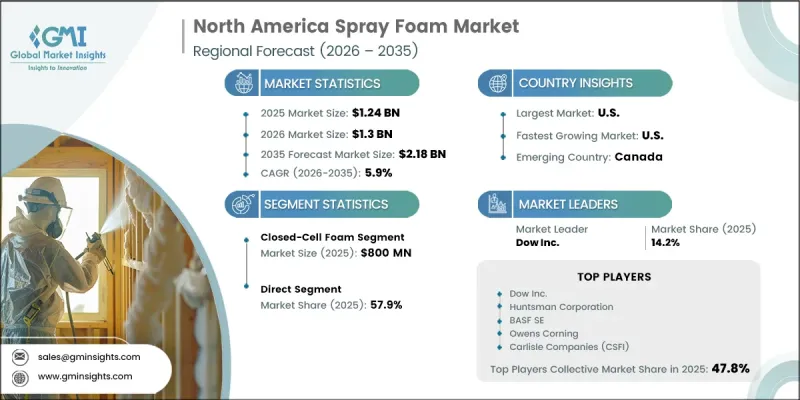
North America Spray Foam Market was valued at USD 1.24 billion in 2025 and is estimated to grow at a CAGR of 5.9% to reach USD 2.18 billion by 2035.
The market growth is driven by increasing emphasis on energy-efficient construction practices, evolving building performance requirements, and stricter regulatory frameworks governing thermal insulation standards across residential and commercial infrastructure. Supportive policy mechanisms and financial incentives aimed at improving building energy performance are further encouraging adoption of spray foam insulation systems. In addition, climatic variability across North America is reinforcing demand for high-performance insulation solutions capable of improving energy efficiency and reducing heating and cooling loads in buildings. Rising awareness regarding indoor environmental quality and long-term durability of building systems is also contributing to market expansion. Spray foam insulation is increasingly being integrated into modern construction practices due to its ability to enhance air sealing, thermal resistance, and overall building efficiency. These factors collectively continue to support consistent growth in demand across both new construction and renovation activities, strengthening the overall market outlook across the region.
| Market Scope | |
|---|---|
| Start Year | 2025 |
| Forecast Year | 2026-2035 |
| Start Value | $1.24 Billion |
| Forecast Value | $2.18 Billion |
| CAGR | 5.9% |
The closed-cell spray foam segment accounted for USD 800 million in 2025 and is projected to reach USD 1.41 billion by 2035. This segment continues to lead the North America Spray Foam Market due to its strong thermal insulation performance and high-density structure. Its ability to provide enhanced resistance to heat transfer, moisture, and air infiltration makes it a preferred choice for applications requiring high energy efficiency and space optimization. The material's integrated barrier properties also reduce the need for additional protective layers, supporting its widespread adoption in construction applications with strict performance requirements.
The direct distribution channel held a 57.9% share in 2025. This channel remains dominant due to its cost efficiency and ability to eliminate intermediary markups in the supply chain. Direct procurement models also allow contractors and end users to maintain better control over product quality and material specifications, which is particularly important in large-scale insulation projects involving complex application requirements.
United States Spray Foam Market represented 88.1% share in 2025. Market expansion in the country is strongly supported by sustained construction activity across residential and commercial sectors, along with increasing demand for energy-efficient building solutions. Regulatory frameworks focused on insulation performance standards, combined with ongoing renovation of aging building infrastructure, continue to drive adoption. Growing emphasis on energy savings and improved indoor environmental conditions further supports market penetration, while alignment with recognized green building certification standards strengthens long-term demand across the country.
Key companies operating in the North America Spray Foam Market include BASF SE, Covestro AG, Dow Inc., Huntsman Corporation, Owens Corning, Carlisle Companies (CSFI), Johns Manville, SOPREMA Group, DAP Global, NCFI Polyurethanes, Gaco Western / Enverge, ICP / HandiFoam, Enerlab Canada, Genyk Inc. (Canada), Shunda Polyurethane Ltd. (Canada), SWD Urethane, PolyCon LLC, Elastochem Specialty Chemicals, EnviroSeal (Quadrant Perf. Materials), Kraken Bond, and Victory Polymers Corporation. Companies operating in the North America Spray Foam Market are focusing on product innovation, capacity expansion, and strategic partnerships to strengthen their competitive position. A key strategy involves developing advanced insulation formulations with improved thermal performance, environmental compatibility, and application efficiency to meet evolving construction standards. Manufacturers are also investing in expanding production capabilities and optimizing supply chain operations to ensure consistent material availability. Strategic collaborations with construction firms, insulation contractors, and distributors are being used to enhance market reach and improve customer engagement. Companies are further emphasizing sustainable product development aligned with green building standards and energy efficiency certifications.
Table of Contents
Chapter 1 Methodology & Scope
- 1.1 Research approach
- 1.2 Quality Commitments
- 1.2.1 GMI AI policy & data integrity commitment
- 1.2.1.1 Source consistency protocol
- 1.2.1 GMI AI policy & data integrity commitment
- 1.3 Research Trail & Confidence Scoring
- 1.3.1 Research Trail Components
- 1.3.2 Scoring Components
- 1.4 Data Collection
- 1.4.1 Partial list of primary sources
- 1.5 Data mining sources
- 1.5.1 Paid sources
- 1.5.1.1 Sources, by region
- 1.5.1 Paid sources
- 1.6 Base estimates and calculations
- 1.6.1 Base year calculation for any one approach
- 1.7 Forecast model
- 1.7.1 Quantified market impact analysis
- 1.7.1.1 Mathematical impact of growth parameters on forecast
- 1.7.1 Quantified market impact analysis
- 1.8 Research transparency addendum
- 1.8.1 Source attribution framework
- 1.8.2 Quality assurance metrics
- 1.8.3 Our commitment to trust
Chapter 2 Executive Summary
- 2.1 Industry 360° synopsis, 2022 - 2035
- 2.2 Key market trends
- 2.2.1 By country
- 2.2.2 By product type
- 2.2.3 By application system
- 2.2.4 By end use industry
- 2.2.5 By distribution channel
Chapter 3 Industry Insights
- 3.1 Industry ecosystem analysis
- 3.1.1 Supplier landscape
- 3.1.2 Profit margin
- 3.1.3 Value addition at each stage
- 3.1.4 Factor affecting the value chain
- 3.2 Industry impact forces
- 3.2.1 Growth drivers
- 3.2.1.1 Increasing demand for energy efficient insulation solutions
- 3.2.1.2 Rising construction activities in residential and commercial sectors
- 3.2.1.3 Growing awareness of environmental sustainability and green building materials
- 3.2.2 Industry pitfalls & challenges
- 3.2.2.1 Health and environmental concerns regarding chemicals in North America spray foam
- 3.2.2.2 High initial costs and installation challenges
- 3.2.3 Opportunities
- 3.2.3.1 Expansion of building energy efficiency retrofit programs
- 3.2.3.2 Rising demand for sustainable and low emission foam solutions
- 3.2.1 Growth drivers
- 3.3 Growth potential analysis
- 3.4 Regulatory framework
- 3.5 Major market trends and disruptions
- 3.6 Pricing Analysis (driven by primary research)
- 3.6.1 Historical price trend analysis (driven by primary research)
- 3.6.2 Pricing strategy by player type (premium / value / cost-plus) (driven by primary research)
- 3.7 Future market trends
- 3.8 Trade data analysis (driven by paid database) (HS Code 3926)
- 3.8.1 Import/export volume & value trends (driven by primary research)
- 3.8.2 Key trade corridors & tariff impact (driven by primary research)
- 3.9 Impact of AI & Generative AI on the Market
- 3.9.1 AI-driven disruption of existing business models
- 3.9.2 Gen-AI use cases & adoption roadmap by segment
- 3.9.3 Risks, limitations & regulatory considerations
- 3.10 Porter's analysis
- 3.11 PESTEL analysis
- 3.12 Capacity & production landscape (driven by primary research)
- 3.12.1 Installed capacity by region & key producer (driven by primary research)
- 3.12.2 Capacity utilization rates & expansion pipelines (driven by primary research)
Chapter 4 Competitive Landscape, 2025
- 4.1 Introduction
- 4.2 Company market share analysis
- 4.2.1 By Country
- 4.2.1.1 U.S.
- 4.2.1.2 Canada
- 4.2.1 By Country
- 4.3 Company matrix analysis
- 4.4 Competitive analysis of major market players
- 4.5 Competitive positioning matrix
- 4.6 Key developments
- 4.6.1 Mergers & acquisitions
- 4.6.2 Partnerships & collaborations
- 4.6.3 New product launches
- 4.6.4 Expansion plans
Chapter 5 Market Estimates & Forecast, By Product Type, 2022 - 2035, (USD Billion) (Thousand Units)
- 5.1 Key trends
- 5.2 Open-cell foam
- 5.2.1 0.5 PCF
- 5.2.2 Water-blown formulations
- 5.3 Closed-cell foam
- 5.3.1 2.0 PCF
- 5.3.2 HFC-blown formulations
- 5.3.3 HFC -blown formulations (low-GWP)
Chapter 6 Market Estimates & Forecast, By Application System, 2022 - 2035, (USD Billion) (Thousand Units)
- 6.1 Key trends
- 6.2 High-pressure systems
- 6.3 Low-pressure systems
Chapter 7 Market Estimates & Forecast, By End User, 2022 - 2035, (USD Billion) (Thousand Units)
- 7.1 Key trends
- 7.2 Building & construction
- 7.3 Automotive
- 7.4 Packaging
- 7.5 Oil & Gas
- 7.6 Others
Chapter 8 Market Estimates & Forecast, By Distribution Channel, 2022 - 2035, (USD Billion) (Thousand Units)
- 8.1 Key trends
- 8.2 Direct
- 8.3 Indirect
Chapter 9 Market Estimates & Forecast, By Country, 2022 - 2035, (USD Billion) (Thousand Units)
- 9.1 Key trends
- 9.2 U.S.
- 9.3 Canada
Chapter 10 Company Profiles
- 10.1 Global Companies
- 10.1.1 BASF SE
- 10.1.1.1 Business Overview
- 10.1.1.2 Financial Data
- 10.1.1.3 Product Landscape
- 10.1.1.4 Strategic Outlook
- 10.1.1.5 SWOT Analysis
- 10.1.2 Carlisle Companies (CSFI)
- 10.1.3 Covestro AG
- 10.1.4 Dow Inc.
- 10.1.5 Huntsman Corporation
- 10.1.6 Owens Corning
- 10.1.7 SOPREMA Group
- 10.1.1 BASF SE
- 10.2 Regional Companies
- 10.2.1 DAP Global
- 10.2.2 Elastochem Specialty Chemicals
- 10.2.3 Gaco Western
- 10.2.4 ICP / HandiFoam
- 10.2.5 Johns Manville
- 10.2.6 NCFI Polyurethanes
- 10.2.7 SWD Urethane
- 10.3 Emerging Companies
- 10.3.1 Enerlab Canada
- 10.3.2 EnviroSeal (Quadrant Perf. Materials)
- 10.3.3 Genyk Inc. (Canada)
- 10.3.4 Kraken Bond
- 10.3.5 PolyCon LLC
- 10.3.6 Shunda Polyurethane Ltd. (Canada)
- 10.3.7 Victory Polymers Corporation

