PUBLISHER: Mordor Intelligence | PRODUCT CODE: 2116637

PUBLISHER: Mordor Intelligence | PRODUCT CODE: 2116637
Carbon Foam - Market Share Analysis, Industry Trends & Statistics, Growth Forecasts (2026 - 2031)
According to Mordor Intelligence, the carbon foam market size was valued at USD 25.97 million in 2025 and is estimated to grow from USD 28.23 million in 2026 to reach USD 42.86 million by 2031, at a CAGR of 8.71% during the forecast period (2026-2031).
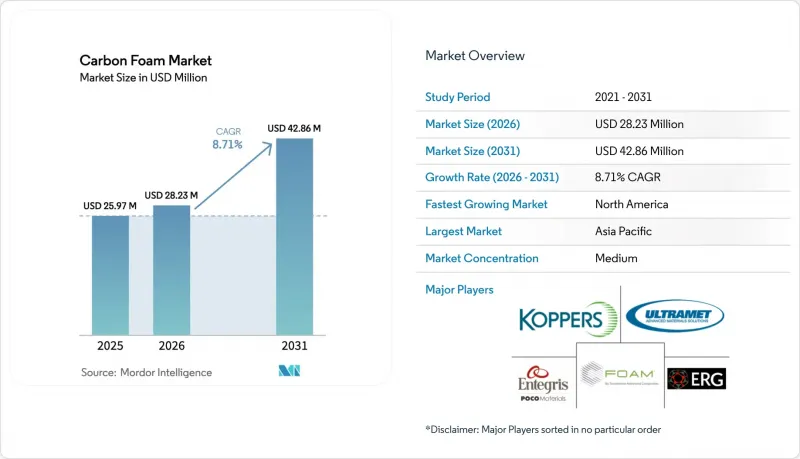
This report is Segmented by Type (Graphitic and Non-Graphitic), End-User Industry (Aerospace and Defence, Electronics and Electrical, Automotive and Transportation, Building and Construction, Energy Storage and Fuel Cells, Industrial Equipment, and Other End-Users), and Geography (Asia-Pacific, North America, Europe, South America, and Middle East and Africa). Market Forecasts are Provided in Terms of Value (USD).
Global Carbon Foam Market Trends and Insights
Increasing Demand from Aerospace and Defence
Hypersonic vehicles endure extreme conditions, facing high heat fluxes and temperatures. Remarkably, graphitic carbon-foam cores withstand these challenges without premature ablation. In 2024-2025, the U.S. Air Force and Navy unveiled several SBIR topics, targeting modular carbon-carbon and carbon-foam structures. Their goal: to reduce unit costs for expendable re-entry systems. Meanwhile, in 2024, Hexcel boasted a robust backlog. This surge indicates that wide-body programs are increasingly opting for nacelle liners and wing de-icing hardware, both integrating carbon foam for enhanced directional heat transfer. This convergence of defense and commercial aerospace not only ensures multi-year volume visibility but also shields suppliers from the typical airframe cycles. As hypersonic testing gains momentum heading into the late-2020s, suppliers who can elevate their graphitization furnaces to higher temperatures stand poised to secure a significant share of emerging contracts.
Expanding Thermal-Management Needs of Power Electronics
Insulated-gate bipolar transistors in electric vehicles have reliability thresholds hovering around 150 °C. However, when combined with phase-change materials, porous carbon heat-spreaders ensure junction temperatures remain well below this limit, even at 5C discharge rates. In trials conducted in June 2025, battery packs utilizing copper-coated carbon foam and PCM achieved a notable reduction in peak temperatures. This setup also managed to reduce the system's mass compared to traditional liquid cooling methods. Such a material switch not only lightens the load but also significantly cuts parasitic power draw. Meanwhile, data-center operators grapple with similar density challenges, especially as artificial-intelligence accelerators push out substantial heat per chip. Enter graphene-foam vapor chambers, now essential players in the thermal management strategies for inference clusters. Given the pressing need to mitigate thermal throttling in both transportation and computing realms, power-electronics cooling has emerged as the most lucrative segment for the carbon foam market.
High Production Cost and Energy Intensity
Graphitizing foam demands furnace temperatures exceeding high thresholds and inert atmospheres for extended durations, consuming significant power-a draw on par with primary aluminum smelting. While CONSOL's continuous pilot streamlines operations by merging oxidation and carbonization into a single pass, establishing an industrial line comes with substantial capital expenditure, a barrier that confines entry to well-capitalized firms. Rising gas and electricity prices in Europe squeezed SGL Carbon's Graphite Solutions EBITDA margin, highlighting persistent margin pressures in energy-intensive locales. As long as renewable energy constitutes less than half of industrial grids, producers will grapple with fossil-fuel price volatility, hindering their competitiveness in price-sensitive sectors like construction and industrial furnace applications.
Other drivers and restraints analyzed in the detailed report include:
- Environmental Regulations Favouring Non-Toxic, Fire-Resistant Insulation
- Rapid Adoption of Carbon-Foam Current Collectors in Solid-State Batteries
- Limited Supply of High-Quality Mesophase Pitch
For complete list of drivers and restraints, kindly check the Table Of Contents.
Segment Analysis
Graphitic foam accounted for 74.55% of 2025 revenue in the carbon foam market and is forecast to grow at a 9.85% CAGR to 2031, reflecting its indispensability for directional heat spreading in hypersonic skins and power inverters. At USD 28.23 million, the 2026 carbon foam market size skews heavily toward graphitized grades despite their higher energy footprint because alternative materials cannot meet 40-180 W/m*K in-plane conductivity requirements. Toray's decision to double graphitization capacity in Japan and the United States proves that high-temperature lines remain the strategic bottleneck that commands the best margins. Oak Ridge National Laboratory's additive manufacturing trials reached flexural strengths near 235 MPa, validating graphitic foam cores above 3,000 °C for rocket-nozzle inserts where non-graphitic foams oxidize. At the same time, non-graphitic foams maintain relevance in building insulation and furnace linings where 5-20 W/m*K conductivity suffices and price beats performance. Lignin-derived foams reaching 1,050 °C fire resistance signal that bio-based non-graphitic options could unlock large-volume construction demand once producers scale beyond pilot lots. Cost-down pressures, therefore, split the carbon foam market into a high-performance, graphitized tier and a cost-sensitive, bio-based tier that will coexist through the decade.
Complete Report Scope:
- By Type
- Graphitic
- Non-graphitic
- By End-user Industry
- Aerospace and Defence
- Electronics and Electrical
- Automotive and Transportation
- Building and Construction
- Energy Storage and Fuel Cells
- Industrial Equipment
- Other End-users
- By Geography
- Asia-Pacific
- China
- India
- Japan
- South Korea
- ASEAN Countries
- Rest of Asia-Pacific
- North America
- United States
- Canada
- Mexico
- Europe
- Germany
- United Kingdom
- France
- Italy
- Spain
- NORDIC Countries
- Russia
- Rest of Europe
- South America
- Brazil
- Argentina
- Rest of South America
- Middle East and Africa
- Saudi Arabia
- South Africa
- Rest of Middle East and Africa
- Asia-Pacific
Geography Analysis
Asia-Pacific delivered 27.53% of 2025 revenue, underpinned by Toray's South Korean expansion and Hyosung's multi-country build-out aimed at hydrogen pressure vessels. Chinese and Japanese investors also advanced capacity for wind-turbine and automotive composites, reinforcing the region's role as the production hub for global customers. Government roadmaps in Japan that prioritize high-density heat storage further elevate domestic demand for industrial thermal barriers made from carbon foam.
North America will be the fastest-growing region at a 9.24% CAGR through 2031. U.S. defense agencies fund hypersonic vehicle programs that insist on graphitic foams for 5,000 °F heat shields, while commercial aerospace backlogs stretch to the decade's end.
Europe blends strong aerospace activity with stringent building-energy codes that favor non-toxic, fire-safe insulation. Energy-price volatility compressed graphite-solutions margins in 2024, yet circular-economy policies catalyzed investment in recycling lines that recover carbon-fiber scrap for foam production at up to 95% lower carbon footprint. These moves, coupled with the EPBD's zero-emission trajectory, create a dual pull for high-end aerospace foams and low-cost building foams, positioning Europe as both a technology incubator and a regulatory driver.
- American Elements
- Beijing Jingke Xingye Technology Development Co., Ltd.
- Carbon-Core Corporation
- CONSOL Energy Inc.
- Entegris Inc.
- ERG Aerospace
- Evonik Industries
- Goodfellow Cambridge Ltd.
- Graphite India Limited
- Hexcel Corporation
- Koppers Inc.
- SGL Carbon
- TORAY CARBON MAGIC CO., LTD
- Touchstone Advanced Composites
- Ultramet
- Xiamen Zopin New Material Limited
Additional Benefits:
- The market estimate (ME) sheet in Excel format
- 3 months of analyst support
TABLE OF CONTENTS
1 Introduction
- 1.1 Study Assumptions and Market Definition
- 1.2 Scope of the Study
2 Research Methodology
3 Executive Summary
4 Market Landscape
- 4.1 Market Overview
- 4.2 Market Drivers
- 4.2.1 Increasing demand from aerospace and defence
- 4.2.2 Expanding thermal-management needs of power electronics
- 4.2.3 Environmental regulations favouring non-toxic, fire-resistant insulation
- 4.2.4 Rapid adoption of carbon-foam current collectors in solid-state batteries
- 4.2.5 Biomass-derived carbon-foam feedstocks enabling cost reduction
- 4.3 Market Restraints
- 4.3.1 High production cost and energy intensity
- 4.3.2 Limited supply of high-quality mesophase pitch
- 4.3.3 Lack of global test standards delaying OEM qualification
- 4.4 Value Chain Analysis
- 4.5 Porter's Five Forces
- 4.5.1 Bargaining Power of Suppliers
- 4.5.2 Bargaining Power of Buyers
- 4.5.3 Threat of New Entrants
- 4.5.4 Threat of Substitutes
- 4.5.5 Degree of Competition
5 Market Size and Growth Forecasts (Value)
- 5.1 By Type
- 5.1.1 Graphitic
- 5.1.2 Non-graphitic
- 5.2 By End-user Industry
- 5.2.1 Aerospace and Defence
- 5.2.2 Electronics and Electrical
- 5.2.3 Automotive and Transportation
- 5.2.4 Building and Construction
- 5.2.5 Energy Storage and Fuel Cells
- 5.2.6 Industrial Equipment
- 5.2.7 Other End-users
- 5.3 By Geography
- 5.3.1 Asia-Pacific
- 5.3.1.1 China
- 5.3.1.2 India
- 5.3.1.3 Japan
- 5.3.1.4 South Korea
- 5.3.1.5 ASEAN Countries
- 5.3.1.6 Rest of Asia-Pacific
- 5.3.2 North America
- 5.3.2.1 United States
- 5.3.2.2 Canada
- 5.3.2.3 Mexico
- 5.3.3 Europe
- 5.3.3.1 Germany
- 5.3.3.2 United Kingdom
- 5.3.3.3 France
- 5.3.3.4 Italy
- 5.3.3.5 Spain
- 5.3.3.6 NORDIC Countries
- 5.3.3.7 Russia
- 5.3.3.8 Rest of Europe
- 5.3.4 South America
- 5.3.4.1 Brazil
- 5.3.4.2 Argentina
- 5.3.4.3 Rest of South America
- 5.3.5 Middle East and Africa
- 5.3.5.1 Saudi Arabia
- 5.3.5.2 South Africa
- 5.3.5.3 Rest of Middle East and Africa
- 5.3.1 Asia-Pacific
6 Competitive Landscape
- 6.1 Market Concentration
- 6.2 Strategic Moves
- 6.3 Market Share/Ranking Analysis
- 6.4 Company Profiles (includes Global-level Overview, Market-level Overview, Core Segments, Financials as available, Strategic Information, Market Rank/Share, Products and Services, Recent Developments)
- 6.4.1 American Elements
- 6.4.2 Beijing Jingke Xingye Technology Development Co., Ltd.
- 6.4.3 Carbon-Core Corporation
- 6.4.4 CONSOL Energy Inc.
- 6.4.5 Entegris Inc.
- 6.4.6 ERG Aerospace
- 6.4.7 Evonik Industries
- 6.4.8 Goodfellow Cambridge Ltd.
- 6.4.9 Graphite India Limited
- 6.4.10 Hexcel Corporation
- 6.4.11 Koppers Inc.
- 6.4.12 SGL Carbon
- 6.4.13 TORAY CARBON MAGIC CO., LTD
- 6.4.14 Touchstone Advanced Composites
- 6.4.15 Ultramet
- 6.4.16 Xiamen Zopin New Material Limited
7 Market Opportunities and Future Outlook
- 7.1 White-space and Unmet-need Assessment

