PUBLISHER: Mordor Intelligence | PRODUCT CODE: 2114733

PUBLISHER: Mordor Intelligence | PRODUCT CODE: 2114733
Engineered Foam - Market Share Analysis, Industry Trends & Statistics, Growth Forecasts (2026 - 2031)
According to Mordor Intelligence, engineered foam market size market size in 2026 is estimated at USD 128.81 billion, growing from 2025 value of USD 123.65 billion with 2031 projections showing USD 158.03 billion, growing at 4.17% CAGR over 2026-2031.
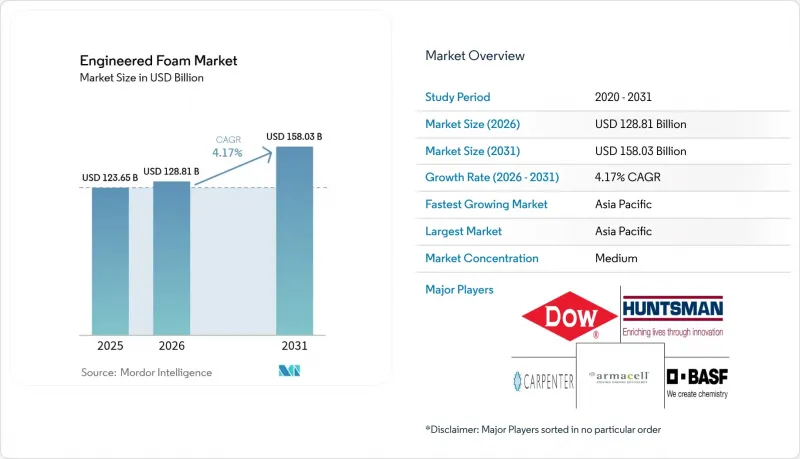
This report is Segmented by Polymer Type (Polyurethane, Polyolefins, and More), Foam Type (Flexible, Rigid, and More), Function (Thermal Insulation, Acoustic and Vibration Control, and More), End-User Industry (Building and Construction, Packaging, and More), and Geography (Asia-Pacific, North America, and More). The Market Forecasts are Provided in Terms of Value (USD).
Global Engineered Foam Market Trends and Insights
Surging demand for lightweight, fuel-efficient materials in automotive
Automakers target weight savings to shore up EV driving range and meet fleet-average CO2 limits. Polyurethane systems such as Huntsman's SHOKLESS(TM) provide density windows that secure battery modules while cutting mass Life-cycle analyses show natural-fiber composites cut energy demand versus metals, reinforcing the appeal of hybrid foam-composite architectures. Mexico's 13% output surge and its rise to fourth-largest polyurethane market underline the regional pull created by near-shoring strategies. As EV skateboard platforms proliferate, foams that fuse structural support, thermal management, and NVH damping shift from optional to critical components in the engineered foam market.
Stringent building energy codes driving demand for engineered insulation foams
The 2021 IECC mandates exterior continuous insulation in climate zones 4 and 5, cementing closed-cell spray polyurethane foam's R-7 per inch profile. Federal adoption lifts new-home efficiency by 34.4% compared with 2009 baselines, even after a USD 7 229 incremental build cost. Huntsman estimates that insulating the existing US housing stock could save 648 billion kWh a year-power equivalent to taking 38.9 million cars off the road. Commercial builders seeking LEED points specify rigid panels blown with greater than 10 GWP agents, accelerating the conversion away from HFC-141b. Consequently, code pressure channels the bulk of insulation volume toward higher-performance foams in the engineered foam market.
Volatility in isocyanate and polyol prices
MDI spot indices swung double-digit in 2024, lifting polyurethane resin quotes even as automotive demand dipped 25% BASF's buy-out of the Alsachimie PA 6.6 joint venture secures adipic-acid and HMD streams, illustrating how backward integration hedges cost risk. Mid-tier converters rely on multi-source contracts, yet price lags still compress margins across the engineered foam market.
Other drivers and restraints analyzed in the detailed report include:
- Expanding e-commerce boosting protective foam packaging
- Rapid adoption of acoustic metamaterial foams in EV cabins
- Tightening VOC blowing-agent regulations
For complete list of drivers and restraints, kindly check the Table Of Contents.
Segment Analysis
Polyurethane retained the largest engineered foam market share at 41.25% in 2025, rooted in closed-cell systems that deliver R-7 per inch and dominate cold-chain and roofing builds. Nonetheless, bio-based routes, non-isocyanate chemistries, and CO2-modified backbones fuel a 5.06% CAGR for the Other Polymer Types segment. BASF's Ludwigshafen EPS expansion targets appliance and packaging niches, while Covestro's prototype rigid foam with 20% captured CO2 hits spec parity with petro-based incumbents.
Second-generation polyolefins improve recyclability, giving e-commerce shippers a low-density option that meets circular pledges. Specialty silicones penetrate rolling-stock interiors thanks to intrinsic flame-smoke-toxicity compliance. As feedstock diversification deepens, polyurethane's revenue dominance will narrow slightly, yet it will still anchor engineered foam market size in 2030 because of unmatched insulation efficiency and mature supply chains.
Flexible foams accounted for 52.30% revenue in 2025, buoyed by bedding, furniture, and seat applications. Rigid boards preserved food-retail cold lanes, and elastomeric foams served HVAC gasket needs. Spray foams, however, are slated for a 5.03% CAGR-fastest in class-because they meet air-sealing and insulation codes in one pass, raising their engineered foam market size share year-over-year. Huntsman Building Solutions' Icynene Series reaches 7.4 per-inch R-value and rolls out in low-pressure kits for remodelers.
HFO-blown chemistry now dominates new launches, while roofing contractors exploit high-lift closed-cell variants to curb labor hours. As insurers tighten energy-loss clauses, spray foam penetration could top 20% of North American wall-and-roof insulation by 2030, further enlarging the engineered foam market.
Complete Report Scope:
- By Polymer Type
- Polyurethane
- Polyolefins
- Polystyrene
- Other Polymer Types (Polyvinyl Chloride, Silicone, etc.)
- By Foam Type
- Flexible
- Rigid
- Spray
- Other Foam Types (Elastomeric, etc.)
- By Function
- Thermal Insulation
- Acoustic and Vibration Control
- Energy Absorption and Cushioning
- Buoyancy and Floatation
- Structural Core and Lightweighting
- By End-user Industry
- Building and Construction
- Packaging
- Furniture and Interiors
- Automotive and Transportation
- End-user Industries (Aerospace and Defense, Energy, etc.)
- By Geography
- Asia-Pacific
- China
- Japan
- India
- South Korea
- ASEAN Countries
- Rest of Asia-Pacific
- North America
- United States
- Canada
- Mexico
- Europe
- Germany
- United Kingdom
- France
- Italy
- Spain
- Russia
- NORDIC Countries
- Rest of Europe
- South America
- Brazil
- Argentina
- Rest of South America
- Middle-East and Africa
- Saudi Arabia
- South Africa
- Rest of Middle-East and Africa
- Asia-Pacific
Geography Analysis
Asia-Pacific's 44.30% share and 4.90% CAGR reflect a full-spectrum industrial ecosystem that spans civil construction, auto assembly, and consumer electronics. China's renewable-powered TPU complex in Zhanjiang underscores commitment to local value chains. Japan refines NVH foams for premium EVs, and India's construction boom absorbs rigid boards and spray systems in new urban housing. South Korea contributes advanced resins for memory-chip packaging, whereas ASEAN factories gain share by offering cost-competitive conversion. Together these dynamics sustain the engineered foam market's highest regional momentum.
North America combines strict building codes with capital access, supporting leadership in low-GWP spray-foam capacity. Huntsman's Icynene Series and regionwide installer training push open-cell products deeper into retrofit attic jobs. Mexico's near-shoring wave powers automotive PU usage, and Canada's cold climate bolsters insulation demand. Upside persists, yet feedstock volatility remains a cost wild card for engineered foam market players across the region.
Europe plays sustainability spearhead, mainstreaming CO2-based polyols and bio-circular attributions. Covestro's rigid-foam prototypes with 20% captured CO2 set new life-cycle benchmarks. Nordic housing stimuli amplify demand for high-R SIP panels, whereas Germany's automotive tier system pilots flame-retardant lightweight cores for EV battery trays. Regulatory certainty around F-gas and VOC ceilings helps long-term investment planning, anchoring the engineered foam market's European strategy.
- BASF SE
- Armacell International SA
- Carpenter Co.
- Covestro AG
- Dow Inc.
- Evonik Industries AG
- Huntsman Corporation
- Kaneka Corporation
- Rogers Foam Corporation
- SABIC
- Sealed Air
- Trelleborg
- Woodbridge
- Zotefoams plc
Additional Benefits:
- The market estimate (ME) sheet in Excel format
- 3 months of analyst support
TABLE OF CONTENTS
1 Introduction
- 1.1 Study Assumptions and Market Definition
- 1.2 Scope of the Study
2 Research Methodology
3 Executive Summary
4 Market Landscape
- 4.1 Market Overview
- 4.2 Market Drivers
- 4.2.1 Surging Demand for Lightweight, Fuel-Efficient Materials in Automotive
- 4.2.2 Stringent Building Energy Codes Driving Demand for Engineered Insulation Foams
- 4.2.3 Expanding E-Commerce Boosting Protective Foam Packaging
- 4.2.4 Rapid Adoption of Acoustic Metamaterial Foams in EV Cabins
- 4.2.5 Growing Demand for Cryogenic-Capable Foams for Hydrogen Infrastructure Insulation
- 4.3 Market Restraints
- 4.3.1 Volatility in Isocyanate and Polyol Prices
- 4.3.2 Tightening VOC Blowing-Agent Regulations
- 4.3.3 Scarcity of Certified Bio-Based Polyol Feedstock
- 4.4 Value Chain Analysis
- 4.5 Porter's Five Forces
- 4.5.1 Bargaining Power of Suppliers
- 4.5.2 Bargaining Power of Buyers
- 4.5.3 Threat of New Entrants
- 4.5.4 Threat of Substitutes
- 4.5.5 Competitive Rivalry
5 Market Size and Growth Forecasts (Value)
- 5.1 By Polymer Type
- 5.1.1 Polyurethane
- 5.1.2 Polyolefins
- 5.1.3 Polystyrene
- 5.1.4 Other Polymer Types (Polyvinyl Chloride, Silicone, etc.)
- 5.2 By Foam Type
- 5.2.1 Flexible
- 5.2.2 Rigid
- 5.2.3 Spray
- 5.2.4 Other Foam Types (Elastomeric, etc.)
- 5.3 By Function
- 5.3.1 Thermal Insulation
- 5.3.2 Acoustic and Vibration Control
- 5.3.3 Energy Absorption and Cushioning
- 5.3.4 Buoyancy and Floatation
- 5.3.5 Structural Core and Lightweighting
- 5.4 By End-user Industry
- 5.4.1 Building and Construction
- 5.4.2 Packaging
- 5.4.3 Furniture and Interiors
- 5.4.4 Automotive and Transportation
- 5.4.5 End-user Industries (Aerospace and Defense, Energy, etc.)
- 5.5 By Geography
- 5.5.1 Asia-Pacific
- 5.5.1.1 China
- 5.5.1.2 Japan
- 5.5.1.3 India
- 5.5.1.4 South Korea
- 5.5.1.5 ASEAN Countries
- 5.5.1.6 Rest of Asia-Pacific
- 5.5.2 North America
- 5.5.2.1 United States
- 5.5.2.2 Canada
- 5.5.2.3 Mexico
- 5.5.3 Europe
- 5.5.3.1 Germany
- 5.5.3.2 United Kingdom
- 5.5.3.3 France
- 5.5.3.4 Italy
- 5.5.3.5 Spain
- 5.5.3.6 Russia
- 5.5.3.7 NORDIC Countries
- 5.5.3.8 Rest of Europe
- 5.5.4 South America
- 5.5.4.1 Brazil
- 5.5.4.2 Argentina
- 5.5.4.3 Rest of South America
- 5.5.5 Middle-East and Africa
- 5.5.5.1 Saudi Arabia
- 5.5.5.2 South Africa
- 5.5.5.3 Rest of Middle-East and Africa
- 5.5.1 Asia-Pacific
6 Competitive Landscape
- 6.1 Market Concentration
- 6.2 Strategic Moves
- 6.3 Market Share(%)/Ranking Analysis
- 6.4 Company Profiles {(includes Global level Overview, Market level overview, Core Segments, Financials as available, Strategic Information, Market Rank/Share for key companies, Products and Services, and Recent Developments)}
- 6.4.1 BASF SE
- 6.4.2 Armacell International SA
- 6.4.3 Carpenter Co.
- 6.4.4 Covestro AG
- 6.4.5 Dow Inc.
- 6.4.6 Evonik Industries AG
- 6.4.7 Huntsman Corporation
- 6.4.8 Kaneka Corporation
- 6.4.9 Rogers Foam Corporation
- 6.4.10 SABIC
- 6.4.11 Sealed Air
- 6.4.12 Trelleborg
- 6.4.13 Woodbridge
- 6.4.14 Zotefoams plc
7 Market Opportunities and Future Outlook
- 7.1 White-space and Unmet-Need Assessment

