PUBLISHER: Global Market Insights Inc. | PRODUCT CODE: 2083115

PUBLISHER: Global Market Insights Inc. | PRODUCT CODE: 2083115
Biodegradable Wet Wipes Market Opportunity, Growth Drivers, Industry Trend Analysis, and Forecast 2026 - 2035
The Global Biodegradable Wet Wipes Market was valued at USD 2.8 billion in 2025 and is estimated to grow at a CAGR of 7% to reach USD 5.6 billion by 2035.
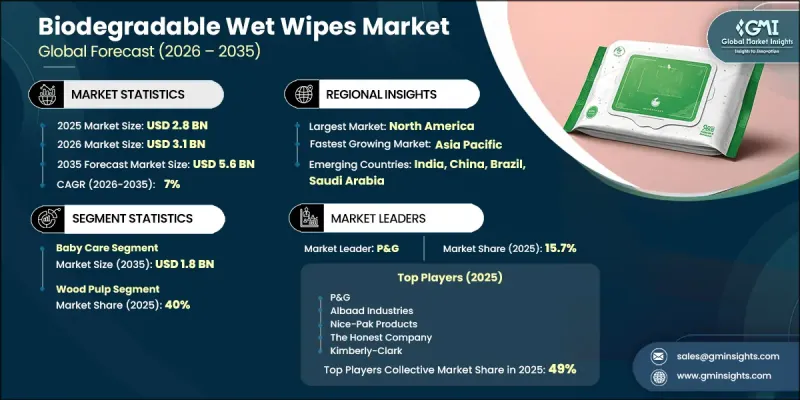
Market growth is supported by rising demand for sustainable personal care solutions, increasing awareness of environmental concerns associated with conventional wipes, and the growing adoption of biodegradable alternatives across multiple end-use categories. Manufacturers are increasingly transitioning toward renewable, plant-derived materials and compostable nonwoven substrates to meet evolving consumer expectations and regulatory requirements. Sustainability has become a key differentiating factor in the market, particularly within personal hygiene and baby care applications, where consumers are actively seeking products with verified environmental credentials and reduced ecological impact. Growing preference for certified eco-friendly products is encouraging brands to invest in biodegradable product development and premium product positioning. Although biodegradable wet wipes generally involve higher manufacturing costs due to specialized raw materials, certification requirements, and modified production processes, consumer demand continues to strengthen as environmental responsibility becomes a more influential purchasing factor. These trends are expected to support sustained market expansion throughout the forecast period.
| Market Scope | |
|---|---|
| Start Year | 2025 |
| Forecast Year | 2026-2035 |
| Start Value | $2.8 Billion |
| Forecast Value | $5.6 Billion |
| CAGR | 7% |
The baby care segment held a 35% share, generating USD 984 million in 2025. Continued leadership within this category is driven by strong consumer preference for gentle, chemical-free, skin-friendly, and environmentally conscious hygiene solutions. Parents are increasingly prioritizing product safety, sustainability, and quality, contributing to the growing adoption of biodegradable wipes across the baby care sector.
The wood pulp and regenerated cellulose materials segment accounted for 40% share, generating USD 1.1 billion in 2025. These materials maintain a strong position across household cleaning products, private-label offerings, and value-oriented personal care applications due to their favorable performance characteristics and cost efficiency. Demand for premium biodegradable wipes is also supporting increased use of advanced cellulose-based materials that provide enhanced softness, durability, and environmental compatibility while meeting consumer expectations for high-quality sustainable products.
North America Biodegradable Wet Wipes Market generated USD 776 million in 2025. Strong market growth is driven by increasing consumer awareness of sustainability issues, expanding availability of environmentally friendly hygiene products, and growing investments in eco-focused retail distribution channels. Regulatory developments encouraging the adoption of sustainable consumer products are also contributing to market expansion, while manufacturers continue to strengthen product portfolios to address evolving environmental and consumer expectations.
Major participants operating in the global biodegradable wet wipes market include The Clorox Company, Nice-Pak Products, Inc., Kimberly-Clark Corporation, Essity AB, Procter & Gamble Co., Rockline Industries, Albaad Industries, Ontex Group NV, Unicharm Corporation, Ecowipes Sp. z o.o., Abena A/S, Eurowipes (ANJAC Group), LILLYDOO GmbH, Vinda International Holdings Limited, Hengan International Group Co., Ltd., Natracare, Naty AB, Seventh, WaterWipes, The Honest Company, Inc., Coterie, and Jackson Reece Ltd. Companies operating in the biodegradable wet wipes market are adopting several strategic initiatives to strengthen their market position and expand their customer base. Product innovation remains a major focus, with manufacturers investing in advanced biodegradable materials, plant-based fibers, and sustainable formulations to meet changing consumer preferences. Many companies are expanding their portfolios with premium eco-friendly products that emphasize environmental responsibility and product performance. Strategic partnerships, acquisitions, and collaborations are also being utilized to enhance manufacturing capabilities and improve market reach. Investments in sustainable packaging, supply chain optimization, and environmentally responsible production processes continue to gain importance.
Table of Contents
Chapter 1 Methodology & Scope
- 1.1 Research approach
- 1.2 Quality Commitments
- 1.2.1 GMI AI policy & data integrity commitment
- 1.2.1.1 Source consistency protocol
- 1.2.1 GMI AI policy & data integrity commitment
- 1.3 Research Trail & Confidence Scoring
- 1.3.1 Research Trail Components
- 1.3.2 Scoring Components
- 1.4 Data Collection
- 1.4.1 Partial list of primary sources
- 1.5 Data mining sources
- 1.5.1 Paid sources
- 1.5.1.1 Sources, by region
- 1.5.1 Paid sources
- 1.6 Base estimates and calculations
- 1.6.1 Base year calculation for any one approach
- 1.7 Forecast model
- 1.7.1 Quantified market impact analysis
- 1.7.1.1 Mathematical impact of growth parameters on forecast
- 1.7.1 Quantified market impact analysis
- 1.8 Research transparency addendum
- 1.8.1 Source attribution framework
- 1.8.2 Quality assurance metrics
- 1.8.2.1 Our commitment to trust
Chapter 2 Executive Summary
- 2.1 Industry 360° synopsis, 2022 - 2035
- 2.2 Key market trends
- 2.2.1 Region
- 2.2.2 Product type
- 2.2.3 Material and substrate type
- 2.2.4 Flushability
- 2.2.5 Distribution channel
Chapter 3 Industry Insights
- 3.1 Industry ecosystem analysis
- 3.2 Supply chain analysis
- 3.2.1 Key Raw Material Sourcing Geography
- 3.2.2 Supply Chain Risks - Geographic Concentration & Price Volatility
- 3.2.3 Nearshoring & Supplier Diversification Trends Post-2025 Tariffs
- 3.3 Industry impact forces
- 3.3.1 Market drivers
- 3.3.1.1 EU single-use plastics directive & UK plastic wipes ban
- 3.3.1.2 Rising consumer environmental awareness driving premiumization of personal care & baby care routines
- 3.3.1.3 Post-COVID hygiene consciousness sustaining elevated demand for on-the-go wipes
- 3.3.1.4 Retailer & private label sustainability commitments expanding shelf space for biodegradable SKUS
- 3.3.2 Market restraints
- 3.3.2.1 15-25% cost premium of biodegradable substrates vs. conventional synthetic fiber wipes constraining mass market penetration
- 3.3.2.2 Fragmented international certification standards increasing compliance burden & time to market
- 3.3.3 Market opportunities
- 3.3.3.1 Accelerating private-label adoption in eco & natural retail channels, creating white-label OEM manufacturing opportunity
- 3.3.3.2 Untapped institutional demand in hospitality, food service & healthcare for certified biodegradable wipes
- 3.3.3.3 Pet care wipes are emerging with a high growth niche with favorable biodegradable substrate alignment
- 3.3.1 Market drivers
- 3.4 Growth potential analysis
- 3.5 Technology & innovation landscape
- 3.5.1 Spun lace Hydroentanglement Technology for Biodegradable Substrates
- 3.5.2 Air laid Nonwoven Technology
- 3.5.3 Lyocell Closed Loop Fiber Processing (Tencel, Veocel)
- 3.5.4 Biodegradable Melt Blown & PLA Fiber Advances
- 3.5.5 Active Ingredient & Preservative Free Formulation Innovation
- 3.6 Regulatory framework
- 3.6.1 EU Single Use Plastics (SUP) Directive - Wipes Provisions & Timeline
- 3.6.2 UK Environmental Protection (Wet Wipes Containing Plastic) Regulations 2025
- 3.6.3 INDA/EDANA GD4 Flushability Guidelines & Fine to Flush (FTF) Certification
- 3.6.4 EN13432 & ASTM D6400 Biodegradability & Composability Standards
- 3.6.5 USDA Bio Preferred Program & OK Compost / TUV AUSTRIA Certification
- 3.6.6 Emerging Regulations - Asia Pacific & Latin America
- 3.7 Major market trends and disruptions
- 3.8 Future market trends
- 3.9 Pricing analysis (driven by primary research)
- 3.9.1 Historical price trend analysis (2019-2024) (driven by primary research)
- 3.9.2 Pricing strategy by player type (premium/value/cost-plus) (driven by primary research)
- 3.9.3 Price premium of biodegradable vs. Conventional wet wipes by segment (driven by primary research)
- 3.10 Trade data analysis (driven by primary research)
- 3.10.1 Import/export volume & value trends - biodegradable nonwoven substrates & finished wipes (driven by primary research)
- 3.10.2 Key trade corridors & tariff impact (US-China, EU-Asia, intra-EU) (driven by primary research)
- 3.11 Impact of AI & generative AI on the market
- 3.11.1 AI-driven disruption of existing business models (predictive demand planning, automated quality control)
- 3.11.2 GENAI use cases & adoption roadmap by segment (formulation design, compliance documentation, consumer education)
- 3.11.3 Risks, limitations & regulatory considerations (AI in claims validation, greenwashing risk)
- 3.12 Investment & funding analysis
- 3.12.1 Capital Investment Trends in Manufacturing Capacity
- 3.12.2 M&A Activity & Strategic Acquisition Patterns
- 3.12.3 R&D Expenditure Benchmarks by Company Tier
- 3.13 Porter's analysis
- 3.14 PESTEL analysis
Chapter 4 Competitive Landscape, 2025
- 4.1 Introduction
- 4.2 Company market share analysis
- 4.2.1 By Region
- 4.2.1.1 North America
- 4.2.1.2 Europe
- 4.2.1.3 Asia Pacific
- 4.2.1.4 Latin America
- 4.2.1.5 Middle East and Africa
- 4.2.1 By Region
- 4.3 Company matrix analysis
- 4.4 Competitive analysis of major market players
- 4.5 Competitive positioning matrix
- 4.6 Key developments
- 4.6.1 Mergers & acquisitions
- 4.6.2 Partnerships & collaborations
- 4.6.3 New product launches
- 4.6.4 Expansion plans
Chapter 5 Market Estimates and Forecast, By Product type, 2022 - 2035 (USD Billion) (Thousand Units)
- 5.1 Key Trends
- 5.2 Baby Care Wipes
- 5.2.1 Diapering & Bottom Wipes
- 5.2.2 Full-Body & Bath Wipes
- 5.2.3 Personal Care & Hygiene Wipes
- 5.2.4 Facial & Makeup Remover Wipes
- 5.3 Hand & Body Wipes
- 5.3.1 Feminine & Intimate Hygiene Wipes
- 5.3.2 Household & Surface Cleaning Wipes
- 5.3.3 Multi-Surface Cleaning Wipes
- 5.3.4 Kitchen & Food-Safe Disinfectant Wipes
- 5.4 Bathroom Cleaning Wipes
- 5.4.1 Healthcare & Medical Wipes
- 5.4.2 Patient Skin Prep & Wound Care Wipes
- 5.4.3 Incontinence Management Wipes
- 5.4.4 Hospital Surface Sanitization Wipes
- 5.5 Industrial & Institutional Wipes
- 5.5.1 Food Service & Hospitality Wipes
- 5.5.2 Commercial Facility & Janitorial Wipes
- 5.6 Pet Care Wipes
- 5.6.1 Grooming & Coat Cleaning Wipes
- 5.6.2 Paw & Ear Cleaning Wipes
Chapter 6 Market Estimates and Forecast, By Material and Substrate Type, 2022 - 2035 (USD Billion) (Thousand Units)
- 6.1 Key Trends
- 6.2 Cotton-Based
- 6.2.1 100% Natural Cotton
- 6.2.2 Cotton Blends (Cotton + Wood Pulp, Cotton + Lyocell)
- 6.3 Bamboo Fiber-Based
- 6.3.1 Bamboo Viscose
- 6.3.2 Bamboo Lyocell (Closed-Loop Process)
- 6.4 Wood Pulp & Regenerated Cellulose (Viscose/Lyocell)
- 6.4.1 Wood Pulp Air-Laid
- 6.4.2 Viscose (Wood-Derived)
- 6.4.3 Lyocell (Wood-Derived, E.G., Tencel/Veloce)
- 6.5 Biobased Synthetic Alternatives (PLA)
- 6.5.1 Polylactic Acid (PLA)- Corn Starch Derived
- 6.5.2 Polylactic Acid (PLA) - Sugarcane-Derived
- 6.6 Blended Natural Fiber Composites
- 6.6.1 Bamboo + Wood Pulp Blends
- 6.6.2 Cotton + Lyocell Blends
- 6.6.3 Flax/Viscose & Other Multifiber Blends
Chapter 7 Market Estimates and Forecast, By Flushability, 2022 - 2035 (USD Billion) (Thousand Units)
- 7.1 Key trends
- 7.2 Flushable wipes
- 7.2.1 Fine to flush (FFTF) certified
- 7.2.2 Inda/Edana gd4 compliant
- 7.2.3 Noncertified flushable claims
- 7.3 Non flushable wipes
- 7.3.1 Compostable (industrial composting certified)
- 7.3.2 Home compostable certified
- 7.3.3 Landfill biodegradable (noncertified compostable)
Chapter 8 Market Estimates and Forecast, By End Use, 2022 - 2035 (USD Billion) (Thousand Units)
- 8.1 Key trends
- 8.2 Residential
- 8.2.1 New Construction
- 8.2.2 Renovation & Replacement
- 8.3 Commercial
- 8.3.1 Hospitality (Hotels, Resorts, Restaurants)
- 8.3.2 Office Buildings
- 8.3.3 Retail & Mixed-use Developments
- 8.3.4 Healthcare Facilities
Chapter 9 Market Estimates and Forecast, By Distribution Channel, 2022 - 2035 (USD Billion) (Thousand Units)
- 9.1 Key Trends
- 9.2 Supermarkets & Hypermarkets
- 9.3 Online Retail (Ecommerce & D2c Platforms)
- 9.3.1 Marketplace Platforms (Amazon, Walmart.Com, Tmall)
- 9.3.2 Brand D2c Subscription & Refill Models
- 9.4 Pharmacies & Drug Stores
- 9.5 Specialty & Eco/Natural Product Stores
- 9.6 Convenience Stores & Others
Chapter 10 Market Estimates & Forecast, By Region, 2022 - 2035, (USD Billion) (Thousand Units)
- 10.1 Key Trends
- 10.2 North America
- 10.2.1 U.S.
- 10.2.2 Canada
- 10.3 Europe
- 10.3.1 Germany
- 10.3.2 U.K.
- 10.3.3 France
- 10.3.4 Italy
- 10.3.5 Spain
- 10.4 Asia Pacific
- 10.4.1 China
- 10.4.2 India
- 10.4.3 Japan
- 10.4.4 South Korea
- 10.4.5 Australia
- 10.5 Latin America
- 10.5.1 Brazil
- 10.5.2 Mexico
- 10.5.3 Argentina
- 10.6 MEA
- 10.6.1 UAE
- 10.6.2 Saudi Arabia
- 10.6.3 South Africa
Chapter 11 Company Profiles
- 11.1 Global Companies
- 11.1.1 Procter & Gamble Co
- 11.1.2 KimberlyClark Corporation
- 11.1.3 NicePak Products, Inc.
- 11.1.4 Albaad Industries (Massuot Yitzhak, Israel)
- 11.1.5 Rockline Industries
- 11.1.6 Essity AB
- 11.1.7 Unicharm Corporation
- 11.1.8 Ontex Group NV
- 11.1.9 Abena A/S
- 11.1.10 Ecowipes Sp. z o.o.
- 11.1.11 The Clorox Company
- 11.1.12 Eurowipes (ANJAC Group)
- 11.1.13 LILLYDOO GmbH
- 11.2 Regional Companies
- 11.2.1 Hengan International Group Co., Ltd.
- 11.2.2 Vinda International Holdings Limited
- 11.2.3 Natracare
- 11.2.4 Naty AB
- 11.2.5 Seventh Generation, Inc.
- 11.3 Emerging Companies
- 11.3.1 WaterWipes
- 11.3.2 The Honest Company, Inc.
- 11.3.3 Coterie
- 11.3.4 Jackson Reece Ltd.

