PUBLISHER: Global Market Insights Inc. | PRODUCT CODE: 2083282

PUBLISHER: Global Market Insights Inc. | PRODUCT CODE: 2083282
Flushable Wipes Market Opportunity, Growth Drivers, Industry Trend Analysis, and Forecast 2026 - 2035
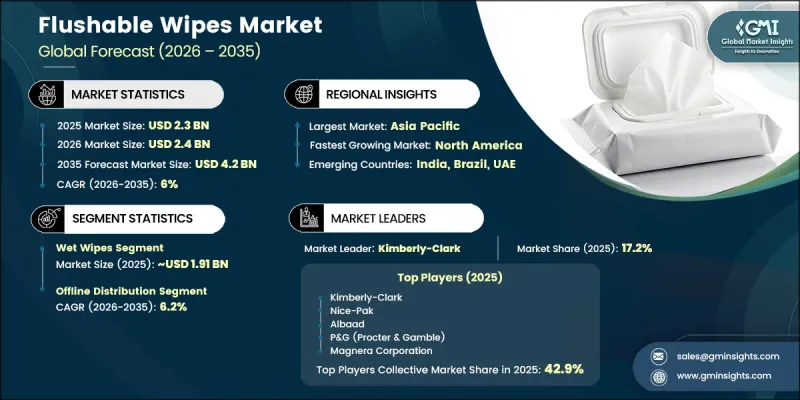
The Global Flushable Wipes Market was valued at USD 2.3 billion in 2025 and is estimated to grow at a CAGR of 6% to reach USD 4.2 billion by 2035.
Market expansion is driven by a combination of demographic, economic, and consumer lifestyle factors that continue to increase demand for convenient hygiene solutions. Growing aging populations across developed economies, rising awareness of personal hygiene in emerging countries, and the rapid expansion of digital retail channels are collectively enlarging the consumer base for flushable wipes products. At the same time, evolving environmental regulations and wastewater management standards are influencing product development strategies across the industry, encouraging manufacturers to invest in biodegradable and dispersible nonwoven materials derived from renewable resources. A notable long-term market trend is the increasing separation between premium certified flushable products and value-oriented alternatives. Premium products are gaining traction due to growing consumer preference for higher-quality, environmentally responsible hygiene solutions, while lower-cost products continue to compete in mass-market retail environments. This market segmentation is reshaping competitive dynamics among established consumer goods manufacturers and regional suppliers. Furthermore, increasing disposable incomes and stronger hygiene awareness are transforming flushable wipes from occasional purchases into regular household essentials, supporting steady market growth through 2035.
| Market Scope | |
|---|---|
| Start Year | 2025 |
| Forecast Year | 2026-2035 |
| Start Value | $2.3 Billion |
| Forecast Value | $4.2 Billion |
| CAGR | 6% |
The wet wipes segment accounted for 83.2% share in 2025, representing USD 1.91 billion, and is projected to grow at a CAGR of 6.3% throughout 2035. The segment's leadership is attributed to its widespread adoption across multiple hygiene and cleaning applications, as well as strong consumer preference for moisture-based cleansing solutions. The format continues to benefit from the inclusion of specialized ingredients and enhanced formulations that improve user convenience and product effectiveness. Ongoing product innovation and increasing consumer demand for premium hygiene solutions are expected to support sustained growth within this segment.
The offline retail channels segment held a 75.6% share in 2025, equivalent to USD 1.74 billion, and is expected to grow at a CAGR of 6.2% through 2035. The dominance of offline distribution is supported by the category's strong presence across established retail networks, where product visibility and accessibility encourage both planned and impulse purchases. Physical retail locations continue to offer a broad selection of products across various pricing tiers, enabling manufacturers to reach a wide range of consumer demographics while maintaining strong sales volumes.
North America Flushable Wipes Market held 27.7% share in 2025, accounting for USD 0.64 billion. The region's growth is supported by rising consumer demand for advanced hygiene products, increasing awareness regarding product performance standards, and a regulatory environment that emphasizes product quality and wastewater compatibility. Continued focus on product certification and compliance is encouraging innovation and strengthening consumer confidence, contributing to the region's favorable market outlook.
Key companies operating in the global flushable wipes market include Universal Wipes, Nice-Pak, Magnera Corporation, Albaad, Kimberly-Clark, P&G (Procter & Gamble), Diamond Wipes International, Codi Group, Nolken Hygiene Products, RPD Sdn Bhd, Saraco Industries, Accrol Group Holdings, FILTRA (Thea-Tex Healthcare), Freshening Industries, Eco Wipes Vietnam, Dai Phat Phat, Luba Group, NEVA Global, KINDCLOTH, Kleen-Pak, and Oldam Co., Ltd. Companies operating in the flushable wipes market are adopting several strategic initiatives to strengthen their market presence and enhance competitive positioning. Product innovation remains a primary focus, with manufacturers investing in biodegradable materials, improved dispersibility technologies, and environmentally responsible formulations to align with evolving regulatory requirements and consumer preferences. Many companies are expanding their premium product portfolios to capture higher-margin opportunities while also maintaining value-oriented offerings to serve price-sensitive customers. Strategic partnerships, acquisitions, and production capacity expansions are being utilized to increase geographic reach and strengthen supply chain capabilities.
Table of Contents
Chapter 1 Methodology & Scope
- 1.1 Research approach
- 1.2 Quality Commitments
- 1.2.1 GMI AI policy & data integrity commitment
- 1.2.1.1 Source consistency protocol
- 1.2.1 GMI AI policy & data integrity commitment
- 1.3 Research Trail & Confidence Scoring
- 1.3.1 Research Trail Components
- 1.3.2 Scoring Components
- 1.4 Data Collection
- 1.4.1 Partial list of primary sources
- 1.5 Data mining sources
- 1.5.1 Paid sources
- 1.5.1.1 Sources, by region
- 1.5.1 Paid sources
- 1.6 Base estimates and calculations
- 1.6.1 Base year calculation for any one approach
- 1.7 Forecast model
- 1.7.1 Quantified market impact analysis
- 1.7.1.1 Mathematical impact of growth parameters on forecast
- 1.7.1 Quantified market impact analysis
- 1.8 Research transparency addendum
- 1.8.1 Source attribution framework
- 1.8.2 Quality assurance metrics
- 1.8.3 Our commitment to trust
Chapter 2 Executive Summary
- 2.1 Industry 360° synopsis, 2022 - 2035
- 2.2 Key market trends
- 2.2.1 Regional
- 2.2.2 By Product type
- 2.2.3 By Scent type
- 2.2.4 By Consumer group
- 2.2.5 By Material
- 2.2.6 By Price range
- 2.2.7 By Distribution channel
Chapter 3 Industry Insights
- 3.1 Industry ecosystem analysis
- 3.1.1 Supplier landscape
- 3.1.2 Profit margin
- 3.1.3 Value addition at each stage
- 3.1.4 Factor affecting the value chain
- 3.2 Industry impact forces
- 3.2.1 Growth drivers
- 3.2.1.1 Increased awareness about personal hygiene
- 3.2.1.2 Improving standard of living in emerging economies
- 3.2.1.3 Growing demand from developing economies
- 3.2.1.4 E-commerce penetration & digital distribution expansion
- 3.2.2 Industry pitfalls & challenges
- 3.2.2.1 Environmental impact and regulatory scrutiny
- 3.2.2.2 Consumer skepticism and misinformation
- 3.2.3 Opportunities
- 3.2.3.1 Innovation in biodegradable & compostable materials
- 3.2.3.2 Expansion in emerging markets
- 3.2.1 Growth drivers
- 3.3 Growth potential analysis
- 3.4 Regulatory framework
- 3.4.1 Standards & compliance requirements
- 3.4.2 Regional regulatory frameworks
- 3.4.3 Certification standards
- 3.5 Major market trends and disruptions
- 3.6 Technology/innovation landscape
- 3.6.1 Current trends
- 3.6.2 Emerging trends
- 3.7 Pricing Analysis (driven by primary research)
- 3.7.1 Historical price trend analysis (driven by primary research)
- 3.7.2 Pricing strategy by player type (premium / value / cost- plus) (driven by primary research)
- 3.8 Future market trends
- 3.9 Trade data analysis (driven by paid database) (HS Code-3808.94.5010)
- 3.9.1 Import/export volume & value trends (driven by primary research)
- 3.9.2 Key trade corridors & tariff impact (driven by primary research)
- 3.10 Impact of AI & Generative AI on the Market
- 3.10.1 AI- driven disruption of existing business models
- 3.10.2 Gen- AI use cases & adoption roadmap by segment
- 3.10.3 Risks, limitations & regulatory considerations
- 3.11 Porter’s analysis
- 3.12 PESTEL analysis
- 3.13 Distribution infrastructure & channel penetration landscape (driven by primary research)
- 3.13.1 Channel coverage by country & format (modern vs. Traditional trade) (driven by primary research)
- 3.13.2 Last- mile infrastructure gaps & emerging channel shifts (driven by primary research)
- 3.14 Consumer behavior analysis
- 3.14.1 Purchasing patterns
- 3.14.2 Preference analysis
- 3.14.3 Regional variations in consumer behavior
- 3.14.4 Impact of e-commerce on buying decisions
Chapter 4 Competitive Landscape, 2025
- 4.1 Introduction
- 4.2 Company market share analysis
- 4.2.1 By Region
- 4.2.1.1 North America
- 4.2.1.2 Europe
- 4.2.1.3 Asia Pacific
- 4.2.1.4 Middle East and Africa
- 4.2.1.5 Latin America
- 4.2.1 By Region
- 4.3 Company matrix analysis
- 4.4 Competitive analysis of major market players
- 4.5 Competitive positioning matrix
- 4.6 Key developments
- 4.6.1 Mergers & acquisitions
- 4.6.2 Partnerships & collaborations
- 4.6.3 New product launches
- 4.6.4 Expansion plans
Chapter 5 Market Estimates & Forecast, By Product Type, 2022 - 2035 (USD Billion, Million Units)
- 5.1 Key trends
- 5.2 Wet wipes
- 5.3 Dry wipes
Chapter 6 Market Estimates & Forecast, By Scent type, 2022 - 2035 (USD Billion, Million Units)
- 6.1 Key trends
- 6.2 Scented
- 6.3 Unscented
Chapter 7 Market Estimates & Forecast, By Consumer group, 2022 - 2035 (USD Billion, Million Units)
- 7.1 Adult care
- 7.2 Baby care
Chapter 8 Market Estimates & Forecast, By Material, 2022 - 2035 (USD Billion, Million Units)
- 8.1 Biodegradable
- 8.2 Non-biodegradable
Chapter 9 Market Estimates & Forecast, By Price range, 2022 - 2035 (USD Billion, Million Units)
- 9.1 Key trends
- 9.2 Low
- 9.3 Medium
- 9.4 High
Chapter 10 Market Estimates & Forecast, By Distribution Channel, 2022 - 2035 (USD Billion, Million Units)
- 10.1 Key trends
- 10.2 Online
- 10.2.1 E-commerce
- 10.2.2 Company websites
- 10.3 Offline
- 10.3.1 Supermarkets/hypermarket
- 10.3.2 Specialty retail stores
- 10.3.3 Others (independent retailer etc.)
Chapter 11 Market Estimates & Forecast, By Region, 2022-2035 (USD Billion) (Million Units)
- 11.1 Key trends
- 11.2 North America
- 11.2.1 U.S.
- 11.2.2 Canada
- 11.3 Europe
- 11.3.1 UK
- 11.3.2 Germany
- 11.3.3 France
- 11.3.4 Italy
- 11.3.5 Spain
- 11.4 Asia Pacific
- 11.4.1 China
- 11.4.2 India
- 11.4.3 Japan
- 11.4.4 South Korea
- 11.4.5 Australia
- 11.5 Latin America
- 11.5.1 Brazil
- 11.5.2 Mexico
- 11.5.3 Argentina
- 11.6 MEA
- 11.6.1 South Africa
- 11.6.2 Saudi Arabia
- 11.6.3 UAE
Chapter 12 Company Profiles
- 12.1 Global Companies
- 12.1.1 Albaad
- 12.1.1.1 Business Overview
- 12.1.1.2 Financial Data
- 12.1.1.3 Product Landscape
- 12.1.1.4 Strategic Outlook
- 12.1.1.5 SWOT Analysis
- 12.1.1.6 Diamond Wipes International
- 12.1.1.7 Kimberly-Clark
- 12.1.1.8 Magnera Corporation
- 12.1.1.9 NEVA Global
- 12.1.1.10 Nice-Pak
- 12.1.1.11 P&G (Procter & Gamble)
- 12.1.2 Regional Companies
- 12.1.2.1 Accrol Group Holdings
- 12.1.2.2 Codi Group
- 12.1.2.3 Dai Phat Phat
- 12.1.2.4 Eco Wipes Vietnam
- 12.1.2.5 Kleen-Pak
- 12.1.2.6 Nolken Hygiene Products
- 12.1.2.7 Saraco Industries
- 12.1.3 Emerging Companies
- 12.1.3.1 FILTRA (Thea-Tex Healthcare)
- 12.1.3.2 Freshening Industries
- 12.1.3.3 KINDCLOTH
- 12.1.3.4 Luba Group
- 12.1.3.5 Oldam Co., Ltd
- 12.1.3.6 RPD Sdn Bhd
- 12.1.3.7 Universal Wipes
- 12.1.1 Albaad

