
PUBLISHER: Global Market Insights Inc. | PRODUCT CODE: 2083280

PUBLISHER: Global Market Insights Inc. | PRODUCT CODE: 2083280
Glyphosate Technical Market Opportunity, Growth Drivers, Industry Trend Analysis, and Forecast 2026 - 2035
The Global Glyphosate Technical Market was valued at USD 4.1 billion in 2025 and is estimated to grow at a CAGR of 5.2% to reach USD 6.8 billion by 2035.
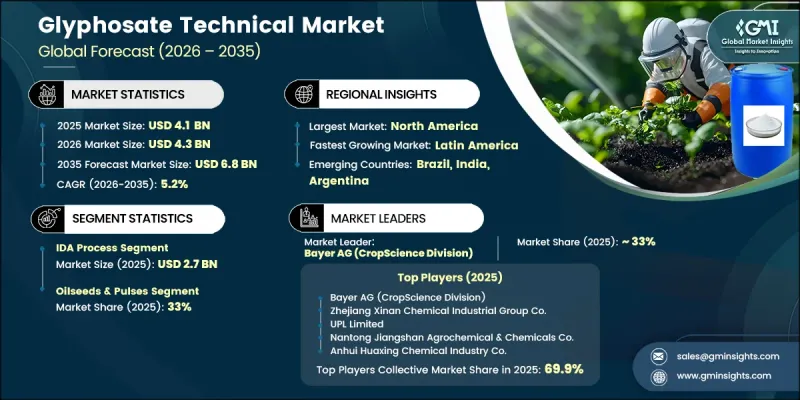
The global glyphosate technical market continues to expand steadily, supported by increasing agricultural productivity requirements, broader cultivation of herbicide-tolerant crops, and rising demand from both agricultural and non-agricultural applications. Market growth is being driven by the ongoing modernization of farming practices in developing economies and the increasing need for effective weed management solutions that improve crop yields and operational efficiency. Industry dynamics are also evolving as manufacturers adopt more advanced production technologies to improve environmental performance, product quality, and manufacturing efficiency. A gradual transition toward cleaner production processes is reshaping the competitive landscape as regulatory expectations related to environmental compliance become more stringent in key manufacturing regions. Although pricing conditions are expected to remain relatively stable due to balanced production capacity, investments in sustainable manufacturing methods and higher-quality production technologies continue to influence purchasing decisions across the value chain. Expanding demand from industrial vegetation management and agricultural applications, combined with continued improvements in production efficiency, is expected to support long-term growth across the global glyphosate technical market.
| Market Scope | |
|---|---|
| Start Year | 2025 |
| Forecast Year | 2026-2035 |
| Start Value | $4.1 Billion |
| Forecast Value | $6.8 Billion |
| CAGR | 5.2% |
In 2025, the IDA process segment accounted for USD 2.71 billion, representing 66% share. The segment is projected to expand at a CAGR of 6.1% through 2035, reaching approximately USD 4.90 billion. Growing preference for production methods that offer improved environmental performance, greater manufacturing efficiency, and consistent product quality continues to strengthen demand for the IDA process. Increasing regulatory compliance requirements and evolving purchasing preferences further reinforce the segment's leading market position.
The non-crop and industrial segment is expected to grow from USD 369 million in 2025 to USD 646 million by 2035. Growth is supported by increasing demand for vegetation management across transportation infrastructure, utility networks, industrial facilities, and public spaces. Continued investment in infrastructure development and ongoing maintenance activities are expected to sustain demand for glyphosate technical products in non-agricultural applications.
North America Glyphosate Technical Market accounted USD 1.23 billion in 2025, representing 30% share. Strong agricultural production, widespread adoption of modern weed management practices, and consistent demand for herbicide applications across large-scale farming operations continue to support regional market growth. Ongoing demand from agricultural producers and industrial vegetation management programs further strengthens North America's position within the global market.
Major companies operating in the global glyphosate technical market include UPL Limited, Bayer AG (CropScience Division), Adama Agricultural Solutions Ltd., Nufarm Ltd., Sinochem Corporation, Zhejiang Xinan Chemical Industrial Group Co., Ltd. (Wynca), Nantong Jiangshan Agrochemical & Chemicals Co., Ltd. (JSAC), Anhui Huaxing Chemical Industry Co., Ltd., Sikko Industries Ltd., and SinoHarvest. Companies operating in the global glyphosate technical market are strengthening their competitive position through continuous investment in advanced manufacturing technologies, sustainable production processes, and product quality improvements. Industry participants are expanding production capacity while enhancing operational efficiency to meet rising global demand and evolving regulatory standards. Businesses are also investing in research and development to improve manufacturing performance, reduce environmental impact, and optimize production economics. Strategic partnerships, broader distribution networks, and stronger relationships with agricultural formulators and distributors enable companies to expand market reach and improve customer access.
Table of Contents
Chapter 1 Methodology
- 1.1 Market scope and definition
- 1.2 Research design
- 1.2.1 Research approach
- 1.2.2 Data collection methods
- 1.3 Data mining sources
- 1.3.1 Global
- 1.3.2 Regional/Country
- 1.4 Base estimates and calculations
- 1.4.1 Base year calculation
- 1.4.2 Key trends for market estimation
- 1.5 Primary research and validation
- 1.5.1 Primary sources
- 1.6 Forecast model
- 1.7 Research assumptions and limitations
Chapter 2 Executive Summary
- 2.1 Industry 360° synopsis
- 2.2 Key market trends
- 2.2.1 Regional
- 2.2.2 Manufacturing Process Type
- 2.2.3 Application
- 2.3 TAM Analysis, 2026-2035
- 2.4 CXO perspectives: Strategic imperatives
- 2.4.1 Executive decision points
- 2.4.2 Critical success factors
- 2.5 Future Outlook and Strategic Recommendations
Chapter 3 Industry Insights
- 3.1 Industry ecosystem analysis
- 3.1.1 Supplier Landscape
- 3.1.2 Profit Margin
- 3.1.3 Value addition at each stage
- 3.1.4 Factor affecting the value chain
- 3.1.5 Disruptions
- 3.2 Industry impact forces
- 3.2.1 Growth drivers
- 3.2.2 Industry pitfalls and challenges
- 3.2.3 Market opportunities
- 3.3 Growth potential analysis
- 3.4 Regulatory landscape
- 3.4.1 North America
- 3.4.2 Europe
- 3.4.3 Asia Pacific
- 3.4.4 Latin America
- 3.4.5 Middle East & Africa
- 3.5 Porter's analysis
- 3.6 PESTEL analysis
- 3.7 Price trends
- 3.7.1 By region
- 3.7.2 By product
- 3.8 Future market trends
- 3.9 Technology and Innovation landscape
- 3.9.1 Current technological trends
- 3.9.2 Emerging technologies
- 3.10 Patent Landscape
- 3.11 Trade statistics (Note: the trade statistics will be provided for key countries only)
- 3.11.1 Major importing countries
- 3.11.2 Major exporting countries
- 3.12 Sustainability and Environmental Aspects
- 3.12.1 Sustainable Practices
- 3.12.2 Waste Reduction Strategies
- 3.12.3 Energy Efficiency in Production
- 3.12.4 Eco-friendly Initiatives
- 3.13 Carbon Footprint Considerations
Chapter 4 Competitive Landscape, 2025
- 4.1 Introduction
- 4.2 Company market share analysis
- 4.2.1 By region
- 4.2.1.1 North America
- 4.2.1.2 Europe
- 4.2.1.3 Asia Pacific
- 4.2.1.4 LATAM
- 4.2.1.5 MEA
- 4.2.1 By region
- 4.3 Company matrix analysis
- 4.4 Competitive analysis of major market players
- 4.5 Competitive positioning matrix
- 4.6 Key developments
- 4.6.1 Mergers & acquisitions
- 4.6.2 Partnerships & collaborations
- 4.6.3 New Product Launches
- 4.6.4 Expansion Plans
Chapter 5 Market Estimates and Forecast, By Manufacturing Process Type, 2022 - 2035 (USD Billion, Kilo Tons)
- 5.1 Key trends
- 5.2 IDA Process
- 5.3 Glycine Process
Chapter 6 Market Estimates and Forecast, By Application, 2022 - 2035 (USD Billion, Kilo Tons)
- 6.1 Key trends
- 6.2 Grains & Cereals
- 6.3 Oilseeds & pulses
- 6.4 Fruits & Vegetables
- 6.5 Plantation Crops
- 6.6 Forestry
- 6.7 Non-Crop/Industrial
- 6.8 Others
Chapter 7 Market Estimates and Forecast, By Region, 2022 - 2035 (USD Billion, Kilo Tons)
- 7.1 Key trends
- 7.2 North America
- 7.2.1 U.S.
- 7.2.2 Canada
- 7.3 Europe
- 7.3.1 Germany
- 7.3.2 UK
- 7.3.3 France
- 7.3.4 Italy
- 7.3.5 Spain
- 7.3.6 Rest of Europe
- 7.4 Asia Pacific
- 7.4.1 China
- 7.4.2 India
- 7.4.3 Japan
- 7.4.4 Australia
- 7.4.5 South Korea
- 7.4.6 Rest of Asia Pacific
- 7.5 Latin America
- 7.5.1 Brazil
- 7.5.2 Mexico
- 7.5.3 Argentina
- 7.5.4 Rest of Latin America
- 7.6 Middle East & Africa
- 7.6.1 Saudi Arabia
- 7.6.2 South Africa
- 7.6.3 UAE
- 7.6.4 Rest of Middle East & Africa
Chapter 8 Company Profiles
- 8.1 Bayer AG (CropScience Division)
- 8.2 Zhejiang Xinan Chemical Industrial Group Co., Ltd. (Wynca)
- 8.3 UPL Limited
- 8.4 Nantong Jiangshan Agrochemical & Chemicals Co., Ltd. (JSAC)
- 8.5 Anhui Huaxing Chemical Industry Co., Ltd.
- 8.6 Nufarm Ltd.
- 8.7 Adama Agricultural Solutions Ltd.
- 8.8 Sinochem Corporation
- 8.9 SinoHarvest
- 8.10 Sikko Industries Ltd.

