
PUBLISHER: Global Market Insights Inc. | PRODUCT CODE: 2101615

PUBLISHER: Global Market Insights Inc. | PRODUCT CODE: 2101615
Off-Patent / Generic Pesticides Market Opportunity, Growth Drivers, Industry Trend Analysis, and Forecast 2026 - 2035
The Global Off-Patent/Generic Pesticides Market was valued at USD 67.5 billion in 2025 and is estimated to grow at a CAGR of 5.8% to reach USD 119 billion by 2035.
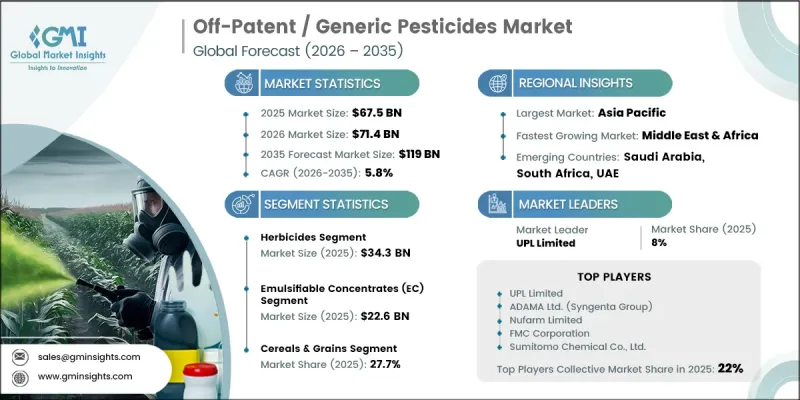
The off-patent/generic pesticides market continues to expand despite periodic pricing adjustments and inventory corrections that temporarily affect short-term performance. These fluctuations reflect normal market cycles rather than any long-term decline in demand. Stable consumption of economical crop protection products continues to support market growth, allowing industry to recover steadily after temporary disruptions. Increasing emphasis on maximizing farm profitability has encouraged wider adoption of generic crop protection solutions, as growers continue to seek products that deliver reliable performance while lowering production costs. The steady transition of active ingredients from patent protection into the generic category continues to broaden product availability across multiple crop protection segments. At the same time, the ongoing expansion of agricultural land in developing economies supports higher product consumption and creates a dependable demand base regardless of temporary pricing movements. The market is also witnessing a gradual transition toward advanced formulations that improve product efficiency and application performance, further strengthening long-term growth opportunities across the global off-patent/generic pesticides market.
| Market Scope | |
|---|---|
| Start Year | 2025 |
| Forecast Year | 2026-2035 |
| Start Value | $67.5 Billion |
| Forecast Value | $119 Billion |
| CAGR | 5.8% |
The herbicides segment held 50.8% share, generating USD 34.3 billion in 2025, and is anticipated to grow at a 5.4% CAGR through 2035. Continued demand for effective weed control remains the primary factor supporting this segment, as weed management plays a vital role in protecting crop yields across agricultural production systems. Broad acceptance of generic herbicide molecules, combined with their growing use in integrated resistance management programs and multi-product treatment approaches, continues to reinforce demand across both established and developing agricultural markets.
The cereals & grains application segment captured 27.7% share in 2025, making it the largest application category. Its leadership is supported by the widespread cultivation of staple crops and the ongoing need for dependable crop protection solutions to maintain consistent productivity. Generic pesticides remain a preferred choice for large-scale farming operations because they provide economical protection while fitting efficiently into commercial agricultural production practices.
North America Off-Patent/Generic Pesticides Market held 22.8% share in 2025. Strong utilization of generic crop protection products across commercial farming operations continues to support regional demand. The need for affordable agricultural inputs remains an important growth driver, while evolving regulatory assessments continue to influence product portfolios by creating opportunities for alternative generic solutions. Industry consolidation, together with changing regulatory compliance requirements, is further encouraging the adoption of safer and more sustainable off-patent pesticide products throughout the region.
Major companies operating in the global off-patent / generic pesticides market include UPL Limited, ADAMA Ltd. (Syngenta Group), Nufarm Limited, FMC Corporation, Sumitomo Chemical Co., Ltd., Sharda Cropchem Ltd., Albaugh LLC, Sipcam-Oxon S.p.A., Rotam CropSciences Ltd., American Vanguard Corporation, Jiangsu Yangnong Chemical Co., Ltd., Zhejiang Wynca Chemical Group Co., Ltd., Gharda Chemicals Ltd., Meghmani Organics Ltd., and Rallis India Limited (Tata Group). Leading participants in the off-patent / generic pesticides market continue to strengthen their market position by expanding their generic product portfolios as additional active ingredients transition beyond patent protection. Companies are investing in formulation improvements that enhance product performance, application efficiency, and overall value for growers. Strategic partnerships, distribution network expansion, and greater penetration into high-growth agricultural regions remain important approaches for increasing market reach. Many manufacturers are also focusing on regulatory compliance by aligning product offerings with evolving environmental and safety requirements. Capacity expansion, manufacturing optimization, and supply chain improvements help ensure reliable product availability while maintaining cost competitiveness.
Table of Contents
Chapter 1 Methodology & Scope
- 1.1 Research approach
- 1.2 Quality Commitments
- 1.2.1 GMI AI policy & data integrity commitment
- 1.2.1.1 Source consistency protocol
- 1.2.1 GMI AI policy & data integrity commitment
- 1.3 Research Trail & Confidence Scoring
- 1.3.1 Research Trail Components
- 1.3.2 Scoring Components
- 1.4 Data Collection
- 1.4.1 Partial list of primary sources
- 1.5 Data mining sources
- 1.5.1 Paid sources
- 1.5.1.1 Sources, by region
- 1.5.1 Paid sources
- 1.6 Base estimates and calculations
- 1.6.1 Base year calculation for any one approach
- 1.7 Forecast model
- 1.7.1 Quantified market impact analysis
- 1.7.1.1 Mathematical impact of growth parameters on forecast
- 1.7.1 Quantified market impact analysis
- 1.8 Research transparency addendum
- 1.8.1 Source attribution framework
- 1.8.2 Quality assurance metrics
- 1.8.3 Our commitment to trust
Chapter 2 Executive Summary
- 2.1 Industry 360° synopsis
- 2.2 Key market trends
- 2.2.1 Regional
- 2.2.2 Pesticide Type
- 2.2.3 Formulation Type
- 2.2.4 Crop Type
Chapter 3 Industry Insights
- 3.1 Industry ecosystem analysis
- 3.1.1 Supplier landscape
- 3.1.2 Profit margin
- 3.1.3 Value addition at each stage
- 3.1.4 Factor affecting the value chain
- 3.1.5 Disruptions
- 3.2 Industry impact forces
- 3.2.1 Growth drivers
- 3.2.2 Industry pitfalls and challenges
- 3.2.3 Market opportunities
- 3.3 Growth potential analysis
- 3.4 Regulatory landscape
- 3.4.1 North America
- 3.4.2 Europe
- 3.4.3 Asia Pacific
- 3.4.4 Latin America
- 3.4.5 Middle East & Africa
- 3.5 Porter's analysis
- 3.6 PESTEL analysis
- 3.7 Price trends
- 3.7.1 By region
- 3.7.2 By feedstock type
- 3.8 Future market trends
- 3.9 Technology and innovation landscape
- 3.9.1 Current technological trends
- 3.9.2 Emerging technologies
- 3.10 Patent Landscape
- 3.11 Trade statistics (HS code)
- 3.11.1 Major importing countries
- 3.11.2 Major exporting countries
- 3.12 Sustainability and environmental aspects
- 3.12.1 Sustainable practices
- 3.12.2 Waste reduction strategies
- 3.12.3 Energy efficiency in production
- 3.12.4 Eco-friendly initiatives
- 3.13 Carbon footprint consideration
Chapter 4 Competitive Landscape, 2025
- 4.1 Introduction
- 4.2 Company market share analysis
- 4.2.1 By region
- 4.2.1.1 North America
- 4.2.1.2 Europe
- 4.2.1.3 Asia Pacific
- 4.2.1.4 LATAM
- 4.2.1.5 MEA
- 4.2.1 By region
- 4.3 Competitive analysis of major market players
- 4.4 Competitive positioning matrix
- 4.5 Key developments
- 4.5.1 Mergers & acquisitions
- 4.5.2 Partnerships & collaborations
- 4.5.3 New Product Launches
- 4.5.4 Expansion Plans
Chapter 5 Market Estimates and Forecast, By Pesticide Type, 2022-2035 (USD Billion) (Kilo Tons)
- 5.1 Key trends
- 5.2 Herbicides
- 5.2.1 Glyphosate-Based Generics
- 5.2.2 2,4-D-Based Generics
- 5.2.3 Paraquat-Based Generics
- 5.2.4 Atrazine-Based Generics
- 5.2.5 Metolachlor & Acetochlor-Based Generics
- 5.2.6 Others
- 5.3 Insecticides
- 5.3.1 Organophosphates (Chlorpyrifos, Malathion, Dimethoate)
- 5.3.2 Pyrethroids (Lambda-cyhalothrin, Cypermethrin, Deltamethrin)
- 5.3.3 Neonicotinoids (Imidacloprid, Thiamethoxam)
- 5.3.4 Carbamates (Carbofuran, Carbaryl, Methomyl)
- 5.3.5 Others
- 5.4 Fungicides
- 5.4.1 Triazoles (Propiconazole, Tebuconazole, Epoxiconazole)
- 5.4.2 Strobilurins (Azoxystrobin, Trifloxystrobin)
- 5.4.3 Dithiocarbamates (Mancozeb, Thiram, Maneb)
- 5.4.4 Benzimidazoles (Carbendazim, Thiophanate-Methyl)
- 5.4.5 Others
- 5.5 Nematicides
- 5.5.1 Organophosphate Nematicides
- 5.5.2 Carbamate Nematicides
- 5.5.3 Others
- 5.6 Plant Growth Regulators (PGRs)
- 5.6.1 Ethylene-Based (Ethephon)
- 5.6.2 Gibberellin-Based
- 5.6.3 Cytokinin-Based
- 5.6.4 Others
- 5.7 Others
- 5.7.1 Rodenticides
- 5.7.2 Molluscicides
- 5.7.3 Soil Fumigants
Chapter 6 Market Estimates and Forecast, By Formulation Type, 2022-2035 (USD Billion) (Kilo Tons)
- 6.1 Key trends
- 6.2 Emulsifiable Concentrates (EC)
- 6.3 Wettable Powders (WP)
- 6.4 Water Dispersible Granules / Dry Flowables (WDG/WG)
- 6.5 Suspension Concentrates (SC)
- 6.6 Granules (GR)
- 6.7 Others
- 6.7.1 Soluble Liquids
- 6.7.2 Dusts
- 6.7.3 Aerosols
- 6.7.4 Baits
- 6.7.5 Microencapsulated
Chapter 7 Market Estimates and Forecast, By Crop Type, 2022-2035 (USD Billion) (Kilo Tons)
- 7.1 Key trends
- 7.2 Cereals & Grains
- 7.2.1 Wheat
- 7.2.2 Rice
- 7.2.3 Maize/Corn
- 7.2.4 Barley & Others
- 7.3 Fruits & Vegetables
- 7.3.1 Deciduous Fruits & Citrus
- 7.3.2 Berries & Soft Fruits
- 7.3.3 Vegetables (Leafy, Root & Cucurbits)
- 7.4 Oilseeds & Pulses
- 7.4.1 Soybean
- 7.4.2 Canola/Rapeseed
- 7.4.3 Sunflower, Groundnut & Others
- 7.4.4 Lentils, Chickpeas & Other Pulses
- 7.5 Turf, Ornamentals & Non-Crop
- 7.5.1 Turf & Golf Course Management
- 7.5.2 Ornamental Horticulture & Nurseries
- 7.5.3 Right-of-Way & Industrial/Non-Agricultural Land
- 7.6 Others
- 7.6.1 Sugarcane
- 7.6.2 Cotton
- 7.6.3 Tobacco
- 7.6.4 Plantation Crops
Chapter 8 Market Estimates and Forecast, By Region, 2022-2035 (USD Billion) (Kilo Tons)
- 8.1 Key trends
- 8.2 North America
- 8.2.1 U.S.
- 8.2.2 Canada
- 8.3 Europe
- 8.3.1 Germany
- 8.3.2 UK
- 8.3.3 France
- 8.3.4 Spain
- 8.3.5 Italy
- 8.3.6 Rest of Europe
- 8.4 Asia Pacific
- 8.4.1 China
- 8.4.2 India
- 8.4.3 Japan
- 8.4.4 Australia
- 8.4.5 South Korea
- 8.4.6 Rest of Asia Pacific
- 8.5 Latin America
- 8.5.1 Brazil
- 8.5.2 Mexico
- 8.5.3 Argentina
- 8.5.4 Rest of Latin America
- 8.6 Middle East and Africa
- 8.6.1 Saudi Arabia
- 8.6.2 South Africa
- 8.6.3 UAE
- 8.6.4 Rest of Middle East and Africa
Chapter 9 Company Profiles
- 9.1 UPL Limited
- 9.2 ADAMA Ltd. (Syngenta Group)
- 9.3 Nufarm Limited
- 9.4 FMC Corporation
- 9.5 Sumitomo Chemical Co., Ltd.
- 9.6 Sharda Cropchem Ltd.
- 9.7 Albaugh LLC
- 9.8 Sipcam-Oxon S.p.A.
- 9.9 Rotam CropSciences Ltd.
- 9.10 American Vanguard Corporation
- 9.11 Jiangsu Yangnong Chemical Co., Ltd.
- 9.12 Zhejiang Wynca Chemical Group Co., Ltd.
- 9.13 Gharda Chemicals Ltd.
- 9.14 Meghmani Organics Ltd.
- 9.15 Rallis India Limited (Tata Group)

