PUBLISHER: Global Market Insights Inc. | PRODUCT CODE: 2083284

PUBLISHER: Global Market Insights Inc. | PRODUCT CODE: 2083284
RNA Interference Therapeutics Market Opportunity, Growth Drivers, Industry Trend Analysis, and Forecast 2026 - 2035
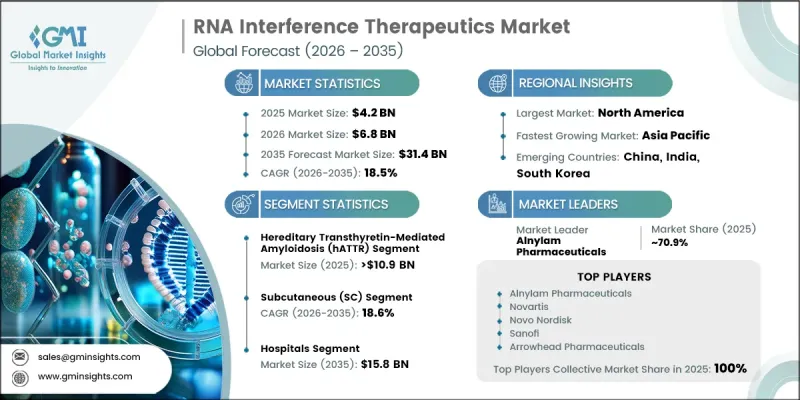
The Global RNA Interference Therapeutics Market was valued at USD 4.2 billion in 2025 and is estimated to grow at a CAGR of 18.5% to reach USD 31.4 billion by 2035.
The RNA interference therapeutics market is witnessing strong expansion as advances in genetic science, growing disease burden, and increasing focus on precision medicine continue to reshape modern drug development. RNAi-based therapies are gaining momentum due to their ability to selectively silence disease-causing genes, offering targeted treatment options for complex genetic and chronic conditions. Rising prevalence of rare genetic disorders and metabolic diseases is further accelerating demand for innovative gene-silencing therapies. Continuous improvements in molecular biology, RNA delivery systems, and drug design are enhancing therapeutic performance and clinical applicability. The integration of advanced delivery platforms has significantly improved targeting accuracy, stability, and safety profiles, supporting broader clinical adoption. Pharmaceutical companies are increasingly investing in RNA-based research programs to expand treatment applications across multiple therapeutic areas. Growing regulatory support for orphan and precision medicines is also contributing to faster development timelines and commercialization opportunities. These factors collectively support strong long-term growth potential across the global RNA interference therapeutics market.
| Market Scope | |
|---|---|
| Start Year | 2025 |
| Forecast Year | 2026-2035 |
| Start Value | $4.2 Billion |
| Forecast Value | $31.4 Billion |
| CAGR | 18.5% |
The hereditary transthyretin-mediated amyloidosis (hATTR) segment accounted for 35.7% share in 2025 and is expected to reach USD 10.9 billion by 2035. This segment continues to lead due to rising diagnostic rates and the availability of approved RNAi-based treatment options targeting the condition. hATTR is a genetic disorder caused by mutations in the transthyretin gene, resulting in abnormal protein buildup that affects multiple organs and leads to progressive complications over time. Increasing clinical recognition and treatment adoption continue to support segment growth.
The subcutaneous administration segment is projected to grow at a CAGR of 18.6% through 2035. This route of administration is widely preferred due to its convenience, reduced need for clinical supervision, and improved patient adherence compared to intravenous methods. The adoption of advanced conjugation technologies has enabled efficient targeted delivery through subcutaneous injection, improving therapeutic outcomes while reducing systemic exposure and associated side effects. These advantages continue to reinforce the dominance of this delivery approach in RNAi-based treatments.
North America RNA Interference Therapeutics Market accounted for 72% share in 2025, due to strong clinical adoption, advanced healthcare infrastructure, and favorable regulatory frameworks supporting rare disease therapies. The region benefits from early access to approved RNAi-based medicines and a well-established biotechnology ecosystem that supports ongoing research and commercialization. Continuous investment in genetic research and expanding clinical capabilities further strengthen North America's dominance in the global market.
Major companies operating in the global RNA interference therapeutics market include Novartis, Alnylam Pharmaceuticals, Arrowhead Pharmaceuticals, Sanofi, Novo Nordisk, Silence Therapeutics, Sirnaomics, Arbutus Biopharma, Benitec Biopharma, OliX Pharmaceuticals, and Atalanta Therapeutics. Companies operating in the RNA interference therapeutics market are strengthening their market position through continuous investment in RNA technology platforms, advanced delivery systems, and precision medicine development. Market participants are expanding clinical pipelines across multiple disease areas while improving molecular design strategies to enhance stability, efficacy, and targeting accuracy. Strategic collaborations with biotechnology firms, academic institutions, and research organizations are accelerating innovation and reducing development timelines. Companies are also focusing on scaling manufacturing capabilities to support commercial demand and ensure consistent product quality. In addition, increasing emphasis on targeted delivery technologies, regulatory approvals, and global expansion strategies is enabling firms to broaden their market reach, strengthen competitive positioning, and build long-term leadership in the RNA interference therapeutics market.
Table of Contents
Chapter 1 Methodology and Scope
- 1.1 Market scope and definition
- 1.2 Research approach
- 1.3 Quality commitments
- 1.3.1 GMI AI policy and data integrity commitment
- 1.3.1.1 Source consistency protocol
- 1.3.1 GMI AI policy and data integrity commitment
- 1.4 Research trail and confidence scoring
- 1.4.1 Research trail components
- 1.4.2 Scoring components
- 1.5 Data collection
- 1.5.1 Partial list of primary sources
- 1.6 Data mining sources
- 1.6.1 Paid sources
- 1.6.1.1 Sources, by region
- 1.6.1 Paid sources
- 1.7 Base estimates and calculations
- 1.7.1 Revenue share analysis
- 1.7.2 Base year calculation
- 1.8 Forecast model
- 1.9 Research transparency addendum
- 1.9.1 Source attribution framework
- 1.9.2 Quality assurance metrics
- 1.9.3 Our commitment to trust
Chapter 2 Executive Summary
- 2.1 Industry 360° synopsis
- 2.2 Key market trends
- 2.2.1 Regional trends
- 2.2.2 Indication trends
- 2.2.3 Route of administration trends
- 2.2.4 End use trends
- 2.3 CXO perspectives: Strategic imperatives
Chapter 3 Industry Insights
- 3.1 Industry ecosystem analysis
- 3.2 Industry impact forces
- 3.2.1 Growth drivers
- 3.2.1.1 Increasing prevalence of genetic disorders
- 3.2.1.2 Advancements in RNA delivery technologies
- 3.2.1.3 Rising investment in RNAi-based research
- 3.2.1.4 Approval of RNAi therapeutics for chronic and rare diseases
- 3.2.2 Industry pitfalls and challenges
- 3.2.2.1 Challenges in effective delivery of RNAi molecules
- 3.2.2.2 High cost of RNAi therapeutics development
- 3.2.3 Market opportunities
- 3.2.3.1 RNAi applications in neurology and neurodegenerative diseases
- 3.2.3.2 Personalized RNAi therapies for genetic diseases
- 3.2.1 Growth drivers
- 3.3 Growth potential analysis
- 3.4 Technology landscape
- 3.4.1 Current technology
- 3.4.2 Emerging technologies
- 3.5 Regulatory landscape (Driven by primary research)
- 3.5.1 North America
- 3.5.2 Europe
- 3.5.3 Asia Pacific
- 3.6 Porter's analysis
- 3.7 PESTEL analysis
- 3.8 Pipeline analysis (Driven by primary research)
- 3.9 Impact of AI and generative AI on the market (Driven by primary research)
- 3.10 Future market trends (Driven by primary research)
Chapter 4 Competitive Landscape, 2025
- 4.1 Introduction
- 4.2 Company market share analysis
- 4.2.1 North America
- 4.2.2 Europe
- 4.3 Company matrix analysis
- 4.4 Competitive analysis of major market players
- 4.5 Competitive positioning matrix
- 4.6 Key developments
- 4.6.1 Merger and acquisition
- 4.6.2 Partnership and collaboration
- 4.6.3 New product launches
- 4.6.4 Expansion plans
Chapter 5 Market Estimates and Forecast, By Indication, 2022 - 2035 ($ Mn)
- 5.1 Key trends
- 5.2 Hereditary transthyretin-mediated amyloidosis (hATTR)
- 5.3 Transthyretin amyloidosis with cardiomyopathy (ATTR-CM)
- 5.4 Acute hepatic porphyria (AHP)
- 5.5 Primary hyperoxaluria type 1 (PH1)
- 5.6 Hypercholesterolemia / Dyslipidemia
- 5.7 Familial chylomicronemia syndrome (FCS)
Chapter 6 Market Estimates and Forecast, By Route of Administration, 2022 - 2035 ($ Mn)
- 6.1 Key trends
- 6.2 Subcutaneous (SC)
- 6.3 Intravenous (IV)
Chapter 7 Market Estimates and Forecast, By End Use, 2022 - 2035 ($ Mn)
- 7.1 Key trends
- 7.2 Hospitals
- 7.3 Specialty treatment centers
- 7.4 Clinics
Chapter 8 Market Estimates and Forecast, By Region, 2022 - 2035 ($ Mn)
- 8.1 Key trends
- 8.2 North America
- 8.2.1 U.S.
- 8.2.2 Canada
- 8.3 Europe
- 8.3.1 Germany
- 8.3.2 UK
- 8.3.3 France
- 8.3.4 Spain
- 8.3.5 Italy
- 8.3.6 Netherlands
- 8.4 Asia Pacific
- 8.4.1 China
- 8.4.2 India
- 8.4.3 Japan
- 8.4.4 Australia
- 8.4.5 South Korea
- 8.5 Rest of the world
Chapter 9 Company Profiles
- 9.1 Commercial players
- 9.1.1 Alnylam Pharmaceuticals
- 9.1.2 Novartis
- 9.1.3 Novo Nordisk
- 9.1.4 Sanofi
- 9.1.5 Arrowhead Pharmaceuticals
- 9.2 Emerging/ pipeline players
- 9.2.1 Silence Therapeutics
- 9.2.2 Sirnaomics
- 9.2.3 Arbutus Biopharma
- 9.2.4 Benitec Biopharma
- 9.2.5 OliX Pharmaceuticals
- 9.2.6 Atalanta Therapeutics

