PUBLISHER: Mordor Intelligence | PRODUCT CODE: 2113720

PUBLISHER: Mordor Intelligence | PRODUCT CODE: 2113720
RNAi Technology - Market Share Analysis, Industry Trends & Statistics, Growth Forecasts (2026 - 2031)
According to Mordor Intelligence, the rNAi technology market size is expected to grow from USD 1.58 billion in 2025 to USD 1.83 billion in 2026 and is forecast to reach USD 3.85 billion by 2031 at 16.01% CAGR over 2026-2031.
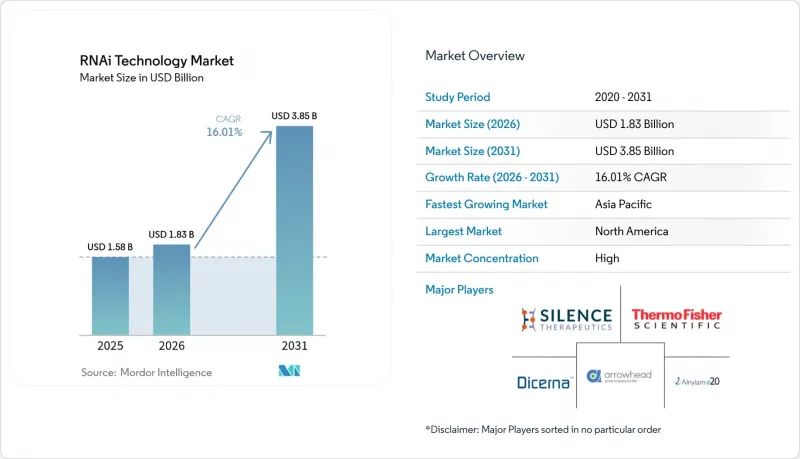
This report is Segmented by Molecule Type (siRNA, Mirna, and More), Application (Therapeutics Including Oncology, Cardiometabolic Disorders, and More), Delivery Technology (Lipid Nanoparticles Including Ionizable LNPs and Liposomes, and More), End User (Pharmaceutical & Biotechnology Companies, Cdmos, and More), and Geography (North America, and More). The Market Forecasts are Provided in Terms of Value (USD).
Global RNAi Technology Market Trends and Insights
FDA/EMA Approvals of siRNA Drugs Accelerating Investor Confidence
Regulatory momentum has reached an inflection point, with the FDA's approval of fitusiran for hemophilia A and B in April 2025 marking the latest milestone in a string of siRNA drug endorsements that began gaining pace in 2024. Active interventional trials now top 150, more than triple the 2021 figure, reflecting a strong late-stage pipeline that sustains the RNAi technology market. This validation has catalyzed venture funding; City Therapeutics captured USD 135 million in Series A financing led by former Alnylam executives, underscoring seasoned leadership's conviction in next-gen RNA therapeutics. EMA's synchronized review procedures create dual-continent launch potential, trimming commercialization latency and sharpening revenue forecasts for pipeline assets.
Government Orphan-Drug Incentives for Rare-Disease RNAi Assets
Seven-year exclusivity, up to 25% R&D tax credits, and waived FDA fees make rare disorders a capital-efficient proving ground. Silence Therapeutics secured multiple designations, slashing development costs and accelerating market access for hepatological and hematological programs. Parallel EMA incentives double addressable revenue under a single trial design, intensifying investor interest and diversifying the RNAi technology market pipeline toward ultra-rare indications with premium pricing.
Off-Target Toxicity & Innate-Immune Activation Concerns
Toll-like receptor engagement can trigger cytokine release, imposing dose ceilings and lengthier toxicology studies that extend timelines by 12-18 months. Regulators now demand exhaustive genome-wide screens, adding analytical cost and slowing the RNAi technology market's systemic-delivery programs.
Other drivers and restraints analyzed in the detailed report include:
- Advances in Lipid-Nanoparticle Delivery Enhancing In-Vivo Stability
- AI-Driven siRNA Design Platforms Shortening Discovery Timelines
- High Cost of GMP-Grade Lipids/Oligonucleotide Manufacturing
For complete list of drivers and restraints, kindly check the Table Of Contents.
Segment Analysis
siRNA held 63.82% of the RNAi technology market share in 2025, supported by well-established regulatory precedents from patisiran, givosiran, and fitusiran. The segment's 16.1% CAGR ensures it remains the prime revenue engine even as newer modalities gain traction. miRNA therapeutics explore bidirectional regulation in cardiovascular and oncology settings, although undefined pathways slow approvals. shRNA vectors enable long-term silencing for chronic diseases, while ribozymes and antisense hybrids occupy niche mechanistic gaps, collectively diversifying the RNAi technology market.
siRNA's proven delivery compatibility with LNPs and GalNAc conjugates underpins its commercial momentum, attracting Big-Pharma alliances eager to layer platform efficiency across wider disease franchises. Investor capital, however, is incrementally shifting toward miRNA and gene-editing hybrids to hedge technological concentration risk, suggesting a gradual broadening of the RNAi technology market beyond siRNA over the next decade.
Therapeutics generated the bulk of 2025 revenue, with oncology commanding 26.74% of the RNAi technology market size thanks to its ability to silence undruggable drivers such as KRAS G12D. Cardiometabolic programs aiming at PCSK9 and ANGPTL3 build chronic-dosing annuity streams, enhancing lifetime value per asset. Infectious-disease candidates benefit from rapid sequence redesign to tackle mutating pathogens.
Outside therapeutics, high-content screening libraries and companion diagnostics supply recurring platform revenue. The EPA's approval of ledprona for Colorado potato beetle control signposted agricultural potential, hinting at a peripheral but strategic extension of the RNAi technology market.
Complete Report Scope:
- By Molecule Type (Value)
- siRNA
- miRNA
- shRNA
- Other RNA molecules
- By Application (Value)
- Therapeutics
- Oncology
- Cardiometabolic Disorders
- Infectious Diseases
- Neurological Disorders
- Rare Genetic Disorders
- Drug Discovery & Screening
- Diagnostics
- Agriculture
- Other Applications
- Therapeutics
- By Delivery Technology (Value)
- Lipid Nanoparticles
- Ionizable LNPs
- Liposomes
- Polymer & Conjugate Systems
- GalNAc Conjugates
- PEGylated Carriers
- Viral Vectors
- Adeno-associated Virus
- Lentiviral Vectors
- Physical Delivery Methods
- Emerging Nanomaterials (Exosomes, Metal-oxide, etc.)
- Lipid Nanoparticles
- By End User (Value)
- Pharmaceutical & Biotechnology Companies
- Contract Development & Manufacturing Organizations (CDMOs)
- Academic & Research Institutes
- Diagnostic Laboratories
- Agricultural Biotechnology Firms
- By Geography (Value)
- North America
- United States
- Canada
- Mexico
- Europe
- Germany
- United Kingdom
- France
- Italy
- Spain
- Rest of Europe
- Asia-Pacific
- China
- India
- Japan
- South Korea
- Australia
- Rest of Asia-Pacific
- South America
- Brazil
- Argentina
- Rest of South America
- Middle East and Africa
- GCC
- South Africa
- Rest of Middle East and Africa
- North America
Geography Analysis
North America retained 41.02% of the RNAi technology market share in 2025 on the back of FDA clarity, venture-capital liquidity, and mature CDMO clusters that compress development timelines. Agilent's USD 150 million nucleic-acid expansion and MilliporeSigma's viral-vector facility secure regional supply, further anchoring dominance.
Asia-Pacific is projected to grow at a 17.25% CAGR through 2031 as governments fund biotech parks and streamline approvals. South Korea's ST Pharm invested USD 126 million to reach 14 mole/year oligo output, positioning the region as a global supply hub. China's Sanegene Bio drew USD 130 million in funding, illustrating domestic momentum in the RNAi technology market.
Europe sustains steady growth under EMA's centralized review and robust pharma infrastructure. Wacker Chemie's EUR 100 million RNA site strengthens continental manufacturing resilience despite Brexit-related dual-filing requirements. Latin America, Middle East, and Africa remain nascent opportunities pending infrastructure upgrades and pricing-model refinements.
- Alnylam Pharmaceuticals
- Ionis Pharmaceuticals
- Arrowhead Pharmaceuticals
- Novo Nordisk
- Silence Therapeutics
- Sanofi
- Arbutus Biopharma Corp.
- Sirnaomics Ltd.
- Benitec Biopharma Ltd.
- Phio Pharmaceuticals
- Olix Pharmaceuticals Co. Ltd.
- ST Pharm Co. Ltd.
Additional Benefits:
- The market estimate (ME) sheet in Excel format
- 3 months of analyst support
TABLE OF CONTENTS
1 Introduction
- 1.1 Study Assumptions & Market Definition
- 1.2 Scope of the Study
2 Research Methodology
3 Executive Summary
4 Market Landscape
- 4.1 Market Overview
- 4.2 Market Drivers
- 4.2.1 FDA / EMA approvals of siRNA drugs accelerating investor confidence
- 4.2.2 Advances in lipid-nanoparticle (LNP) delivery enhancing in-vivo stability
- 4.2.3 Government orphan-drug incentives for rare-disease RNAi assets
- 4.2.4 Rising prevalence of cardiometabolic & genetic diseases addressable by gene-silencing
- 4.2.5 Expansion of RNA-focused CDMO capacity enabling smaller biotechs
- 4.2.6 AI-driven siRNA design platforms shortening discovery timelines
- 4.3 Market Restraints
- 4.3.1 Off-target toxicity & innate-immune activation concerns
- 4.3.2 High cost of GMP-grade lipids / oligonucleotide manufacturing
- 4.3.3 Patent thickets around proprietary ionizable-lipid chemistries
- 4.3.4 Public opposition to gene-silencing in agriculture
- 4.4 Value / Supply-Chain Analysis
- 4.5 Regulatory Landscape
- 4.6 Technological Outlook
- 4.7 Porter's Five Forces
- 4.7.1 Threat of New Entrants
- 4.7.2 Bargaining Power of Suppliers
- 4.7.3 Bargaining Power of Buyers
- 4.7.4 Threat of Substitutes
- 4.7.5 Competitive Rivalry
5 Market Size & Growth Forecasts
- 5.1 By Molecule Type (Value)
- 5.1.1 siRNA
- 5.1.2 miRNA
- 5.1.3 shRNA
- 5.1.4 Other RNA molecules
- 5.2 By Application (Value)
- 5.2.1 Therapeutics
- 5.2.1.1 Oncology
- 5.2.1.2 Cardiometabolic Disorders
- 5.2.1.3 Infectious Diseases
- 5.2.1.4 Neurological Disorders
- 5.2.1.5 Rare Genetic Disorders
- 5.2.2 Drug Discovery & Screening
- 5.2.3 Diagnostics
- 5.2.4 Agriculture
- 5.2.5 Other Applications
- 5.2.1 Therapeutics
- 5.3 By Delivery Technology (Value)
- 5.3.1 Lipid Nanoparticles
- 5.3.1.1 Ionizable LNPs
- 5.3.1.2 Liposomes
- 5.3.2 Polymer & Conjugate Systems
- 5.3.2.1 GalNAc Conjugates
- 5.3.2.2 PEGylated Carriers
- 5.3.3 Viral Vectors
- 5.3.3.1 Adeno-associated Virus
- 5.3.3.2 Lentiviral Vectors
- 5.3.4 Physical Delivery Methods
- 5.3.5 Emerging Nanomaterials (Exosomes, Metal-oxide, etc.)
- 5.3.1 Lipid Nanoparticles
- 5.4 By End User (Value)
- 5.4.1 Pharmaceutical & Biotechnology Companies
- 5.4.2 Contract Development & Manufacturing Organizations (CDMOs)
- 5.4.3 Academic & Research Institutes
- 5.4.4 Diagnostic Laboratories
- 5.4.5 Agricultural Biotechnology Firms
- 5.5 By Geography (Value)
- 5.5.1 North America
- 5.5.1.1 United States
- 5.5.1.2 Canada
- 5.5.1.3 Mexico
- 5.5.2 Europe
- 5.5.2.1 Germany
- 5.5.2.2 United Kingdom
- 5.5.2.3 France
- 5.5.2.4 Italy
- 5.5.2.5 Spain
- 5.5.2.6 Rest of Europe
- 5.5.3 Asia-Pacific
- 5.5.3.1 China
- 5.5.3.2 India
- 5.5.3.3 Japan
- 5.5.3.4 South Korea
- 5.5.3.5 Australia
- 5.5.3.6 Rest of Asia-Pacific
- 5.5.4 South America
- 5.5.4.1 Brazil
- 5.5.4.2 Argentina
- 5.5.4.3 Rest of South America
- 5.5.5 Middle East and Africa
- 5.5.5.1 GCC
- 5.5.5.2 South Africa
- 5.5.5.3 Rest of Middle East and Africa
- 5.5.1 North America
6 Competitive Landscape
- 6.1 Market Concentration
- 6.2 Market Share Analysis
- 6.3 Company Profiles (includes Global level Overview, Market level overview, Core Segments, Financials as available, Strategic Information, Market Rank/Share for key companies, Products & Services, and Recent Developments)
- 6.3.1 Alnylam Pharmaceuticals Inc.
- 6.3.2 Ionis Pharmaceuticals Inc.
- 6.3.3 Arrowhead Pharmaceuticals Inc.
- 6.3.4 Novo Nordisk A/S
- 6.3.5 Silence Therapeutics PLC
- 6.3.6 Sanofi S.A.
- 6.3.7 Arbutus Biopharma Corp.
- 6.3.8 Sirnaomics Ltd.
- 6.3.9 Benitec Biopharma Ltd.
- 6.3.10 Phio Pharmaceuticals Corp.
- 6.3.11 Olix Pharmaceuticals Co. Ltd.
- 6.3.12 ST Pharm Co. Ltd.
7 Market Opportunities & Future Outlook
- 7.1 White-space & Unmet-need Assessment

