PUBLISHER: Global Market Insights Inc. | PRODUCT CODE: 2083299

PUBLISHER: Global Market Insights Inc. | PRODUCT CODE: 2083299
Micro-LED Market Opportunity, Growth Drivers, Industry Trend Analysis, and Forecast 2026 - 2035
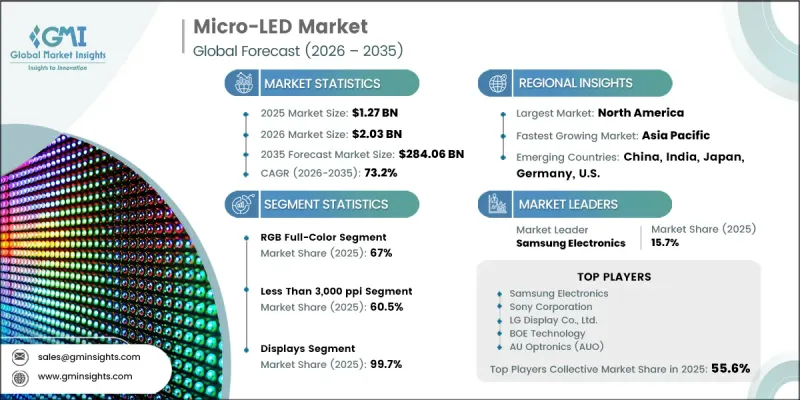
The Global Micro-LED Market was valued at USD 1.27 billion in 2025 and is estimated to grow at a CAGR of 73.2% to reach USD 284.06 billion by 2035.
Market growth is driven by superior display performance, increasing demand for energy-efficient display technologies, and rapid adoption across consumer electronics and automotive applications. Micro-LED technology is revolutionizing the display industry by offering exceptional brightness, contrast, energy efficiency, and durability compared to conventional display technologies such as LCD and OLED. The growing demand for high-end televisions, digital signage, wearable devices, and AR/VR headsets is significantly contributing to market expansion. Additionally, advancements in microfabrication, mass transfer techniques, and semiconductor integration are improving production scalability and cost efficiency. Despite challenges such as high manufacturing costs and yield complexities, increasing investments in R&D and commercialization efforts are accelerating the transition of Micro-LED from prototype to large-scale deployment across multiple industries.
| Market Scope | |
|---|---|
| Start Year | 2025 |
| Forecast Year | 2026-2035 |
| Start Value | $1.27 Billion |
| Forecast Value | $284.06 Billion |
| CAGR | 73.2% |
Based on technology, the RGB full-color Micro-LED segment held a 67% share in 2025, owing to its superior color accuracy, brightness, and suitability for premium display applications. RGB full-color Micro-LEDs are widely used in high-end televisions, large-format displays, and immersive digital signage, where visual performance is a critical factor. These displays provide vibrant colors, deeper blacks, and enhanced viewing angles, making them ideal for premium consumer electronics and commercial installations. The increasing demand for ultra-large displays and next-generation entertainment systems is further driving adoption. Moreover, ongoing innovations in wafer-level manufacturing and integration technologies are enhancing scalability and reducing production costs, supporting the growth of this segment across both consumer and enterprise applications.
The displays segment accounted for 99.7% share in 2025. Its leadership is primarily attributed to the widespread integration of Micro LED technology across a broad range of consumer electronic devices, including smartphones, televisions, smartwatches, and large-screen display systems. The technology offers exceptional brightness levels, enhanced contrast performance, superior color quality, and improved energy efficiency, making it an ideal solution for premium and ultra-high-definition display applications. Growing consumer demand for immersive visual experiences and technologically advanced display products continues to support the strong growth of this segment.
North America Micro-LED Market captured 31.1% share in 2025. Growth across the region is being fueled by rising demand for advanced consumer electronics, ongoing innovations in display technologies, and increasing deployment across commercial and industrial applications. The presence of major technology developers and the early adoption of emerging display solutions provide a strong foundation for market expansion. Demand for high-performance displays across automotive, media, entertainment, and smart device applications continues to accelerate adoption. Furthermore, sustained investments in research and development, combined with rapid technological progress, are reinforcing North America's position as a leading market for Micro LED technology.
Key players operating in the Global Micro-LED Market include Samsung Electronics, Sony Corporation, LG Display Co., Ltd., BOE Technology, AU Optronics (AUO), Leyard, Absen, TCL CSOT, Epistar Corporation, PlayNitride, Plessey Semiconductors, VueReal, X-Celeprint, Kopin Corporation, MICLEDI Microdisplays, eLux Inc., and Aledia SA. Companies in the Global Micro-LED market are focusing on technological innovation, strategic partnerships, and manufacturing scale-up to strengthen their market position. Leading players are heavily investing in R&D to improve mass transfer processes, enhance yield rates, and reduce production costs, addressing one of the key challenges in Micro-LED commercialization. Strategic collaborations with semiconductor firms, OEMs, and research institutions are accelerating product development and enabling faster market entry. Companies are also expanding production capacities through pilot lines and large-scale manufacturing facilities, particularly in Asia Pacific. Additionally, firms are targeting high-growth applications such as AR/VR, automotive displays, and wearables to diversify revenue streams. Intellectual property development and patent portfolios are further helping companies secure competitive advantages and long-term market leadership.
Table of Contents
Chapter 1 Methodology and Scope
- 1.1 Market scope and definition
- 1.2 Research design
- 1.2.1 Research approach
- 1.2.2 Data collection methods
- 1.3 Data mining sources
- 1.3.1 Global
- 1.3.2 Regional/Country
- 1.4 Base estimates and calculations
- 1.4.1 Base year calculation
- 1.4.2 Key trends for market estimation
- 1.5 Primary research and validation
- 1.5.1 Primary sources
- 1.6 Forecast model
- 1.7 Research assumptions and limitations
Chapter 2 Executive Summary
- 2.1 Industry 360° synopsis, 2022 - 2035
- 2.2 Key market trends
- 2.2.1 Technology trends
- 2.2.2 Pixel Density trends
- 2.2.3 Application trends
- 2.2.4 End-user industry trends
- 2.2.5 Regional trends
- 2.3 TAM Analysis, 2026-2035
- 2.4 CXO perspectives: Strategic imperatives
Chapter 3 Industry Insights
- 3.1 Industry ecosystem analysis
- 3.1.1 Supplier Landscape
- 3.1.2 Profit Margin
- 3.1.3 Cost structure
- 3.1.4 Value addition at each stage
- 3.1.5 Factor affecting the value chain
- 3.1.6 Disruptions
- 3.2 Industry impact forces
- 3.2.1 Growth drivers
- 3.2.1.1 Increasing demand for high-quality and next-generation display technologies
- 3.2.1.2 Growing adoption in consumer electronics and wearable devices
- 3.2.1.3 Superior energy efficiency and longer lifespan
- 3.2.1.4 Expansion across automotive, AR/VR, and digital signage applications
- 3.2.1.5 Technological advancements and improving manufacturing processes
- 3.2.2 Industry pitfalls and challenges
- 3.2.2.1 High production costs and complex manufacturing processes
- 3.2.2.2 Competition from OLED and LCD display technologies
- 3.2.3 Market opportunities
- 3.2.3.1 Rising adoption in augmented reality (AR) and virtual reality (VR) devices
- 3.2.3.2 Integration with smart devices and next-generation display ecosystems
- 3.2.1 Growth drivers
- 3.3 Growth potential analysis
- 3.4 Regulatory landscape
- 3.4.1 North America
- 3.4.2 Europe
- 3.4.3 Asia Pacific
- 3.4.4 Latin America
- 3.4.5 Middle East & Africa
- 3.5 Porter's analysis
- 3.6 PESTEL analysis
- 3.7 Technology and Innovation landscape
- 3.7.1 Current technological trends
- 3.7.2 Emerging technologies
- 3.8 Price trends
- 3.8.1 By region
- 3.8.2 By product
- 3.9 Pricing Strategies
- 3.10 Emerging Business Models
- 3.11 Compliance Requirements
- 3.12 Patent and IP analysis
Chapter 4 Competitive Landscape, 2025
- 4.1 Introduction
- 4.2 Company market share analysis
- 4.2.1 By region
- 4.2.1.1 North America
- 4.2.1.2 Europe
- 4.2.1.3 Asia Pacific
- 4.2.1.4 Latin America
- 4.2.1.5 Middle East & Africa
- 4.2.2 Market concentration analysis
- 4.2.1 By region
- 4.3 Competitive benchmarking of key players
- 4.3.1 Financial performance comparison
- 4.3.1.1 Revenue
- 4.3.1.2 Profit margin
- 4.3.1.3 R&D
- 4.3.2 Product portfolio comparison
- 4.3.2.1 Product range breadth
- 4.3.2.2 Technology
- 4.3.2.3 Innovation
- 4.3.3 Geographic presence comparison
- 4.3.3.1 Global footprint analysis
- 4.3.3.2 Service network coverage
- 4.3.3.3 Market penetration by region
- 4.3.4 Competitive positioning matrix
- 4.3.4.1 Leaders
- 4.3.4.2 Challengers
- 4.3.4.3 Followers
- 4.3.4.4 Niche players
- 4.3.5 Strategic outlook matrix
- 4.3.1 Financial performance comparison
- 4.4 Key developments
- 4.4.1 Mergers and acquisitions
- 4.4.2 Partnerships and collaborations
- 4.4.3 Technological advancements
- 4.4.4 Expansion and investment strategies
- 4.4.5 Digital transformation initiatives
- 4.5 Emerging/ startup competitors landscape
Chapter 5 Market Estimates and Forecast, By Application, 2022 - 2035 (USD Billion)
- 5.1 Key trends
- 5.2 Displays
- 5.2.1 AR/VR Headsets
- 5.2.2 Smartphones
- 5.2.3 Tablets & Laptops
- 5.2.4 Televisions & Monitors
- 5.2.5 Smartwatches
- 5.2.6 Digital Signage & Video Walls
- 5.2.7 Other
- 5.3 Lighting
- 5.3.1 General Lighting
- 5.3.2 Automotive Lighting
Chapter 6 Market Estimates and Forecast, By Technology, 2022 - 2035 (USD Billion)
- 6.1 Key trends
- 6.2 RGB Full-Color
- 6.3 Monochrome
Chapter 7 Market Estimates and Forecast, By Pixel Density, 2022 - 2035 (USD Billion)
- 7.1 Key trends
- 7.2 Less than 3,000ppi
- 7.3 3,000ppi to 5000ppi
- 7.4 Greater than 5000ppi
Chapter 8 Market Estimates and Forecast, By End-use Industry, 2022 - 2035 (USD Billion)
- 8.1 Key trends
- 8.2 Consumer Electronics
- 8.3 Automotive
- 8.4 Healthcare
- 8.5 Aerospace & Defense
- 8.6 Retail & Hospitality
- 8.7 Others
Chapter 9 Market Estimates and Forecast, By Region, 2022 - 2035 (USD Billion)
- 9.1 Key trends
- 9.2 North America
- 9.2.1 U.S.
- 9.2.2 Canada
- 9.3 Europe
- 9.3.1 Germany
- 9.3.2 UK
- 9.3.3 France
- 9.3.4 Spain
- 9.3.5 Italy
- 9.4 Asia Pacific
- 9.4.1 China
- 9.4.2 India
- 9.4.3 Japan
- 9.4.4 Australia
- 9.4.5 South Korea
- 9.5 Latin America
- 9.5.1 Brazil
- 9.5.2 Mexico
- 9.5.3 Argentina
- 9.6 Middle East and Africa
- 9.6.1 South Africa
- 9.6.2 Saudi Arabia
- 9.6.3 UAE
Chapter 10 Company Profiles
- 10.1 Global Key Players
- 10.1.1 Samsung Electronics
- 10.1.2 Sony Corporation
- 10.1.3 LG Display Co., Ltd.
- 10.1.4 AU Optronics (AUO)
- 10.1.5 BOE Technology
- 10.2 Regional key players
- 10.2.1 North America
- 10.2.1.1 Kopin Corporation
- 10.2.1.2 eLux Inc
- 10.2.1.3 Nanosys
- 10.2.2 Asia Pacific
- 10.2.2.1 PlayNitride
- 10.2.2.2 Epistar Corporation
- 10.2.2.3 Jade Bird Display (JBD)
- 10.2.2.4 Konka Global
- 10.2.3 Europe
- 10.2.3.1 Plessey Semiconductors
- 10.2.1 North America
- 10.3 Niche Players/Disruptors
- 10.3.1 Absen
- 10.3.2 Leyard

