PUBLISHER: Global Market Insights Inc. | PRODUCT CODE: 2083326

PUBLISHER: Global Market Insights Inc. | PRODUCT CODE: 2083326
Active Pharmaceutical Ingredient CDMO Market Opportunity, Growth Drivers, Industry Trend Analysis, and Forecast 2026 - 2035
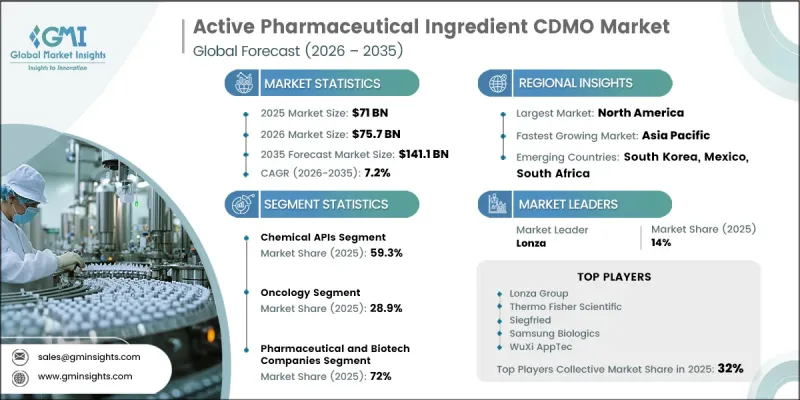
The Global Active Pharmaceutical Ingredient CDMO Market was valued at USD 71 billion in 2025 and is estimated to grow at a CAGR of 7.2% to reach USD 141.1 billion by 2035.
The expansion is shaped by a structural reconfiguration of the pharmaceutical value chain, where rising R&D expenditure, increasingly complex drug pipelines, and sustained pressure to optimize capital efficiency are pushing innovators to rely more heavily on contract development and manufacturing organizations. At the same time, the increasing global burden of chronic and infectious diseases continues to expand demand for active pharmaceutical ingredients across a wide range of therapies. The rapid evolution of drug modalities, particularly biologics, peptides, oligonucleotides, and antibody-drug conjugates, has intensified the need for advanced synthesis capabilities and highly specialized manufacturing expertise. Smaller biotechnology firms, which now represent a significant portion of regulatory approvals, typically lack in-house production infrastructure, making external manufacturing partnerships essential. Across the industry, pharmaceutical companies are increasingly shifting toward flexible, outsourced manufacturing networks as regulatory expectations tighten and pipeline complexity continues to rise.
| Market Scope | |
|---|---|
| Start Year | 2025 |
| Forecast Year | 2026-2035 |
| Start Value | $71 Billion |
| Forecast Value | $141.1 Billion |
| CAGR | 7.2% |
The chemical-based APIs segment held a 59.3% share in 2025. This dominance is supported by the continued global reliance on small-molecule therapeutics, which remain the foundation of most prescribed treatments, including cardiovascular, metabolic, infectious, and chronic disease medications.
The pharmaceutical and biotechnology segment held a 72% share in 2025, positioning them as the primary end-user group in the API CDMO landscape. This includes large multinational pharmaceutical organizations that selectively outsource production while maintaining internal capabilities, as well as emerging biotech firms that depend almost entirely on external manufacturing partners to support clinical and commercial production requirements.
North America Active Pharmaceutical Ingredient CDMO Market held a 41.2% share in 2025, supported by a highly active drug approval environment and widespread outsourcing of manufacturing activities. A significant majority of approved medicines rely on externally manufactured APIs, reflecting the strong dependence of the pharmaceutical ecosystem on contract manufacturing. Regulatory frameworks under established GMP and quality compliance standards reinforce a highly structured operating environment that favors experienced and inspection-ready CDMO providers.
Major players operating in the global active pharmaceutical ingredient CDMO industry include WuXi AppTec, Thermo Fisher Scientific, Lonza AG, Dr. Reddy's Laboratories, Catalent, Inc., Piramal Pharma Solutions, Recipharm AB, Cambrex Corporation, Siegfried Holding AG, Teva API (TAPI), Boehringer Ingelheim, Aurobindo Pharma, Divi's Laboratories, Ajinomoto Biopharma Services, and CordenPharma International. The Active Pharmaceutical Ingredient CDMO Market is being shaped by several strategic priorities adopted by leading companies to strengthen competitive positioning. Firms are heavily investing in expanding high-potency API and complex molecule manufacturing capacity to align with evolving drug pipelines. Many players are strengthening geographic footprints through facility expansions and acquisitions across North America, Europe, and Asia to ensure supply chain resilience and proximity to key clients. Long-term supply agreements with pharmaceutical innovators are increasingly used to secure predictable revenue streams and deepen client relationships. Companies are also prioritizing digital manufacturing technologies, process automation, and continuous manufacturing systems to improve efficiency and regulatory compliance.
Table of Contents
Chapter 1 Methodology & Scope
- 1.1 Research approach
- 1.2 Quality commitments
- 1.2.1 GMI AI policy & data integrity commitment
- 1.2.1.1 Source consistency protocol
- 1.2.1 GMI AI policy & data integrity commitment
- 1.3 Research trail & confidence scoring
- 1.3.1 Research trail components
- 1.3.2 Scoring components
- 1.4 Data collection
- 1.4.1 Partial list of primary sources
- 1.5 Data mining sources
- 1.5.1 Paid sources
- 1.5.1.1 Sources, by region
- 1.5.1 Paid sources
- 1.6 Base estimates and calculations
- 1.6.1 Base year calculation for any one approach
- 1.7 Market estimates & forecasts parameters
- 1.8 Forecast model
- 1.8.1 Quantified market impact analysis
- 1.8.1.1 Mathematical impact of growth parameters on forecast
- 1.8.1 Quantified market impact analysis
- 1.9 Research transparency addendum
- 1.9.1 Source attribution framework
- 1.9.2 Quality assurance metrics
- 1.9.3 Our commitment to trust
Chapter 2 Executive Summary
- 2.1 Industry 3600 synopsis
- 2.1.1 Business trends
- 2.1.2 Product trends
- 2.1.3 Indication trends
- 2.1.4 Drug trends
- 2.1.5 Workflow trends
- 2.1.6 Application trends
- 2.1.7 End use trends
- 2.1.8 Regional trends
- 2.2 CXO perspectives: Strategic imperatives
Chapter 3 Industry Insights
- 3.1 Industry ecosystem analysis
- 3.2 Industry impact forces
- 3.2.1 Growth drivers
- 3.2.1.1 Growing prevalence of chronic disease
- 3.2.1.2 Rising R&D activities in the pharmaceutical industry
- 3.2.1.3 Rising demand for generic drugs
- 3.2.1.4 Rising adoption of outsourcing services
- 3.2.2 Industry pitfalls and challenges
- 3.2.2.1 Stringent regulatory compliance
- 3.2.2.2 Pricing pressure and margin constraints
- 3.2.3 Market opportunities
- 3.2.3.1 Expansion of high-potency and complex API manufacturing
- 3.2.3.2 Long-term strategic outsourcing partnerships
- 3.2.1 Growth drivers
- 3.3 Growth potential analysis
- 3.4 Technology and innovation landscape
- 3.4.1 Current technological trends
- 3.4.2 Emerging technologies
- 3.5 Pricing trend analysis (Driven by primary research)
- 3.6 Regulatory landscape (Driven by primary research)
- 3.6.1 North America
- 3.6.2 Europe
- 3.6.3 Asia Pacific
- 3.6.4 Latin America
- 3.6.5 MEA
- 3.7 Porter's analysis
- 3.8 PESTEL analysis
- 3.9 Future market trends
- 3.10 Impact of AI and Generative AI on the market (Driven by primary research)
- 3.11 Investment & funding analysis (Driven by primary research)
Chapter 4 Competitive Landscape, 2025
- 4.1 Introduction
- 4.2 Company market share analysis
- 4.2.1 North America
- 4.2.2 Europe
- 4.2.3 Asia Pacific
- 4.3 Company matrix analysis
- 4.4 Competitive analysis of major market players
- 4.5 Competitive positioning matrix
- 4.6 Key developments
- 4.6.1 Merger and acquisition
- 4.6.2 Partnership and collaboration
- 4.6.3 New product launches
- 4.6.4 Expansion plans
Chapter 5 Market Estimates and Forecast, By Product, 2022 - 2035 ($ Mn)
- 5.1 Key trends
- 5.2 Chemical APIs
- 5.3 Biological APIs
- 5.4 High Potent APIs
Chapter 6 Market Estimates and Forecast, By Indication, 2022 - 2035 ($ Mn)
- 6.1 Key trends
- 6.2 Oncology
- 6.3 Cardiovascular diseases
- 6.4 Diabetes
- 6.5 Hormonal disorders
- 6.6 Infectious diseases
- 6.7 Other indications
Chapter 7 Market Estimates and Forecast, By Drug, 2022 - 2035 ($ Mn)
- 7.1 Key trends
- 7.2 Branded
- 7.3 Generic
Chapter 8 Market Estimates and Forecast, By Workflow, 2022 - 2035 ($ Mn)
- 8.1 Key trends
- 8.2 Clinical
- 8.3 Commercial
Chapter 9 Market Estimates and Forecast, By Application, 2022 - 2035 ($ Mn)
- 9.1 Key trends
- 9.2 Human application
- 9.3 Veterinary application
Chapter 10 Market Estimates and Forecast, By End Use, 2022 - 2035 ($ Mn)
- 10.1 Key trends
- 10.2 Pharmaceutical and biotechnology companies
- 10.3 Academic and research institutes
Chapter 11 Market Estimates and Forecast, By Region, 2022 - 2035 ($ Mn)
- 11.1 Key trends
- 11.2 North America
- 11.2.1 U.S.
- 11.2.2 Canada
- 11.3 Europe
- 11.3.1 Germany
- 11.3.2 France
- 11.3.3 UK
- 11.3.4 Spain
- 11.3.5 Italy
- 11.3.6 Netherlands
- 11.4 Asia Pacific
- 11.4.1 China
- 11.4.2 Japan
- 11.4.3 India
- 11.4.4 Australia
- 11.4.5 South Korea
- 11.5 Latin America
- 11.5.1 Brazil
- 11.5.2 Mexico
- 11.5.3 Argentina
- 11.6 Middle East & Africa
- 11.6.1 Saudi Arabia
- 11.6.2 South Africa
- 11.6.3 UAE
Chapter 12 Company Profiles
- 12.1 Lonza Group
- 12.2 Thermo Fisher Scientific
- 12.3 Catalent
- 12.4 Recipharm
- 12.5 Cambrex
- 12.6 CordenPharma International
- 12.7 Siegfried
- 12.8 Boehringer Ingelheim
- 12.9 Ajinomoto Biopharma Services
- 12.10 Teva API (TAPI)
- 12.11 Piramal Pharma Solutions
- 12.12 WuXi AppTec
- 12.13 Divi’s Laboratories
- 12.14 Aurobindo Pharma
- 12.15 Dr. Reddy’s Laboratories

