PUBLISHER: Global Market Insights Inc. | PRODUCT CODE: 2083335

PUBLISHER: Global Market Insights Inc. | PRODUCT CODE: 2083335
Digital Therapeutics Market Opportunity, Growth Drivers, Industry Trend Analysis, and Forecast 2026 - 2035
The Global Digital Therapeutics Market was valued at USD 9.6 billion in 2025 and is estimated to grow at a CAGR of 25.6% to reach USD 93.4 billion by 2035.
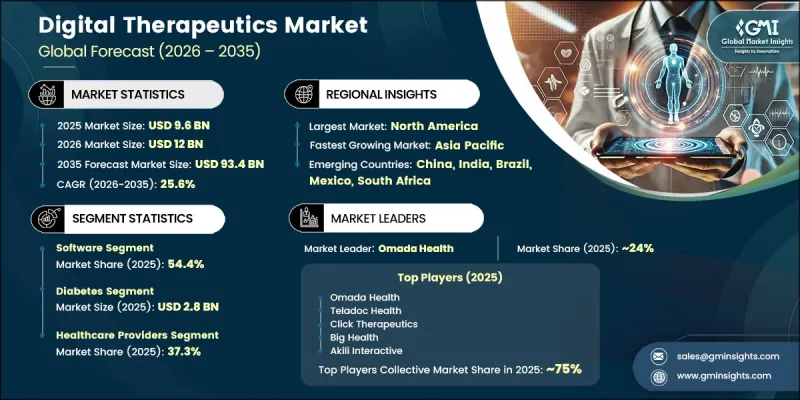
Market growth is driven by the increasing prevalence of chronic health conditions worldwide, creating a stronger need for innovative and technology-enabled disease management approaches. As healthcare systems continue to prioritize preventive care, long-term patient monitoring, and outcome-based treatment models, digital therapeutics are gaining recognition as effective solutions capable of delivering personalized and scalable healthcare interventions. The growing demand for accessible care, combined with rising healthcare expenditures and increasing patient expectations for convenient treatment options, is further accelerating adoption. Advances in digital health infrastructure, expanding connectivity, and greater acceptance of remote healthcare services are also contributing to market development. Digital therapeutics have emerged as an important component of modern healthcare strategies by supporting continuous patient engagement, improving treatment adherence, and enabling data-driven clinical decision-making. As healthcare providers, payers, and patients increasingly seek efficient and cost-effective treatment alternatives, the Digital Therapeutics Market is expected to witness sustained growth throughout the forecast period.
| Market Scope | |
|---|---|
| Start Year | 2025 |
| Forecast Year | 2026-2035 |
| Start Value | $9.6 Billion |
| Forecast Value | $93.4 Billion |
| CAGR | 25.6% |
Continuous advancements in technologies such as artificial intelligence, machine learning, mobile health platforms, wearable technologies, and interactive digital engagement tools are significantly improving the capabilities of digital therapeutics solutions. These innovations are enhancing personalization, increasing patient participation, and supporting better treatment outcomes, which in turn is driving broader market acceptance. Digital therapeutics consist of evidence-based software-driven interventions developed to prevent, manage, and treat a wide range of medical conditions through clinically validated methodologies. Delivered through various digital channels, these solutions are subject to healthcare regulatory oversight and are becoming increasingly integrated into healthcare delivery systems. Growing support from regulatory agencies and healthcare authorities is further encouraging adoption by establishing frameworks that promote safety, effectiveness, and quality standards across the industry.
The software segment held 54.4% share in 2025. Segment growth is supported by the increasing use of clinically validated digital treatment platforms, widespread accessibility, and strong compatibility with connected healthcare ecosystems. Software-based solutions facilitate highly customized treatment pathways by utilizing patient-generated data, advanced analytics, behavioral science principles, and intelligent algorithms. These capabilities support long-term behavioral change, strengthen treatment compliance, and improve the management of chronic conditions. The scalability of software-driven therapeutics also contributes significantly to adoption, as these solutions can be deployed across multiple digital devices and healthcare environments. Their accessibility enables broader patient reach, including populations with limited access to traditional healthcare services, while supporting more efficient healthcare delivery models.
The healthcare providers segment captured 37.3% share in 2025. Healthcare organizations are increasingly integrating digital therapeutics into patient care pathways to enhance monitoring capabilities, improve treatment effectiveness, and support better clinical outcomes. Access to real-time patient insights, advanced analytics, and personalized intervention strategies allows clinicians to make more informed treatment decisions and optimize healthcare delivery. Adoption among healthcare providers is further supported by the growing availability of clinically validated and regulatory-compliant digital therapeutic solutions. Regulatory clearances and formal validation processes strengthen confidence among medical professionals by demonstrating the safety, reliability, and effectiveness of these technologies, contributing to higher prescription and utilization rates.
North America Digital Therapeutics Market accounted for 58.1% share in 2025, establishing the region as the largest contributor to global market growth. The region continues to face a significant burden of chronic health conditions, creating strong demand for scalable, technology-enabled therapeutic solutions that support ongoing patient management and personalized care. Increasing emphasis on preventive healthcare, remote monitoring, and value-based care models is further encouraging adoption throughout the healthcare ecosystem. Additionally, employers across the region are increasingly incorporating digital health solutions into workforce wellness initiatives to enhance employee well-being, improve productivity, and reduce healthcare-related costs. This expanding application beyond conventional healthcare settings is creating additional growth opportunities and broadening the adoption of digital therapeutics across multiple user groups.
Key participants operating in the Global Digital Therapeutics Market include Teladoc Health, WellDoc, Omada Health, Kaia Health, Otsuka Holdings, Click Therapeutics, Virta Health, DarioHealth, Big Health, Sidekick Health, Orexo, Better Therapeutics, Akili Interactive, Propeller Health, and AmerisourceBergen. Companies competing in the Digital Therapeutics Market are implementing a range of strategic initiatives to strengthen their market position and expand their customer base. Key strategies include continuous investment in research and development to enhance clinical effectiveness, improve user engagement, and develop personalized treatment solutions. Market participants are increasingly incorporating advanced technologies such as artificial intelligence, predictive analytics, and data-driven healthcare tools to improve therapeutic outcomes and differentiate their offerings. Strategic collaborations with healthcare providers, payers, technology companies, and research organizations are helping firms accelerate commercialization and broaden market access. Companies are also focusing on obtaining regulatory approvals, expanding reimbursement coverage, and generating strong clinical evidence to increase physician confidence and adoption rates.
Table of Contents
Chapter 1 Methodology and Scope
- 1.1 Research approach
- 1.2 Quality commitments
- 1.2.1 GMI AI policy & data integrity commitment
- 1.2.1.1 Source consistency protocol
- 1.2.1 GMI AI policy & data integrity commitment
- 1.3 Research trail & confidence scoring
- 1.3.1 Research trail components
- 1.3.2 Scoring components
- 1.4 Data collection
- 1.4.1 Partial list of primary sources
- 1.5 Data mining sources
- 1.5.1 Paid sources
- 1.5.1.1 Sources, by region
- 1.5.1 Paid sources
- 1.6 Base estimates and calculations
- 1.6.1 Base year calculation for any one approach
- 1.7 Forecast model
- 1.7.1 Quantified market impact analysis
- 1.7.1.1 Mathematical impact of growth parameters on forecast
- 1.7.1 Quantified market impact analysis
- 1.8 Research transparency addendum
- 1.8.1 Source attribution framework
- 1.8.2 Quality assurance metrics
- 1.8.3 Our commitment to trust
Chapter 2 Executive Summary
- 2.1 Industry 360° synopsis
- 2.2 Key market trends
- 2.2.1 Business trends
- 2.2.2 Component trends
- 2.2.3 Application trends
- 2.2.4 End use trends
- 2.2.5 Regional trends
- 2.3 CXO perspectives: Strategic imperatives
Chapter 3 Industry Insights
- 3.1 Industry ecosystem analysis
- 3.2 Industry impact forces
- 3.2.1 Growth drivers
- 3.2.1.1 Increasing prevalence of chronic disease
- 3.2.1.2 Rising demand for cost containment
- 3.2.1.3 Expansion of quality-of-care delivery
- 3.2.1.4 Growing popularity of digital therapeutics
- 3.2.2 Industry pitfalls and challenges
- 3.2.2.1 Data security and privacy concerns
- 3.2.2.2 Lack of skilled IT professionals
- 3.2.3 Market opportunities
- 3.2.3.1 Increasing shift toward preventive and value-based care
- 3.2.3.2 Expansion of combination therapy models
- 3.2.1 Growth drivers
- 3.3 Growth potential analysis
- 3.4 Technology landscape (Driven by primary research)
- 3.4.1 Current technological trends
- 3.4.2 Emerging technologies
- 3.5 Regulatory landscape (Driven by primary research)
- 3.5.1 North America
- 3.5.2 Europe
- 3.5.3 Asia Pacific
- 3.5.4 Latin America
- 3.5.5 Middle East and Africa
- 3.6 Porter's analysis
- 3.7 PESTEL analysis
- 3.8 Impact of AI and Generative AI on the market (Driven by primary research)
- 3.9 Investment & funding analysis
- 3.10 Future market trends
- 3.11 FDA-cleared digital therapeutics landscape
- 3.11.1 Limited FDA-cleared product availability
- 3.11.2 Key FDA-cleared products & players
- 3.11.3 Gap between wellness apps & regulated DTx
- 3.12 Reimbursement landscape
- 3.12.1 Payer coverage challenges
- 3.12.2 Employer-sponsored vs payer-reimbursed models
- 3.12.3 Germany DiGA reimbursement framework
Chapter 4 Competitive Landscape, 2025
- 4.1 Introduction
- 4.2 Company market share analysis (Driven by primary research)
- 4.2.1 North America
- 4.2.2 Europe
- 4.3 Company matrix analysis
- 4.4 Competitive analysis of major market players
- 4.5 Competitive positioning matrix
- 4.6 Key developments
- 4.6.1 Merger and acquisition
- 4.6.2 Partnership and collaboration
- 4.6.3 New product launches
- 4.6.4 Expansion plans
Chapter 5 Market Estimates and Forecast, By Component, 2022 - 2035 ($ Mn)
- 5.1 Key trends
- 5.2 Software
- 5.2.1 On-premises
- 5.2.2 Cloud-based
- 5.3 Hardware
- 5.3.1 Wearable devices
- 5.3.2 Sensors and monitoring devices
- 5.3.3 Other devices
- 5.4 Services
- 5.4.1 Consulting and integration
- 5.4.2 Training and education
- 5.4.3 Other services
Chapter 6 Market Estimates and Forecast, By Application, 2022 - 2035 ($ Mn)
- 6.1 Key trends
- 6.2 Diabetes
- 6.3 Obesity
- 6.4 Cardiovascular
- 6.5 Mental & behavior health
- 6.6 Hypertension
- 6.7 Insomnia
- 6.8 Other applications
Chapter 7 Market Estimates and Forecast, By End Use, 2022 - 2035 ($ Mn)
- 7.1 Key trends
- 7.2 Healthcare providers
- 7.2.1 Hospitals
- 7.2.2 Clinics
- 7.2.3 Telehealth platforms
- 7.3 Payers
- 7.4 Patients
- 7.5 Other end users
Chapter 8 Market Estimates and Forecast, By Region, 2022 - 2035 ($ Mn)
- 8.1 Key trends
- 8.2 North America
- 8.2.1 U.S.
- 8.2.2 Canada
- 8.3 Europe
- 8.3.1 Germany
- 8.3.2 UK
- 8.3.3 France
- 8.3.4 Spain
- 8.3.5 Italy
- 8.3.6 Netherlands
- 8.4 Asia Pacific
- 8.4.1 China
- 8.4.2 India
- 8.4.3 Japan
- 8.4.4 Australia
- 8.4.5 South Korea
- 8.5 Latin America
- 8.5.1 Brazil
- 8.5.2 Mexico
- 8.5.3 Argentina
- 8.6 Middle East and Africa
- 8.6.1 South Africa
- 8.6.2 Saudi Arabia
- 8.6.3 UAE
Chapter 9 Company Profiles
- 9.1 Akili Interactive
- 9.2 AmerisourceBergen
- 9.3 Better Therapeutics
- 9.4 Big Health
- 9.5 Click Therapeutics
- 9.6 DarioHealth
- 9.7 Kaia Health
- 9.8 Omada Health
- 9.9 Orexo
- 9.10 Otsuka Holdings
- 9.11 Propeller Health
- 9.12 Sidekick Health
- 9.13 Teladoc Health
- 9.14 Virta Health
- 9.15 WellDoc

