PUBLISHER: Global Market Insights Inc. | PRODUCT CODE: 2083358

PUBLISHER: Global Market Insights Inc. | PRODUCT CODE: 2083358
Veterinary Rapid Tests Market Opportunity, Growth Drivers, Industry Trend Analysis, and Forecast 2026 - 2035
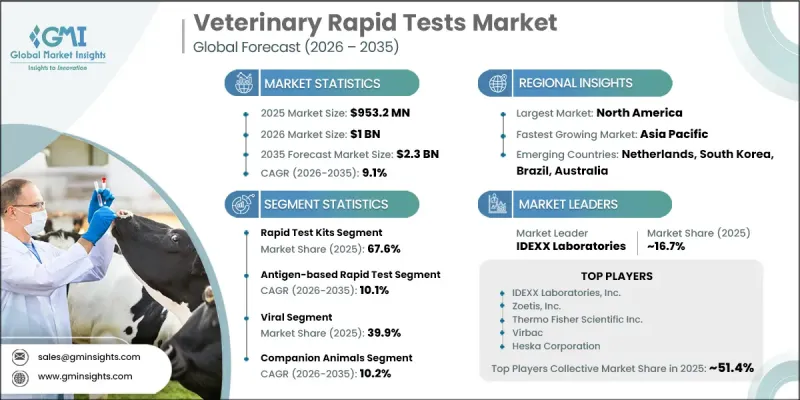
The Global Veterinary Rapid Tests Market was valued at USD 953.2 million in 2025 and is estimated to grow at a CAGR of 9.1% to reach USD 2.3 billion by 2035.
The market growth is driven by the ongoing shift from centralized diagnostic laboratories toward point-of-care testing across veterinary care environments, including companion animal clinics and livestock field operations. Expanding pet ownership, increasing focus on preventive animal healthcare, and rising demand for fast diagnostic outcomes are further strengthening market adoption. The growing influence of One Health initiatives is also supporting integrated disease monitoring across animals and humans, reinforcing the importance of rapid diagnostic tools. Continuous cost reductions in lateral flow assay technologies are improving affordability and accessibility across developing and developed regions. In addition, advancements in multiplex testing and digital connectivity solutions are enhancing diagnostic accuracy and enabling real-time data sharing. Rising awareness among pet owners and livestock producers regarding early disease detection is further accelerating utilization rates, making veterinary rapid diagnostics a consistently expanding segment within the broader animal health industry.
| Market Scope | |
|---|---|
| Start Year | 2025 |
| Forecast Year | 2026-2035 |
| Start Value | $953.2 Million |
| Forecast Value | $2.3 Billion |
| CAGR | 9.1% |
The rapid test kits segment held 67.6% share in 2025 and is projected to grow at a CAGR of 9.9% through 2035. The dominance of this segment is supported by its recurring consumable demand model, wide clinical applicability across multiple animal diseases, and continuous innovation by manufacturers targeting both companion and livestock health applications. Their ease of use, quick turnaround time, and suitability for on-site testing further strengthen their adoption across veterinary care systems.
The veterinary clinics segment held 39.7% share in 2025 and is projected to grow at a CAGR of 8.6% through 2035. This segment leads due to the high concentration of veterinary service providers and the strong reliance on in-clinic diagnostic testing for timely decision-making. Clinics remain the primary access point for animal healthcare services, particularly for companion animals, where rapid testing supports immediate treatment planning and disease management. Increasing demand for point-of-care diagnostics continues to reinforce their central role in veterinary healthcare delivery.
North America Veterinary Rapid Tests Market accounted for 40.5% share in 2025 and is expected to grow at a CAGR of 8.3% through 2035, maintaining its dominant global position. The region's leadership is supported by high companion animal ownership rates, advanced veterinary care infrastructure, and strong adoption of diagnostic technologies. The United States remains the primary contributor to regional demand, driven by a large base of veterinary practices and increasing emphasis on preventive animal healthcare and early disease detection.
Key market participants include Zoetis, IDEXX Laboratories, Thermo Fisher Scientific, Virbac, Neogen, Heska Corporation (Mars Inc.), BioNote, MEGACOR Diagnostik, Fassisi, Swissavans, INDICAL Bioscience, VetAll Laboratories, BioChek, Agrolabo, and Shenzhen Bioeasy Biotechnology. Companies in the veterinary rapid tests market are strengthening their market position through continuous product innovation focused on improving diagnostic speed, accuracy, and ease of use. Many players are expanding their portfolios with multiplex testing solutions capable of detecting multiple pathogens in a single test. Strategic investments in digital diagnostics and connected platforms are enabling real-time data sharing and enhanced clinical decision-making. Firms are also increasing partnerships with veterinary clinics, laboratories, and distributors to improve market penetration. Expansion into emerging markets with rising pet adoption and livestock populations is another key strategy.
Table of Contents
Chapter 1 Methodology & Scope
- 1.1 Market scope and definition
- 1.2 Research approach
- 1.3 Quality commitments
- 1.3.1 GMI AI policy and data integrity commitment
- 1.3.1.1 Source consistency protocol
- 1.3.1 GMI AI policy and data integrity commitment
- 1.4 Research trail and confidence scoring
- 1.4.1 Research trail components
- 1.4.2 Scoring components
- 1.5 Data collection
- 1.5.1 Partial list of primary sources
- 1.6 Data mining sources
- 1.6.1 Paid sources
- 1.6.1.1 Sources, by region
- 1.6.1 Paid sources
- 1.7 Base estimates and calculations
- 1.7.1 Revenue share analysis
- 1.7.2 Base year calculation
- 1.8 Forecast model
- 1.9 Research transparency addendum
- 1.9.1 Source attribution framework
- 1.9.2 Quality assurance metrics
- 1.9.3 Our commitment to trust
Chapter 2 Executive Summary
- 2.1 Industry 360° synopsis
- 2.2 Key market trends
- 2.2.1 Regional trends
- 2.2.2 Product type trends
- 2.2.3 Test type trends
- 2.2.4 Application trends
- 2.2.5 Animal type trends
- 2.2.6 Sample type trends
- 2.2.7 End use trends
- 2.3 CXO perspectives: Strategic imperatives
Chapter 3 Industry Insights
- 3.1 Industry ecosystem analysis
- 3.2 Industry impact forces
- 3.2.1 Growth drivers
- 3.2.1.1 Growing number of companion animal population
- 3.2.1.2 Increasing prevalence of zoonotic diseases in animals
- 3.2.1.3 Rising demand for rapid test diagnosis over other tests
- 3.2.1.4 Increasing pet ownership
- 3.2.2 Industry pitfalls & challenges
- 3.2.2.1 Limited number of infrastructures for veterinary diagnosis
- 3.2.2.2 Lack of awareness for veterinary health in underdeveloped countries
- 3.2.2.3 Increasing cost of animal healthcare
- 3.2.3 Market opportunities
- 3.2.3.1 Development of multiplex and portable rapid testing solutions
- 3.2.3.2 Expansion of veterinary diagnostics in emerging and rural markets
- 3.2.1 Growth drivers
- 3.3 Growth potential analysis
- 3.4 Technology landscape
- 3.4.1 Current technology
- 3.4.2 Emerging technologies
- 3.5 Pricing analysis (Driven by Primary Research)
- 3.6 Regulatory landscape (Driven by primary research)
- 3.6.1 North America
- 3.6.2 Europe
- 3.6.3 Asia Pacific
- 3.6.4 Latin America
- 3.6.5 Middle East and Africa
- 3.7 Porter's analysis
- 3.8 PESTEL analysis
- 3.9 Impact of AI and generative AI on the market
- 3.10 Future market trends (Driven by primary research)
- 3.11 Pet population statistics
Chapter 4 Competitive Landscape, 2025
- 4.1 Introduction
- 4.2 Company market share analysis
- 4.2.1 North America
- 4.2.2 Europe
- 4.2.3 Asia Pacific
- 4.3 Company matrix analysis
- 4.4 Competitive analysis of major market players
- 4.5 Competitive positioning matrix
- 4.6 Key developments
- 4.6.1 Merger and acquisition
- 4.6.2 Partnership and collaboration
- 4.6.3 New product launches
- 4.6.4 Expansion plans
Chapter 5 Market Estimates and Forecast, By Product Type, 2022 - 2035 ($ Mn)
- 5.1 Key trends
- 5.2 Rapid test kits
- 5.3 Rapid test readers
Chapter 6 Market Estimates and Forecast, By Test Type, 2022 - 2035 ($ Mn)
- 6.1 Key trends
- 6.2 Antigen based rapid test
- 6.3 Antibody-based rapid test
- 6.4 Mixed tests
Chapter 7 Market Estimates and Forecast, By Application, 2022 - 2035 ($ Mn)
- 7.1 Key trends
- 7.2 Viral
- 7.3 Parasitic
- 7.4 Bacterial
- 7.5 Allergies
- 7.6 Other applications
Chapter 8 Market Estimates and Forecast, By Animal Type, 2022 - 2035 ($ Mn)
- 8.1 Key trends
- 8.2 Companion animals
- 8.2.1 Dogs
- 8.2.2 Cats
- 8.2.3 Horses
- 8.2.4 Other companion animals
- 8.3 Livestock animals
- 8.3.1 Cattle
- 8.3.2 Swine
- 8.3.3 Poultry
- 8.3.4 Other livestock animals
Chapter 9 Market Estimates and Forecast, By Sample Type, 2022 - 2035 ($ Mn)
- 9.1 Key trends
- 9.2 Blood
- 9.3 Feces
- 9.4 Serum
- 9.5 Plasma
- 9.6 Urine
- 9.7 Other sample types
Chapter 10 Market Estimates and Forecast, By End Use, 2022 - 2035 ($ Mn)
- 10.1 Key trends
- 10.2 Homecare settings
- 10.3 Veterinary hospitals
- 10.4 Veterinary clinics
- 10.5 Other end users
Chapter 11 Market Estimates and Forecast, By Region, 2022 - 2035 ($ Mn)
- 11.1 Key trends
- 11.2 North America
- 11.2.1 U.S.
- 11.2.2 Canada
- 11.3 Europe
- 11.3.1 Germany
- 11.3.2 UK
- 11.3.3 France
- 11.3.4 Spain
- 11.3.5 Italy
- 11.3.6 Netherlands
- 11.4 Asia Pacific
- 11.4.1 China
- 11.4.2 Japan
- 11.4.3 India
- 11.4.4 Australia
- 11.4.5 South Korea
- 11.5 Latin America
- 11.5.1 Brazil
- 11.5.2 Mexico
- 11.5.3 Argentina
- 11.6 Middle East and Africa
- 11.6.1 South Africa
- 11.6.2 Saudi Arabia
- 11.6.3 UAE
Chapter 12 Company Profiles
- 12.1 Zoetis
- 12.2 IDEXX Laboratories
- 12.3 Thermo Fisher Scientific
- 12.4 Virbac
- 12.5 Neogen
- 12.6 Heska Corporation (Mars Inc.)
- 12.7 BioNote
- 12.8 MEGACOR Diagnostik
- 12.9 Fassisi
- 12.10 Swissavans
- 12.11 INDICAL Bioscience
- 12.12 VetAll Laboratories
- 12.13 BioChek
- 12.14 Agrolabo
- 12.15 Shenzhen Bioeasy Biotechnology

