PUBLISHER: Mordor Intelligence | PRODUCT CODE: 2117299

PUBLISHER: Mordor Intelligence | PRODUCT CODE: 2117299
Veterinary Point-of-Care (POC) Diagnostics - Market Share Analysis, Industry Trends & Statistics, Growth Forecasts (2026 - 2031)
According to Mordor Intelligence, the veterinary point of care diagnostics market size is expected to grow from USD 2.23 billion in 2025 to USD 2.43 billion in 2026 and is forecast to reach USD 3.77 billion by 2031 at 9.18% CAGR over 2026-2031.
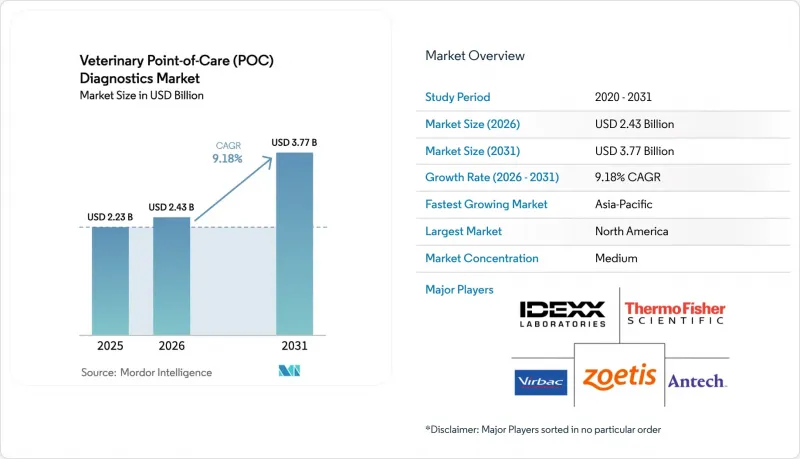
This report is Segmented by Product (Diagnostic Instruments, and More), Technology (Immunodiagnostics, and More), Animal Type (Companion [Dogs and More] and Livestock), Sample Type (Blood, and More), Indication (Infectious Diseases, and More), End User (Veterinary Clinics, and More), and Geography (North America, Europe, and More). The Market Forecasts are Provided in Terms of Value (USD).
Global Veterinary Point-of-Care (POC) Diagnostics Market Trends and Insights
Increasing Companion Animal Ownership Driving On-site Diagnostic Demand
Sustained growth in pet adoption elevates owners' willingness to fund sophisticated care, shifting expectations toward real-time results during appointments. US households keep 70% pet ownership, and clinics report that roughly 30% of veterinarians now deploy AI tools for imaging interpretation and record management. Platforms such as Zoetis Vetscan Imagyst deliver cytology, fecal, and blood smear results in under 10 minutes, shrinking revisit rates and boosting case throughput. Clinics leveraging same-visit answers capture higher compliance on follow-up therapies and wellness panels, reinforcing revenue per patient metrics. The trend also fuels upsell opportunities for preventive screens that were once feasible only at reference labs.
Rising Prevalence of Zoonotic & Transboundary Livestock Diseases Prompting Rapid Field Testing Adoption
African swine fever flare-ups, avian influenza incursions, and brucellosis outbreaks are pushing producers to invest in portable diagnostics that confirm infection status on-farm. The US FDA's 2024 policy that re-classified laboratory-developed tests as devices tightens validation standards and propels firms to innovate compliant, ruggedized kits for barns and trucks. CRISPR-Cascade assays under development at University of California detect bloodstream pathogens in minutes without thermal cyclers, emphasising sensitivity useful for herd surveillance. Speedy confirmation shortens quarantine windows, cuts unintended culling, and safeguards export accreditation, creating a business case for higher-priced molecular cartridges in food-animal settings
Other drivers and restraints analyzed in the detailed report include:
- Technological Miniaturization of Immunoassay & Molecular Platforms Enabling Portable Vet Devices
- Regulatory Push for Antimicrobial Stewardship Requiring Immediate Diagnostics in Food-Producing Animals
- High Capital & Per-Test Costs of Advanced POC Analyzers Limiting Uptake in Price-Sensitive Regions
- Limited Reimbursement Frameworks for In-Clinic Veterinary Diagnostics Curbing Volume Growth
For complete list of drivers and restraints, kindly check the Table Of Contents.
Segment Analysis
Veterinary point of care diagnostics market size for diagnostic instruments and analyzers reached USD 1.01 billion in 2025 and maintained a 45.05% slice of global revenue. These platforms deliver comprehensive chemistry, hematology, and immunoassay panels from minimal volumes, aligning with workflow efficiency goals. Modular systems such as VETSCAN VS2 can process 12 panels in 12 minutes, freeing technicians for patient care duties. Premium analyzers incorporate AI algorithms that flag spurious results and suggest confirmatory tests, enhancing clinical confidence.
Test kits and reagents, valued at USD 0.74 billion in 2025, are slated for a 10.12% CAGR through 2031, the fastest among product lines. Cartridge-based formats require no external calibration and suit mixed-practice vans or dairy parlors. IDEXX Cancer Dx underscores how single-disease panels priced at USD 15 unlock new screening programs that boost early detection rates. Consumables and accessories, though a smaller revenue pool, provide annuity-style income that smooths vendor cash flow and supports service bundling strategies.
Clinical chemistry produced USD 0.74 billion revenue and 33.10% of the veterinary point of care diagnostics market in 2025, rooted in its ability to profile organ function across species. Portable photometric and electrochemical sensors now deliver aspartate aminotransferase or bile acid panels from 50 µL samples, expanding feasibility in exotics practice. Integration of automated quality-control cycles maintains accuracy comparable with reference labs, reassuring clinicians when making anesthetic decisions.
Molecular diagnostics tracking the highest 11.64% CAGR to 2031. Isothermal amplification kits bypass thermal cyclers, compressing workflow into battery-powered handhelds. CRISPR-Cascade prototypes clock attomolar sensitivity, revealing co-infections invisible to lateral-flow devices. Immunodiagnostics continues evolving with multiplexed fluorescence assays that identify endocrine markers, while hematology advances through optical-flow cytometers that grade reticulocytes and platelets simultaneously
Complete Report Scope:
- By Product
- Diagnostic Instruments/Analyzers
- Test Kits & Reagents
- Consumables & Accessories
- By Technology
- Immunodiagnostics
- Molecular Diagnostics (PCR, Isothermal)
- Hematology
- Clinical Chemistry
- Urinalysis
- Microbiological Culture & Parasitology (Rapid)
- Others
- By Animal Type
- Companion Animals
- Dogs
- Cats
- Equine
- Others
- Livestock
- Cattle
- Swine
- Poultry
- Small Ruminants
- Others
- Companion Animals
- By Sample Type
- Blood / Serum / Plasma
- Urine
- Feces
- Milk
- Saliva
- Others
- By Indication
- Infectious Diseases
- Metabolic & Endocrine Disorders
- Reproductive & Pregnancy Management
- Gastrointestinal & Hepatic Conditions
- Cardio-Respiratory Disorders
- Renal & Urinary Disorders
- Others
- By End-User
- Veterinary Clinics & Hospitals
- Diagnostic Laboratories
- Home care settings
- Others
- Geography
- North America
- United States
- Canada
- Mexico
- Europe
- Germany
- United Kingdom
- France
- Italy
- Spain
- Rest of Europe
- Asia-Pacific
- China
- Japan
- India
- South Korea
- Australia
- Rest of Asia-Pacific
- Middle East and Africa
- GCC
- South Africa
- Rest of Middle East and Africa
- South America
- Brazil
- Argentina
- Rest of South America
- North America
Geography Analysis
North America generated USD 0.94 billion and 42.10% of 2025 global revenue, benefitting from high pet insurance uptake and mature distributor networks. Early adopters of AI imaging drive incremental spend per visit, and stewardship policies spur adoption in cattle and swine sectors. The veterinary point of care diagnostics market size for North America is expected to climb at 8.25% CAGR to 2031 as clinics refresh ageing benchtops with cartridge-powered units.
Stringent antimicrobial oversight mandates diagnostic confirmation before prescribing Category B antibiotics, driving lab scanner placements in mixed-practice settings. Low-to-moderate resistance levels in canine and feline urinary pathogens (1-20%) demonstrate the positive feedback loop between testing and stewardship. EU sustainability programs that tie subsidy payments to health monitoring bolster demand in sheep and goat production systems.
Asia-Pacific exhibits the fastest 10.92% CAGR through 2031. Rapid urbanisation increases disposable income available for pet healthcare, while governments prioritise traceability in pork and poultry exports. Local biotech clusters in South Korea and Singapore are licensing mRNA and gene-editor platforms first applied to human vaccines for animal diagnostic reagents, accelerating technology diffusion. Regional service providers bundle telehealth with home sample pickup to overcome clinic scarcity in secondary cities, widening addressable reach.
- IDEXX
- Zoetis
- Antech Diagnostics
- Thermo Fisher Scientific
- Virbac
- Mindray Bio-Medical Electronics Co., Ltd.
- Randox Laboratories
- Neogen
- scil animal care company GmbH (Henry Schein)
- Bionote USA Inc.
- Woodley Equipment Company Ltd.
- Eurolyser Diagnostica
- Fassisi
- BioChek B.V.
- QIAGEN
Additional Benefits:
- The market estimate (ME) sheet in Excel format
- 3 months of analyst support
TABLE OF CONTENTS
1 Introduction
- 1.1 Study Assumptions & Market Definition
- 1.2 Scope of the Study
2 Research Methodology
3 Executive Summary
4 Market Landscape
- 4.1 Market Overview
- 4.2 Market Drivers
- 4.2.1 Increasing Companion Animal Ownership and Willingness-to-Pay Driving On-site Diagnostic Demand
- 4.2.2 Rising Prevalence of Zoonotic & Transboundary Livestock Diseases Prompting Rapid Field Testing Adoption
- 4.2.3 Technological Miniaturization of Immunoassay & Molecular Platforms Enabling Portable Vet Devices
- 4.2.4 Regulatory Push for Antimicrobial Stewardship Requiring Immediate Diagnostics in Food-Producing Animals
- 4.2.5 Growth of Tele-Veterinary Services Integrating Connected POC Diagnostic Data Streams
- 4.3 Market Restraints
- 4.3.1 High Capital & Per-Test Costs of Advanced POC Analyzers Limiting Uptake in Price-Sensitive Regions
- 4.3.2 Limited Reimbursement Frameworks for In-Clinic Veterinary Diagnostics Curbing Volume Growth
- 4.3.3 Stringent Regulatory Approval Processes Delaying Product Launch and Market Penetration
- 4.4 Supply-Chain Analysis
- 4.5 Technological Outlook
- 4.6 Porter's Five Forces
- 4.6.1 Bargaining Power of Buyers
- 4.6.2 Bargaining Power of Suppliers
- 4.6.3 Threat of New Entrants
- 4.6.4 Threat of Substitutes
- 4.6.5 Intensity of Competitive Rivalry
5 Market Size & Growth Forecasts (Value, USD)
- 5.1 By Product
- 5.1.1 Diagnostic Instruments/Analyzers
- 5.1.2 Test Kits & Reagents
- 5.1.3 Consumables & Accessories
- 5.2 By Technology
- 5.2.1 Immunodiagnostics
- 5.2.2 Molecular Diagnostics (PCR, Isothermal)
- 5.2.3 Hematology
- 5.2.4 Clinical Chemistry
- 5.2.5 Urinalysis
- 5.2.6 Microbiological Culture & Parasitology (Rapid)
- 5.2.7 Others
- 5.3 By Animal Type
- 5.3.1 Companion Animals
- 5.3.1.1 Dogs
- 5.3.1.2 Cats
- 5.3.1.3 Equine
- 5.3.1.4 Others
- 5.3.2 Livestock
- 5.3.2.1 Cattle
- 5.3.2.2 Swine
- 5.3.2.3 Poultry
- 5.3.2.4 Small Ruminants
- 5.3.2.5 Others
- 5.3.1 Companion Animals
- 5.4 By Sample Type
- 5.4.1 Blood / Serum / Plasma
- 5.4.2 Urine
- 5.4.3 Feces
- 5.4.4 Milk
- 5.4.5 Saliva
- 5.4.6 Others
- 5.5 By Indication
- 5.5.1 Infectious Diseases
- 5.5.2 Metabolic & Endocrine Disorders
- 5.5.3 Reproductive & Pregnancy Management
- 5.5.4 Gastrointestinal & Hepatic Conditions
- 5.5.5 Cardio-Respiratory Disorders
- 5.5.6 Renal & Urinary Disorders
- 5.5.7 Others
- 5.6 By End-User
- 5.6.1 Veterinary Clinics & Hospitals
- 5.6.2 Diagnostic Laboratories
- 5.6.3 Home care settings
- 5.6.4 Others
- 5.7 Geography
- 5.7.1 North America
- 5.7.1.1 United States
- 5.7.1.2 Canada
- 5.7.1.3 Mexico
- 5.7.2 Europe
- 5.7.2.1 Germany
- 5.7.2.2 United Kingdom
- 5.7.2.3 France
- 5.7.2.4 Italy
- 5.7.2.5 Spain
- 5.7.2.6 Rest of Europe
- 5.7.3 Asia-Pacific
- 5.7.3.1 China
- 5.7.3.2 Japan
- 5.7.3.3 India
- 5.7.3.4 South Korea
- 5.7.3.5 Australia
- 5.7.3.6 Rest of Asia-Pacific
- 5.7.4 Middle East and Africa
- 5.7.4.1 GCC
- 5.7.4.2 South Africa
- 5.7.4.3 Rest of Middle East and Africa
- 5.7.5 South America
- 5.7.5.1 Brazil
- 5.7.5.2 Argentina
- 5.7.5.3 Rest of South America
- 5.7.1 North America
6 Competitive Landscape
- 6.1 Market Concentration
- 6.2 Market Share Analysis
- 6.3 Company Profiles (includes Global level Overview, Market level overview, Core Business Segments, Financials, Headcount, Key Information, Market Rank, Market Share, Products and Services, and analysis of Recent Developments)
- 6.3.1 IDEXX Laboratories Inc.
- 6.3.2 Zoetis Inc.
- 6.3.3 Antech Diagnostics, Inc.
- 6.3.4 Thermo Fisher Scientific Inc.
- 6.3.5 Virbac SA
- 6.3.6 Mindray Bio-Medical Electronics Co., Ltd.
- 6.3.7 Randox Laboratories Ltd.
- 6.3.8 Neogen Corporation
- 6.3.9 scil animal care company GmbH (Henry Schein)
- 6.3.10 Bionote USA Inc.
- 6.3.11 Woodley Equipment Company Ltd.
- 6.3.12 Eurolyser Diagnostica GmbH
- 6.3.13 Fassisi GmbH
- 6.3.14 BioChek B.V.
- 6.3.15 QIAGEN N.V.
7 Market Opportunities & Future Outlook
- 7.1 White-Space & Unmet-Need Assessment

