PUBLISHER: Global Market Insights Inc. | PRODUCT CODE: 2083365

PUBLISHER: Global Market Insights Inc. | PRODUCT CODE: 2083365
Hybrid Marine Gensets Market Opportunity, Growth Drivers, Industry Trend Analysis, and Forecast 2026 - 2035
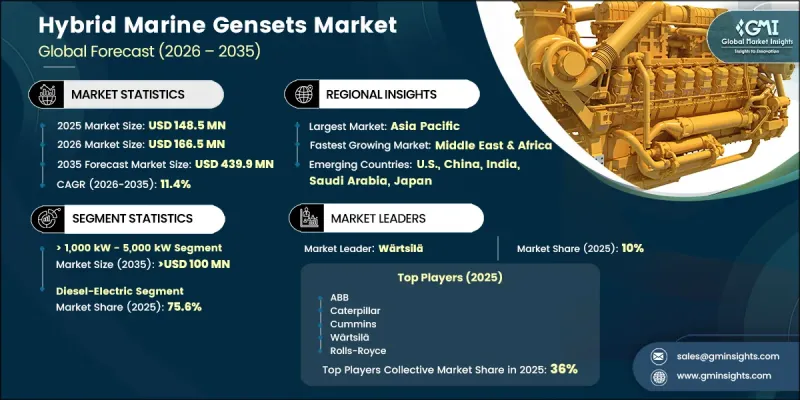
The Global Hybrid Marine Gensets Market was valued at USD 148.5 million in 2025 and is estimated to grow at a CAGR of 11.4% to reach USD 439.9 million by 2035.
The market growth is influenced by tightening emission regulations across maritime operations and increasing global focus on decarbonization in the shipping industry. Regulatory frameworks targeting reduced greenhouse gas emissions are pushing vessel operators toward cleaner propulsion and power solutions, accelerating the adoption of hybrid systems. Rising maritime trade activity, supported by population growth and industrial expansion in developing economies, is further strengthening demand for efficient marine transport infrastructure. In parallel, expanding tourism activity, particularly cruise-based travel and ferry transportation, is contributing to higher vessel utilization and fleet modernization. Hybrid marine gensets combine conventional diesel or gas-based generation with integrated energy storage systems, improving fuel efficiency while reducing environmental impact. The growing emphasis on operational efficiency, energy optimization, and sustainable marine operations is reinforcing the shift toward hybrid configurations across commercial and recreational vessels. Increasing international trade volumes involving commodities such as energy resources and raw materials is also supporting the long-term deployment of advanced marine power systems.
| Market Scope | |
|---|---|
| Start Year | 2025 |
| Forecast Year | 2026-2035 |
| Start Value | $148.5 Million |
| Forecast Value | $439.9 Million |
| CAGR | 11.4% |
The diesel-electric hybrid marine gensets segment accounted for 75.6% share in 2025. This configuration is widely adopted due to its ability to reduce fuel consumption and emissions while improving operational flexibility. It enables vessels to switch efficiently between diesel generation and electric propulsion modes, particularly during low-load operations such as harbor maneuvering, thereby enhancing efficiency and supporting compliance with environmental regulations.
The 1,000 kW to 5,000 kW power rating segment is expected to reach USD 100 million by 2035. Demand in this category is driven by its suitability for a wide range of vessels, including commercial fleets, luxury yachts, and passenger ships. Growth in global seaborne trade, increasing energy requirements, and expanding maritime tourism activity continue to support adoption across medium-to-large vessel classes.
United States Hybrid Marine Gensets Market was valued at USD 19 million in 2025. Market expansion is supported by rising offshore exploration activity and increasing deployment of specialized vessels used in deepwater operations. Strong growth in upstream oil and gas activity and continued interest in untapped offshore reserves are further strengthening demand for advanced marine power systems.
Key companies operating in the global hybrid marine gensets market include ABB, Wartsila, Rolls-Royce, Caterpillar, Cummins, AB Volvo Penta, Yanmar Holdings, Mitsubishi Heavy Industries, Scania, NIDEC CORPORATION, ZF Friedrichshafen AG, BAE Systems, Anglo Belgian Corporation, ELIN Motoren, Everllence, Genesal Energy, Molabo, Nanni, Steyr Motors AG, and Zenoro. Companies in the hybrid marine gensets market are focusing on improving fuel efficiency and reducing emissions through continuous innovation in hybrid propulsion and energy management systems. A strong emphasis is placed on integrating advanced battery storage technologies with conventional generator systems to optimize vessel performance across varying load conditions. Manufacturers are expanding partnerships with shipbuilders and marine operators to secure long-term supply contracts and strengthen project pipelines. Investment in R&D is centered on enhancing system reliability, compact design, and modular architecture to support diverse vessel applications. Companies are also prioritizing compliance with evolving international emission standards by developing low-carbon and fuel-flexible solutions.
Table of Contents
Chapter 1 Methodology & Scope
- 1.1 Research approach
- 1.2 Quality commitments
- 1.2.1 GMI AI policy & data integrity commitment
- 1.2.1.1 Source consistency protocol
- 1.2.1 GMI AI policy & data integrity commitment
- 1.3 Research trail & confidence scoring
- 1.3.1 Research trail components
- 1.3.2 Scoring components
- 1.4 Data collection
- 1.4.1 Partial list of primary sources
- 1.5 Data mining sources
- 1.5.1 Paid sources
- 1.5.1.1 Sources, by region
- 1.5.1 Paid sources
- 1.6 Base estimates and calculations
- 1.6.1 Base year calculation for any one approach
- 1.7 Market estimates & forecasts parameters
- 1.8 Forecast model
- 1.8.1 Quantified market impact analysis
- 1.8.1.1 Mathematical impact of growth parameters on forecast
- 1.8.1 Quantified market impact analysis
- 1.9 Research transparency addendum
- 1.9.1 Source attribution framework
- 1.9.2 Quality assurance metrics
- 1.9.3 Our commitment to trust
- 1.10 Market definitions
Chapter 2 Executive Summary
- 2.1 Industry synopsis, 2022 - 2035
- 2.1.1 Business trends
- 2.1.2 Power rating trends
- 2.1.3 Type trends
- 2.1.4 Application trends
- 2.1.5 Regional trends
Chapter 3 Industry Insights
- 3.1 Industry ecosystem analysis
- 3.1.1 Raw material availability & sourcing analysis
- 3.1.2 Manufacturing capacity assessment
- 3.1.3 Supply chain resilience & risk factors
- 3.1.4 Distribution network analysis
- 3.2 Industry impact forces
- 3.2.1 Growth drivers
- 3.2.2 Industry pitfalls & challenges
- 3.3 Regulatory landscape
- 3.4 Growth potential analysis
- 3.5 Porter's analysis
- 3.5.1 Bargaining power of suppliers
- 3.5.2 Bargaining power of buyers
- 3.5.3 Threat of new entrants
- 3.5.4 Threat of substitutes
- 3.6 PESTEL analysis
- 3.6.1 Political factors
- 3.6.2 Economic factors
- 3.6.3 Social factors
- 3.6.4 Technological factors
- 3.6.5 Legal factors
- 3.6.6 Environmental factors
- 3.7 Cost structure analysis of hybrid marine gensets
- 3.8 Emerging opportunities & trends
- 3.9 Growth in untapped markets & applications
- 3.10 Investment analysis & future prospects
- 3.11 Price trend analysis (USD/Unit) (Driven by Primary Research)
- 3.11.1 By region (Driven by Primary Research)
- 3.11.2 By type (Driven by Primary Research)
- 3.12 Impact of AI & Generative AI on the market (Driven by Primary Research)
- 3.12.1 AI-Driven production optimization (Driven by Primary Research)
- 3.12.2 Predictive maintenance & fault detection (Driven by Primary Research)
Chapter 4 Competitive Landscape, 2026
- 4.1 Introduction
- 4.2 Company market share analysis, by region, 2025
- 4.2.1 North America
- 4.2.2 Europe
- 4.2.3 Asia Pacific
- 4.2.4 Middle East & Africa
- 4.2.5 Latin America
- 4.3 Competitive analysis of major market players
- 4.4 Competitive positioning matrix
- 4.5 Key developments
- 4.5.1 Mergers & acquisitions
- 4.5.2 Partnerships & collaborations
- 4.5.3 New product launches
- 4.5.4 Expansion plans & funding
- 4.6 Company tier benchmarking
- 4.6.1 Tier classification criteria & qualifying thresholds
- 4.6.2 Tier positioning matrix by revenue, geography & innovation
Chapter 5 Market Size and Forecast, By Power Rating, 2022 - 2035 (USD Million & Units)
- 5.1 Key trends
- 5.2 ≤ 1,000 kW
- 5.3 > 1,000 kW - 5,000 kW
- 5.4 > 5,000 kW - 10,000 kW
- 5.5 > 10,000 kW - 20,000 kW
- 5.6 > 20,000 kW
Chapter 6 Market Size and Forecast, By Type, 2022 - 2035 (USD Million & Units)
- 6.1 Key trends
- 6.2 Diesel-electric
- 6.3 Gas-electric
- 6.4 Others
Chapter 7 Market Size and Forecast, By Application, 2022 - 2035 (USD Million & Units)
- 7.1 Key trends
- 7.2 Merchant
- 7.3 Offshore
- 7.4 Cruise & ferry
- 7.5 Navy
- 7.6 Others
Chapter 8 Market Size and Forecast, By Region, 2022 - 2035 (USD Million & Units)
- 8.1 Key trends
- 8.2 North America
- 8.2.1 U.S.
- 8.2.2 Canada
- 8.3 Europe
- 8.3.1 Germany
- 8.3.2 UK
- 8.3.3 Italy
- 8.3.4 Norway
- 8.3.5 France
- 8.3.6 Russia
- 8.3.7 Denmark
- 8.3.8 Netherlands
- 8.3.9 Belgium
- 8.4 Asia Pacific
- 8.4.1 China
- 8.4.2 Japan
- 8.4.3 India
- 8.4.4 South Korea
- 8.4.5 Australia
- 8.4.6 Vietnam
- 8.4.7 Singapore
- 8.5 Middle East & Africa
- 8.5.1 Saudi Arabia
- 8.5.2 UAE
- 8.5.3 Iran
- 8.5.4 Angola
- 8.5.5 Egypt
- 8.5.6 South Africa
- 8.6 Latin America
- 8.6.1 Brazil
- 8.6.2 Argentina
- 8.6.3 Mexico
Chapter 9 Company Profiles
- 9.1 ABB
- 9.2 AB Volvo Penta
- 9.3 Anglo Belgian Corporation
- 9.4 BAE Systems
- 9.5 Caterpillar
- 9.6 Cummins
- 9.7 ELIN Motoren
- 9.8 Everllence
- 9.9 Genesal Energy
- 9.10 Mitsubishi Heavy Industries
- 9.11 Molabo
- 9.12 Nanni
- 9.13 NIDEC CORPORATION
- 9.14 Rolls-Royce
- 9.15 Scania
- 9.16 Steyr Motors AG
- 9.17 Wartsila
- 9.18 Yanmar Holdings
- 9.19 Zenoro
- 9.20 ZF Friedrichshafen AG

