
PUBLISHER: Global Market Insights Inc. | PRODUCT CODE: 2083378

PUBLISHER: Global Market Insights Inc. | PRODUCT CODE: 2083378
Europe Cloud Computing Market Opportunity, Growth Drivers, Industry Trend Analysis, and Forecast 2026 - 2035
Europe Cloud Computing Market was valued at USD 173.6 billion in 2025 and is estimated to grow at a CAGR of 17.4% to reach USD 837 billion by 2035.
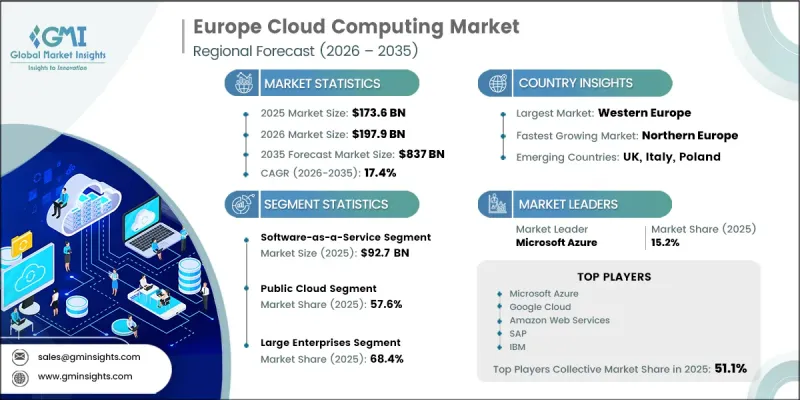
Growth is driven by a clear shift in enterprise demand beyond basic storage and productivity workloads toward advanced use cases such as artificial intelligence, data analytics, regulated workload hosting, and cloud-native application modernization. Western Europe continues to represent the largest revenue base due to established enterprise IT ecosystems, while Northern Europe is emerging as the fastest-expanding sub-region as digital readiness, public procurement programs, and sovereign cloud requirements align. Generative AI adoption is reshaping enterprise cloud consumption patterns, with organizations prioritizing integrated platforms that combine compute, data, and governance. At the same time, regulatory expectations around data privacy and operational control are influencing deployment architecture decisions, accelerating hybrid and multi-cloud strategies across industries.
| Market Scope | |
|---|---|
| Start Year | 2025 |
| Forecast Year | 2026-2035 |
| Start Value | $173.6 Billion |
| Forecast Value | $837 Billion |
| CAGR | 17.4% |
The software-as-a-service segment generated USD 92.7 billion, accounting for 53.4% share in 2025. Demand is concentrated around mission-critical enterprise applications such as customer relationship management, enterprise resource planning, workforce management, and IT service automation systems. The growing integration of AI-driven capabilities within SaaS platforms is increasing revenue per user and strengthening vendor lock-in, as enterprises embed intelligent automation into existing workflows rather than replacing core systems.
The hybrid cloud segment was valued at USD 41.4 billion in 2025 and is growing at a CAGR of 18.3%, slightly ahead of public cloud growth. Its adoption is particularly strong in banking, healthcare, manufacturing, telecommunications, and government sectors, where regulatory compliance, data sovereignty, and latency sensitivity require workload distribution across both private and public environments. This model continues to gain traction as organizations seek greater flexibility in workload placement while maintaining control over critical data assets.
Northern Europe accounted for USD 29.7 billion in 2025 and is expected to reach USD 159.4 billion by 2035, registering a CAGR of 18.6%. The United Kingdom supports cloud adoption through structured public-sector procurement frameworks that streamline access to pre-approved cloud services. Meanwhile, Nordic countries such as Sweden and Finland are strengthening adoption through advanced digital infrastructure and increasing alignment with EU-focused sovereign cloud standards.
Major players operating in the Europe cloud computing industry include Microsoft, Amazon Web Services, Google, SAP, Oracle, IBM, Salesforce, Snowflake, Databricks, and Cloudera. Companies in the Europe cloud computing market are strengthening their competitive position by focusing on AI-first cloud integration, where generative AI and machine learning capabilities are embedded directly into core infrastructure and enterprise applications. Providers are expanding hybrid and multi-cloud architectures to address strict data sovereignty requirements and industry-specific compliance needs. Strategic partnerships with enterprise software vendors are helping cloud providers deepen ecosystem lock-in and increase platform dependency. Firms are also investing heavily in regional data center expansion to meet latency, regulatory, and sustainability expectations across European markets. Additionally, vendors are enhancing managed services, security frameworks, and industry-specific cloud offerings to attract regulated sectors such as finance, healthcare, and public administration.
Table of Contents
Chapter 1 Methodology & Scope
- 1.1 Research approach
- 1.2 Quality Commitments
- 1.2.1 GMI AI policy & data integrity commitment
- 1.2.1.1 Source consistency protocol
- 1.2.1 GMI AI policy & data integrity commitment
- 1.3 Research Trail & Confidence Scoring
- 1.3.1 Research Trail Components
- 1.3.2 Scoring Components
- 1.4 Data Collection
- 1.4.1 Partial list of primary sources
- 1.5 Data mining sources
- 1.5.1 Paid sources
- 1.5.1.1 Sources, by region
- 1.5.1 Paid sources
- 1.6 Base estimates and calculations
- 1.6.1 Base year calculation
- 1.7 Forecast
- 1.7.1 Quantified market impact analysis
- 1.7.1.1 Mathematical impact of growth parameters on forecast
- 1.7.1 Quantified market impact analysis
- 1.8 Research transparency addendum
- 1.8.1 Source attribution framework
- 1.8.2 Quality assurance metrics
- 1.8.3 Our commitment to trust
Chapter 2 Executive Summary
- 2.1 Industry 360° synopsis
- 2.2 Key market trends
- 2.2.1 Regional
- 2.2.2 Service Model
- 2.2.3 Deployment Model
- 2.2.4 Organization Size
- 2.2.5 Application
- 2.2.6 End-Use Industry
- 2.3 TAM Analysis, 2026-2035
- 2.4 CXO perspectives: Strategic imperatives
Chapter 3 Industry Insights
- 3.1 Industry ecosystem analysis
- 3.1.1 Supplier landscape
- 3.1.1.1 Raw material suppliers
- 3.1.1.2 Component suppliers
- 3.1.1.3 Manufacturers
- 3.1.1.4 Service providers
- 3.1.1.5 Distribution channel
- 3.1.1.6 End Use
- 3.1.2 Cost structure
- 3.1.3 Profit margin
- 3.1.4 Value addition at each stage
- 3.1.5 Vertical integration trends
- 3.1.6 Disruptors
- 3.1.1 Supplier landscape
- 3.2 Industry impact forces
- 3.2.1 Growth drivers
- 3.2.1.1 Increasing digital transformation initiatives
- 3.2.1.2 Demand for scalable and cost-efficient IT infrastructure
- 3.2.1.3 Growing adoption of cloud-based business applications
- 3.2.1.4 Rising data storage and analytics requirements
- 3.2.2 Industry pitfalls & challenges
- 3.2.2.1 Data security and regulatory compliance concerns
- 3.2.2.2 Cloud migration and multi-cloud management complexity
- 3.2.3 Market opportunities
- 3.2.3.1 AI/ML cloud services expansion
- 3.2.3.2 SME cloud adoption in Eastern Europe
- 3.2.3.3 Sovereign cloud frameworks driving public sector spend
- 3.2.3.4 Edge computing integration
- 3.2.1 Growth drivers
- 3.3 Growth potential analysis
- 3.4 Pricing Analysis (Driven by Primary Research)
- 3.4.1 Historical Price Trend Analysis
- 3.4.2 Pricing Strategy by Player Type (Premium / Value / Cost-plus)
- 3.5 Regulatory landscape
- 3.5.1 GDPR & Cross-Border Data Flow Regulations
- 3.5.2 EU AI Act - Cloud Infrastructure Implications
- 3.5.3 DORA (Digital Operational Resilience Act) - Financial Sector Cloud Compliance
- 3.5.4 NIS2 Directive - Cybersecurity & Cloud Provider Obligations
- 3.5.5 EU Data Act & Data Spaces Framework
- 3.5.6 National Cloud Regulatory Variations by Country
- 3.6 Technology and Innovation landscape
- 3.6.1 Current technologies
- 3.6.2 Emerging technologies
- 3.7 Porter's analysis
- 3.8 PESTEL analysis
- 3.9 Patent analysis (Driven by Primary Research)
- 3.10 Impact of AI & generative AI on the market
- 3.10.1 AI-Driven Disruption of Existing Business Models
- 3.10.2 Automated design optimization
- 3.10.3 Supply chain AI for demand forecasting
- 3.10.4 GenAI use cases & adoption roadmap by segment
- 3.10.5 Risks, Limitations & Regulatory Considerations
- 3.11 Sustainability and environmental aspects
- 3.11.1 Sustainable practices
- 3.11.2 Waste reduction strategies
- 3.11.3 Energy efficiency in production
- 3.11.4 Eco-friendly Initiatives
- 3.11.5 Carbon footprint considerations
- 3.12 Forecast assumptions & scenario analysis (Driven by Primary Research)
- 3.12.1 Base Case - key macro & industry variables driving CAGR
- 3.12.2 Optimistic Scenarios - Favorable Macro and Industry Tailwinds
- 3.12.3 Pessimistic Scenario - Macroeconomic slowdown or industry headwinds
Chapter 4 Competitive Landscape, 2025
- 4.1 Introduction
- 4.2 Company market share analysis
- 4.2.1 Western Europe
- 4.2.2 Eastern Europe
- 4.2.3 Northern Europe
- 4.2.4 Southern Europe
- 4.3 Competitive positioning matrix
- 4.4 Key developments
- 4.4.1 Mergers & acquisitions
- 4.4.2 Partnerships & collaborations
- 4.4.3 New product launches
- 4.4.4 Expansion plans and funding
- 4.5 Company tier benchmarking
- 4.5.1 Tier classification criteria & qualifying thresholds
- 4.5.2 Tier positioning matrix by revenue, geography & innovation
Chapter 5 Market Estimates & Forecast, By Service Model, 2022 - 2035 ($Mn)
- 5.1 Key trends
- 5.2 Infrastructure-as-a-Service
- 5.3 Platform-as-a-Service
- 5.4 Software-as-a-Service
Chapter 6 Market Estimates & Forecast, By Deployment Model, 2022 - 2035 ($Mn)
- 6.1 Key trends
- 6.2 Public Cloud
- 6.3 Private Cloud
- 6.4 Hybrid Cloud
Chapter 7 Market Estimates & Forecast, By Application, 2022 - 2035 ($Mn)
- 7.1 Key trends
- 7.2 Compute
- 7.3 Storage & Backup
- 7.4 Networking
- 7.5 Database Management
- 7.6 AI, ML & Analytics
- 7.7 Security & Compliance
- 7.8 Application Development & Testing (DevOps/DevSecOps)
- 7.9 Others
Chapter 8 Market Estimates & Forecast, By Organization Size, 2022 - 2035 ($Mn)
- 8.1 Key trends
- 8.2 Large Enterprises
- 8.3 Small & Medium Enterprises
Chapter 9 Market Estimates & Forecast, By End-Use Industry, 2022 - 2035 ($Mn)
- 9.1 Key trends
- 9.2 BFSI
- 9.2.1 Retail Banking
- 9.2.2 Corporate & Investment Banking
- 9.2.3 Insurance
- 9.2.4 Capital Markets & Asset Management
- 9.2.5 FinTech & Digital Payments
- 9.3 Healthcare & Life Sciences
- 9.3.1 Hospitals & Clinical Care
- 9.3.2 Pharmaceutical & Biotechnology
- 9.3.3 Medical Devices & Diagnostics
- 9.3.4 Health Insurance & Payers
- 9.3.5 Research & Academic Medical Institutions
- 9.4 IT & Telecom
- 9.4.1 Cloud Service Providers & Hyperscalers
- 9.4.2 Telecom Operators & Network Providers
- 9.4.3 IT Services & Managed Service Providers (MSPs)
- 9.4.4 Software Vendors & ISVs
- 9.5 Retail & E-commerce
- 9.5.1 Brick-and-Mortar Retail
- 9.5.2 Pure-Play E-commerce
- 9.5.3 Omnichannel Retail
- 9.5.4 Direct-to-Consumer (D2C) Brands
- 9.5.5 Grocery & FMCG Retail
- 9.6 Manufacturing
- 9.6.1 Discrete Manufacturing (Automotive, Aerospace & Electronics)
- 9.6.2 Process Manufacturing (Chemicals, Food & Beverage & Pharma)
- 9.6.3 Industrial Equipment & Machinery
- 9.6.4 Defense & Aerospace Manufacturing
- 9.7 Government & Public Sector
- 9.7.1 Central & Federal Government
- 9.7.2 Regional & Local Government
- 9.7.3 Defense & Intelligence
- 9.7.4 Public Safety & Emergency Services
- 9.7.5 Social Services & Public Welfare
- 9.8 Education
- 9.8.1 K-12 Primary & Secondary Education
- 9.8.2 Higher Education
- 9.8.3 Vocational & Professional Training
- 9.8.4 EdTech Platforms & Online Learning
- 9.9 Energy & Utilities
- 9.9.1 Oil & Gas (Upstream, Midstream & Downstream)
- 9.9.2 Power Generation & Grid Distribution
- 9.9.3 Renewable Energy (Solar, Wind & Hydro)
- 9.9.4 Water & Waste Management
- 9.10 Media & Entertainment
- 9.10.1 Broadcast & Streaming
- 9.10.2 Gaming & Interactive Entertainment
- 9.10.3 Publishing & Digital Media
- 9.10.4 Advertising Technology (AdTech)
- 9.11 Others
- 9.11.1 Legal & Professional Services
- 9.11.2 Real Estate & Construction
- 9.11.3 Non-Profits & NGOs
Chapter 10 Market Estimates & Forecast, By Region, 2022 - 2035 ($Mn)
- 10.1 Western Europe
- 10.1.1 Germany
- 10.1.2 France
- 10.1.3 Netherlands
- 10.1.4 Belgium
- 10.1.5 Switzerland
- 10.1.6 Austria
- 10.1.7 Ireland
- 10.1.8 Luxembourg
- 10.2 Eastern Europe
- 10.2.1 Poland
- 10.2.2 Czech Republic
- 10.2.3 Portugal
- 10.2.4 Serbia
- 10.2.5 Albania
- 10.2.6 Slovakia
- 10.2.7 Romania
- 10.3 Northern Europe
- 10.3.1 UK
- 10.3.2 Denmark
- 10.3.3 Sweden
- 10.3.4 Norway
- 10.3.5 Iceland
- 10.3.6 Faroe Islands
- 10.4 Southern Europe
- 10.4.1 Italy
- 10.4.2 Spain
- 10.4.3 Vatican City
- 10.4.4 San Marino
Chapter 11 Company Profiles
- 11.1 Global Players
- 11.1.1 Microsoft (Azure)
- 11.1.2 Amazon Web Services (AWS)
- 11.1.3 Google Cloud
- 11.1.4 SAP
- 11.1.5 Salesforce
- 11.1.6 Oracle
- 11.1.7 IBM
- 11.1.8 Workday
- 11.1.9 ServiceNow
- 11.1.10 Snowflake
- 11.2 Regional Players
- 11.2.1 OVHcloud
- 11.2.2 Deutsche Telekom
- 11.2.3 Hetzner Online
- 11.2.4 IONOS Cloud
- 11.2.5 Scaleway
- 11.2.6 Orange Business
- 11.2.7 Telefonica Tech
- 11.2.8 Aruba Cloud
- 11.2.9 Capgemini
- 11.2.10 STACKIT

