PUBLISHER: Mordor Intelligence | PRODUCT CODE: 2073096

PUBLISHER: Mordor Intelligence | PRODUCT CODE: 2073096
Carbon-Aware Computing Platform - Market Share Analysis, Industry Trends & Statistics, Growth Forecasts (2026 - 2031)
According to Mordor Intelligence, the carbon-aware computing platform market size is projected to be USD 1.38 billion in 2025, USD 1.56 billion in 2026, and reach USD 2.95 billion by 2031, growing at a CAGR of 13.58% from 2026 to 2031.
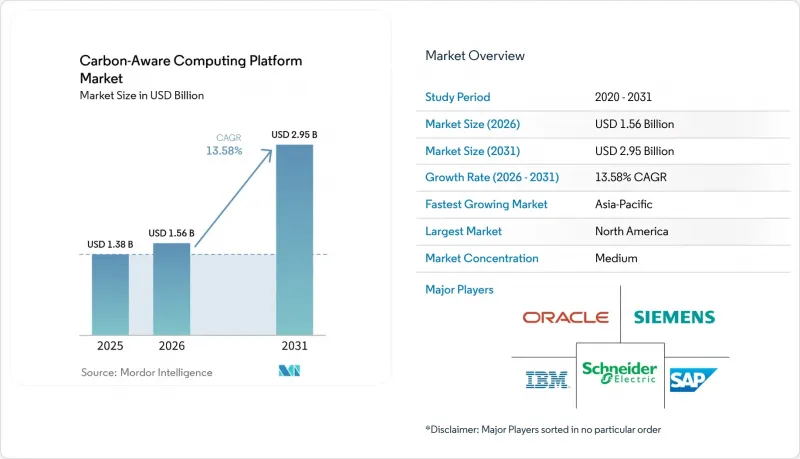
This report is Segmented by Component (Software, and Services), Application (Cloud Workload Scheduling, Cloud Infrastructure Monitoring and Optimization, and More), Deployment Mode (Cloud-Based, Hybrid, and More), Organization Size (Large Enterprises, and More), End-User (Information Technology and Telecom, and More), and Geography. The Market Forecasts are Provided in Terms of Value (USD).
Global Carbon-Aware Computing Platform Market Trends and Insights
AI and GPU Workload Energy Intensity Rising
The carbon-aware computing platform market is gaining direct support from the power profile of AI infrastructure, because GPU clusters now shape the operating footprint of modern compute estates. Research cited in the user draft showed that GPUs accounted for 60% of power in multi-GPU servers and 41% of total power across AI clusters, which means a large share of emissions now comes from a narrow set of compute assets. Separate work on H100 systems found that nameplate thermal design assumptions can overstate actual production power draw by up to 24%, making specification-based accounting less reliable than live telemetry. That gap matters for the carbon-aware computing platform market because buyers increasingly need platform outputs that reflect real workloads rather than static hardware labels. Google also stated that its Ironwood TPUs delivered a 3.7x improvement in compute carbon intensity compared to the prior generation, underscoring why software platforms must keep pace with changing chip efficiency curves as fleets refresh.
Net Zero and ESG Reporting Requirements
Tighter reporting requirements are also boosting the carbon-aware computing platform market, as enterprises now need emissions records that can withstand internal control and external review. The Software Carbon Intensity standard, formalized as ISO/IEC 21031:2024, provides organizations with a structured way to measure software-related emissions, making carbon data more usable in governance processes. SAP stated in 2026 that new Sustainability AI Agents in the SAP Sustainability Control Tower would automate scope alignment, emissions factor mapping, and disclosure preparation, indicating that enterprise buyers are moving from manual reporting to system-based reporting workflows. AWS also launched a standalone Sustainability console with Scope 1, Scope 2, and Scope 3 reporting, which indicates that workload emissions data is becoming a standard procurement expectation rather than a niche feature. In the carbon-aware computing platform market, this shifts demand toward vendors that can connect measurement, attribution, and disclosure outputs without creating parallel reporting processes.
Limited Carbon Intensity Forecast Accuracy
The carbon-aware computing platform market still faces a fundamental data limitation, as scheduling quality depends on confidence in forward carbon-intensity signals. Electricity Maps discontinued its marginal carbon intensity signal in 2025 due to concerns about its veracity and verifiability, narrowing one of the more precise signal options used for fine-grained scheduling. The CarbonX research cited in the user draft also noted that parts of sub-Saharan Africa and Southeast Asia still lack usable source-mix data at the sub-annual level, which restricts forecast applicability across a large share of global compute locations. Oxford research further showed that balancing forecast accuracy with the carbon cost of producing the forecast remains unresolved, indicating the prediction layer is still technically immature. In the carbon-aware computing platform market, this keeps some enterprises cautious because a weak forecast can shift workloads without delivering a clear real-world carbon benefit.
Other drivers and restraints analyzed in the detailed report include:
- Carbon-Aware Scheduling Reduces Cloud Opex
- Renewable-Powered Cloud Region Expansion
- Integration Complexity Across Hybrid Estates
For complete list of drivers and restraints, kindly check the Table Of Contents.
Segment Analysis
Software accounted for 69.41% of the carbon-aware computing platform market in 2025, keeping this segment at the center of current revenue growth. The software-heavy mix reflects the commercial structure of the carbon-aware computing platform market, where subscription products handle continuous monitoring, reporting, and scheduling logic. Buyers prefer software first because emissions tracking must run continuously across workloads, regions, and reporting periods, rather than being refreshed only during annual reviews. This also suits enterprises that want one system to connect workload telemetry with sustainability dashboards and governance records. As a result, software remains the basic control layer through which the carbon-aware computing platform market is being deployed across large cloud estates.
The services segment is projected to grow at a 15.49% CAGR from 2026 to 2031, indicating that implementation depth is becoming increasingly valuable as deployments scale. Much of that demand comes from connecting scheduling APIs with cloud cost tools, ERP sustainability modules, and greenhouse gas inventory systems that were not designed together at the start. SAP stated that new Sustainability AI Agents will become generally available within SAP Sustainability Control Tower by the end of 2026, and that announcement supports the view that integration work will rise as automation features spread into large enterprise environments. Services also remain important because factor libraries, region mappings, and reporting templates must be updated as rules and data sources change. Within the carbon-aware computing platform industry, managed services and support work play a durable role even as core software becomes more standardized.
Cloud infrastructure monitoring and optimization accounted for 38.65% of the carbon-aware computing platform market in 2025, making it the largest application by current revenue. This lead is logical because visibility comes before intervention, and most enterprises first need reliable data on where emissions sit across regions, services, and workloads. The large cloud providers have already normalized dashboard-based attribution, meaning the carbon-aware computing platform market now builds on a visibility baseline rather than starting from zero measurement. That pushes differentiation toward deeper telemetry, stronger workload recommendations, and more usable cost-carbon trade-off controls. Monitoring, therefore, remains the anchor application even as more advanced optimization use cases expand.
AI and high-performance compute emissions optimization is projected to grow at a 14.55% CAGR through 2031, which makes it the most dynamic application area in the carbon-aware computing platform market. Microsoft Research described a framework that jointly schedules AI training jobs, routes inference workloads, and dispatches battery storage and on-site generation under carbon-budget constraints, demonstrating that optimization is moving beyond simple time shifting. The Open Compute Project also released a carbon disclosure base specification in 2025, which supports a broader shift toward standardized carbon information across the data center supply chain. That matters because reporting and compliance tools can expand more quickly when operational and embodied carbon data are structured more consistently. In the carbon-aware computing platform market, the center of gravity is slowly moving from passive visibility to active control over AI-heavy workloads.
Complete Report Scope:
- By Component
- Software
- Services
- Implementation and Integration Services
- Support and Maintenance Services
- By Application
- Cloud Workload Scheduling
- Cloud Infrastructure Monitoring and Optimization
- AI and High-Performance Compute Emissions Optimization
- Sustainability Reporting and Compliance
- Other Applications
- By Deployment Mode
- Cloud-Based
- On-Premises
- Hybrid
- By Organization Size
- Large Enterprises
- Small and Medium Enterprises
- By End-User
- Information Technology and Telecom
- Banking, Financial Services, and Insurance
- Healthcare and Life Sciences
- Manufacturing
- Government and Public Sector
- Retail and E-Commerce
- Other End-Users
- By Geography
- North America
- United States
- Canada
- Mexico
- South America
- Brazil
- Argentina
- Rest of South America
- Europe
- Germany
- United Kingdom
- France
- Italy
- Spain
- Russia
- Rest of Europe
- Asia-Pacific
- China
- India
- Japan
- South Korea
- Australia
- Rest of Asia-Pacific
- Middle East
- Saudi Arabia
- United Arab Emirates
- Turkey
- Rest of Middle East
- Africa
- South Africa
- Nigeria
- Rest of Africa
- North America
Geography Analysis
North America held a 36.71% share in 2025, ranking it at the forefront of the carbon-aware computing platform market by current regional revenue. The region combines the largest installed hyperscale cloud base with a high concentration of AI infrastructure and enterprise software spending. EPRI stated that data centers currently consume 4% to 5% of U.S. electricity and could reach 17% by 2030, underscoring the importance of compute-related power management. Microsoft also confirmed in February 2026 that it had matched 100% of its global electricity consumption with renewable energy, showing how major vendors are aligning infrastructure expansion with cleaner power sourcing. AWS added a standalone Sustainability console in March 2026, further raising expectations for native emissions visibility across its commercial cloud regions.
Europe remained the second-largest regional market, and the carbon-aware computing platform market there is shaped by strong disclosure pressure and tighter governance expectations. The FinOps Foundation reported that 53% of European FinOps practices now report cloud carbon, suggesting a more mature operating approach to carbon accountability than in many other regions. AWS also launched the European Sovereign Cloud in Germany in January 2026, which shows that residency requirements are becoming part of the practical design boundary for emissions-aware workload movement. This combination of reporting maturity and jurisdiction sensitivity keeps Europe important for both platform adoption and deployment model innovation in the carbon-aware computing platform market.
Asia-Pacific is projected to grow at a 14.24% CAGR through 2031, making it the fastest-growing regional market for carbon-aware computing platforms. Growth is supported by new hyperscaler capacity, expanding AI workloads, and a wider regional push to improve data center efficiency. Fujitsu and the University of Tokyo started Japan's first cloud-connected inter-regional workload shift trial in December 2025 based on real-time grid conditions, which provides a direct example of carbon-aware operations moving from concept to live testing. Japan and Australia show stronger compliance-led demand, while India and Southeast Asia are being lifted more by infrastructure expansion and the need to manage rising compute intensity. South America, the Middle East, and Africa remain earlier-stage markets, but they are strategically relevant because future cloud build-outs and renewable-backed data center capacity can widen the addressable footprint of the carbon-aware computing platform market.
- Microsoft Corporation
- Google LLC
- Amazon Web Services, Inc.
- IBM Corporation
- Schneider Electric SE
- Siemens AG
- Hewlett Packard Enterprise Company
- Cisco Systems, Inc.
- Oracle Corporation
- SAP SE
- Salesforce, Inc.
- VMware, Inc.
- Accenture plc
- Carbon Aware Cloud Limited
- Electricity Maps ApS
- WattTime, Inc.
- NTT DATA Group Corporation
- Dell Technologies Inc.
- ServiceNow, Inc.
- Cloud Bolt Software, Inc.
- Flexera Holdings LLC
Additional Benefits:
- The market estimate (ME) sheet in Excel format
- 3 months of analyst support
TABLE OF CONTENTS
1 INTRODUCTION
- 1.1 Study Assumptions and Market Definition
- 1.2 Scope of the Study
2 RESEARCH METHODOLOGY
3 EXECUTIVE SUMMARY
4 MARKET LANDSCAPE
- 4.1 Market Overview
- 4.2 Market Drivers
- 4.2.1 AI and GPU Workload Energy Intensity Rising
- 4.2.2 Net Zero and ESG Reporting Requirements
- 4.2.3 Carbon-Aware Scheduling Reduces Cloud Opex
- 4.2.4 Renewable-Powered Cloud Region Expansion
- 4.2.5 FinOps and Sustainability Convergence
- 4.2.6 Demand for Audit-Ready Emissions Attribution
- 4.3 Market Restraints
- 4.3.1 Limited Carbon Intensity Forecast Accuracy
- 4.3.2 Integration Complexity Across Hybrid Estates
- 4.3.3 Data Residency Constraints Limit Cross-Region Workload Shifting
- 4.3.4 Performance Risk from Aggressive Job Deferral Policies
- 4.4 Industry Value Chain Analysis
- 4.5 Regulatory Landscape
- 4.6 Technological Outlook
- 4.7 Porter's Five Forces Analysis
- 4.7.1 Bargaining Power of Buyers
- 4.7.2 Bargaining Power of Suppliers
- 4.7.3 Threat of New Entrants
- 4.7.4 Threat of Substitutes
- 4.7.5 Intensity of Competitive Rivalry
- 4.8 Impact of Macroeconomic Factors on the Market
5 MARKET SIZE AND GROWTH FORECASTS (VALUE)
- 5.1 By Component
- 5.1.1 Software
- 5.1.2 Services
- 5.1.2.1 Implementation and Integration Services
- 5.1.2.2 Support and Maintenance Services
- 5.2 By Application
- 5.2.1 Cloud Workload Scheduling
- 5.2.2 Cloud Infrastructure Monitoring and Optimization
- 5.2.3 AI and High-Performance Compute Emissions Optimization
- 5.2.4 Sustainability Reporting and Compliance
- 5.2.5 Other Applications
- 5.3 By Deployment Mode
- 5.3.1 Cloud-Based
- 5.3.2 On-Premises
- 5.3.3 Hybrid
- 5.4 By Organization Size
- 5.4.1 Large Enterprises
- 5.4.2 Small and Medium Enterprises
- 5.5 By End-User
- 5.5.1 Information Technology and Telecom
- 5.5.2 Banking, Financial Services, and Insurance
- 5.5.3 Healthcare and Life Sciences
- 5.5.4 Manufacturing
- 5.5.5 Government and Public Sector
- 5.5.6 Retail and E-Commerce
- 5.5.7 Other End-Users
- 5.6 By Geography
- 5.6.1 North America
- 5.6.1.1 United States
- 5.6.1.2 Canada
- 5.6.1.3 Mexico
- 5.6.2 South America
- 5.6.2.1 Brazil
- 5.6.2.2 Argentina
- 5.6.2.3 Rest of South America
- 5.6.3 Europe
- 5.6.3.1 Germany
- 5.6.3.2 United Kingdom
- 5.6.3.3 France
- 5.6.3.4 Italy
- 5.6.3.5 Spain
- 5.6.3.6 Russia
- 5.6.3.7 Rest of Europe
- 5.6.4 Asia-Pacific
- 5.6.4.1 China
- 5.6.4.2 India
- 5.6.4.3 Japan
- 5.6.4.4 South Korea
- 5.6.4.5 Australia
- 5.6.4.6 Rest of Asia-Pacific
- 5.6.5 Middle East
- 5.6.5.1 Saudi Arabia
- 5.6.5.2 United Arab Emirates
- 5.6.5.3 Turkey
- 5.6.5.4 Rest of Middle East
- 5.6.6 Africa
- 5.6.6.1 South Africa
- 5.6.6.2 Nigeria
- 5.6.6.3 Rest of Africa
- 5.6.1 North America
6 COMPETITIVE LANDSCAPE
- 6.1 Market Concentration
- 6.2 Strategic Moves
- 6.3 Market Share Analysis
- 6.4 Company Profiles (includes Global Level Overview, Market Level Overview, Core Segments, Financials as available, Strategic Information, Market Rank/Share, Products and Services, Recent Developments)
- 6.4.1 Microsoft Corporation
- 6.4.2 Google LLC
- 6.4.3 Amazon Web Services, Inc.
- 6.4.4 IBM Corporation
- 6.4.5 Schneider Electric SE
- 6.4.6 Siemens AG
- 6.4.7 Hewlett Packard Enterprise Company
- 6.4.8 Cisco Systems, Inc.
- 6.4.9 Oracle Corporation
- 6.4.10 SAP SE
- 6.4.11 Salesforce, Inc.
- 6.4.12 VMware, Inc.
- 6.4.13 Accenture plc
- 6.4.14 Carbon Aware Cloud Limited
- 6.4.15 Electricity Maps ApS
- 6.4.16 WattTime, Inc.
- 6.4.17 NTT DATA Group Corporation
- 6.4.18 Dell Technologies Inc.
- 6.4.19 ServiceNow, Inc.
- 6.4.20 Cloud Bolt Software, Inc.
- 6.4.21 Flexera Holdings LLC
7 MARKET OPPORTUNITIES AND FUTURE OUTLOOK
- 7.1 White-space and Unmet-Need Assessment

