PUBLISHER: Global Market Insights Inc. | PRODUCT CODE: 2101532

PUBLISHER: Global Market Insights Inc. | PRODUCT CODE: 2101532
Space-Based Navigation and Positioning (PNT) Systems Market Opportunity, Growth Drivers, Industry Trend Analysis, and Forecast 2026 - 2035
The Global Space-Based Navigation & Positioning (PNT) Systems Market was valued at USD 5.7 billion in 2025 and is estimated to grow at a CAGR of 8.2% to reach USD 12.5 billion by 2035.
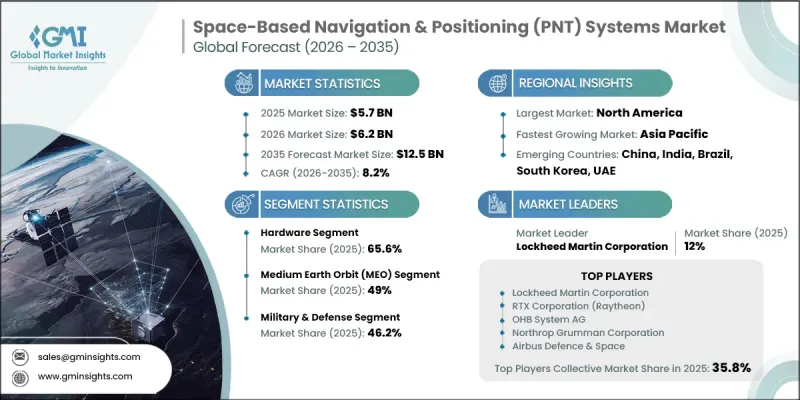
The space-based navigation & positioning (PNT) systems market is expanding steadily as governments, commercial organizations, and defense agencies continue investing in advanced navigation infrastructure and high-precision positioning capabilities. Growing adoption of multi-constellation satellite navigation technologies, rising demand for highly accurate positioning services, and increasing reliance on space-derived timing synchronization are supporting long-term market growth. The expansion of autonomous platforms, digital infrastructure, and next-generation transportation systems is further strengthening demand for reliable navigation and timing solutions. In addition, growing commercialization of space technologies and continued modernization of defense capabilities are encouraging investments in resilient positioning systems designed to deliver enhanced accuracy, reliability, and operational continuity. As industries become increasingly dependent on uninterrupted positioning and timing services, ongoing technological advancements in satellite navigation architecture, signal processing, and secure positioning technologies are expected to create significant growth opportunities for the space-based navigation & positioning (PNT) systems market throughout the forecast period.
| Market Scope | |
|---|---|
| Start Year | 2025 |
| Forecast Year | 2026-2035 |
| Start Value | $5.7 Billion |
| Forecast Value | $12.5 Billion |
| CAGR | 8.2% |
The space-based navigation & positioning (PNT) systems market is benefiting from broader adoption of multi-constellation navigation capabilities that improve positioning accuracy, increase signal availability, and enhance operational reliability across a wide range of applications. Organizations are modernizing navigation infrastructure by deploying advanced multi-frequency receiver technologies that support improved performance and greater resilience. At the same time, increasing government investment in secure positioning solutions, electronic resilience, and advanced navigation capabilities continues to drive market expansion as national security and critical infrastructure operators prioritize dependable positioning services for future operational requirements.
The hardware segment accounted for 65.6% share in 2025. The segment maintains its leadership due to the significant capital investment required for satellite manufacturing, ground infrastructure development, and deployment of advanced navigation equipment supporting defense, aviation, transportation, and critical infrastructure applications. Continued investment in satellite production, supporting ground systems, and navigation infrastructure is expected to sustain the hardware segment's leading market position throughout the forecast period.
The medium Earth orbit (MEO) segment held 49% share in 2025, making it the largest orbital segment. MEO remains the preferred operating environment for global navigation infrastructure because it provides an effective balance between coverage, signal performance, and long-term operational efficiency. The extensive worldwide deployment of compatible navigation receivers, together with ongoing investments in constellation modernization and supporting ground infrastructure, continues to reinforce the segment's dominant position while supporting long-term revenue growth.
North America Space-Based Navigation & Positioning (PNT) Systems Market accounted for 40.8% share in 2025. The region maintains its leading position due to its advanced satellite navigation infrastructure, strong government support, well-established aerospace industry, and continued investment in resilient positioning technologies. Ongoing modernization of navigation capabilities, together with sustained procurement of advanced positioning solutions for defense, transportation, and critical infrastructure applications, continues to create stable demand for satellite-based navigation technologies across the regional market.
Leading companies participating in the global space-based navigation & positioning (PNT) systems market include L3Harris Technologies, Lockheed Martin Corporation, Safran Navigation & Timing, Airbus Defence & Space, RTX Corporation (Raytheon), GMV Innovating Solutions, Thales Alenia Space, Mitsubishi Electric Corporation, Northrop Grumman Corporation, OHB System AG, Indra Sistemas S.A., Telespazio S.p.A., Iridium Communications Inc., Xona Space Systems, and TrustPoint Inc. Companies operating in the space-based navigation & positioning (PNT) systems market are strengthening their competitive positions by investing in advanced navigation technologies, resilient positioning capabilities, and next-generation satellite infrastructure that improve accuracy, security, and operational reliability. Continuous research and development efforts are focused on enhancing signal performance, supporting multi-constellation compatibility, and strengthening resistance to interference. Manufacturers are also expanding strategic partnerships with government agencies, aerospace organizations, and commercial customers to broaden technology adoption and secure long-term contracts. Product innovation, increased investment in ground infrastructure, and expanded manufacturing capabilities remain important growth strategies.
Table of Contents
Chapter 1 Methodology and Scope
- 1.1 Market scope and definition
- 1.2 Research design
- 1.2.1 Research approach
- 1.2.2 Data collection methods
- 1.3 Data mining sources
- 1.3.1 Global
- 1.3.2 Regional/Country
- 1.4 Base estimates and calculations
- 1.4.1 Base year calculation
- 1.4.2 Key trends for market estimation
- 1.5 Primary research and validation
- 1.5.1 Primary sources
- 1.6 Forecast model
- 1.7 Research assumptions and limitations
Chapter 2 Executive Summary
- 2.1 Industry 360° synopsis, 2022 - 2035
- 2.2 Key market trends
- 2.2.1 Offering trends
- 2.2.2 Orbit architecture trends
- 2.2.3 End-user trends
- 2.2.4 Regional trends
- 2.3 TAM Analysis, 2026-2035
- 2.4 CXO perspectives: Strategic imperatives
Chapter 3 Industry Insights
- 3.1 Industry ecosystem analysis
- 3.1.1 Supplier Landscape
- 3.1.2 Profit Margin
- 3.1.3 Cost structure
- 3.1.4 Value addition at each stage
- 3.1.5 Factor affecting the value chain
- 3.1.6 Disruptions
- 3.2 Industry impact forces
- 3.2.1 Growth drivers
- 3.2.1.1 Surge in multi-constellation GNSS adoption for resilient navigation
- 3.2.1.2 Rising strategic importance of PNT in defense modernization programs
- 3.2.1.3 Expansion of autonomous systems requiring high-precision positioning
- 3.2.1.4 Increasing commercialization of space and satellite infrastructure
- 3.2.1.5 Emergence of critical infrastructure dependency on timing synchronization
- 3.2.2 Industry pitfalls and challenges
- 3.2.2.1 Vulnerability to signal interference and jamming
- 3.2.2.2 High dependency on government funding and regulatory frameworks
- 3.2.3 Market opportunities
- 3.2.3.1 Integration of PNT capabilities with 5G and next-generation communication networks
- 3.2.3.2 Development of regional and low-earth orbit (LEO) navigation constellations
- 3.2.1 Growth drivers
- 3.3 Growth potential analysis
- 3.4 Regulatory landscape
- 3.4.1 North America
- 3.4.2 Europe
- 3.4.3 Asia Pacific
- 3.4.4 Latin America
- 3.4.5 Middle East & Africa
- 3.5 Porter's analysis
- 3.6 PESTEL analysis
- 3.7 Technology and Innovation landscape
- 3.7.1 Current technological trends
- 3.7.2 Emerging technologies
- 3.8 Price trends
- 3.8.1 By region
- 3.8.2 By product
- 3.9 Pricing Strategies
- 3.10 Emerging Business Models
- 3.11 Compliance Requirements
- 3.12 Patent and IP analysis
Chapter 4 Competitive Landscape, 2025
- 4.1 Introduction
- 4.2 Company market share analysis
- 4.2.1 By region
- 4.2.1.1 North America
- 4.2.1.2 Europe
- 4.2.1.3 Asia Pacific
- 4.2.1.4 Latin America
- 4.2.1.5 Middle East & Africa
- 4.2.2 Market concentration analysis
- 4.2.1 By region
- 4.3 Competitive benchmarking of key players
- 4.3.1 Financial performance comparison
- 4.3.1.1 Revenue
- 4.3.1.2 Profit margin
- 4.3.1.3 R&D
- 4.3.2 Product portfolio comparison
- 4.3.2.1 Product range breadth
- 4.3.2.2 Technology
- 4.3.2.3 Innovation
- 4.3.3 Geographic presence comparison
- 4.3.3.1 Global footprint analysis
- 4.3.3.2 Service network coverage
- 4.3.3.3 Market penetration by region
- 4.3.4 Competitive positioning matrix
- 4.3.4.1 Leaders
- 4.3.4.2 Challengers
- 4.3.4.3 Followers
- 4.3.4.4 Niche players
- 4.3.5 Strategic outlook matrix
- 4.3.1 Financial performance comparison
- 4.4 Key developments
- 4.4.1 Mergers and acquisitions
- 4.4.2 Partnerships and collaborations
- 4.4.3 Technological advancements
- 4.4.4 Expansion and investment strategies
- 4.4.5 Digital transformation initiatives
- 4.5 Emerging/ startup competitors landscape
Chapter 5 Market Estimates and Forecast, By Offering, 2022 - 2035 (USD Million)
- 5.1 Key trends
- 5.2 Hardware
- 5.2.1 Navigation satellites
- 5.2.2 Ground segment infrastructure
- 5.2.3 PNT augmentation infrastructure
- 5.3 Software
- 5.4 Services
- 5.4.1 Operational & lifecycle services
- 5.4.2 Engineering & system integration services
Chapter 6 Market Estimates and Forecast, By Orbit Architecture, 2022 - 2035 (USD Million)
- 6.1 Key trends
- 6.2 Medium earth orbit (MEO)
- 6.3 Geosynchronous orbit (GEO/IGSO)
- 6.4 Low earth orbit (LEO)
- 6.5 Hybrid / multi-orbit PNT architecture
Chapter 7 Market Estimates and Forecast, By End-User, 2022 - 2035 (USD Million)
- 7.1 Key trends
- 7.2 Military & defense
- 7.3 Civil government & space agencies
- 7.4 Commercial
Chapter 8 Market Estimates and Forecast, By Region, 2022 - 2035 (USD Million)
- 8.1 Key trends
- 8.2 North America
- 8.2.1 U.S.
- 8.2.2 Canada
- 8.3 Europe
- 8.3.1 Germany
- 8.3.2 UK
- 8.3.3 France
- 8.3.4 Spain
- 8.3.5 Italy
- 8.3.6 Russia
- 8.4 Asia Pacific
- 8.4.1 China
- 8.4.2 India
- 8.4.3 Japan
- 8.4.4 Australia
- 8.4.5 South Korea
- 8.5 Latin America
- 8.5.1 Brazil
- 8.5.2 Mexico
- 8.5.3 Argentina
- 8.6 Middle East and Africa
- 8.6.1 South Africa
- 8.6.2 Saudi Arabia
- 8.6.3 UAE
Chapter 9 Company Profiles
- 9.1 Global Key Players
- 9.1.1 Lockheed Martin Corporation
- 9.1.2 RTX Corporation (Raytheon)
- 9.1.3 OHB System AG
- 9.1.4 Northrop Grumman Corporation
- 9.1.5 Airbus Defence & Space
- 9.2 Regional key players
- 9.2.1 North America
- 9.2.1.1 L3Harris Technologies
- 9.2.1.2 Iridium Communications Inc.
- 9.2.2 Asia Pacific
- 9.2.2.1 Mitsubishi Electric Corporation
- 9.2.3 Europe
- 9.2.3.1 Thales Alenia Space
- 9.2.3.2 GMV Innovating Solutions
- 9.2.3.3 Safran Navigation & Timing
- 9.2.3.4 Indra Sistemas S.A.
- 9.2.3.5 Telespazio S.p.A.
- 9.2.1 North America
- 9.3 Niche Players/Disruptors
- 9.3.1 Xona Space Systems
- 9.3.2 TrustPoint Inc.

