PUBLISHER: Global Market Insights Inc. | PRODUCT CODE: 2101561

PUBLISHER: Global Market Insights Inc. | PRODUCT CODE: 2101561
Hydrogen Pipeline Materials Market Opportunity, Growth Drivers, Industry Trend Analysis, and Forecast 2026 - 2035
The Global Hydrogen Pipeline Materials Market was valued at USD 3.7 billion in 2025 and is estimated to grow at a CAGR of 13.1% to reach USD 12.8 billion by 2035.
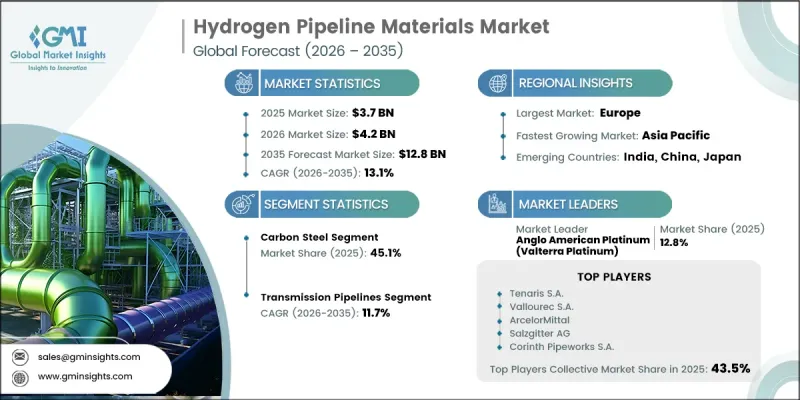
Growth is supported by the rising development of hydrogen production projects, increasing demand for dedicated transportation networks, and the establishment of stricter material requirements for hydrogen-related applications. The market is evolving differently from traditional pipeline material sectors because hydrogen transportation requires materials with enhanced resistance to performance challenges associated with hydrogen exposure. Growing focus on certified materials, advanced manufacturing processes, and reliable infrastructure solutions is encouraging suppliers to develop specialized pipeline materials. Government-backed clean energy initiatives and infrastructure investments across major hydrogen-producing and consuming regions are also accelerating project development and increasing demand for qualified materials. As hydrogen networks continue to expand, manufacturers with proven technical capabilities and certification expertise are expected to gain stronger competitive advantages in this emerging market.
| Market Scope | |
|---|---|
| Start Year | 2025 |
| Forecast Year | 2026-2035 |
| Start Value | $3.7 Billion |
| Forecast Value | $12.8 Billion |
| CAGR | 13.1% |
The carbon steel segment held 45.1% share in 2025. The segment maintains its leadership position due to its widespread use in pipeline infrastructure, established manufacturing capabilities, cost advantages, and suitability for large-scale fabrication requirements. Carbon steel products continue to attract demand because of their balance between performance, availability, and economic efficiency compared with higher-cost alloy alternatives. Within this segment, specialized linepipe solutions designed for hydrogen applications are gaining importance as pipeline developers increasingly prioritize material reliability and long-term operational performance.
The transmission pipelines segment held 41.7% share in 2025 growing at 11.7% CAGR through 2035. This segment is benefiting from increasing investment in large-scale hydrogen transportation infrastructure designed to connect production facilities with industrial users and distribution networks. Transmission systems require advanced material performance due to demanding operational conditions, including high-pressure transportation requirements, extended service life expectations, and continuous operation requirements. These technical factors are increasing demand for high-quality steel and alloy materials capable of supporting reliable hydrogen pipeline performance.
North America Hydrogen Pipeline Materials Market captured significant share in 2025 supported by government initiatives, infrastructure funding, and growing interest in hydrogen-based energy systems. Expanding hydrogen infrastructure projects are creating demand for specialized pipeline materials used across transportation networks, production facilities, and distribution systems. As project development progresses, material selection requirements are becoming increasingly focused on durability, safety, and compliance with established engineering standards. Growing investments in hydrogen infrastructure development are expected to strengthen regional demand for advanced pipeline materials and create new opportunities for manufacturers capable of supplying qualified solutions.
Major companies operating in the global hydrogen pipeline materials industry include ArcelorMittal, Tenaris S.A., Vallourec S.A., JFE Steel Corporation, Salzgitter AG, Borealis AG, POSCO, Jindal SAW Ltd., Corinth Pipeworks S.A., and Baosteel Group (China Baowu Steel Group). Companies operating in the hydrogen pipeline materials market are strengthening their market position by expanding production capabilities, investing in research and development, and developing materials specifically designed for hydrogen transportation requirements. Manufacturers are focusing on improving product certification, enhancing material performance, and creating advanced steel and alloy solutions to meet evolving industry standards. Strategic collaborations with pipeline developers, energy companies, and infrastructure stakeholders are helping businesses improve market access and strengthen project participation. Companies are also increasing investments in testing capabilities, manufacturing technologies, and quality assurance systems to improve customer confidence.
Table of Contents
Chapter 1 Methodology & Scope
- 1.1 Market scope and definition
- 1.2 Research design
- 1.2.1 Research approach
- 1.2.2 Data collection methods
- 1.3 Data mining sources
- 1.3.1 Global
- 1.3.2 Regional/Country
- 1.4 Base estimates and calculations
- 1.4.1 Base year calculation
- 1.4.2 Key trends for market estimation
- 1.5 Primary research and validation
- 1.5.1 Primary sources
- 1.6 Forecast model
- 1.7 Research assumptions and limitations
Chapter 2 Executive Summary
- 2.1 Industry 360° synopsis
- 2.2 Key market trends
- 2.2.1 Material Type
- 2.2.2 Application
- 2.2.3 End User
- 2.2.4 Regional
- 2.3 TAM Analysis, 2026-2035
- 2.4 CXO perspectives: Strategic imperatives
- 2.5 Future outlook and strategic recommendations
Chapter 3 Industry Insights
- 3.1 Industry ecosystem analysis
- 3.1.1 Supplier landscape
- 3.1.2 Profit margin
- 3.1.3 Value addition at each stage
- 3.1.4 Factor affecting the value chain
- 3.1.5 Disruptions
- 3.2 Industry impact forces
- 3.2.1 Growth drivers
- 3.2.1.1 Growing investments in hydrogen infrastructure
- 3.2.1.2 Rising demand for clean energy
- 3.2.1.3 Expansion of cross-border hydrogen networks
- 3.2.2 Industry pitfalls and challenges
- 3.2.2.1 Hydrogen embrittlement affecting material durability
- 3.2.2.2 High installation and maintenance costs
- 3.2.3 Market opportunities
- 3.2.3.1 Development of advanced pipeline alloys
- 3.2.3.2 Increasing green hydrogen production projects
- 3.2.3.3 Retrofitting existing natural gas pipelines
- 3.2.1 Growth drivers
- 3.3 Growth potential analysis
- 3.4 Regulatory landscape
- 3.4.1 North America
- 3.4.2 Europe
- 3.4.3 Asia Pacific
- 3.4.4 Latin America
- 3.4.5 Middle East & Africa
- 3.5 Porter's analysis
- 3.6 PESTEL analysis
- 3.7 Technology and innovation landscape
- 3.7.1 Current technological trends
- 3.7.2 Emerging technologies
- 3.8 Price trends
- 3.8.1 By region
- 3.8.2 By Material Type
- 3.9 Future market trends
- 3.10 Patent landscape
- 3.11 Trade statistics (HS code)
- 3.11.1 Major importing countries
- 3.11.2 Major exporting countries
- 3.12 Sustainability and environmental aspects
- 3.12.1 Sustainable practices
- 3.12.2 Waste reduction strategies
- 3.12.3 Energy efficiency in production
- 3.12.4 Eco-friendly initiatives
- 3.13 Carbon footprint consideration
Chapter 4 Competitive Landscape, 2025
- 4.1 Introduction
- 4.2 Company market share analysis
- 4.2.1 By region
- 4.2.1.1 North America
- 4.2.1.2 Europe
- 4.2.1.3 Asia Pacific
- 4.2.1.4 LATAM
- 4.2.1.5 MEA
- 4.2.1 By region
- 4.3 Company matrix analysis
- 4.4 Competitive analysis of major market players
- 4.5 Competitive positioning matrix
- 4.6 Key developments
- 4.6.1 Mergers & acquisitions
- 4.6.2 Partnerships & collaborations
- 4.6.3 New product launches
- 4.6.4 Expansion plans
Chapter 5 Market Estimates and Forecast, By Material Type, 2022-2035 (USD Million)
- 5.1 Key trends
- 5.2 Carbon Steel
- 5.3 Austenitic Stainless Steel
- 5.4 Nickel Alloys & High-Performance Alloys
- 5.5 Aluminum & Aluminum Alloys
- 5.6 Polymer & Composite Materials
- 5.7 Others
Chapter 6 Market Estimates and Forecast, By Application, 2022-2035 (USD Million)
- 6.1 Key trends
- 6.2 Transmission Pipelines
- 6.3 Distribution Pipelines
- 6.4 Storage Pipelines
- 6.5 Industrial & Process Piping
- 6.6 Others
Chapter 7 Market Estimates and Forecast, By End User, 2022-2035 (USD Million)
- 7.1 Key trends
- 7.2 Oil & Gas
- 7.3 Chemical & Petrochemical
- 7.4 Power Generation
- 7.5 Transportation & Mobility
- 7.6 Industrial Manufacturing
- 7.7 Others
Chapter 8 Market Estimates and Forecast, By Region, 2022-2035 (USD Million)
- 8.1 Key trends
- 8.2 North America
- 8.2.1 U.S.
- 8.2.2 Canada
- 8.3 Europe
- 8.3.1 Germany
- 8.3.2 UK
- 8.3.3 France
- 8.3.4 Spain
- 8.3.5 Italy
- 8.3.6 Rest of Europe
- 8.4 Asia Pacific
- 8.4.1 China
- 8.4.2 India
- 8.4.3 Japan
- 8.4.4 Australia
- 8.4.5 South Korea
- 8.4.6 Rest of Asia Pacific
- 8.5 Latin America
- 8.5.1 Brazil
- 8.5.2 Mexico
- 8.5.3 Argentina
- 8.5.4 Rest of Latin America
- 8.6 Middle East and Africa
- 8.6.1 Saudi Arabia
- 8.6.2 South Africa
- 8.6.3 UAE
- 8.6.4 Rest of Middle East and Africa
Chapter 9 Company Profiles
- 9.1 Tenaris S.A.
- 9.2 Vallourec S.A.
- 9.3 ArcelorMittal
- 9.4 Salzgitter AG
- 9.5 Borealis AG
- 9.6 Jindal SAW Ltd.
- 9.7 JFE Steel Corporation
- 9.8 POSCO
- 9.9 Corinth Pipeworks S.A.
- 9.10 Baosteel Group (China Baowu Steel Group)
- 9.11 Strohm B.V.
- 9.12 Soluforce B.V.

