PUBLISHER: Mordor Intelligence | PRODUCT CODE: 2154476

PUBLISHER: Mordor Intelligence | PRODUCT CODE: 2154476
Hydrogen Pipeline - Market Share Analysis, Industry Trends & Statistics, Growth Forecasts (2026 - 2031)
According to Mordor Intelligence, the hydrogen pipeline market size was estimated at USD 11.87 billion in 2025 and is estimated to grow from USD 13.74 billion in 2026 to USD 28.05 billion by 2031, at a CAGR of 15.34% during the forecast period (2026-2031).
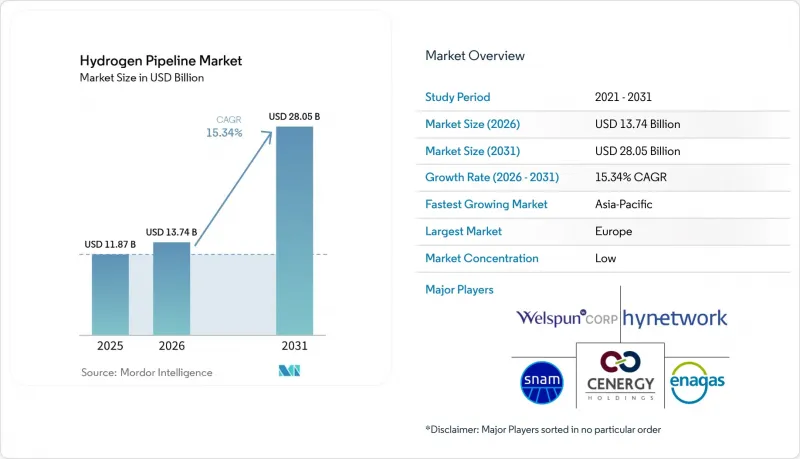
Global Hydrogen Pipeline Market Trends and Insights
Industrial Decarbonization and Hydrogen Demand
Hard-to-abate sectors are establishing hydrogen as a long-term industrial input rather than a pilot fuel. This shift is bringing pipeline investment closer to demand from steel, chemical, refining, and industrial clusters. Complete decarbonization of EU crude steel production would require 6 million to 8 million tons of hydrogen per year, comparable to current global hydrogen demand. Germany's steel sector alone could require 850,000 tons per year of hydrogen via the national grid by 2030. Salzgitter AG finalized a 7-year agreement with EWE for 10,000 tons of green hydrogen per year starting in 2030, with delivery planned via the German core network. Research published in 2025 found that green hydrogen direct-reduced iron pathways could become cost-competitive in the European Union by 2035, supporting longer-term network planning.
Government Hydrogen Infrastructure Funding and Regulation
Public funding is supporting hydrogen supply while also seeking to provide transport projects with a clearer revenue base. The UK government confirmed more than GBP 500 million in June 2025 for its first regional hydrogen transport and storage network, intended to connect producers and industrial users in Merseyside, Teesside, and the Humber. KfW committed a EUR 24 billion (USD 27.76 billion) loan facility for Germany's hydrogen core network amortization account, with the federal government covering 76% of the repayment risk. In June 2026, the Bundesnetzagentur consulted on a plan for a 9,241 km hydrogen network by 2037, with total costs of EUR 24.3 billion (USD 28.11 billion). Uneven adoption of the European Union gas and hydrogen framework can create tariff differences across borders and delay final investment decisions. The UK's July 2025 consultation on an economic framework for 100% hydrogen pipeline networks indicates that the regulatory framework remains under development.
High Capital Cost and Slow Permitting
Capital costs and long permitting periods remain immediate constraints for project delivery. The Netherlands Court of Audit reported in December 2025 that the national hydrogen network experienced low initial throughput and potential startup losses, despite a state grant mechanism of up to EUR 750 million (~USD 867.72 million). The court found the mechanism ineffective under the then-current demand conditions, raising the risk of underused infrastructure. Many sections of Germany's 9,040 km core network still require permits, tariff approvals, and certification before operation. Hydrogen projects are often assessed under processes designed for natural gas, even though hydrogen has distinct ignition, buoyancy, material, and leakage characteristics. Standards such as ASME B31.12 and Nederlands Normalisatie Instituut (NEN) 3650 are advancing, but their implementation remains uneven across jurisdictions.
Other drivers and restraints analyzed in the detailed report include:
- Repurposing of Natural-Gas Transmission Assets
- Cross-Border Hydrogen Corridors and Import Infrastructure
- Hydrogen Embrittlement, Permeation, and Leakage Risk
For complete list of drivers and restraints, kindly check the Table Of Contents.
Segment Analysis
Fixed pipelines held 71.67% of the hydrogen pipeline market share in 2025, reflecting their role in high-pressure transmission and regional distribution. Hydrogen moves primarily from centralized production sites to industrial clusters, favoring permanent networks. GASCADE's 400 km conversion in Germany demonstrated the scale achievable when existing transmission infrastructure is available. Fixed infrastructure provides a direct route between supply and large industrial users, though it requires capital commitments before each customer connection is fully utilized.
Mobile pipelines are forecast to grow at a 17.67% CAGR through 2031. They primarily use high-pressure tube trailers carrying compressed hydrogen at 200-500 bar. This model serves refueling stations and smaller industrial customers outside the fixed network's coverage. Japan's plan for 30 large-scale hydrogen refueling stations along expressways will require trailer distribution until dedicated links reach those locations. Mobile delivery can also be used to test demand before a permanent connection is built. Once trailer quantities establish steady use on a corridor, operators have a clearer basis for investing in a fixed pipeline. ASME B31.12 remains a key design and pressure-rating reference for fixed hydrogen pipelines in North America. DNV-RP-F318 and ISO 19880 guide offshore and international deployments, while standards for composite tubes are still being finalized.
Metal pipelines accounted for 67.34% of the hydrogen pipeline market share in 2025. API 5L and ISO 3183-qualified carbon and low-alloy steels remain the primary materials for high-pressure, long-distance transmission. Tenaris, Vallourec, JFE Steel, and voestalpine Tubulars maintain hydrogen-service portfolios supported by ASME B31.12 design data. Established installation methods and lower cost per kilometer at large diameters support the use of metal in backbone routes, and existing qualification records make metal a familiar choice for major transmission operators.
Plastics and composites are projected to grow at a 19.24% CAGR through 2031. Their resistance to hydrogen embrittlement and continuous-length installation make them useful for urban crossings and constrained rights-of-way. SoluForce deployed a flexible composite pipe under the Oosterhornkanaal canal crossing in the Netherlands in a single pull, eliminating weld joints at that crossing. A 2025 peer-reviewed study validated thermoplastic composite pipelines with a PA12 liner and carbon-fiber reinforcement at pressures up to 10 MPa. The tested system recorded burst pressure above 60 MPa and low hydrogen permeation. Gas Networks Ireland began testing Purapipe International's composite technology in 2025, with results expected in late 2026. Metal remains suited to large, high-pressure corridors, while composites are gaining relevance in distribution, crossings, and marine applications.
Complete Report Scope:
- By Pipeline Type
- Fixed Pipelines
- Mobile Pipelines
- By Pipeline Structure
- Metal
- Plastics and Composites
- By Pipeline Status
- New-Build Pipelines
- Repurposed Natural-Gas Pipelines
- By Application
- Industrial Feedstock and Refining
- Steel and Metals
- Power Generation and Heating
- Hydrogen Mobility and Refueling
- Others
- By Geography
- Asia-Pacific
- China
- India
- Japan
- South Korea
- ASEAN Countries
- Rest of Asia-Pacific
- North America
- United States
- Canada
- Mexico
- Europe
- Germany
- United Kingdom
- France
- Italy
- NORDIC Countries
- Rest of Europe
- South America
- Brazil
- Argentina
- Rest of South America
- Middle East and Africa
- Saudi Arabia
- South Africa
- Rest of Middle East and Africa
- Asia-Pacific
Geography Analysis
Europe held 38.45% of the hydrogen pipeline market share in 2025. This position reflects regional policy targets, national backbone plans, and early infrastructure development in Dutch and German hydrogen grids. Germany's June 2026 development plan consultation covered a 9,241 km network by 2037, with costs estimated at EUR 24.3 billion (USD 28.11 billion). Snam allocated EUR 200 million to a hydrogen backbone as part of its EUR 14 billion (USD 16.19 billion) investment plan for 2026-2030. Enagas launched a public consultation on its 2,600-km Spanish hydrogen backbone in 2025. The Nordic-Baltic Hydrogen Corridor secured a EUR 6.8 million(USD 7.86 million) European Union grant in July 2025 for feasibility work on a 2,500 km link connecting Finland, Estonia, Latvia, Lithuania, Poland, and Germany. Compliance with the European Union's hydrogen and decarbonized gas framework remains important for permits and tariff-setting.
Asia-Pacific is projected to record an 18.12% CAGR through 2031, making it the fastest-growing region in the hydrogen pipeline market. Japan plans to increase hydrogen supply from 4 million tons per year to 12 million tons per year by 2040 and is advancing a USD 2.7 billion program for liquid hydrogen terminals, carriers, and a 4 km pipeline in Kawasaki capable of transporting 1 million tons per year. South Korea confirmed state funding for a 37.2 km pipeline serving the Saemangeum industrial complex at a cost above KRW 160 billion (USD 0.11 billion). China is building dedicated routes and planning a larger grid. The Energy Industries Council tracked 221 regional hydrogen projects with a potential capital expenditure of USD 407 billion, although only 6.46 GW of 56.35 GW of green hydrogen capacity was under construction as of 2026. In North America, the PIPES Act of 2025 established a dedicated United States hydrogen pipeline safety framework. Cadiz and RIC Energy are evaluating a 220-mile corridor in California under a July 2026 memorandum of understanding.
South America, the Middle East, and Africa are at earlier stages of infrastructure development. Brazil and Argentina have wind and solar resources that could support green hydrogen production for export, with planning in South America centered on port clusters such as Pecem in Brazil. The Middle-East is more strongly positioned around export projects, including Saudi Arabia's NEOM project and Oman's planned corridor from the Port of Duqm. Gasunie signed a joint development agreement in April 2025 for a liquid hydrogen import corridor from Oman to the Netherlands and Germany. African markets, particularly South Africa and Morocco, are attracting investment linked to European import demand. Domestic pipeline development in these regions will depend on stronger local industrial offtake.
- ArcelorMittal
- CENERGY HOLDINGS
- Enagas, S.A.
- Hexagon Purus
- Hynetwork
- JFE Steel Corporation
- Jindal SAW Limited
- NPROXX
- Salzgitter AG
- Snam SPA
- SoluForce B.V.
- Tenaris
- TMK Group
- Vallourec
- voestalpine Tubulars GmbH & Co KG
- Welspun
Additional Benefits:
- The market estimate (ME) sheet in Excel format
- 3 months of analyst support
TABLE OF CONTENTS
1 Introduction
- 1.1 Study Assumptions and Market Definition
- 1.2 Scope of the Study
2 Research Methodology
3 Executive Summary
4 Market Landscape
- 4.1 Market Overview
- 4.2 Market Drivers
- 4.2.1 Industrial Decarbonization and Hydrogen Demand
- 4.2.2 Government Hydrogen Infrastructure Funding and Regulation
- 4.2.3 Repurposing of Natural-Gas Transmission Assets
- 4.2.4 Cross-Border Hydrogen Corridors and Import Infrastructure
- 4.2.5 Binding Offtake-Led Infrastructure Financing
- 4.2.6 Hydrogen Network Conversion Design Platforms and Digital Integrity Monitoring
- 4.3 Market Restraints
- 4.3.1 High Capital Cost and Slow Permitting
- 4.3.2 Hydrogen Embrittlement, Permeation, and Leakage Risk
- 4.3.3 Non-Uniform Qualification of Repurposed Natural-Gas Assets
- 4.3.4 Low-Density Utilization and Uncertain Corridor Load Factors
- 4.4 Value Chain Analysis
- 4.5 Porter's Five Forces Analysis
- 4.5.1 Threat of New Entrants
- 4.5.2 Bargaining Power of Suppliers
- 4.5.3 Bargaining Power of Buyers
- 4.5.4 Threat of Substitutes
- 4.5.5 Competitive Rivalry
5 Market Size and Growth Forecasts (Value)
- 5.1 By Pipeline Type
- 5.1.1 Fixed Pipelines
- 5.1.2 Mobile Pipelines
- 5.2 By Pipeline Structure
- 5.2.1 Metal
- 5.2.2 Plastics and Composites
- 5.3 By Pipeline Status
- 5.3.1 New-Build Pipelines
- 5.3.2 Repurposed Natural-Gas Pipelines
- 5.4 By Application
- 5.4.1 Industrial Feedstock and Refining
- 5.4.2 Steel and Metals
- 5.4.3 Power Generation and Heating
- 5.4.4 Hydrogen Mobility and Refueling
- 5.4.5 Others
- 5.5 By Geography
- 5.5.1 Asia-Pacific
- 5.5.1.1 China
- 5.5.1.2 India
- 5.5.1.3 Japan
- 5.5.1.4 South Korea
- 5.5.1.5 ASEAN Countries
- 5.5.1.6 Rest of Asia-Pacific
- 5.5.2 North America
- 5.5.2.1 United States
- 5.5.2.2 Canada
- 5.5.2.3 Mexico
- 5.5.3 Europe
- 5.5.3.1 Germany
- 5.5.3.2 United Kingdom
- 5.5.3.3 France
- 5.5.3.4 Italy
- 5.5.3.5 NORDIC Countries
- 5.5.3.6 Rest of Europe
- 5.5.4 South America
- 5.5.4.1 Brazil
- 5.5.4.2 Argentina
- 5.5.4.3 Rest of South America
- 5.5.5 Middle East and Africa
- 5.5.5.1 Saudi Arabia
- 5.5.5.2 South Africa
- 5.5.5.3 Rest of Middle East and Africa
- 5.5.1 Asia-Pacific
6 Competitive Landscape
- 6.1 Market Concentration
- 6.2 Strategic Moves
- 6.3 Market Share (%)/Ranking Analysis
- 6.4 Company Profiles (includes Global Overview, Market Overview, Core Segments, Financials as available, Strategic Information, Products and Services, and Recent Developments)
- 6.4.1 ArcelorMittal
- 6.4.2 CENERGY HOLDINGS
- 6.4.3 Enagas, S.A.
- 6.4.4 Hexagon Purus
- 6.4.5 Hynetwork
- 6.4.6 JFE Steel Corporation
- 6.4.7 Jindal SAW Limited
- 6.4.8 NPROXX
- 6.4.9 Salzgitter AG
- 6.4.10 Snam SPA
- 6.4.11 SoluForce B.V.
- 6.4.12 Tenaris
- 6.4.13 TMK Group
- 6.4.14 Vallourec
- 6.4.15 voestalpine Tubulars GmbH & Co KG
- 6.4.16 Welspun
7 Market Opportunities and Future Outlook
- 7.1 White-Space and Unmet-Need Assessment

