PUBLISHER: Global Market Insights Inc. | PRODUCT CODE: 2101571

PUBLISHER: Global Market Insights Inc. | PRODUCT CODE: 2101571
Commercial Vehicle Leasing Market Opportunity, Growth Drivers, Industry Trend Analysis, and Forecast 2026 - 2035
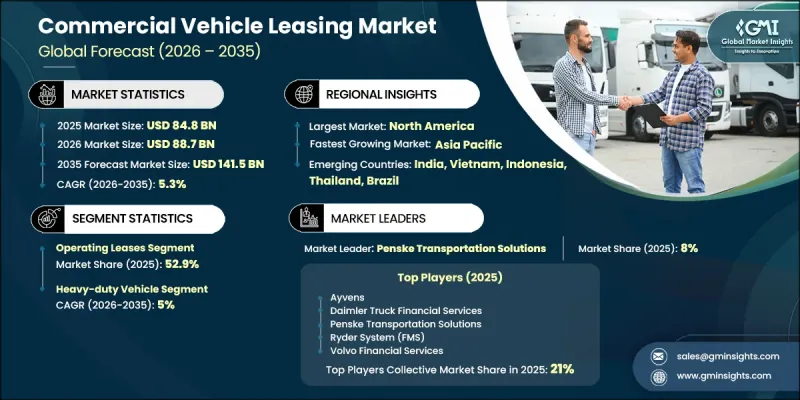
The Global Commercial Vehicle Leasing Market was valued at USD 84.8 billion in 2025 and is estimated to grow at a CAGR of 5.3% to reach USD 141.5 billion by 2035.
The market continues to expand as organizations across multiple industries increasingly favor leasing over direct fleet ownership to improve financial flexibility and optimize operating costs. Strong adoption of operating leases, finance leases, and short-term rental agreements reflects the growing preference for asset-light fleet management strategies. Rising borrowing costs have encouraged businesses to prioritize operating expenses over large capital investments, making leasing a more attractive solution for commercial vehicle acquisition. In addition, stricter vehicle emission regulations across several regions are accelerating fleet replacement cycles, creating consistent demand for leased vehicles. The growing integration of value-added services within leasing contracts has further enhanced the appeal of these solutions by providing customers with comprehensive fleet management support beyond vehicle financing. Services such as maintenance, insurance, telematics, and regulatory compliance continue to increase the overall value proposition of leasing programs. These structural factors are collectively strengthening long-term demand and supporting steady expansion across the global commercial vehicle leasing market.
| Market Scope | |
|---|---|
| Start Year | 2025 |
| Forecast Year | 2026-2035 |
| Start Value | $84.8 Billion |
| Forecast Value | $141.5 Billion |
| CAGR | 5.3% |
The operating leases segment held 52.9% share in 2025 and is projected to grow at a CAGR of 5.9% through 2035. The continued dominance of this segment reflects increasing corporate preference for leasing structures that improve capital allocation while reducing ownership-related financial exposure. Businesses continue to favor full-service operating lease agreements because they combine vehicle access with maintenance, insurance, telematics, and fleet management services, allowing organizations to improve operational efficiency while minimizing administrative responsibilities.
The heavy-duty vehicle segment accounted for 37.7% share in 2025 and is forecast to grow at a CAGR of 5% through 2035. Demand within this category continues to benefit from rising outsourcing activities across freight transportation, logistics, and construction industries. Leasing remains an attractive option for organizations requiring high-capacity commercial vehicles because it offers greater financial flexibility, supports regular fleet modernization, and reduces long-term ownership commitments while ensuring reliable fleet availability.
North America Commercial Vehicle Leasing Market held 34.3% share in 2025 and is anticipated to grow at a CAGR of 5.4% during 2026-2035. The United States continues to lead regional demand due to the widespread adoption of outsourced fleet management solutions across large commercial enterprises. Long-term leasing agreements remain a preferred approach for organizations seeking efficient fleet operations, while the region's well-developed fleet management infrastructure continues to support stable market growth. Ongoing improvements in leasing activity further reflect strengthening business confidence and sustained demand for outsourced transportation solutions.
Major companies operating in the global commercial vehicle leasing market include Ayvens, Daimler Truck Financial Services, Ford Pro Financial Services, Isuzu Finance of America, Leasys, Penske Transportation Solutions, Ryder System (FMS), and Volvo Financial Services. Companies operating in the commercial vehicle leasing market continue to strengthen their competitive position by expanding full-service leasing programs that combine vehicle financing with maintenance, insurance, telematics, and fleet management solutions. Market participants are enhancing customer value through flexible leasing terms that accommodate changing fleet requirements while improving operational efficiency. Businesses are also investing in digital fleet management platforms that provide real-time vehicle monitoring, performance analytics, and maintenance scheduling to improve customer experience. Geographic expansion, stronger dealer and service partnerships, and broader commercial vehicle portfolios continue to support wider market penetration.
Table of Contents
Chapter 1 Methodology & Scope
- 1.1 Research approach
- 1.2 Quality Commitments
- 1.2.1 GMI AI policy & data integrity commitment
- 1.2.1.1 Source consistency protocol
- 1.2.1 GMI AI policy & data integrity commitment
- 1.3 Research Trail & Confidence Scoring
- 1.3.1 Research Trail Components
- 1.3.2 Scoring Components
- 1.4 Data Collection
- 1.4.1 Partial list of primary sources
- 1.5 Data mining sources
- 1.5.1 Paid sources
- 1.5.1.1 Sources, by region
- 1.5.1 Paid sources
- 1.6 Base estimates and calculations
- 1.6.1 Base year calculation
- 1.7 Forecast
- 1.7.1 Quantified market impact analysis
- 1.7.1.1 Mathematical impact of growth parameters on forecast
- 1.7.1 Quantified market impact analysis
- 1.8 Research transparency addendum
- 1.8.1 Source attribution framework
- 1.8.2 Quality assurance metrics
- 1.8.3 Our commitment to trust
Chapter 2 Executive Summary
- 2.1 Industry 360° synopsis
- 2.2 Key market trends
- 2.2.1 Regional
- 2.2.2 Lease
- 2.2.3 Vehicle
- 2.2.4 Lease Duration
- 2.2.5 End Use
- 2.2.6 Propulsion
- 2.3 TAM Analysis, 2026-2035
- 2.4 CXO perspectives: Strategic imperatives
Chapter 3 Industry Insights
- 3.1 Industry ecosystem analysis
- 3.1.1 Supplier landscape
- 3.1.1.1 Raw material suppliers
- 3.1.1.2 Component suppliers
- 3.1.1.3 Manufacturers
- 3.1.1.4 Service providers
- 3.1.1.5 Distribution channel
- 3.1.1.6 End Use
- 3.1.2 Cost structure
- 3.1.3 Profit margin
- 3.1.4 Value addition at each stage
- 3.1.5 Vertical integration trends
- 3.1.6 Disruptors
- 3.1.1 Supplier landscape
- 3.2 Industry impact forces
- 3.2.1 Growth drivers
- 3.2.1.1 Corporate fleet outsourcing
- 3.2.1.2 E-commerce & last-mile delivery growth
- 3.2.1.3 Emission regulations driving fleet renewal
- 3.2.1.4 Telematics-enabled fleet management
- 3.2.2 Market Restraints
- 3.2.2.1 High interest rates
- 3.2.2.2 EV residual value uncertainty
- 3.2.2.3 High EV fleet transition costs
- 3.2.3 Market Opportunities
- 3.2.3.1 Full-service EV leasing
- 3.2.3.2 Truck-as-a-Service (TaaS) & subscription leasing
- 3.2.3.3 Fleet outsourcing in emerging markets
- 3.2.3.4 Government green fleet programs
- 3.2.1 Growth drivers
- 3.3 Growth potential analysis
- 3.4 Technology and Innovation landscape
- 3.4.1 Current technologies
- 3.4.2 Emerging technologies
- 3.5 Pricing Analysis (Driven by Primary Research)
- 3.5.1 Historical Price Trend Analysis
- 3.5.2 Pricing Strategy by Player Type (Premium / Value / Cost-plus)
- 3.6 Regulatory guideline
- 3.6.1 North America
- 3.6.1.1 Environmental Protection Agency (EPA)
- 3.6.1.2 National Highway Traffic Safety Administration (NHTSA)
- 3.6.1.3 Federal Motor Carrier Safety Administration (FMCSA)
- 3.6.1.4 U.S. Department of Transportation (DOT)
- 3.6.1.5 Canadian National Safety Code (NSC) for Motor Carriers
- 3.6.2 Europe
- 3.6.2.1 EU Mobility Package
- 3.6.2.2 Euro VII Emission Standards
- 3.6.2.3 General Safety Regulation (GSR)
- 3.6.2.4 Alternative Fuels Infrastructure Regulation (AFIR)
- 3.6.2.5 European Agreement Concerning the Work of Crews of Vehicles Engaged in International Road Transport (AETR)
- 3.6.3 Asia Pacific
- 3.6.3.1 China VI Emission Standards
- 3.6.3.2 China Road Transport Regulations
- 3.6.3.3 Central Motor Vehicles Rules (CMVR) - India
- 3.6.3.4 Japan Road Transport Vehicle Act
- 3.6.3.5 Australian Heavy Vehicle National Law (HVNL)
- 3.6.4 Latin America
- 3.6.4.1 Brazilian National Traffic Council (CONTRAN)
- 3.6.4.2 Brazilian National Land Transport Agency (ANTT)
- 3.6.4.3 Mexican Official Standards (NOM) for Commercial Vehicles
- 3.6.4.4 Regional Vehicle Registration & Fleet Licensing Requirements
- 3.6.5 MEA
- 3.6.5.1 GCC Standardization Organization (GSO) Vehicle Regulations
- 3.6.5.2 Saudi Transport General Authority (TGA)
- 3.6.5.3 South African National Road Traffic Act (NRTA)
- 3.6.5.4 UAE Federal Traffic Law & Commercial Vehicle Regulations
- 3.6.1 North America
- 3.7 Trade data analysis (Driven by Paid Research)
- 3.7.1 Import/export volume & value trends
- 3.7.2 Key trade corridors & tariff impact
- 3.8 Impact of AI & generative AI on the market
- 3.8.1 AI-driven disruption of existing business models
- 3.8.2 GenAI use cases & adoption roadmap by segment
- 3.8.3 Risks, limitations & regulatory considerations
- 3.9 Capacity & production landscape (Driven by Primary Research)
- 3.9.1 Installed capacity by region & key producer
- 3.9.2 Capacity utilization rates & expansion pipelines
- 3.10 Cost breakdown analysis
- 3.11 Patent analysis (Driven by Primary Research)
- 3.12 Porter's analysis
- 3.13 PESTEL analysis
- 3.14 Sustainability and environmental aspects
- 3.14.1 Sustainable practices
- 3.14.2 Waste reduction strategies
- 3.14.3 Energy efficiency in production
- 3.14.4 Eco-friendly Initiatives
- 3.14.5 Carbon footprint considerations
- 3.15 Forecast assumptions & scenario analysis (Driven by Primary Research)
- 3.15.1 Base Case key macro & industry variables driving CAGR
- 3.15.2 Optimistic Scenarios Favorable macro and industry tailwinds
- 3.15.3 Pessimistic Scenario Macroeconomic slowdown or industry headwinds
Chapter 4 Competitive Landscape, 2025
- 4.1 Introduction
- 4.2 Company market share analysis
- 4.2.1 North America
- 4.2.2 Europe
- 4.2.3 Asia-Pacific
- 4.2.4 Latin America
- 4.2.5 Middle East & Africa
- 4.3 Competitive positioning matrix
- 4.4 Key developments
- 4.4.1 Mergers & acquisitions
- 4.4.2 Partnerships & collaborations
- 4.4.3 New product launches
- 4.4.4 Expansion plans and funding
- 4.5 Company tier benchmarking
- 4.5.1 Tier classification criteria & qualifying thresholds
- 4.5.2 Tier positioning matrix by revenue, geography & innovation
Chapter 5 Market Estimates & Forecast, By Lease, 2022 - 2035 ($Mn, Fleet Size)
- 5.1 Key trends
- 5.2 Operating Lease
- 5.3 Finance Lease
- 5.4 Short-Term Rental
Chapter 6 Market Estimates & Forecast, By Vehicle, 2022 - 2035 ($Mn, Fleet Size)
- 6.1 Key trends
- 6.2 Light duty
- 6.2.1 Class 1
- 6.2.2 Class 2
- 6.2.3 Class 3
- 6.3 Medium duty
- 6.3.1 Class 4
- 6.3.2 Class 5
- 6.3.3 Class 6
- 6.4 Heavy duty
- 6.4.1 Class 7
- 6.4.2 Class 8
- 6.5 Buses & Coaches
- 6.6 Specialty & Other Vehicles
Chapter 7 Market Estimates & Forecast, By Lease Duration, 2022 - 2035 ($Mn, Fleet Size)
- 7.1 Key trends
- 7.2 Short-Term (Up to 12 Months)
- 7.3 Medium-Term (1-3 Years)
- 7.4 Long-Term (More than 3 Years)
Chapter 8 Market Estimates & Forecast, By End Use, 2022 - 2035 ($Mn, Fleet Size)
- 8.1 Key trends
- 8.2 Transportation & Logistics
- 8.3 Retail & E-commerce
- 8.4 Construction & Mining
- 8.5 Manufacturing
- 8.6 Government & Public Sector
- 8.7 Utilities
- 8.8 Oil & Gas
- 8.9 Healthcare
- 8.10 Others
Chapter 9 Market Estimates & Forecast, By Propulsion, 2022 - 2035 ($Mn, Fleet Size)
- 9.1 Key Trends
- 9.2 ICE
- 9.3 BEV
- 9.4 PHEV
- 9.5 FCEV
Chapter 10 Market Estimates & Forecast, By Region, 2022 - 2035 ($Mn, Fleet Size)
- 10.1 Key Trends
- 10.2 North America
- 10.2.1 US
- 10.2.2 Canada
- 10.3 Europe
- 10.3.1 UK
- 10.3.2 Germany
- 10.3.3 France
- 10.3.4 Italy
- 10.3.5 Spain
- 10.3.6 Russia
- 10.3.7 Nordics
- 10.4 Asia Pacific
- 10.4.1 China
- 10.4.2 India
- 10.4.3 Japan
- 10.4.4 South Korea
- 10.4.5 Southeast Asia
- 10.4.5.1 Indonesia
- 10.4.5.2 Malaysia
- 10.4.5.3 Singapore
- 10.4.5.4 Thailand
- 10.4.5.5 Vietnam
- 10.4.6 ANZ
- 10.5 Latin America
- 10.5.1 Brazil
- 10.5.2 Mexico
- 10.5.3 Argentina
- 10.6 MEA
- 10.6.1 South Africa
- 10.6.2 Saudi Arabia
- 10.6.3 UAE
Chapter 11 Company Profiles
- 11.1 Global Players
- 11.1.1 Alphabet International
- 11.1.2 Arval
- 11.1.3 Ayvens
- 11.1.4 Daimler Truck Financial Services
- 11.1.5 Element Fleet Management
- 11.1.6 Ford Pro Financial Services
- 11.1.7 Holman Enterprises
- 11.1.8 Leasys
- 11.1.9 Penske Transportation Solutions
- 11.1.10 Ryder System
- 11.1.11 Volvo Financial Services
- 11.2 Regional Players
- 11.2.1 Fraikin
- 11.2.2 Idealease
- 11.2.3 Isuzu Finance of America
- 11.2.4 NationaLease
- 11.2.5 Navistar Financial
- 11.2.6 PACCAR Financial / PacLease
- 11.2.7 Traton Financial Services
- 11.3 Emerging Players
- 11.3.1 BYD Fleet Financial Services
- 11.3.2 Wheels Donlen

