PUBLISHER: Mordor Intelligence | PRODUCT CODE: 2115059

PUBLISHER: Mordor Intelligence | PRODUCT CODE: 2115059
Asia Pacific Tourism Vehicle Rental - Market Share Analysis, Industry Trends & Statistics, Growth Forecasts (2026 - 2031)
According to Mordor Intelligence, the Asia Pacific tourism vehicle rental market size market is expected to grow from USD 43.17 billion in 2025 to USD 45.61 billion in 2026 and is forecast to reach USD 60.01 billion by 2031 at 5.64% CAGR over 2026-2031.
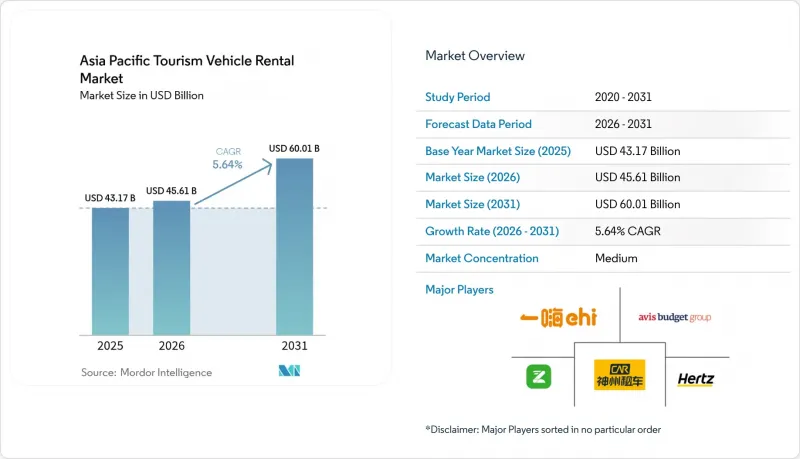
This report is Segmented by Vehicle Type (Economy, SUV / MUV, and More), Booking Mode (Online and Offline), End User (Self-Drive and Chauffeur / Rental-Agency Driven), Rental Duration (Short-Term and More), Service Channel (On-Airport and Off-Airport), and Country. The Market Forecasts are Provided in Terms of Value (USD).
Asia Pacific Tourism Vehicle Rental Market Trends and Insights
Rebound of inbound & domestic tourism
International arrivals are bouncing back sharply: Japan hosted more than 35 million visitors in 2024 and targets 60 million by 2030 under its Tourism Nation Promotion Basic Plan, anchoring fresh demand for regional car rentals. Domestic excursions in China already exceed pre-COVID peaks, and the country intends to eclipse the United States as the world's largest travel market by 2030. The widening appetite for "slow travel" and off-grid itineraries is driving self-drive and one-way rental uptake, particularly on secondary airport routes and heritage trails. As passengers look beyond standard group tours, the Asia Pacific tourism vehicle rental market benefits from diverse booking durations, including micro-vacations and multiday itineraries. This recovery is also sparking demand for larger vehicle classes that allow multigenerational families to travel together, fueling SUV/MUV penetration across the Asia Pacific tourism vehicle rental market.
Mobile OTA & super-app penetration
Mobile gross bookings in Northeast Asia are set to reach a new high in 2025, outpacing 2019 levels and consolidating online dominance. Super-apps such as Grab, Gojek, and Didi are embedding rental modules inside ride-hailing menus, eliminating app-switching friction and turning spontaneous trips into structured rentals. For traditional operators, the pivot from offline counters to digital funnels means repricing commission structures and integrating API-based inventory feeds in real time. In Thailand and Indonesia, super-app mobility passes that bundle rides, rentals, and last-mile delivery services are driving higher frequency among urban millennials. Consequently, the Asia Pacific tourism vehicle rental market is re-architecting distribution toward "anywhere pick-up" models, reshaping legacy return policies and backend fleet-management logic.
Volatile fuel prices
Fluctuating pump prices compress rental margins and stoke consumer price sensitivity, especially among leisure travelers who pre-pay bundles. Operators in markets importing refined products-such as the Philippines and South Korea-face currency depreciation that compounds procurement costs. Dynamic fuel surcharges can preserve yields but often erode price transparency on OTA listings, deterring bargain hunters. While EV uptake offers a strategic hedge, charging infrastructure gaps and higher acquisition costs limit immediate relief. The Asia Pacific tourism vehicle rental market therefore maintains cautious fleet renewal cycles, prioritizing fuel-efficient engine variants and hybrid powertrains where subsidies apply.
Other drivers and restraints analyzed in the detailed report include:
- Rising middle-class road-trip culture
- ASEAN digital licence interoperability
- Ride-hailing & MaaS substitution
For complete list of drivers and restraints, kindly check the Table Of Contents.
Segment Analysis
In 2025 the economy class still supplied 41.02% of Asia Pacific tourism vehicle rental market share, but future mixes skew toward crossovers and seven-seat MPVs. SUV/MUV demand is rewriting fleet economics in the Asia Pacific tourism vehicle rental market. The segment's 5.98% CAGR to 2031 outpaces the core economy class as middle-income families prioritize cabin comfort, luggage volume, and perceived safety. Japanese inbound arrivals frequently request hybrid SUVs to match long countryside drives, while Chinese millennials opt for MUVs on road trips to Hainan Island. At the high end, luxury marques like Lexus RX and BMW X5 lure corporate travelers in Australia who can offset fees via business expense claims.
Rental companies enjoy a dual benefit: higher average daily rates and lower per-kilometer depreciation due to stronger residual values of premium vehicles. Many operators therefore partner with automakers for fleet buy-back guarantees, protecting residuals against oversupply. Electric SUVs from BYD and MG are entering pilot fleets in Singapore and Shenzhen, signaling an EV twist in premiumization. With component shortages easing, firms are front-loading orders for 2026 models to hedge future supply risk.
Online portals account for 63.62% of Asia Pacific tourism vehicle rental market share in 2025, converting discovery to booking within a few taps and capturing mobile-native travelers across South Korea and Taiwan, the online segment grows at a CAGR of 5.73% through 2031. Super-app integration means the Asia Pacific tourism vehicle rental market now surfaces inside ride-hailing dashboards, turning casual scrolling into rental intent. Offline counters, however, retain importance in regions such as Laos and Cambodia where tourists prefer assistance with local insurance options and language translation.
Comparison widgets that bundle fuel policies, collision-damage waivers, and loyalty perks are narrowing perceived price gaps between big brands and independents. As a corollary, franchise operators embrace channel-management software to synchronize rate parity and cancel penalties across GDS feeds, preventing revenue leakage.
Complete Report Scope:
- By Vehicle Type
- Economy
- SUV / MUV
- Luxury / Premium
- By Booking Mode
- Online
- Offline
- By End User
- Self-drive (Leisure & Business)
- Chauffeur / Rental-agency driven
- By Rental Duration
- Short-term (Less than or equal to 7 days)
- Medium-term (8 to 30 days)
- Long-term (More than 30 days)
- By Service Channel
- On-airport
- Off-airport
- By Country
- China
- India
- Japan
- Australia & New Zealand
- South Korea
- Indonesia
- Singapore
- Thailand
- Rest of Asia Pacific
List of Companies Covered in this Report:
- Beijing China Auto Rental (CAR Inc.)
- eHi Car Services
- Hertz Corporation
- Avis Budget Group
- Sixt SE
- Zoomcar
- Carzonrent
- Drivezy
- Shouqi Car Rental
- Top One Car Rental
- Enterprise Mobility
- Europcar Mobility Group
- Zuzuche
- Didi Chuxing (Hello Car)
- Ola Drive
- Uber Rent
- Klook Mobility
- Gojek GoCar
- GrabRentals
- Thai Rent-a-Car
Additional Benefits:
- The market estimate (ME) sheet in Excel format
- 3 months of analyst support
TABLE OF CONTENTS
1 Introduction
- 1.1 Study Assumptions & Market Definition
- 1.2 Scope of the Study
2 Research Methodology
3 Executive Summary
4 Market Landscape
- 4.1 Market Overview
- 4.2 Market Drivers
- 4.2.1 Rebound of inbound & domestic tourism
- 4.2.2 Mobile OTA & super-app penetration
- 4.2.3 Rising middle-class road-trip culture
- 4.2.4 Mobility-pass bundles via super-apps
- 4.2.5 ASEAN digital licence interoperability
- 4.2.6 Carbon-credit incentives for EV rentals
- 4.3 Market Restraints
- 4.3.1 Volatile fuel prices
- 4.3.2 Ride-hailing & MaaS substitution
- 4.3.3 Urban ICE-free zones in tier-1 cities
- 4.3.4 Semiconductor-linked fleet shortages
- 4.4 Value / Supply-Chain Analysis
- 4.5 Regulatory Landscape
- 4.6 Technological Outlook
- 4.7 Porter's Five Forces
- 4.7.1 Bargaining Power of Suppliers
- 4.7.2 Bargaining Power of Buyers / Consumers
- 4.7.3 Threat of New Entrants
- 4.7.4 Threat of Substitutes
- 4.7.5 Intensity of Competitive Rivalry
5 Market Size & Growth Forecasts (Value (USD))
- 5.1 By Vehicle Type
- 5.1.1 Economy
- 5.1.2 SUV / MUV
- 5.1.3 Luxury / Premium
- 5.2 By Booking Mode
- 5.2.1 Online
- 5.2.2 Offline
- 5.3 By End User
- 5.3.1 Self-drive (Leisure & Business)
- 5.3.2 Chauffeur / Rental-agency driven
- 5.4 By Rental Duration
- 5.4.1 Short-term (Less than or equal to 7 days)
- 5.4.2 Medium-term (8 to 30 days)
- 5.4.3 Long-term (More than 30 days)
- 5.5 By Service Channel
- 5.5.1 On-airport
- 5.5.2 Off-airport
- 5.6 By Country
- 5.6.1 China
- 5.6.2 India
- 5.6.3 Japan
- 5.6.4 Australia & New Zealand
- 5.6.5 South Korea
- 5.6.6 Indonesia
- 5.6.7 Singapore
- 5.6.8 Thailand
- 5.6.9 Rest of Asia Pacific
6 Competitive Landscape
- 6.1 Market Concentration
- 6.2 Strategic Moves
- 6.3 Market Share Analysis
- 6.4 Company Profiles (includes Global Level Overview, Market Level Overview, Core Segments, Financials as Available, Strategic Information, Market Rank/Share for Key Companies, Products and Services, SWOT Analysis, and Recent Developments)
- 6.4.1 Beijing China Auto Rental (CAR Inc.)
- 6.4.2 eHi Car Services
- 6.4.3 Hertz Corporation
- 6.4.4 Avis Budget Group
- 6.4.5 Sixt SE
- 6.4.6 Zoomcar
- 6.4.7 Carzonrent
- 6.4.8 Drivezy
- 6.4.9 Shouqi Car Rental
- 6.4.10 Top One Car Rental
- 6.4.11 Enterprise Mobility
- 6.4.12 Europcar Mobility Group
- 6.4.13 Zuzuche
- 6.4.14 Didi Chuxing (Hello Car)
- 6.4.15 Ola Drive
- 6.4.16 Uber Rent
- 6.4.17 Klook Mobility
- 6.4.18 Gojek GoCar
- 6.4.19 GrabRentals
- 6.4.20 Thai Rent-a-Car
7 Market Opportunities & Future Outlook
- 7.1 White-space & Unmet-need Assessment

