PUBLISHER: Mordor Intelligence | PRODUCT CODE: 2116599

PUBLISHER: Mordor Intelligence | PRODUCT CODE: 2116599
Europe Tourism Vehicle Rental - Market Share Analysis, Industry Trends & Statistics, Growth Forecasts (2026 - 2031)
According to Mordor Intelligence, the Europe tourism vehicle rental market size is expected to grow from USD 173.28 billion in 2025 to USD 200.77 billion in 2026 and is forecast to reach USD 419.21 billion by 2031 at 15.86% CAGR over 2026-2031.
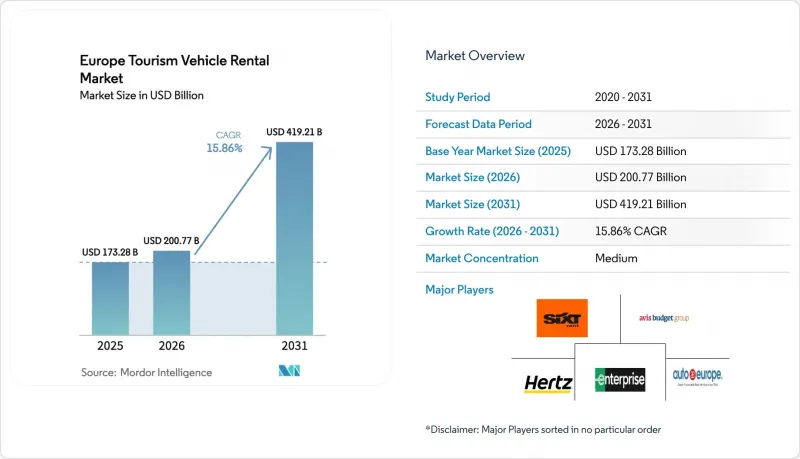
This report is Segmented by Application (Leisure/Tourism and Business), Booking Channel (Online and Offline), Rental Duration (Short-Term and Long-Term), Vehicle Type (Economy/Compact, SUV and Crossover, and More) and Country (United Kingdom, Germany, and More). The Market Forecasts are Provided in Terms of Value (USD).
Europe Tourism Vehicle Rental Market Trends and Insights
Post-pandemic intra-Europe leisure boom sustains rental demand
Demand has tilted toward flexible road trips as airport slot shortages and rail bottlenecks persist, making the Europe tourism vehicle rental market integral to itinerary planning. EU tourist establishments logged more than 3 billion guest-nights in 2024, a record that directly converted into higher fleet utilisation. Spain, Italy, and France captured the bulk of incremental visitors, rewarding operators located at gateway airports and downtown depots. Rental companies also lengthened average contract days because travelers explored multiple secondary cities per trip.
Shift from ownership to usership among Gen Z travellers
Digital-native Gen Z consumers perceive vehicles as on-demand mobility solutions rather than depreciating assets, dovetailing with car-sharing and subscription offers. Survey data show 57% of non-EV drivers across 12 EU states are open to battery-electric usage in the next vehicle decision cycle. Netherlands-based car-share platforms logged around one fifth of the rise in corporate memberships, signalling wider crossover from business mobility budgets to leisure extensions.
Ultra-low-cost public transport in CEE markets hampers conversion
Governments in Poland, Hungary, and Romania subsidise bus and rail fares that undercut daily rental rates by up to 70%. The price gap discourages tourists from booking cars, especially for point-to-point city breaks. Additionally, CEE cities have expanded multimodal ticketing that integrates trams, metro, and inter-city coaches, lowering friction for riders. Rental operators face utilisation dips during shoulder seasons when discretionary spend tightens. Some have responded by repositioning idle vehicles to Western markets, but logistics costs trim margins.
Other drivers and restraints analyzed in the detailed report include:
- Air-rail capacity pinch pushes tourists to road trips in Southern Europe
- Electric-vehicle subsidy schemes favour rental fleet renewals (2025-2028)
- EV charging-infrastructure latency at rural tourist hot-spots
For complete list of drivers and restraints, kindly check the Table Of Contents.
Segment Analysis
The leisure segment accounted for 66.42% of the Europe tourism vehicle rental market in 2025, and it is projected to outpace the overall market with a 16.12% CAGR to 2031, underscoring its dual role as both volume and growth engine. Leisure bookings surged as EU guest-night totals hit 3 billion in 2024, reflecting travelers' preference for flexible road itineraries over group tours, a 2.2% increase compared to 2023. Intraregional trips represented 70% of cross-border flows, extending average rental durations and enhancing yield per contract. Multi-city journeys also increased one-way drop-off revenue.
Leisure growth also benefits from EU push for seamless Schengen travel, allowing tourists to drive across multiple countries without border controls. Promotional campaigns such as Spain's "Travel Safe" initiative strengthened destination confidence, supporting longer stays that align with extended vehicle bookings. Digital influencers amplify road-trip itineraries, inspiring younger segments to replicate similar experiences, further widening the rental funnel.
Online channels captured 72.84% of 2025 rental transactions and are forecast to log a 16.05% CAGR through 2031, cementing their primacy in customer acquisition. Algorithmic meta-search visibility, instant confirmation, and transparent pricing underpin customer trust. The EU Digital Markets Act labelled Booking Holdings a gatekeeper in 2024, raising the likelihood of higher commission structures. Operators mitigate dependence on intermediaries by refining direct-to-consumer apps that bundle rewards and seamless check-in.
Dynamic-pricing engines embedded in operator web portals sharpen revenue capture by tailoring rates to search-history signals. Free2move's all-in-one mobility app offers access to more than 500,000 vehicles worldwide, integrating short-term rental, car-sharing, and subscription plans. Such super-apps reframe bookings as part of broader mobility ecosystems, reinforcing customer lifetime value.
Complete Report Scope:
- By Application
- Leisure / Tourism
- Business
- By Booking Channel
- Online
- Offline
- By Rental Duration
- Short-term
- Long-term
- By Vehicle Type
- Economy/Compact
- SUV and Crossover
- Luxury and Premium
- Electric and Hybrid
- By Country
- United Kingdom
- Germany
- Italy
- France
- Spain
- Rest of Europe
List of Companies Covered in this Report:
- Enterprise Holdings Inc.
- Avis Budget Group
- Europcar Mobility Group
- Hertz Global Holdings Inc.
- Sixt SE
- Booking Holdings Inc. (Rentalcars.com)
- Auto Europe
- OK Mobility
- Virtuo
- Green Motion International
- Getaround
- Carwiz International
Additional Benefits:
- The market estimate (ME) sheet in Excel format
- 3 months of analyst support
TABLE OF CONTENTS
1 Introduction
- 1.1 Study Assumptions and Market Definition
- 1.2 Scope of the Study
2 Research Methodology
3 Executive Summary
4 Market Landscape
- 4.1 Market Overview
- 4.2 Market Drivers
- 4.2.1 Post-pandemic intra-Europe leisure boom sustains rental demand
- 4.2.2 Shift from ownership to usership among Gen-Z travellers
- 4.2.3 Air-rail capacity pinch pushes tourists to road trips in Southern Europe
- 4.2.4 Electric-vehicle subsidy schemes favour rental fleet renewals (2025-2028)
- 4.2.5 Dynamic-pricing algorithms lift average daily rates for operators
- 4.2.6 5G/telematics integration enables real-time fleet optimisation
- 4.3 Market Restraints
- 4.3.1 Ultra-low-cost public transport in CEE markets hampers conversion
- 4.3.2 EV charging-infrastructure latency at rural tourist hot-spots
- 4.3.3 EU Digital Markets Act may raise OTA distribution costs
- 4.3.4 Surge-pricing caps proposed by Italy and Spain regulators
- 4.4 Value/Supply-Chain Analysis
- 4.5 Regulatory Landscape
- 4.6 Technological Outlook
- 4.7 Porter's Five Forces
- 4.7.1 Threat of New Entrants
- 4.7.2 Bargaining Power of Buyers
- 4.7.3 Bargaining Power of Suppliers
- 4.7.4 Threat of Substitutes
- 4.7.5 Intensity of Competitive Rivalry
5 Market Size and Growth Forecasts (Value (USD))
- 5.1 By Application
- 5.1.1 Leisure / Tourism
- 5.1.2 Business
- 5.2 By Booking Channel
- 5.2.1 Online
- 5.2.2 Offline
- 5.3 By Rental Duration
- 5.3.1 Short-term
- 5.3.2 Long-term
- 5.4 By Vehicle Type
- 5.4.1 Economy/Compact
- 5.4.2 SUV and Crossover
- 5.4.3 Luxury and Premium
- 5.4.4 Electric and Hybrid
- 5.5 By Country
- 5.5.1 United Kingdom
- 5.5.2 Germany
- 5.5.3 Italy
- 5.5.4 France
- 5.5.5 Spain
- 5.5.6 Rest of Europe
6 Competitive Landscape
- 6.1 Market Concentration
- 6.2 Strategic Moves
- 6.3 Market Share Analysis
- 6.4 Company Profiles (Includes Global Level Overview, Market Level Overview, Core Segments, Financials as Available, Strategic Information, Market Rank/Share for Key Companies, Products and Services, SWOT Analysis, and Recent Developments)
- 6.4.1 Enterprise Holdings Inc.
- 6.4.2 Avis Budget Group
- 6.4.3 Europcar Mobility Group
- 6.4.4 Hertz Global Holdings Inc.
- 6.4.5 Sixt SE
- 6.4.6 Booking Holdings Inc. (Rentalcars.com)
- 6.4.7 Auto Europe
- 6.4.8 OK Mobility
- 6.4.9 Virtuo
- 6.4.10 Green Motion International
- 6.4.11 Getaround
- 6.4.12 Carwiz International
7 Market Opportunities and Future Outlook
- 7.1 White-space and Unmet-need Assessment

