PUBLISHER: Global Market Insights Inc. | PRODUCT CODE: 2101595

PUBLISHER: Global Market Insights Inc. | PRODUCT CODE: 2101595
Satellite Thermal Control Systems Market Opportunity, Growth Drivers, Industry Trend Analysis, and Forecast 2026 - 2035
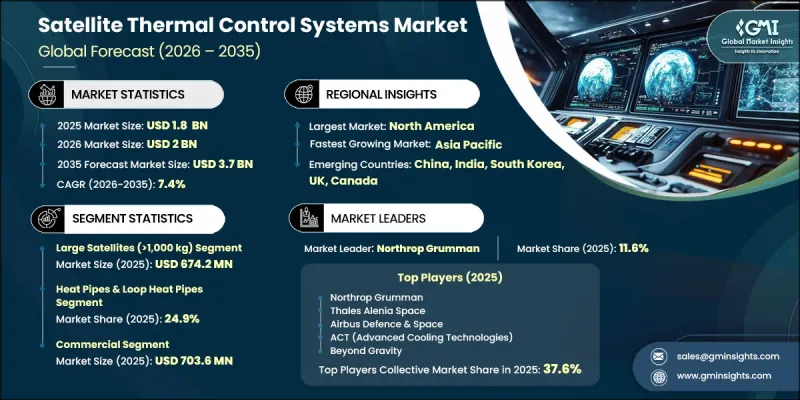
The Global Satellite Thermal Control Systems Market was valued at USD 1.8 billion in 2025 and is estimated to grow at a CAGR of 7.4% to reach USD 3.7 billion by 2035.
The satellite thermal control systems market continues to gain momentum as the number of satellite deployments increases across commercial, civil, and defense applications worldwide. Rising investments in satellite communications, Earth observation, scientific missions, and space exploration are generating sustained demand for advanced thermal management technologies capable of maintaining stable operating conditions in the harsh space environment. Continuous improvements in satellite electronics, increasing onboard processing capabilities, and more compact spacecraft architectures are creating greater thermal management challenges, encouraging broader adoption of high-performance thermal control solutions. As satellites become more powerful and mission durations continue to expand, thermal control systems are playing an increasingly important role in ensuring equipment reliability, extending operational life, and maintaining consistent payload performance. Ongoing technological innovation and expanding satellite production activities are expected to create long-term growth opportunities for the satellite thermal control systems market throughout the forecast period.
| Market Scope | |
|---|---|
| Start Year | 2025 |
| Forecast Year | 2026-2035 |
| Start Value | $1.8 Billion |
| Forecast Value | $3.7 Billion |
| CAGR | 7.4% |
The rapid deployment of Low Earth Orbit (LEO) satellite constellations, along with the growing number of Earth observation programs, continues to support expansion across the satellite thermal control systems market. At the same time, the integration of more advanced onboard technologies, including higher-capacity payloads, next-generation processors, sophisticated communication equipment, and increasingly complex electronic architectures, has significantly increased thermal management requirements. Modern satellite payloads generate considerably higher heat levels than previous generations, creating stronger demand for efficient thermal dissipation solutions capable of maintaining stable operating temperatures throughout extended mission lifecycles.
The large satellites segment, consisting of spacecraft weighing more than 1,000 kg, led the satellite thermal control systems market in 2025 with a valuation of USD 674.2 million. The segment's leadership is supported by the extensive thermal management requirements associated with high-capacity satellite platforms operating demanding missions over long service lives. These spacecraft require comprehensive thermal control architectures capable of effectively managing significant heat generation while ensuring reliable operation of critical onboard systems, making thermal management one of the highest-value subsystem categories within larger satellite platforms.
The commercial segment accounted for USD 703.6 million in 2025. Strong market growth is being driven by increasing deployment of commercial satellite constellations supporting connectivity, navigation, communications, and remote sensing services. Higher levels of private sector investment and growing demand for advanced satellite capabilities are encouraging broader adoption of sophisticated thermal control technologies that enhance payload performance, improve operational efficiency, extend spacecraft service life, and support long-term mission success.
North America Satellite Thermal Control Systems Market held 39.5% share in 2025. The region maintains its leading position due to its well-established space industry, substantial government investment, advanced manufacturing capabilities, and strong presence of satellite developers and subsystem suppliers. Continuous funding for satellite communications, Earth observation, national security, scientific research, and space exploration programs continues to provide stable demand for advanced thermal management technologies, supporting long-term market growth across the regional supply chain.
Key companies participating in the global satellite thermal control systems market include Airbus Defence & Space, Boyd Corporation, ACT (Advanced Cooling Technologies), Redwire Space, Beyond Gravity, ARQUIMEA, Euro Heat Pipes (EHP), Northrop Grumman, Dunmore Corporation, Sierra Space, SAB Aerospace, Thales Alenia Space, Paragon Space Development, Soditech SAS, TMT (Thermal Management Technologies), SQUID3 Space, and Zoppas Industries / IRCA. Companies operating in the satellite thermal control systems market are strengthening their competitive positions by investing in advanced thermal technologies that improve heat dissipation, reduce system weight, and enhance long-term spacecraft reliability. Manufacturers continue to focus on developing highly efficient passive and active thermal management solutions capable of supporting increasingly powerful satellite platforms. Product innovation, continuous research and development, and improved subsystem integration remain central strategies for addressing evolving customer requirements. Companies are also expanding strategic collaborations with satellite manufacturers, increasing production capabilities, and enhancing engineering expertise to support growing satellite deployment programs.
Table of Contents
Chapter 1 Methodology and Scope
- 1.1 Market scope and definition
- 1.2 Research design
- 1.2.1 Research approach
- 1.2.2 Data collection methods
- 1.3 Data mining sources
- 1.3.1 Global
- 1.3.2 Regional/Country
- 1.4 Base estimates and calculations
- 1.4.1 Base year calculation
- 1.4.2 Key trends for market estimation
- 1.5 Primary research and validation
- 1.5.1 Primary sources
- 1.6 Forecast model
- 1.7 Research assumptions and limitations
Chapter 2 Executive Summary
- 2.1 Industry 360° synopsis, 2022 - 2035
- 2.2 Key market trends
- 2.2.1 Component trends
- 2.2.2 Satellite application trends
- 2.2.3 Satellite mass class trends
- 2.2.4 End-user trends
- 2.2.5 Regional trends
- 2.3 TAM Analysis, 2026-2035
- 2.4 CXO perspectives: Strategic imperatives
Chapter 3 Industry Insights
- 3.1 Industry ecosystem analysis
- 3.1.1 Supplier Landscape
- 3.1.2 Profit Margin
- 3.1.3 Cost structure
- 3.1.4 Value addition at each stage
- 3.1.5 Factor affecting the value chain
- 3.1.6 Disruptions
- 3.2 Industry impact forces
- 3.2.1 Growth drivers
- 3.2.1.1 Growing deployment of LEO satellite constellations and Earth observation missions
- 3.2.1.2 Increasing investments in deep-space exploration and lunar missions
- 3.2.1.3 Growing adoption of high-power satellite payloads and onboard electronics
- 3.2.1.4 Expansion of commercial satellite manufacturing and small satellite programs
- 3.2.1.5 Advancements in lightweight thermal control technologies and smart materials
- 3.2.2 Industry pitfalls and challenges
- 3.2.2.1 High development and qualification cost of advanced thermal control systems
- 3.2.2.2 Thermal management complexity in compact and high-power satellites
- 3.2.3 Market opportunities
- 3.2.3.1 Development of next-generation lightweight and smart thermal materials
- 3.2.3.2 Expansion of lunar exploration, commercial space stations, and deep-space missions
- 3.2.1 Growth drivers
- 3.3 Growth potential analysis
- 3.4 Regulatory landscape
- 3.4.1 North America
- 3.4.2 Europe
- 3.4.3 Asia Pacific
- 3.4.4 Latin America
- 3.4.5 Middle East & Africa
- 3.5 Porter's analysis
- 3.6 PESTEL analysis
- 3.7 Technology and Innovation landscape
- 3.7.1 Current technological trends
- 3.7.2 Emerging technologies
- 3.8 Price trends
- 3.8.1 By region
- 3.8.2 By product
- 3.9 Pricing Strategies
- 3.10 Emerging Business Models
- 3.11 Compliance Requirements
- 3.12 Patent and IP analysis
Chapter 4 Competitive Landscape, 2025
- 4.1 Introduction
- 4.2 Company market share analysis
- 4.2.1 By region
- 4.2.1.1 North America
- 4.2.1.2 Europe
- 4.2.1.3 Asia Pacific
- 4.2.1.4 Latin America
- 4.2.1.5 Middle East & Africa
- 4.2.2 Market concentration analysis
- 4.2.1 By region
- 4.3 Competitive benchmarking of key players
- 4.3.1 Financial performance comparison
- 4.3.1.1 Revenue
- 4.3.1.2 Profit margin
- 4.3.1.3 R&D
- 4.3.2 Product portfolio comparison
- 4.3.2.1 Product range breadth
- 4.3.2.2 Technology
- 4.3.2.3 Innovation
- 4.3.3 Geographic presence comparison
- 4.3.3.1 Global footprint analysis
- 4.3.3.2 Service network coverage
- 4.3.3.3 Market penetration by region
- 4.3.4 Competitive positioning matrix
- 4.3.4.1 Leaders
- 4.3.4.2 Challengers
- 4.3.4.3 Followers
- 4.3.4.4 Niche players
- 4.3.5 Strategic outlook matrix
- 4.3.1 Financial performance comparison
- 4.4 Key developments
- 4.4.1 Mergers and acquisitions
- 4.4.2 Partnerships and collaborations
- 4.4.3 Technological advancements
- 4.4.4 Expansion and investment strategies
- 4.4.5 Digital transformation initiatives
- 4.5 Emerging/ startup competitors landscape
Chapter 5 Market Estimates and Forecast, By Component, 2022 - 2035 (USD Million)
- 5.1 Key trends
- 5.2 Multi-layer insulation (MLI)
- 5.3 Radiators
- 5.4 Heat pipes & loop heat pipes
- 5.5 Thermal coatings & surface finishes
- 5.6 Heaters & thermostats
- 5.7 Cryocoolers & thermoelectric coolers (TECs)
- 5.8 Thermal switches
- 5.9 Others
Chapter 6 Market Estimates and Forecast, By Satellite Application, 2022 - 2035 (USD Million)
- 6.1 Key trends
- 6.2 Communication satellites
- 6.3 Earth observation & weather satellites
- 6.4 Navigation satellites
- 6.5 Military, defense & isr satellites
- 6.6 Scientific & research satellites
- 6.7 Technology demonstration satellites
- 6.8 Others
Chapter 7 Market Estimates and Forecast, By Satellite Mass Class, 2022 - 2035 (USD Million)
- 7.1 Key trends
- 7.2 Nanosatellites (<10 kg)
- 7.3 Microsatellites (10-100 kg)
- 7.4 Minisatellites (100-500 kg)
- 7.5 Medium satellites (500-1,000 kg)
- 7.6 Large satellites (>1,000 kg)
Chapter 8 Market Estimates and Forecast, By End-User, 2022 - 2035 (USD Million)
- 8.1 Key trends
- 8.2 Commercial
- 8.3 Government & civil space agencies
- 8.4 Military & Defense
Chapter 9 Market Estimates and Forecast, By Region, 2022 - 2035 (USD Million)
- 9.1 Key trends
- 9.2 North America
- 9.2.1 U.S.
- 9.2.2 Canada
- 9.3 Europe
- 9.3.1 Germany
- 9.3.2 UK
- 9.3.3 France
- 9.3.4 Spain
- 9.3.5 Italy
- 9.4 Asia Pacific
- 9.4.1 China
- 9.4.2 India
- 9.4.3 Japan
- 9.4.4 Australia
- 9.4.5 South Korea
- 9.5 Latin America
- 9.5.1 Brazil
- 9.5.2 Mexico
- 9.5.3 Argentina
- 9.6 Middle East and Africa
- 9.6.1 South Africa
- 9.6.2 Saudi Arabia
- 9.6.3 UAE
Chapter 10 Company Profiles
- 10.1 Global Key Players
- 10.1.1 Northrop Grumman
- 10.1.2 Thales Alenia Space
- 10.1.3 Airbus Defence & Space
- 10.1.4 ACT (Advanced Cooling Technologies)
- 10.1.5 Beyond Gravity
- 10.2 Regional key players
- 10.2.1 North America
- 10.2.1.1 Boyd Corporation
- 10.2.1.2 Dunmore Corporation
- 10.2.1.3 Paragon Space Development
- 10.2.1.4 Redwire Space
- 10.2.2 Asia Pacific
- 10.2.2.1 TMT (Thermal Management Technologies)
- 10.2.3 Europe
- 10.2.3.1 ARQUIMEA
- 10.2.3.2 Euro Heat Pipes (EHP)
- 10.2.3.3 SAB Aerospace
- 10.2.3.4 Soditech SAS
- 10.2.3.5 Zoppas Industries / IRCA
- 10.2.1 North America
- 10.3 Niche Players/Disruptors
- 10.3.1 Sierra Space
- 10.3.2 SQUID3 Space

