PUBLISHER: Global Market Insights Inc. | PRODUCT CODE: 2101601

PUBLISHER: Global Market Insights Inc. | PRODUCT CODE: 2101601
Bisphenol Replacements Market Opportunity, Growth Drivers, Industry Trend Analysis, and Forecast 2026 - 2035
The Global Bisphenol Replacements Market was valued at USD 3.9 billion in 2025 and is estimated to grow at a CAGR of 8.3% to reach USD 8.6 billion by 2035.
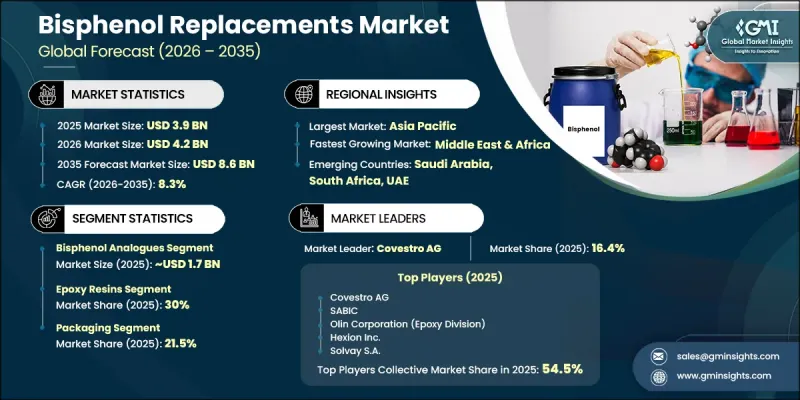
The bisphenol replacements market is undergoing a transformation as manufacturers increasingly shift toward safer and more sustainable material alternatives. Demand patterns continue to evolve across different replacement technologies, with adoption rates varying based on application requirements, regulatory developments, and performance expectations. Bisphenol analogues continue to maintain a strong market presence in applications where direct material replacement remains the most practical and cost-effective solution. At the same time, non-bisphenol synthetic alternatives are gaining wider acceptance as industries prioritize high-performance materials capable of delivering long-term reliability and regulatory compliance. Bio-based replacement technologies are also attracting increasing attention as manufacturers seek renewable solutions that align with sustainability initiatives and changing environmental standards. Market expansion is being supported by stricter regulations governing conventional bisphenol compounds, along with increasing investments in advanced materials used across packaging, electronics, electric mobility, and industrial manufacturing. Improvements in bio-based raw material availability and continuous product innovation are further supporting the commercialization of next-generation bisphenol replacement solutions across global markets.
| Market Scope | |
|---|---|
| Start Year | 2025 |
| Forecast Year | 2026-2035 |
| Start Value | $3.9 Billion |
| Forecast Value | $8.6 Billion |
| CAGR | 8.3% |
The bisphenol replacements market continues to expand as regulatory requirements encourage the adoption of safer chemical alternatives while industries pursue materials that deliver improved performance and long-term reliability. Compliance-driven demand is reducing uncertainty for manufacturers and encouraging investments in production capacity. At the same time, growing requirements from advanced manufacturing industries are strengthening demand for high-performance non-bisphenol synthetic materials, while continued progress in renewable feedstock development is accelerating the commercialization of innovative bio-based replacement technologies.
The bisphenol analogues segment accounted for 44% share in 2025, representing USD 1.7 billion, and is projected to grow at a CAGR of 15.6% through 2035. Their leading market position is supported by strong structural compatibility with conventional bisphenol materials, allowing manufacturers to transition with minimal formulation adjustments. This compatibility continues to encourage adoption in applications where maintaining established manufacturing processes and material performance remains a key priority while controlling production costs.
The packaging segment represented 21.5% share in 2025. Packaging continues to be a major application area as manufacturers increasingly adopt BPA-free materials to comply with evolving regulatory requirements governing food-contact products. Ongoing reformulation efforts across packaging materials continue to generate stable demand for bisphenol replacement technologies in both flexible and rigid packaging applications, supporting long-term market growth.
North America Bisphenol Replacements Market accounted for 24% share in 2025. The regional market is characterized by strong regulatory compliance requirements and continued investments in safer material formulations. The United States remains the primary contributor to regional demand through widespread adoption of BPA-free coatings and packaging materials, while Canada continues to emphasize regulated applications involving food-contact and healthcare-related products. Mexico is emerging as an important growth market, supported by expanding industrial manufacturing activities that are increasing demand for BPA-free materials across automotive, electronics, and broader manufacturing supply chains.
Major companies operating in the global bisphenol replacements market include BASF SE, Covestro AG, SABIC, Hexion Inc., Mitsubishi Chemical Group Corporation, Solvay S.A., Olin Corporation (Epoxy Division), Mitsui Chemicals Inc., LG Chem, Nan Ya Plastics Corporation, UPM Biochemicals, NICCA Chemical Co., Ltd., Nagase ChemteX Corporation, Jiangsu Aolunda High-Tech Industry Co., Ltd., and Specific Polymers SAS. Companies operating in the bisphenol replacements market are strengthening their competitive positions through continuous product innovation, investments in sustainable chemistries, and expansion of advanced material portfolios. Manufacturers are increasing research and development efforts to improve product performance, regulatory compliance, and environmental sustainability while supporting changing customer requirements. Strategic collaborations with downstream manufacturers and industrial partners are helping companies accelerate commercialization and broaden market reach. Businesses are also expanding manufacturing capacity and strengthening supply chain capabilities to ensure reliable product availability across global markets.
Table of Contents
Chapter 1 Methodology & Scope
- 1.1 Research approach
- 1.2 Quality Commitments
- 1.2.1 GMI AI policy & data integrity commitment
- 1.2.1.1 Source consistency protocol
- 1.2.1 GMI AI policy & data integrity commitment
- 1.3 Research Trail & Confidence Scoring
- 1.3.1 Research Trail Components
- 1.3.2 Scoring Components
- 1.4 Data Collection
- 1.4.1 Partial list of primary sources
- 1.5 Data mining sources
- 1.5.1 Paid sources
- 1.5.1.1 Sources, by Region
- 1.5.1 Paid sources
- 1.6 Base estimates and calculations
- 1.6.1 Base Year Calculation for One Approach
- 1.7 Forecast model
- 1.7.1 Quantified market impact analysis
- 1.7.1.1 Mathematical impact of growth parameters on forecast
- 1.7.1 Quantified market impact analysis
- 1.8 Research transparency addendum
- 1.8.1 Source attribution framework
- 1.8.2 Quality assurance metrics
- 1.8.3 Our commitment to trust
Chapter 2 Executive Summary
- 2.1 Industry 360° synopsis
- 2.2 Key market trends
- 2.2.1 Regional
- 2.2.2 Replacement Type
- 2.2.3 Application
- 2.2.4 End-Use Industry
Chapter 3 Industry Insights
- 3.1 Industry ecosystem analysis
- 3.1.1 Supplier landscape
- 3.1.2 Profit margin
- 3.1.3 Value addition at each stage
- 3.1.4 Factor affecting the value chain
- 3.1.5 Disruptions
- 3.2 Industry impact forces
- 3.2.1 Growth drivers
- 3.2.2 Industry pitfalls and challenges
- 3.2.3 Market opportunities
- 3.3 Growth potential analysis
- 3.4 Regulatory landscape
- 3.4.1 North America
- 3.4.2 Europe
- 3.4.3 Asia Pacific
- 3.4.4 Latin America
- 3.4.5 Middle East & Africa
- 3.5 Porter's analysis
- 3.6 PESTEL analysis
- 3.7 Price trends
- 3.7.1 By region
- 3.7.2 By feedstock type
- 3.8 Future market trends
- 3.9 Technology and innovation landscape
- 3.9.1 Current technological trends
- 3.9.2 Emerging technologies
- 3.10 Patent Landscape
- 3.11 Trade statistics (HS code)
- 3.11.1 Major importing countries
- 3.11.2 Major exporting countries
- 3.12 Sustainability and environmental aspects
- 3.12.1 Sustainable practices
- 3.12.2 Waste reduction strategies
- 3.12.3 Energy efficiency in production
- 3.12.4 Eco-friendly initiatives
- 3.13 Carbon footprint consideration
Chapter 4 Competitive Landscape, 2025
- 4.1 Introduction
- 4.2 Company market share analysis
- 4.2.1 By region
- 4.2.1.1 North America
- 4.2.1.2 Europe
- 4.2.1.3 Asia Pacific
- 4.2.1.4 LATAM
- 4.2.1.5 MEA
- 4.2.1 By region
- 4.3 Competitive analysis of major market players
- 4.4 Competitive positioning matrix
- 4.5 Key developments
- 4.5.1 Mergers & acquisitions
- 4.5.2 Partnerships & collaborations
- 4.5.3 New Product Launches
- 4.5.4 Expansion Plans
Chapter 5 Market Estimates and Forecast, By Replacement Type, 2022-2035 (USD Billion) (Kilo Tons)
- 5.1 Key trends
- 5.2 Bisphenol Analogues
- 5.2.1 Bisphenol S (BPS)
- 5.2.2 Bisphenol F (BPF)
- 5.2.3 Bisphenol E (BPE)
- 5.2.4 Other Bisphenol Analogues (BPAF, BPB, BPZ, BPAP)
- 5.3 Non-Bisphenol Synthetic Alternatives
- 5.3.1 Cycloaliphatic Epoxy Resins
- 5.3.2 Novolac Epoxy Resins
- 5.3.3 Glycidylamine Epoxy Resins
- 5.3.4 Acrylic & Other Non-Bisphenol Synthetic Alternatives
- 5.4 Bio-Based Alternatives
- 5.4.1 Vegetable Oil-Derived Alternatives (Epoxidized Soybean Oil, Linseed Oil)
- 5.4.2 Lignin-Derived Alternatives
- 5.4.3 Glycerol & Sugar-Derived Alternatives (Bio-Glycidyl Ethers)
- 5.4.4 Other Bio-Based Alternatives (Cardanol, Rosin, Vanillin, Tannic Acid-Based)
Chapter 6 Market Estimates and Forecast, By Application, 2022-2035 (USD Billion) (Kilo Tons)
- 6.1 Key trends
- 6.2 Epoxy Resins
- 6.2.1 Liquid Epoxy Systems
- 6.2.2 Solid & Powder Epoxy Systems
- 6.2.3 Waterborne Epoxy Systems
- 6.3 Polycarbonate & Engineering Resins
- 6.3.1 Rigid Polycarbonate Substitute Resins
- 6.3.2 Polyethersulfone (PES) & High-Performance Engineering Polymer Applications
- 6.4 Thermal Paper & Ink Developers
- 6.4.1 Point-of-Sale (POS) Receipt Paper
- 6.4.2 Labels, Tags & Ticket Paper
- 6.5 Coatings & Paints
- 6.5.1 Food & Beverage Can Linings (Internal & External)
- 6.5.2 Industrial Protective Coatings (Anti-Corrosion, Pipe & Rebar)
- 6.5.3 Architectural & Decorative Coatings
- 6.6 Adhesives & Sealants
- 6.6.1 Structural Adhesives (Automotive, Construction)
- 6.6.2 Assembly & Lamination Adhesives
- 6.7 Composites & Laminates
- 6.7.1 Fiber-Reinforced Composites (Glass Fiber & Carbon Fiber)
- 6.7.2 Electrical & Electronic Laminates (PCB, CCL)
- 6.8 Flame Retardants
- 6.9 Other Applications
- 6.9.1 Polyurethane Systems
- 6.9.2 Dental & Medical Resins
- 6.9.3 Unsaturated Polyester Resins
Chapter 7 Market Estimates and Forecast, By End-Use Industry, 2022-2035 (USD Billion) (Kilo Tons)
- 7.1 Key trends
- 7.2 Packaging
- 7.2.1 Food & Beverage Packaging (Cans, Rigid Containers, Food-Contact Films)
- 7.2.2 Industrial & Specialty Packaging
- 7.3 Electronics & Electrical
- 7.3.1 Consumer Electronics (Smartphones, Laptops, Wearables)
- 7.3.2 Industrial Electronics & PCB Manufacturing
- 7.4 Automotive & Transportation
- 7.4.1 Passenger Vehicles (ICE & Battery Electric Vehicles)
- 7.4.2 Commercial Vehicles & Heavy Transportation
- 7.5 Healthcare & Medical Devices
- 7.5.1 Medical Device Housings & Surgical Instruments
- 7.5.2 Dental Applications (Sealants, Restorative Materials)
- 7.5.3 Pharmaceutical Packaging & Drug Delivery Devices
- 7.6 Construction & Infrastructure
- 7.6.1 Pipe & Rebar Coatings
- 7.6.2 Structural Adhesives, Flooring & Waterproofing
- 7.7 Consumer Goods
- 7.7.1 Water Bottles, Food Containers & Kitchenware
- 7.7.2 Baby & Infant Products
- 7.8 Aerospace & Defense
- 7.9 Other End-Use Industries
- 7.9.1 Wind Energy (Turbine Blade Resins)
- 7.9.2 Marine (Coatings & Composites)
- 7.9.3 Paper & Printing
Chapter 8 Market Estimates and Forecast, By Region, 2022-2035 (USD Billion) (Kilo Tons)
- 8.1 Key trends
- 8.2 North America
- 8.2.1 U.S.
- 8.2.2 Canada
- 8.3 Europe
- 8.3.1 Germany
- 8.3.2 UK
- 8.3.3 France
- 8.3.4 Spain
- 8.3.5 Italy
- 8.3.6 Rest of Europe
- 8.4 Asia Pacific
- 8.4.1 China
- 8.4.2 India
- 8.4.3 Japan
- 8.4.4 Australia
- 8.4.5 South Korea
- 8.4.6 Rest of Asia Pacific
- 8.5 Latin America
- 8.5.1 Brazil
- 8.5.2 Mexico
- 8.5.3 Argentina
- 8.5.4 Rest of Latin America
- 8.6 Middle East and Africa
- 8.6.1 Saudi Arabia
- 8.6.2 South Africa
- 8.6.3 UAE
- 8.6.4 Rest of Middle East and Africa
Chapter 9 Company Profiles
- 9.1 Covestro AG
- 9.2 SABIC
- 9.3 Olin Corporation (Epoxy Division)
- 9.4 Hexion Inc.
- 9.5 Solvay S.A.
- 9.6 BASF SE
- 9.7 Mitsubishi Chemical Group Corporation
- 9.8 LG Chem
- 9.9 Mitsui Chemicals Inc.
- 9.10 Nan Ya Plastics Corporation
- 9.11 NICCA Chemical Co., Ltd.
- 9.12 Specific Polymers SAS
- 9.13 Nagase ChemteX Corporation
- 9.14 UPM Biochemicals
- 9.15 Jiangsu Aolunda High-Tech Industry Co., Ltd.

