PUBLISHER: Mordor Intelligence | PRODUCT CODE: 2120660

PUBLISHER: Mordor Intelligence | PRODUCT CODE: 2120660
Bisphenol A (BPA) - Market Share Analysis, Industry Trends & Statistics, Growth Forecasts (2026 - 2031)
According to Mordor Intelligence, the bisphenol a market size was valued at 9.33 million tons in 2025 and is estimated to grow from 9.92 million tons in 2026 to reach 13.49 million tons by 2031, at a CAGR of 6.34% during the forecast period (2026-2031).
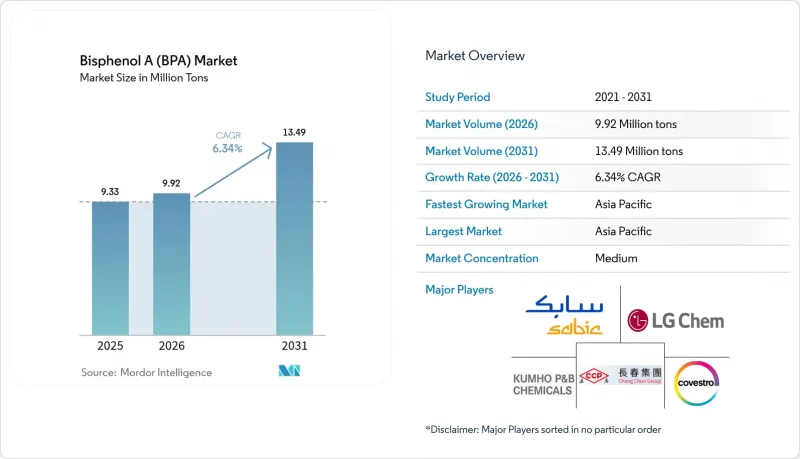
This report is Segmented by Application (Polycarbonate Resins, Epoxy Resins, Unsaturated Polyester Resins, and More), End-User Industry (Electrical and Electronics, Automotive and Transportation, Construction and Infrastructure, Packaging, and More), and Geography (Asia-Pacific, North America, Europe, South America, and the Middle East and Africa). The Market Forecasts are Provided in Terms of Volume (tons).
Global Bisphenol A (BPA) Market Trends and Insights
Growth in Epoxy-Resin Demand for Wind-Turbine Blades
Wind-energy expansion is pulling high-performance epoxy resins into blades exceeding 100 m in length, and each blade contains several hundred kilograms of BPA-derived resin. Europe's offshore installations consumed about 24,000 tons of such epoxy in 2025, and volumes rise as coastal permitting accelerates. The superior adhesion, chemical resistance, and fatigue life of BPA-based epoxy meet blade-longevity targets that determine the levelized cost of energy. Similar property sets are driving adoption within nacelle covers and spar caps. As the renewable-energy supply chain emphasizes durability over cost alone, integrated BPA suppliers gain stable offtake that is largely insulated from food-contact bans. In parallel, aerospace programs keep epoxy demand on a steady trajectory, though long certification cycles push the bulk of lift past 2028.
Asia-Pacific Capacity Additions Lowering Unit Costs
New plants in mainland China added 696,000 t/y of nameplate capacity during 1H-2024, putting downward pressure on global contract prices. These sites sit next to cumene and phenol-acetone hubs, cutting logistics outlays and working capital. Western producers with older, smaller reactors face higher fixed costs, so North American phenol assets ran at only 55-60% through 2025. The margin gap forces some to exit merchant BPA and pivot toward specialty derivatives. Additional captive units that support Chinese polycarbonate lines will shrink merchant trade further, crowding exporters from high-cost geographies and reshaping Bisphenol A market trade flows.
Phenol and Acetone Feedstock Price Volatility
North American phenol averaged USD 902/t in Q4-2025 versus Asia-Pacific at USD 728/t, a gap that spurred arbitrage cargoes and drove spot volatility above 20%. Because BPA absorbs most phenol cost, polycarbonate sellers struggled to secure long-term contracts, and automotive OEMs moved toward fixed-price deals that shift risk back to resin suppliers. Non-integrated producers trimmed rates, leaving assets at 55-60% utilization. Upstream benzene remains tied to crude swings, so feedstock shocks can ripple through the Bisphenol A market within weeks.
Other drivers and restraints analyzed in the detailed report include:
- Aerospace-Grade BPA Derivatives for Advanced Composites
- Continuous-Flow Phenol-Acetone Integration Boosting Margins
- Anti-Dumping Duties on Asian BPA Exports
For complete list of drivers and restraints, kindly check the Table Of Contents.
Segment Analysis
Polycarbonate occupied 61.62% of the Bisphenol A market size in 2025, reflecting entrenched use in LED lenses, smartphone casings, and lightweight vehicle glazing. Price swings of 18-22% during 2025, however, encouraged automakers to test polycarbonate-ABS blends that lower BPA intensity without sacrificing impact performance. Even with these dilution tactics, global EV platforms rely on clear, tough glazing to cut mass, sustaining polycarbonate demand through 2031. Epoxy resin, by contrast, started from a smaller base but is forecast to outpace the overall Bisphenol A market at 6.44% CAGR, buoyed by wind-turbine blades and aerospace composites. Each offshore blade integrates hundreds of kilograms of resin, and blade lengths rising beyond 100 m lock in multi-decade service cycles that stabilize volume. Together, these two products will continue to represent more than four-fifths of the Bisphenol A market share during the outlook period.
Other applications, including flame-retardant tetrabromobisphenol A, unsaturated polyester resins, and specialty coatings, hold niche but profitable positions. Tetrabromobisphenol A dominates printed-circuit-board safety formulations where halogen-free substitutes weaken ignition resistance. Biomass-derived BPA under joint development by Mitsui Chemicals and Teijin could enter pilot scale by 2028, yet cost parity remains elusive. Collectively, these smaller outlets ensure demand diversity, but they lack the scale to counterbalance any future decline in commodity polycarbonate should substitution accelerate in consumer goods.
Complete Report Scope:
- By Application
- Polycarbonate Resins
- Epoxy Resins
- Unsaturated Polyester Resins
- Flame Retardants
- Other Applications
- By End-user Industry
- Electrical and Electronics
- Automotive and Transportation
- Construction and Infrastructure
- Packaging
- Others (Medical, Sports Equipment, etc.)
- By Geography
- Asia-Pacific
- China
- India
- Japan
- South Korea
- ASEAN
- Rest of Asia-Pacific
- North America
- United States
- Canada
- Mexico
- Europe
- Germany
- United Kingdom
- France
- Italy
- Spain
- Russia
- Rest of Europe
- South America
- Brazil
- Argentina
- Rest of South America
- Middle-East and Africa
- Saudi Arabia
- South Africa
- Rest of Middle-East and Africa
- Asia-Pacific
Geography Analysis
Asia-Pacific held 63.10% of the Bisphenol A market share in 2025 and is projected to grow at a 7.32% CAGR to 2031. China alone operated 5.931 million t/y of capacity by 2024 and lifted January-August 2025 output 12% year-on-year to 3.15 million tons. Recent startups at Wanhua, Qingdao Haiwan, and Hengli added 696,000 t/y, underpinning regional cost leadership. India's USD 37 billion petrochemical build-out through 2030 seeks to reduce heavy dependence on imports, 5.018 million-ton inflows of organic chemicals in FY 2023-24 signal latent demand the subcontinent will eventually meet locally.
North America and Europe together account for a declining slice of the Bisphenol A market as higher feedstock costs and anti-dumping duties distort trade. North American phenol hovered near USD 902/t in Q4-2025, squeezing integrated margins when Asian imports landed below domestic cash costs. EU duties of 17.3-33% shield local epoxy suppliers yet raise downstream compounder costs and encourage production shifts toward Asia. Western suppliers respond by doubling down on circular feedstocks and specialty grades, hoping to preserve value despite volume leakage.
South America and the Middle East & Africa remain small but strategic. SABIC's diversification agenda, despite a 63.8% profit drop in Q3-2024, keeps polycarbonate on the investment map. Brazilian vehicle output ranks sixth worldwide, offering opportunities for lightweight glazing once currency stability returns. South African construction specifications now include flame-retardant polycarbonate panels, opening a modest but growing outlet. These emerging nodes will not rival Asia-Pacific in scale but add resilience to global Bisphenol A market demand.
- Altivia
- Chang Chun Group
- Covestro AG
- Formosa Chemicals & Fibre Corp
- Hexion
- Idemitsu Kosan Co., Ltd.
- INEOS
- Kumho P&B Chemicals Inc.
- LG Chem
- Lihua Yiweiyuan Chemical Co., Ltd.
- Mitsubishi Chemical Group Corporation
- NAN YA PLASTICS CORPORATION
- Olin Corporation
- PTT Global Chemical Public Company Limited
- SABIC
- Samyang Innochem Corporation
- Sinopec
- Solvay
- Teijin Limited
- Zhejiang Petroleum & Chemical Co. Ltd
Additional Benefits:
- The market estimate (ME) sheet in Excel format
- 3 months of analyst support
TABLE OF CONTENTS
1 Introduction
- 1.1 Study Assumptions and Market Definition
- 1.2 Scope of the Study
2 Research Methodology
3 Executive Summary
4 Market Landscape
- 4.1 Market Overview
- 4.2 Market Drivers
- 4.2.1 Growth in epoxy-resin demand for wind-turbine blades
- 4.2.2 Asia-Pacific capacity additions lowering unit costs
- 4.2.3 Aerospace-grade BPA derivatives for advanced composites
- 4.2.4 Continuous-flow phenol-acetone integration boosting margins
- 4.2.5 Closed-loop BPA depolymerisation and upcycling technologies gain traction
- 4.3 Market Restraints
- 4.3.1 Phenol and acetone feedstock price volatility
- 4.3.2 Anti-dumping duties on Asian BPA exports
- 4.3.3 Rapid adoption of BPA-free resins in critical electronics
- 4.4 Value Chain Analysis
- 4.5 Porter's Five Forces
- 4.5.1 Bargaining Power of Suppliers
- 4.5.2 Bargaining Power of Buyers
- 4.5.3 Threat of New Entrants
- 4.5.4 Threat of Substitutes
- 4.5.5 Degree of Competition
- 4.6 Feedstock Analysis
- 4.7 Technological Snapshot
- 4.8 Trade Overview
- 4.9 Price Overview
- 4.10 Regulatory Policy Analysis
5 Market Size and Growth Forecasts (Volume)
- 5.1 By Application
- 5.1.1 Polycarbonate Resins
- 5.1.2 Epoxy Resins
- 5.1.3 Unsaturated Polyester Resins
- 5.1.4 Flame Retardants
- 5.1.5 Other Applications
- 5.2 By End-user Industry
- 5.2.1 Electrical and Electronics
- 5.2.2 Automotive and Transportation
- 5.2.3 Construction and Infrastructure
- 5.2.4 Packaging
- 5.2.5 Others (Medical, Sports Equipment, etc.)
- 5.3 By Geography
- 5.3.1 Asia-Pacific
- 5.3.1.1 China
- 5.3.1.2 India
- 5.3.1.3 Japan
- 5.3.1.4 South Korea
- 5.3.1.5 ASEAN
- 5.3.1.6 Rest of Asia-Pacific
- 5.3.2 North America
- 5.3.2.1 United States
- 5.3.2.2 Canada
- 5.3.2.3 Mexico
- 5.3.3 Europe
- 5.3.3.1 Germany
- 5.3.3.2 United Kingdom
- 5.3.3.3 France
- 5.3.3.4 Italy
- 5.3.3.5 Spain
- 5.3.3.6 Russia
- 5.3.3.7 Rest of Europe
- 5.3.4 South America
- 5.3.4.1 Brazil
- 5.3.4.2 Argentina
- 5.3.4.3 Rest of South America
- 5.3.5 Middle-East and Africa
- 5.3.5.1 Saudi Arabia
- 5.3.5.2 South Africa
- 5.3.5.3 Rest of Middle-East and Africa
- 5.3.1 Asia-Pacific
6 Competitive Landscape
- 6.1 Market Concentration
- 6.2 Strategic Moves
- 6.3 Market Share(%)/Ranking Analysis
- 6.4 Company Profiles (includes Global Overview, Market Overview, Core Segments, Financials, Strategic Information, Products and Services, Recent Developments)
- 6.4.1 Altivia
- 6.4.2 Chang Chun Group
- 6.4.3 Covestro AG
- 6.4.4 Formosa Chemicals & Fibre Corp
- 6.4.5 Hexion
- 6.4.6 Idemitsu Kosan Co., Ltd.
- 6.4.7 INEOS
- 6.4.8 Kumho P&B Chemicals Inc.
- 6.4.9 LG Chem
- 6.4.10 Lihua Yiweiyuan Chemical Co., Ltd.
- 6.4.11 Mitsubishi Chemical Group Corporation
- 6.4.12 NAN YA PLASTICS CORPORATION
- 6.4.13 Olin Corporation
- 6.4.14 PTT Global Chemical Public Company Limited
- 6.4.15 SABIC
- 6.4.16 Samyang Innochem Corporation
- 6.4.17 Sinopec
- 6.4.18 Solvay
- 6.4.19 Teijin Limited
- 6.4.20 Zhejiang Petroleum & Chemical Co. Ltd
7 Market Opportunities and Future Outlook
- 7.1 White-space and Unmet-need Assessment

