PUBLISHER: Global Market Insights Inc. | PRODUCT CODE: 2101646

PUBLISHER: Global Market Insights Inc. | PRODUCT CODE: 2101646
Urban Gardening Products Market Opportunity, Growth Drivers, Industry Trend Analysis, and Forecast 2026 - 2035
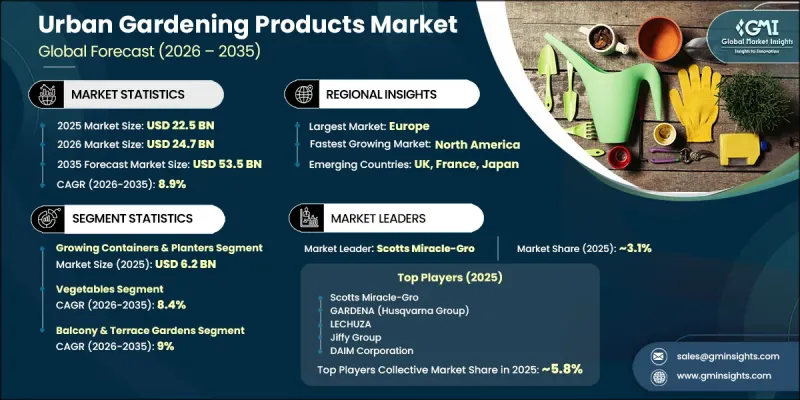
The Global Urban Gardening Products Market was valued at USD 22.5 billion in 2025 and is estimated to grow at a CAGR of 8.9% to reach USD 53.5 billion by 2035.
The expansion is driven by a structural shift in consumer living patterns, where apartment-based and compact residential housing is becoming the dominant urban lifestyle model. As a result, consumers are increasingly adopting indoor planting and balcony-based gardening practices that require compact, efficient, and modular solutions. Urban gardening products such as vertical planting systems, grow bags, container-based kits, and indoor cultivation setups are gaining consistent traction across residential users. Rising interest in home-based leisure activities and wellness-oriented lifestyles is also reinforcing product adoption. Manufacturers are responding by designing space-optimized gardening solutions tailored for constrained urban environments, including multifunctional systems suitable for balconies, terraces, and indoor areas. Expanding smart city development and increasing consumer focus on self-grown food production continue to strengthen demand globally. Sustainability awareness is also playing a key role, with consumers increasingly preferring environmentally responsible gardening solutions such as biodegradable planters, composting systems, organic fertilizers, and automated irrigation technologies that reduce water usage and household waste.
| Market Scope | |
|---|---|
| Start Year | 2025 |
| Forecast Year | 2026-2035 |
| Start Value | $22.5 Billion |
| Forecast Value | $53.5 Billion |
| CAGR | 8.9% |
The containers & planters segment generated USD 6.2 billion in 2025 and is projected to grow at a CAGR of 7.4% between 2026 and 2035. This segment leads the market due to its essential role in enabling plant cultivation in compact residential environments where conventional gardening space is unavailable. Urban consumers increasingly depend on container-based systems to grow plants in restricted areas such as balconies, rooftops, terraces, and indoor spaces, making them a foundational product category within urban gardening solutions.
The vegetables segment accounted for 43.3% share in 2025 and is expected to grow at a CAGR of 8.4% through 2035. This segment remains dominant due to rising consumer awareness around nutrition, food security, and the benefits of fresh homegrown produce. Health-focused dietary recommendations emphasizing increased vegetable consumption are further supporting adoption. Urban gardening enables households to cultivate vegetables such as tomatoes, lettuce, spinach, chilies, and cucumbers, offering a cost-effective and accessible way to improve dietary diversity while ensuring access to fresh, chemical-free food.
Germany Urban Gardening Products Market reached USD 1.6 billion in 2025 and is projected to grow at a CAGR of 8.2% between 2026 and 2035. The country's market strength is supported by strong environmental awareness and a long-standing cultural preference for home gardening practices. Urban consumers are increasingly adopting balcony-based gardening systems, compact greenhouse setups, and indoor herb cultivation solutions as part of sustainable living habits. Demand for recyclable planting materials, eco-friendly gardening tools, and organic soil enhancers continues to increase across environmentally conscious households.
Major companies operating in the global urban gardening products industry include The Scotts Miracle-Gro Company, GARDENA (Husqvarna Group), LECHUZA, Jiffy Group, Click & Grow, CropKing Inc., DAIM Corporation, Minigarden, Veritable SAS, ZipGrow Inc., Myriad Garden GmbH, Urban Planty, SweGreen AB, Urban Ponics, and Lyine Group. Companies in the urban gardening products market are focusing on expanding product portfolios with modular and space-saving designs tailored for compact urban homes. Many players are investing in sustainable and eco-friendly materials such as biodegradable plastics and recyclable substrates to align with environmental expectations. Product innovation is centered on smart gardening systems that integrate automated watering, nutrient monitoring, and app-based control features. Strategic partnerships with e-commerce platforms and home improvement retailers are strengthening distribution reach across urban centers.
Table of Contents
Chapter 1 Methodology & Scope
- 1.1 Market scope and definition
- 1.2 Research design
- 1.2.1 Research approach
- 1.2.2 Data collection methods
- 1.3 Data mining sources
- 1.3.1 Global
- 1.3.2 Regional/Country
- 1.4 Base estimates and calculations
- 1.4.1 Base year calculation
- 1.4.2 Key trends for market estimation
- 1.5 Primary research and validation
- 1.5.1 Primary sources
- 1.6 Forecast model
- 1.7 Research assumptions and limitations
Chapter 2 Executive Summary
- 2.1 Industry 360° synopsis
- 2.2 Key market trends
- 2.2.1 Regional
- 2.2.2 Product type
- 2.2.3 Crop type
- 2.2.4 Cultivation setting
- 2.2.5 End user
- 2.2.6 Distribution channel
Chapter 3 Industry Insights
- 3.1 Industry ecosystem analysis
- 3.1.1 Supplier landscape
- 3.1.2 Profit margin
- 3.1.3 Value addition at each stage
- 3.1.4 Factor affecting the value chain
- 3.2 Industry impact forces
- 3.2.1 Growth drivers
- 3.2.1.1 Rising urbanization increases demand for compact gardening products
- 3.2.1.2 Growing sustainability awareness supports urban gardening product adoption.
- 3.2.1.3 Increasing health consciousness boosts home-grown food cultivation trends
- 3.2.2 Pitfalls & Challenges
- 3.2.2.1 Limited urban space restricts large-scale gardening product adoption
- 3.2.2.2 High premium gardening product costs limit broader affordability
- 3.2.3 Opportunities
- 3.2.3.1 Smart gardening technologies create premium product growth opportunities
- 3.2.3.2 Sustainable gardening products support eco-friendly market expansion globally
- 3.2.1 Growth drivers
- 3.3 Growth potential analysis
- 3.4 Future market trends
- 3.5 Technology and innovation landscape
- 3.5.1 Current technological trends
- 3.5.2 Emerging technologies
- 3.6 Regulatory landscape
- 3.6.1 Standards and compliance requirements
- 3.6.2 Regional regulatory frameworks
- 3.6.3 Certification standards
- 3.7 Porter's analysis
- 3.8 PESTEL analysis
- 3.9 Pricing analysis (driven by primary research)
- 3.9.1 Historical price trend analysis (driven by primary research)
- 3.9.2 Pricing strategy by player type (premium / value / cost-plus) (driven by primary research)
- 3.9.3 Price sensitivity by product category & end user
- 3.10 Trade data analysis (driven by paid database)
- 3.10.1 Import/export volume & value trends by product category (driven by paid database)
- 3.10.2 Key trade corridors & tariff impact on urban gardening products (driven by paid database)
- 3.11 Impact of AI & generative AI on the market
- 3.11.1 AI-driven disruption of existing gardening product business models
- 3.11.2 GenAI use cases & adoption roadmap by segment (plant health diagnostics, personalized growing guides, automated irrigation)
- 3.11.3 Risks, limitations & regulatory considerations of AI in urban gardening
- 3.12 Distribution infrastructure & channel penetration landscape (driven by primary research)
- 3.12.1 Channel coverage by region & format (online vs. specialty vs. mass retail) (driven by primary research)
- 3.12.2 Last-mile infrastructure gaps & emerging channel shifts (DTC subscriptions, social commerce) (driven by primary research)
Chapter 4 Competitive Landscape, 2025
- 4.1 Introduction
- 4.2 Company market share analysis
- 4.2.1 By Region
- 4.2.1.1 North America
- 4.2.1.2 Europe
- 4.2.1.3 Asia Pacific
- 4.2.1.4 Latin America
- 4.2.1.5 Middle East & Africa
- 4.2.1 By Region
- 4.3 Company matrix analysis
- 4.4 Competitive analysis of major market players
- 4.5 Competitive positioning matrix
- 4.6 Key developments
- 4.6.1 Mergers & acquisitions
- 4.6.2 Partnerships & collaborations
- 4.6.3 New product launches
- 4.6.4 Expansion plans
Chapter 5 Market Estimates & Forecast, By Product Type, 2022 - 2035, (USD Billion) (Thousand Units)
- 5.1 Key trends
- 5.2 Growing containers & planters
- 5.3 Growing systems & kits
- 5.4 Growing media, fertilizers & nutrients
- 5.5 Seeds, seedlings & propagation supplies
- 5.6 Irrigation & watering solutions
- 5.7 Grow lights & lighting systems
- 5.8 Gardening tools, pest management & accessories
Chapter 6 Market Estimates & Forecast, By Crop Type, 2022 - 2035, (USD Billion) (Thousand Units)
- 6.1 Key trends
- 6.2 Vegetables
- 6.3 Herbs & microgreens
- 6.4 Fruits
- 6.5 Flowers & ornamentals
- 6.6 Others
Chapter 7 Market Estimates & Forecast, By Cultivation Setting, 2022 - 2035, (USD Billion) (Thousand Units)
- 7.1 Key trends
- 7.2 Balcony & terrace gardens
- 7.3 Rooftop gardens
- 7.4 Indoor & window gardens
- 7.5 Community gardens & shared spaces
- 7.6 Others
Chapter 8 Market Estimates & Forecast, By End User, 2022 - 2035, (USD Billion) (Thousand Units)
- 8.1 Key trends
- 8.2 Residential
- 8.2.1 Apartment dwellers & urban renters
- 8.2.2 Homeowners with terraces & rooftop access
- 8.3 Commercial
- 8.3.1 Restaurants, cafes & food service establishments
- 8.3.2 Hotels, resorts & hospitality venues
- 8.4 Institutional
- 8.4.1 Schools & educational institutions
- 8.4.2 Corporate campuses & offices
- 8.4.3 Community gardens & municipal programs
Chapter 9 Market Estimates & Forecast, By Distribution Channel, 2022 - 2035, (USD Billion) (Thousand Units)
- 9.1 Key trends
- 9.2 Online retail
- 9.3 Specialty garden centers & nurseries
- 9.4 Supermarkets, hypermarkets & home improvement stores
- 9.5 Direct-to-consumer subscription boxes & seed clubs
- 9.6 Others
Chapter 10 Market Estimates & Forecast, By Region, 2022 - 2035, (USD Billion) (Thousand Units)
- 10.1 Key trends
- 10.2 North America
- 10.2.1 U.S.
- 10.2.2 Canada
- 10.3 Europe
- 10.3.1 Germany
- 10.3.2 UK
- 10.3.3 France
- 10.3.4 Italy
- 10.3.5 Spain
- 10.4 Asia Pacific
- 10.4.1 China
- 10.4.2 India
- 10.4.3 Japan
- 10.4.4 South Korea
- 10.4.5 Australia
- 10.5 Latin America
- 10.5.1 Brazil
- 10.5.2 Mexico
- 10.5.3 Argentina
- 10.6 MEA
- 10.6.1 Saudi Arabia
- 10.6.2 UAE
- 10.6.3 South Africa
Chapter 11 Company Profiles
- 11.1 Top Global Players
- 11.1.1 The Scotts Miracle-Gro Company
- 11.1.2 GARDENA (Husqvarna Group)
- 11.1.3 LECHUZA
- 11.1.4 Jiffy Group
- 11.1.5 Click & Grow
- 11.2 Regional Champions
- 11.2.1 DAIM Corporation
- 11.2.2 CropKing Inc.
- 11.2.3 ZipGrow Inc.
- 11.2.4 Minigarden
- 11.2.5 Veritable SAS
- 11.3 Emerging & Specialized Players
- 11.3.1 SweGreen AB
- 11.3.2 Urban Planty
- 11.3.3 Myriad Garden GmbH
- 11.3.4 Lyine Group
- 11.3.5 Urban Ponics

