PUBLISHER: Global Market Insights Inc. | PRODUCT CODE: 2101648

PUBLISHER: Global Market Insights Inc. | PRODUCT CODE: 2101648
Aircraft Water and Waste Systems Market Opportunity, Growth Drivers, Industry Trend Analysis, and Forecast 2026 - 2035
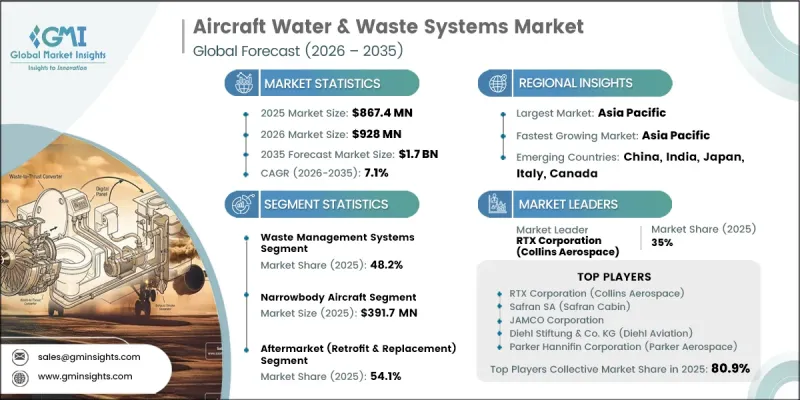
The Global Aircraft Water & Waste Systems Market was valued at USD 867.4 million in 2025 and is estimated to grow at a CAGR of 7.1% to reach USD 1.7 billion by 2035.
The aircraft water & waste systems market is experiencing steady growth as airlines continue expanding their fleets while prioritizing passenger comfort, onboard hygiene, and operational efficiency. Rising investments in advanced cabin infrastructure are encouraging the adoption of modern potable water and waste management technologies that improve performance while reducing aircraft weight. Increasing regulatory focus on water quality, sanitation, and environmental compliance is prompting operators to upgrade onboard systems to meet evolving aviation requirements. Growing demand for lightweight components, efficient water storage solutions, and intelligent monitoring technologies is further supporting market expansion. Fleet modernization programs and the continued extension of aircraft service life are also creating opportunities for retrofit installations across commercial aviation. In addition, airlines are investing in next-generation cabin systems that improve maintenance efficiency, optimize water consumption, and enhance passenger satisfaction. Continuous advancements in aircraft utility systems, combined with increasing maintenance and replacement activities, are expected to sustain long-term demand for aircraft water and waste management solutions across the global aviation industry.
| Market Scope | |
|---|---|
| Start Year | 2025 |
| Forecast Year | 2026-2035 |
| Start Value | $867.4 Million |
| Forecast Value | $1.7 Billion |
| CAGR | 7.1% |
The aircraft water & waste systems market continues to benefit from the expanding global commercial aircraft fleet and increasing regulatory requirements related to onboard hygiene and potable water quality. Airlines are allocating greater investments toward advanced water storage, filtration, distribution, and wastewater handling technologies to comply with evolving operational standards while improving passenger experience. Growing attention to cabin cleanliness and aircraft safety is encouraging operators to replace aging utility systems with more efficient alternatives. The rising focus on extending aircraft operational life is also accelerating the adoption of modern cabin technologies, including lightweight water tanks, vacuum-based sanitation systems, smart lavatories, and digital monitoring solutions that improve maintenance efficiency and overall aircraft performance.
The waste management systems segment accounted for 48.2% share in 2025. This segment continues to dominate because of its critical role in collecting, storing, transporting, and processing onboard wastewater generated during flight operations. Growing adoption of vacuum-based sanitation technologies, increasing commercial aircraft deliveries, and rising global passenger traffic continue to support demand for advanced waste management solutions. Airlines are also emphasizing lightweight system designs that reduce maintenance requirements while improving aircraft efficiency, making advanced waste management technologies an essential component of modern aircraft cabins.
The narrowbody aircraft segment generated USD 391.7 million in 2025. Strong production volumes and widespread deployment of narrowbody aircraft continue to create consistent demand for potable water systems, wastewater management equipment, and lightweight cabin utility components. Expanding airline fleets and increasing aircraft utilization rates are encouraging operators to install durable, low-maintenance systems capable of supporting frequent flight schedules while enhancing operational efficiency and passenger comfort.
North America Aircraft Water & Waste Systems Market held 26.7% share in 2025. Market growth across the region is supported by a strong aerospace manufacturing base, increasing commercial aircraft production, expanding maintenance activities, and strict aviation safety regulations. Regulatory requirements related to potable water quality, sanitation, and aircraft operational standards continue to encourage investments in advanced water distribution technologies, wastewater management systems, and lightweight cabin utility equipment. Ongoing fleet upgrades and modernization programs are also contributing to sustained market demand throughout the region.
Key players involved in the global aircraft water & waste systems market include Adams Rite Aerospace, Diehl Stiftung & Co. KG (Diehl Aviation), Dynamo Aviation Inc., International Water Guard Industries, Inc., JAMCO Corporation, MT Aerospace AG, NMG Aerospace, Parker Hannifin Corporation (Parker Aerospace), RTX Corporation (Collins Aerospace), Safran SA (Safran Cabin), and Yokohama Rubber Co., Ltd. Companies operating in the aircraft water & waste systems market are strengthening their market position by investing in lightweight, high-performance system designs that improve fuel efficiency and reduce maintenance requirements. Manufacturers are expanding research and development activities to introduce smart monitoring technologies, advanced filtration systems, and digitally connected maintenance solutions that enhance operational reliability. Strategic partnerships with aircraft manufacturers, airlines, and maintenance service providers help companies secure long-term supply agreements and expand their customer base. Businesses are also focusing on retrofit opportunities by offering upgrade solutions for aging aircraft fleets.
Table of Contents
Chapter 1 Methodology and Scope
- 1.1 Market scope and definition
- 1.2 Research design
- 1.2.1 Research approach
- 1.2.2 Data collection methods
- 1.3 Data mining sources
- 1.3.1 Global
- 1.3.2 Regional/Country
- 1.4 Base estimates and calculations
- 1.4.1 Base year calculation
- 1.4.2 Key trends for market estimation
- 1.5 Primary research and validation
- 1.5.1 Primary sources
- 1.6 Forecast model
- 1.7 Research assumptions and limitations
Chapter 2 Executive Summary
- 2.1 Industry 360° synopsis, 2022 - 2035
- 2.2 Key market trends
- 2.2.1 System type trends
- 2.2.2 Aircraft type trends
- 2.2.3 Installation trends
- 2.2.4 End-user trends
- 2.2.5 Regional trends
- 2.3 TAM Analysis, 2026-2035
- 2.4 CXO perspectives: Strategic imperatives
Chapter 3 Industry Insights
- 3.1 Industry ecosystem analysis
- 3.1.1 Supplier Landscape
- 3.1.2 Profit Margin
- 3.1.3 Cost structure
- 3.1.4 Value addition at each stage
- 3.1.5 Factor affecting the value chain
- 3.1.6 Disruptions
- 3.2 Industry impact forces
- 3.2.1 Growth drivers
- 3.2.1.1 Expansion of global commercial aircraft fleet
- 3.2.1.2 Stringent potable water safety and sanitation regulations
- 3.2.1.3 OEM focus on passenger hygiene and cabin comfort
- 3.2.1.4 Growing adoption of lightweight and water-efficient onboard systems
- 3.2.1.5 Increasing retrofit and MRO activities for aging aircraft fleets
- 3.2.2 Industry pitfalls and challenges
- 3.2.2.1 High installation and maintenance costs of advanced water & waste systems
- 3.2.2.2 Weight, space, and system integration constraints
- 3.2.3 Market opportunities
- 3.2.3.1 Development of smart and water-efficient onboard systems
- 3.2.3.2 Expansion of next-generation aircraft and fleet modernization programs
- 3.2.1 Growth drivers
- 3.3 Growth potential analysis
- 3.4 Pricing Analysis (Driven by Primary Research)
- 3.4.1 Historical Price Trend Analysis
- 3.4.2 Pricing Strategy by Player Type (Premium / Value / Cost-plus)
- 3.5 Regulatory landscape
- 3.5.1 North America
- 3.5.2 Europe
- 3.5.3 Asia Pacific
- 3.5.4 Latin America
- 3.5.5 Middle East & Africa
- 3.6 Porter's analysis
- 3.7 PESTEL analysis
- 3.8 Trade Data Analysis (Based on Paid Database)
- 3.8.1 Import/Export Volume & Value Trends
- 3.8.2 Key Trade Corridors & Tariff Impact
- 3.9 Impact of AI & Generative AI on the Market (Driven by Primary Research)
- 3.9.1 AI-Driven Disruption of Existing Business Models
- 3.9.2 GenAI Use Cases & Adoption Roadmap by Segment
- 3.10 Capacity & Production Landscape (Driven by Primary Research)
- 3.10.1 Production Capacity by Key Producer
- 3.10.2 Capacity Utilization Rates & Expansion Pipelines
Chapter 4 Competitive Landscape, 2025
- 4.1 Introduction
- 4.2 Company market share analysis, 2025
- 4.2.1 By Region
- 4.2.1.1 North America
- 4.2.1.2 Europe
- 4.2.1.3 Asia-Pacific
- 4.2.1.4 Latin America
- 4.2.1.5 Middle East and Africa
- 4.2.2 Market Concentration Analysis
- 4.2.1 By Region
- 4.3 Competitive analysis of major market players
- 4.4 Competitive positioning matrix
- 4.5 Key developments
- 4.5.1 Mergers & acquisitions
- 4.5.2 Partnerships & collaborations
- 4.5.3 New product launches
- 4.5.4 Expansion plans and funding
- 4.6 Company tier benchmarking
- 4.6.1 Tier classification criteria & qualifying thresholds
- 4.6.2 Tier positioning matrix by revenue, geography & innovation
Chapter 5 Market Estimates and Forecast, By System Type, 2022 - 2035 (USD Million)
- 5.1 Key trends
- 5.2 Potable water systems
- 5.3 Waste management systems
- 5.4 Grey water reuse systems
Chapter 6 Market Estimates and Forecast, By Aircraft Type, 2022 - 2035 (USD Million)
- 6.1 Key trends
- 6.2 Narrowbody aircraft
- 6.3 Widebody aircraft
- 6.4 Regional aircraft
- 6.5 Business jets
- 6.6 Helicopters
Chapter 7 Market Estimates and Forecast, By Installation Type, 2022 - 2035 (USD Million)
- 7.1 Key trends
- 7.2 Line-fit / OEM
- 7.3 Aftermarket (retrofit & replacement)
Chapter 8 Market Estimates and Forecast, By End-User, 2022 - 2035 (USD Million)
- 8.1 Key trends
- 8.2 Commercial operators
- 8.3 Business aviation operators
- 8.4 Government operators
- 8.5 Military operators
Chapter 9 Market Estimates and Forecast, By Region, 2022 - 2035 (USD Million)
- 9.1 Key trends
- 9.2 North America
- 9.2.1 U.S.
- 9.2.2 Canada
- 9.3 Europe
- 9.3.1 Germany
- 9.3.2 UK
- 9.3.3 France
- 9.3.4 Spain
- 9.3.5 Italy
- 9.4 Asia Pacific
- 9.4.1 China
- 9.4.2 India
- 9.4.3 Japan
- 9.4.4 Australia
- 9.4.5 South Korea
- 9.5 Latin America
- 9.5.1 Brazil
- 9.5.2 Mexico
- 9.5.3 Argentina
- 9.6 Middle East and Africa
- 9.6.1 South Africa
- 9.6.2 Saudi Arabia
- 9.6.3 UAE
Chapter 10 Company Profiles
- 10.1 Global Key Players
- 10.1.1 RTX Corporation (Collins Aerospace)
- 10.1.2 Safran SA (Safran Cabin)
- 10.1.3 JAMCO Corporation
- 10.1.4 Diehl Stiftung & Co. KG (Diehl Aviation)
- 10.1.5 Parker Hannifin Corporation (Parker Aerospace)
- 10.2 Regional key players
- 10.2.1 North America
- 10.2.1.1 Adams Rite Aerospace
- 10.2.1.2 International Water Guard Industries, Inc.
- 10.2.2 Asia Pacific
- 10.2.2.1 Yokohama Rubber Co., Ltd.
- 10.2.3 Europe
- 10.2.3.1 MT Aerospace AG
- 10.2.1 North America
- 10.3 DuracoteNiche Players/Disruptors
- 10.3.1 Dynamo Aviation Inc.
- 10.3.2 NMG Aerospace

