PUBLISHER: Mordor Intelligence | PRODUCT CODE: 2100715

PUBLISHER: Mordor Intelligence | PRODUCT CODE: 2100715
United States Water and Wastewater Valves - Market Share Analysis, Industry Trends & Statistics, Growth Forecasts (2026 - 2031)
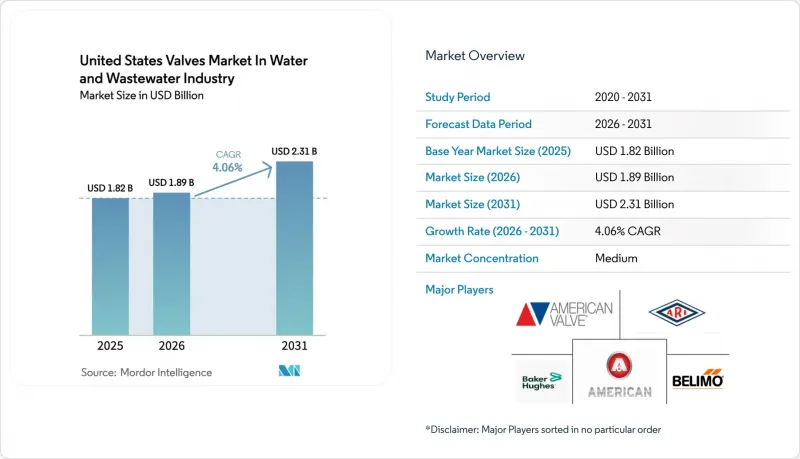
According to Mordor Intelligence, the United States valves market size in water and wastewater industry is expected to grow from USD 1.82 billion in 2025 to USD 1.89 billion in 2026 and is forecast to reach USD 2.31 billion by 2031 at 4.06% CAGR over 2026-2031.
This report is Segmented by Type (Ball Valves, Butterfly Valves, Gate Valves, and More), Material (Ductile Iron, Carbon Steel, and More), Actuation Type (Manual, Electric, and More), End User Industry (Municipal Utilities, Food and Beverage, and More), Size (Below 4 Inch, 4-8 Inch, and More). The Market Forecasts are Provided in Terms of Value (USD).
United States Water and Wastewater Valves Market Trends and Insights
Replacement of Ageing Municipal Pipeline Networks
Water systems average 45 years of service, leading utilities to plan continuous rehabilitation programs that underpin valve procurement cycles in the United States Water and Wastewater Valves Market. The American Society of Civil Engineers estimates that cumulative water infrastructure needs will total USD 1 trillion through 2039, with valves accounting for approximately 15% of project costs. Cities in the Northeast and Midwest report valve failure rates 40% higher than the national mean, creating a steady demand for isolation and control products. Climate-induced freeze-thaw cycles accelerate degradation, shortening replacement intervals and prompting emergency purchase orders that favor suppliers with rapid deployment capabilities. These recurring needs anchor predictable revenue streams within the United States Water and Wastewater Valves Market.
EPA's WIFIA Low-Interest Loan Expansion
The Environmental Protection Agency expanded WIFIA lending capacity to USD 15 billion in 2024, reducing financing costs by up to 30% and freeing municipal budgets for valve modernization programs. Disadvantaged communities stand to benefit, stimulating geographically distributed demand in the United States Water and Wastewater Valves Market. Buy America clauses benefit domestic manufacturers but compel utilities to reassess their sourcing strategies, resulting in temporary procurement delays. Higher-specification standards in WIFIA-funded projects lift average unit values by up to 25%, improving revenue quality for suppliers. The loan program's multi-year pipeline provides visibility, supporting capacity planning among manufacturers.
Intensifying Low-Cost Imports from Asia
Imports grew to 35% of United States valve consumption in 2024, offering cost advantages of 40-50%. Tariffs of 125% on Chinese valves slow but do not halt market entry, sustaining price tension in the United States Water and Wastewater Valves Market. Some utilities adopt lower-cost options for non-critical lines, compelling domestic makers to emphasize lifecycle value and warranty coverage. Quality concerns and NSF compliance gaps limit import penetration into drinking-water applications, preserving a premium segment for accredited domestic suppliers.
Other drivers and restraints analyzed in the detailed report include:
- IIoT-Enabled Real-Time Valve Monitoring Adoption
- Surge in Climate-Resilience Investments (Flood and Drought)
- Price Pressure from Design-Build-Operate Contracts
For complete list of drivers and restraints, kindly check the Table Of Contents.
Segment Analysis
Ball valves held 25.45% of the United States valve market share in 2025 due to reliability and versatile operation. Automatic control valves are forecast to log a 6.24% CAGR, signaling rapid digitalization across utilities. Gate and butterfly valves sustain demand in large-diameter settings, while check valves remain essential for pump isolation in compact settings. Pressure relief valves gain incremental traction by addressing hydraulic surge events in climate-resilient networks within the United States Water and Wastewater Valves Market.
The shift toward smart, automatic control valves is driven by the need for remote monitoring and labor shortages, leading to premium pricing. Globe valves fulfill niche throttling requirements and maintain relevance where fine flow modulation is paramount. Strainers and specialty valves are adapted to water reuse applications, leveraging corrosion-resistant materials that match the chemistry of recycled water. Certification under NSF 61 ensures that all valve types meet potable standards; however, the approval timelines of 12-18 months slow down new product launches.
Ductile iron captured 34.62% of the United States valves market size in 2025, owing to durability and cost efficiency in buried mains. Plastic valves are projected to accelerate at a 5.95% CAGR, reflecting utilities' preference for corrosion resistance and light weight during service line replacements. Stainless and carbon steels retain viability in high-pressure and elevated temperature operations. Advanced alloys serve corrosive coastal and chemical environments.
Lifecycle economics increasingly favor plastics, which deliver 30-40% longer service life in aggressive soils. Utilities weigh material compatibility with PFAS removal processes when specifying new assets in the United States Water and Wastewater Valves Market. Lighter polymers simplify installation in seismic zones and aging tunnels, widening adoption. However, limited pressure ratings in large diameters still justify the continued use of ductile iron and steel.
Complete Report Scope:
- By Type
- Ball Valves
- Butterfly Valves
- Gate Valves
- Globe Valves
- Check Valves
- Pressure Relief Valves (including PORV)
- Automatic Control Valves
- Strainer Valves and Others
- By Material
- Ductile Iron
- Carbon Steel
- Stainless Steel
- Alloys (Duplex, Nickel)
- Plastics (PVC, CPVC, HDPE)
- Other Materials
- By Actuation Type
- Manual
- Electric
- Pneumatic
- Hydraulic
- Smart / Automated (IIoT-integrated)
- By End User Industry
- Municipal Utilities
- Food and Beverage
- Chemicals and Petrochemicals
- Power Generation
- Other End User Industries
- By Size (Diameter)
- Below 4 inch
- 4 - 8 inch
- 8 - 12 inch
- Above 12 inch
- By Region
- Northeast
- Southeast
- Midwest
- Southwest
- West
List of Companies Covered in this Report:
- AMERICAN Cast Iron Pipe Company
- American Valve Inc.
- Ari Valve Corporation
- Baker Hughes Company
- Belimo Aircontrols (USA) Inc.
- Bi-Torq Valve Automation Inc.
- Bray International Inc.
- CIRCOR International Inc.
- Cla-Val Company
- Crane Co.
- DeZURIK Inc.
- Emerson Electric Co.
- Asahi/America Inc.
- Flomatic Corporation
- Flowserve Corporation
- Hayward Flow Control
- Parker-Hannifin Corporation
- Aegis Flow Technologies LLC
- U.S. Valve LLC
- Watts Water Technologies Inc.
- Schlumberger Limited
- Mueller Water Products Inc.
- AVK Holding A/S
- Val-Matic Valve and Manufacturing Corp.
Additional Benefits:
- The market estimate (ME) sheet in Excel format
- 3 months of analyst support
TABLE OF CONTENTS
1 INTRODUCTION
- 1.1 Study Assumptions and Market Definition
- 1.2 Scope of the Study
2 RESEARCH METHODOLOGY
3 EXECUTIVE SUMMARY
4 MARKET LANDSCAPE
- 4.1 Market Overview
- 4.2 Market Drivers
- 4.2.1 Replacement of ageing municipal pipeline networks
- 4.2.2 EPA's WIFIA low-interest loan expansion
- 4.2.3 IIoT-enabled real-time valve monitoring adoption
- 4.2.4 Surge in climate-resilience investments (flood and drought)
- 4.2.5 Federal bipartisan infrastructure bill allocations
- 4.2.6 Untapped reuse-water projects in arid US states
- 4.3 Market Restraints
- 4.3.1 Intensifying low-cost imports from Asia
- 4.3.2 Price-pressure from design-build-operate (DBO) contracts
- 4.3.3 Skilled labour shortage for advanced actuation systems
- 4.3.4 Lengthy NSF / ANSI certification timelines
- 4.4 Industry Value Chain Analysis
- 4.5 Regulatory Landscape
- 4.6 Technological Outlook
- 4.7 Impact of Macroeconomic Factors
- 4.8 Porter's Five Forces Analysis
- 4.8.1 Bargaining Power of Suppliers
- 4.8.2 Bargaining Power of Buyers
- 4.8.3 Threat of New Entrants
- 4.8.4 Threat of Substitute Products
- 4.8.5 Intensity of Competitive Rivalry
- 4.9 Upcoming Water and Wastewater Treatment Projects
5 MARKET SIZE AND GROWTH FORECASTS (VALUES)
- 5.1 By Type
- 5.1.1 Ball Valves
- 5.1.2 Butterfly Valves
- 5.1.3 Gate Valves
- 5.1.4 Globe Valves
- 5.1.5 Check Valves
- 5.1.6 Pressure Relief Valves (including PORV)
- 5.1.7 Automatic Control Valves
- 5.1.8 Strainer Valves and Others
- 5.2 By Material
- 5.2.1 Ductile Iron
- 5.2.2 Carbon Steel
- 5.2.3 Stainless Steel
- 5.2.4 Alloys (Duplex, Nickel)
- 5.2.5 Plastics (PVC, CPVC, HDPE)
- 5.2.6 Other Materials
- 5.3 By Actuation Type
- 5.3.1 Manual
- 5.3.2 Electric
- 5.3.3 Pneumatic
- 5.3.4 Hydraulic
- 5.3.5 Smart / Automated (IIoT-integrated)
- 5.4 By End User Industry
- 5.4.1 Municipal Utilities
- 5.4.2 Food and Beverage
- 5.4.3 Chemicals and Petrochemicals
- 5.4.4 Power Generation
- 5.4.5 Other End User Industries
- 5.5 By Size (Diameter)
- 5.5.1 Below 4 inch
- 5.5.2 4 - 8 inch
- 5.5.3 8 - 12 inch
- 5.5.4 Above 12 inch
- 5.6 By Region
- 5.6.1 Northeast
- 5.6.2 Southeast
- 5.6.3 Midwest
- 5.6.4 Southwest
- 5.6.5 West
6 COMPETITIVE LANDSCAPE
- 6.1 Market Concentration
- 6.2 Strategic Moves
- 6.3 Market Share Analysis
- 6.4 Company Profiles (includes Global level Overview, Market level overview, Core Segments, Financials as available, Strategic Information, Market Rank/Share for key companies, Products and Services, and Recent Developments)
- 6.4.1 AMERICAN Cast Iron Pipe Company
- 6.4.2 American Valve Inc.
- 6.4.3 Ari Valve Corporation
- 6.4.4 Baker Hughes Company
- 6.4.5 Belimo Aircontrols (USA) Inc.
- 6.4.6 Bi-Torq Valve Automation Inc.
- 6.4.7 Bray International Inc.
- 6.4.8 CIRCOR International Inc.
- 6.4.9 Cla-Val Company
- 6.4.10 Crane Co.
- 6.4.11 DeZURIK Inc.
- 6.4.12 Emerson Electric Co.
- 6.4.13 Asahi/America Inc.
- 6.4.14 Flomatic Corporation
- 6.4.15 Flowserve Corporation
- 6.4.16 Hayward Flow Control
- 6.4.17 Parker-Hannifin Corporation
- 6.4.18 Aegis Flow Technologies LLC
- 6.4.19 U.S. Valve LLC
- 6.4.20 Watts Water Technologies Inc.
- 6.4.21 Schlumberger Limited
- 6.4.22 Mueller Water Products Inc.
- 6.4.23 AVK Holding A/S
- 6.4.24 Val-Matic Valve and Manufacturing Corp.
7 MARKET OPPORTUNITIES AND FUTURE OUTLOOK
- 7.1 White-space and Unmet-need Assessment

