PUBLISHER: Global Market Insights Inc. | PRODUCT CODE: 2101665

PUBLISHER: Global Market Insights Inc. | PRODUCT CODE: 2101665
Asia Pacific Rice Water Shampoo Market Opportunity, Growth Drivers, Industry Trend Analysis, and Forecast 2026 - 2035
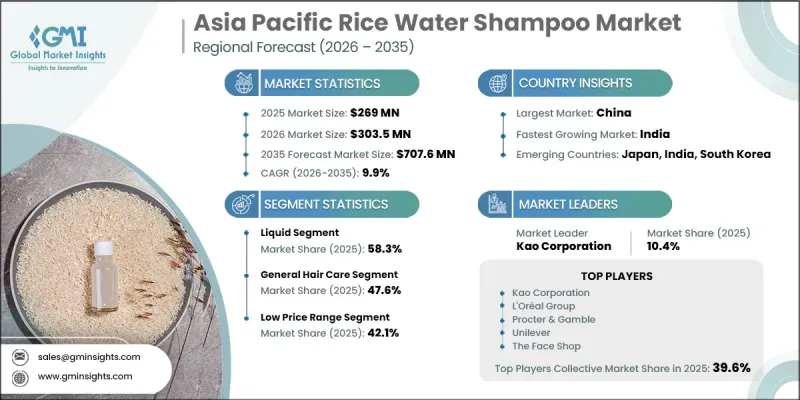
Asia Pacific Rice Water Shampoo Market was valued at USD 269 million in 2025 and is estimated to grow at a CAGR of 9.9% to reach USD 707.6 million by 2035.
Growth in the market is driven by the convergence of traditional botanical hair care practices with modern formulation science, resulting in strong commercial traction for rice-based ingredients. Rice water, long used in East and South Asian personal care traditions, is increasingly being integrated into mass-market and premium shampoo formulations as demand for plant-derived and functional ingredients strengthens. The shift from home-prepared remedies to commercially manufactured products is accelerating product standardization and expanding retail penetration across Asia Pacific. Rising consumer preference for clean-label, sulfate-free, and naturally derived hair care solutions continues to reshape product development strategies. Increased awareness of ingredient safety and transparency, supported by evolving labeling practices across key regional markets, is further reinforcing adoption. As a result, rice water shampoo is transitioning from a niche, tradition-based offering into a mainstream functional hair care category supported by both multinational and regional manufacturers.
| Market Scope | |
|---|---|
| Start Year | 2025 |
| Forecast Year | 2026-2035 |
| Start Value | $269 Million |
| Forecast Value | $707.6 Million |
| CAGR | 9.9% |
The liquid-based formulations segment held 58.3% share, equivalent to USD 156.8 million in 2025, and is projected to grow at a CAGR of 9.2% through 2035. This dominance is attributed to widespread consumer familiarity with liquid formats, ease of application, and compatibility with standard dispensing systems used in households and retail environments. In addition, liquid formats allow manufacturers greater flexibility in balancing active ingredient concentration, texture, and sensory attributes, which supports broader product differentiation.
The general hair care application segment accounted for 47.6% share in 2025, valued at USD 128 million. This segment serves as the primary consumer entry point, focusing on routine cleansing combined with mild conditioning and strengthening benefits. It positions rice water shampoo as an everyday functional upgrade rather than a specialized treatment product, enabling broader consumer adoption across mass-market users.
China Rice Water Shampoo Market held a 41.3% share, generating USD 109.3 million in 2025, and is projected to reach USD 268.9 million by 2035 at a CAGR of around 8.85%. The country's leading position is supported by its large consumer base, strong digital and retail infrastructure, and long-standing familiarity with rice-based personal care practices. Strong distribution networks across both online platforms and offline retail channels continue to reinforce product accessibility and brand expansion. Leading multinational companies such as L'Oreal Group maintain a strong presence in the Chinese market, leveraging established distribution ecosystems and localized product offerings to strengthen market penetration.
Major companies operating in the Asia Pacific rice water shampoo market include Procter & Gamble (Pantene), Unilever (Dove), Unilever (TRESemme), Unilever (Love Beauty and Planet), L'Oreal Group (Garnier), Kao Corporation (MyKirei), Procter & Gamble (Aussie), The Face Shop (LG H&H), Mamaearth (Honasa Consumer), Daeng Gi Meo Ri, Deyga Organics, Pilgrim, WOW Skin Science, Kundal, Ryo (Amorepacific), Lador, Plum Goodness, Oriza Hair, Forest Essentials, Trunish Lifescience, and Nuskhe by Paras. Companies operating in the Asia Pacific rice water shampoo market are strengthening their market position by expanding product portfolios focused on natural, sulfate-free, and plant-based formulations aligned with evolving consumer preferences. Many brands are investing in research and development to enhance the efficacy of rice water-based ingredients and improve product performance claims related to hair strength and scalp health. Strategic partnerships with e-commerce platforms and digital-first retail channels are enabling wider market reach and improved consumer engagement. Companies are also focusing on localized product development tailored to regional hair types and cultural preferences to strengthen brand relevance.
Table of Contents
Chapter 1 Methodology & Scope
- 1.1 Market scope and definition
- 1.2 Research design
- 1.2.1 Research approach
- 1.2.2 Data collection methods
- 1.3 Data mining sources
- 1.3.1 Global
- 1.3.2 Regional/Country
- 1.4 Base estimates and calculations
- 1.4.1 Base year calculation
- 1.4.2 Key trends for market estimation
- 1.5 Primary research and validation
- 1.5.1 Primary sources
- 1.6 Forecast model
- 1.7 Research assumptions and limitations
Chapter 2 Executive Summary
- 2.1 Industry 360° synopsis
- 2.2 Key market trends
- 2.2.1 Country
- 2.2.2 Product type
- 2.2.3 Price range
- 2.2.4 Application
- 2.2.5 Consumer group
- 2.2.6 Material type
- 2.2.7 Distribution channel
Chapter 3 Industry Insights
- 3.1 Industry ecosystem analysis
- 3.1.1 Supplier landscape
- 3.1.2 Profit margin
- 3.1.3 Value addition at each stage
- 3.1.4 Factor affecting the value chain
- 3.2 Industry impact forces
- 3.2.1 Growth drivers
- 3.2.1.1 Rising consumer preference for natural and traditional hair care solutions
- 3.2.1.2 Expansion of premium hair care and scalp treatment product categories
- 3.2.1.3 Growing influence of K-beauty and Asian beauty traditions globally
- 3.2.2 Pitfalls & Challenges
- 3.2.2.1 Availability of counterfeit and low-quality herbal hair care products
- 3.2.2.2 High competition from conventional and multifunctional shampoos
- 3.2.3 Opportunities
- 3.2.3.1 Rising demand for clean-label and sulfate-free personal care products
- 3.2.3.2 Growth of e-commerce and influencer-driven beauty marketing
- 3.2.1 Growth drivers
- 3.3 Growth potential analysis
- 3.4 Future market trends
- 3.5 Technology and innovation landscape
- 3.5.1 Current technological trends
- 3.5.2 Emerging technologies
- 3.6 Regulatory landscape
- 3.6.1 Standards and compliance requirements
- 3.6.2 Regional regulatory frameworks
- 3.6.3 Certification standards
- 3.7 Porter’s analysis
- 3.8 PESTEL analysis
- 3.9 Pricing analysis (driven by primary research)
- 3.9.1 Historical price trend analysis (driven by primary research)
- 3.9.2 Pricing strategy by player type (premium / value / cost-plus) (driven by primary research)
- 3.10 Trade data analysis (driven by paid database)
- 3.10.1 Import/export volume and value trends (driven by paid database)
- 3.10.2 Key trade corridors and tariff impact (driven by paid database)
- 3.11 Impact of AI and generative AI on the market
- 3.11.1 AI-driven disruption of existing business models
- 3.11.2 GenAI use cases and adoption roadmap by segment
- 3.11.3 Personalized product recommendations
- 3.11.4 Virtual hair analysis and diagnostic tools
- 3.11.5 AI-powered formulation optimization
- 3.11.6 Content generation for marketing and e-commerce
- 3.11.7 Risks, limitations, and regulatory considerations
- 3.12 Distribution infrastructure and channel penetration landscape (driven by primary research)
- 3.12.1 Channel coverage by region and format (modern vs. traditional trade) (driven by primary research)
- 3.12.2 Last-mile infrastructure gaps and emerging channel shifts (driven by primary research)
Chapter 4 Competitive Landscape, 2025
- 4.1 Introduction
- 4.2 Company market share analysis
- 4.2.1 By Country
- 4.2.1.1 China
- 4.2.1.2 India
- 4.2.1.3 Japan
- 4.2.1.4 South Korea
- 4.2.1.5 Australia
- 4.2.1.6 Philippines
- 4.2.1.7 Thailand
- 4.2.1.8 Vietnam
- 4.2.1 By Country
- 4.3 Company matrix analysis
- 4.4 Competitive analysis of major market players
- 4.5 Competitive positioning matrix
- 4.6 Key developments
- 4.6.1 Mergers & acquisitions
- 4.6.2 Partnerships & collaborations
- 4.6.3 New product launches
- 4.6.4 Expansion plans
Chapter 5 Market Estimates & Forecast, By Product Type, 2022 – 2035, (USD Billion) (Thousand Units)
- 5.1 Key trends
- 5.2 Liquid
- 5.3 Gel
- 5.4 Foam
- 5.5 Bar/Solid
- 5.6 Cream/Paste
Chapter 6 Market Estimates & Forecast, By Price Range, 2022 – 2035, (USD Billion) (Thousand Units)
- 6.1 Key trends
- 6.2 Low
- 6.3 Medium
- 6.4 High
Chapter 7 Market Estimates & Forecast, By Application, 2022 – 2035, (USD Billion) (Thousand Units)
- 7.1 Key trends
- 7.2 General hair care
- 7.3 Hair growth promotion
- 7.4 Damage repair
- 7.5 Scalp treatment
Chapter 8 Market Estimates & Forecast, By Consumer Group, 2022 – 2035, (USD Billion) (Thousand Units)
- 8.1 Key trends
- 8.2 Women
- 8.3 Men
- 8.4 Unisex
- 8.5 Children
Chapter 9 Market Estimates & Forecast, By Material Type, 2022 – 2035, (USD Billion) (Thousand Units)
- 9.1 Key trends
- 9.2 Organic
- 9.3 Inorganic
Chapter 10 Market Estimates & Forecast, By Distribution Channel, 2022 – 2035, (USD Billion) (Thousand Units)
- 10.1 Key trends
- 10.2 Online
- 10.2.1 Company websites
- 10.2.2 E-commerce
- 10.3 Offline
- 10.3.1 Hypermarket/supermarket
- 10.3.2 Specialty store
- 10.3.3 Retail stores
Chapter 11 Market Estimates & Forecast, By Country, 2022 – 2035, (USD Billion) (Thousand Units)
- 11.1 Key trends
- 11.2 China
- 11.3 India
- 11.4 Japan
- 11.5 South Korea
- 11.6 Australia
- 11.7 Philippines
- 11.8 Thailand
- 11.9 Vietnam
Chapter 12 Company Profiles
- 12.1 Top Global Players
- 12.1.1 Procter & Gamble
- 12.1.2 Unilever
- 12.1.3 L'Oreal Group
- 12.1.4 Kao Corporation
- 12.2 Regional Champions
- 12.2.1 The Face Shop
- 12.2.2 Mamaearth
- 12.2.3 Daeng Gi Meo Ri
- 12.2.4 Deyga Organics
- 12.2.5 Pilgrim
- 12.2.6 WOW Skin Science
- 12.2.7 Kundal
- 12.3 Emerging & Specialized Players
- 12.3.1 Ryo
- 12.3.2 Lador
- 12.3.3 Plum Goodness
- 12.3.4 Oriza Hair
- 12.3.5 Forest Essentials
- 12.3.6 Trunish Lifescience
- 12.3.7 Nuskhe by Paras

