PUBLISHER: Mordor Intelligence | PRODUCT CODE: 2122536

PUBLISHER: Mordor Intelligence | PRODUCT CODE: 2122536
Hair Care Products - Market Share Analysis, Industry Trends & Statistics, Growth Forecasts (2026 - 2031)
According to Mordor Intelligence, the hair care market size is valued at USD 101.52 billion in 2026 and is projected to reach USD 122.60 billion by 2031, advancing at a 3.85% CAGR.
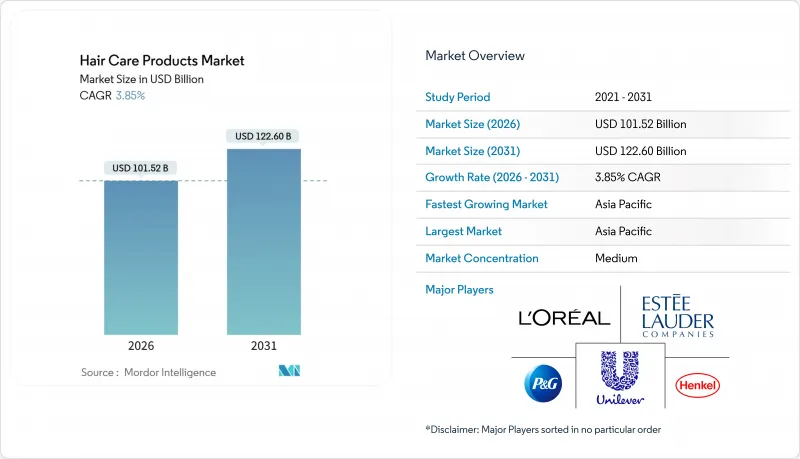
This report is Segmented Into Product Type (Shampoo, Conditioners, and More), Category (Mass and Premium), Ingredient Type (Natural/Organic and Conventional/Synthetic), Distribution Channel (Supermarkets/Hypermarkets, Specialty Stores, and More), and Geography (North America, Europe, Asia-Pacific, South America, and Middle East and Africa). The Market Forecasts are Provided in Terms of Value (USD).
Global Hair Care Products Market Trends and Insights
Strong Demand for Products Formulated with Clean Label Ingredients
In 2024, the U.S. FDA chose not to define "natural" for cosmetics, leaving brands to navigate state-level regulations like California's law mandating the disclosure of 26 fragrance allergens. In contrast, the EU's Regulation 1223/2009 enforces pre-market safety assessments and bans over 1,300 substances, a standard many global brands adopt to avoid the challenges of dual formulations. This regulatory disparity is driving ingredient innovation; brands are replacing synthetic preservatives, such as parabens, with fermentation-derived alternatives like Leuconostoc radish root ferment, recognized for its antimicrobial properties and low allergen risk, as noted in dermatology journals. The shift extends to packaging as well. Refillable formats now account for 12% of premium hair care sales in Western Europe, driven by Extended Producer Responsibility directives that impose recycling fees on single-use plastics. However, the clean-label movement faces challenges; while "natural" claims are widespread, fewer than 15% of products carry third-party certifications like USDA Organic or Ecocert, causing consumer confusion that competitors exploit through transparency-focused marketing.
Technological Innovations in Product Formulations
Artificial intelligence is shifting from being a marketing tool to becoming a critical asset in product formulation, significantly influencing product development cycles. In 2025, L'Oreal utilized its VOYAGER AI platform to evaluate 100,000 ingredient combinations for bond-repair efficacy. This initiative reduced lab testing time by 60% and discovered novel peptide sequences that outperformed existing technologies in tensile strength assessments. Similarly, Shiseido's generative AI examines consumer scalp images to provide personalized regimen recommendations. By processing microbiome data and sebum production metrics, it achieves an impressive 85% accuracy in predicting product performance. These advancements are expanding the scope of customization; brands that once limited bespoke formulations to ultra-premium lines are now introducing mass-market products with modular ingredient systems, enabling consumers to mix and customize at home. Biotechnology is also transforming sourcing methods. Precision fermentation now enables the production of squalane, keratin, and hyaluronic acid without relying on animal or plant extraction. This approach not only meets vegan certification standards but also reduces production costs by 30%. Between 2023 and 2025, patent filings for microencapsulation technologies increased by 40%, as brands aim to stabilize volatile actives like retinol and vitamin C in shampoos-ingredients that traditionally degraded within weeks of opening, as reported by WIPO. However, the rapid pace of innovation presents challenges. The quick turnover of ingredients often surpasses the timeline for comprehensive long-term safety studies. Additionally, regulatory bodies such as the European Chemicals Agency are enforcing stricter allergen testing protocols, causing product launch delays of 6 to 12 months.
Adoption of Traditional At-Home Hair Care Solutions
Traditional remedies are experiencing a significant revival, particularly in regions where Ayurvedic and herbal treatments are culturally ingrained. In 2024, India's traditional medicine sector achieved a substantial USD 18.1 billion valuation. Hair care, fueled by ingredients such as amla, bhringraj, and shikakai-considered safer alternatives to synthetic options-accounted for 28% of these sales, according to the Ministry of AYUSH. Companies like Dabur and Himalaya have capitalized on this trend by launching mass-market products that combine traditional botanicals with modern preservatives, ensuring extended shelf life without refrigeration. Multinational brands face a significant challenge: these traditional remedies are priced 50% to 70% lower than imported products, creating a price-performance gap that marketing efforts struggle to overcome. DIY formulations are also gaining popularity on social media platforms; TikTok videos featuring rice water rinses and coconut oil masks have collectively garnered over 5 billion views, with users citing cost-effectiveness and ingredient transparency as primary drivers. However, the effectiveness of these remedies varies. Peer-reviewed studies reveal that while coconut oil helps reduce protein loss during washing, it does not repair existing damage-a limitation effectively addressed by commercial bond-repair treatments.
Other drivers and restraints analyzed in the detailed report include:
- Demand for Multi-Functional and Damage Control Products
- Rising Awareness of Scalp Health
- Health Concerns Over Chemical Ingredients
For complete list of drivers and restraints, kindly check the Table Of Contents.
Segment Analysis
Shampoo retained 40.58% of 2025 revenue and remained the anchor of the hair care market. In contrast, styling products are projected to log a 6.54% CAGR, reflecting thermal-tool adoption and the popularity of bond-repair sprays. This swing illustrates a maturing wash-category where incremental scent or mildness tweaks no longer warrant premiums. Bond-centric styling lines that restore disulfide bridges are particularly resonant among frequent color-treaters. Conditioners, with 28% share, advance at a gentler 4.8% as consumers experiment with leave-in creams and co-washing regimes. Hair colorants, at 18%, feel pressure from gray-acceptance movements but retain a salon stronghold because professional application mitigates ammonia exposure.
Global shipments of straighteners and curling irons topped 180 million units in 2025, feeding demand for heat-shield serums that prevent cuticle degradation at temperatures above 200 °C. L'Oreal's 2024 Bond Repair release booked USD 320 million in its first year and captured 12% of the bond-repair niche. Scalpel-precise GMP certification (ISO 22716) acts as a trust signal online, lifting conversion rates by 15% for certified styling lines in counterfeit-prone Asian markets.
Mass-market lines controlled 75.68% of 2025 turnover, yet premium collections are slated for a 6.27% CAGR-112 basis points above the total hair care market. The premium sub-sector thrives on dermatologist endorsements and clinically substantiated claims that justify 35% to 50% price uplifts. North America and Western Europe remain strongholds where disposable incomes and eco-consciousness converge. Salon-anchored brands leverage stylist trust to sidestep price wars common on grocery shelves.
Mass-market stalwarts depend on promotional depth and broad distribution. Supermarket shelf presence locks in volume even as e-commerce drains urban share. Online channels reward premium entrants skilled in influencer alliances and subscription models, which can push repeat-purchase rates beyond 60% for customized formulas such as Function of Beauty. Pandemic-era digital acceleration entrenched these buying behaviors, and premium lines continue to outpace mass peers in direct-to-consumer growth.
Complete Report Scope:
- By Product Type
- Shampoo
- Conditioner
- Hair Colorants
- Hair Styling Products
- Other Product Types
- By Category
- Premium Products
- Mass Products
- By Ingredient Type
- Natural and Organic
- Conventional / Synthetic
- By Distribution Channel
- Supermarkets/Hypermarket
- Specialty Stores
- Online Retail Stores
- Others Distribution Channel
- By Geography
- North America
- United States
- Mexico
- Canada
- Rest of North America
- Europe
- United Kingdom
- Germany
- France
- Italy
- Spain
- Russia
- Netherlands
- Sweden
- Rest of Europe
- Asia-Pacific
- Japan
- China
- India
- Australia
- Rest of Asia-Pacific
- South America
- Brazil
- Argentina
- Chile
- Colombia
- Peru
- Rest of South America
- Middle East and Africa
- United Arab Emirates
- South Africa
- Nigeria
- Saudi Arabia
- Egypt
- Morocco
- Turkey
- Rest of Middle East and Africa
- North America
Geography Analysis
Asia-Pacific commanded 35.63% of 2025 revenue and is forecast to rise at 5.92% through 2031. China's 2024 policy shift cut import approvals from 18 months to 90 days and removed animal-testing obligations for most SKUs, slashing entry barriers for Western brands. The ASEAN Cosmetic Directive's mutual-recognition mechanism trims regional launch costs by 40% and speeds cross-border distribution. K-beauty influences remain tangible: South Korean low-pH shampoos and scalp serums gain traction across Japan, China, and Southeast Asia, where gentle-cleansing themes resonate with humidity-prone consumers. India illustrates divergence, with premium imports flourishing in cities while Ayurvedic mainstays like Dabur and Himalaya hold 32% domestic share in 2025. Japan's aging demographic lifts anti-graying and thickening demand; Kao's Segreta line sold USD 180 million in 2025, up 22% year-on-year.
North America and Europe together generated 42% of 2025 sales, yet expand at a milder 4.8% because of saturation and private-label encroachment. Europe's Regulation 1223/2009 sets the de facto global ingredient bar, prompting worldwide adoption to avoid dual formulations. North American clean-beauty proponents grew their slice of U.S. turnover to 18% in 2025, though performance deficits in sulfate- and paraben-free lines still deter mainstream conversion. Canada's regulatory cooperation with the United States eases cross-border trade, but Quebec's French-language packaging rule extends lead times for smaller entrants.
South America, the Middle East, and Africa collectively post a 5.8% growth rate, lifted by urbanization and rising incomes despite logistic hurdles. Brazil's curl-defining category and keratin treatments thrive in humid conditions, fueling 12% 2025 market expansion. Halal standards drive Middle Eastern demand: the region's halal cosmetics market reached USD 24 billion in 2024, with hair-care commanding 30% share; the UAE now mandates third-party audits that add up to nine months to launches. In urban South Africa, natural-hair advocacy lifted sales of curl-friendly lines by 28% in 2025, signaling a pivot away from chemical relaxers.
- L'Oreal S.A.
- Procter and Gamble Company
- Unilever PLC
- Kao Corporation
- Henkel AG and Co. KGaA
- Johnson and Johnson Services inc.
- Shiseido Company Ltd.
- Coty Inc. (Wella)
- Amorepacific Corp.
- Estee Lauder Companies (Aveda)
- Revlon Inc.
- Natura and Co.
- Godrej Consumer Products Ltd.
- Church and Dwight Co. (Batiste)
- Dabur India Ltd.
- Himalaya Global Holdings Ltd.
- Mandom Corp.
- Lush Cosmetics
- Moroccanoil Inc.
- KOSE Corporation
- Conair LLC (Cantu)
Additional Benefits:
- The market estimate (ME) sheet in Excel format
- 3 months of analyst support
TABLE OF CONTENTS
1 INTRODUCTION
- 1.1 Study Assumptions and Market Definition
- 1.2 Scope of the Study
2 RESEARCH METHODOLOGY
3 EXECUTIVE SUMMARY
4 MARKET LANDSCAPE
- 4.1 Market Overview
- 4.2 Market Drivers
- 4.2.1 Strong Demand for Products Formulated with Clean Label Ingredients
- 4.2.2 Technological Innovations in Product Formulations
- 4.2.3 Demand for Multi-Functional and Damage Control Products
- 4.2.4 Rising Awareness of Scalp Health
- 4.2.5 Influence of Social Media and Influencers
- 4.2.6 Rising Consumer Awareness about Personal Hygiene
- 4.3 Market Restraints
- 4.3.1 Adoption of Traditional At-Home Hair Care Solutions
- 4.3.2 Health Concerns Over Chemical Ingredients
- 4.3.3 Availability of Counterfeit Products
- 4.3.4 Intense Market Compeition
- 4.4 Consumer Behaviour Analysis
- 4.5 Regulatory Outlook
- 4.6 Porter's Five Forces Analysis
- 4.6.1 Bargaining Power of Suppliers
- 4.6.2 Bargaining Power of Buyers
- 4.6.3 Threat of New Entrants
- 4.6.4 Threat of Substitutes
- 4.6.5 Degree of Competition
5 MARKET SIZE AND GROWTH FORECASTS (VALUE )
- 5.1 By Product Type
- 5.1.1 Shampoo
- 5.1.2 Conditioner
- 5.1.3 Hair Colorants
- 5.1.4 Hair Styling Products
- 5.1.5 Other Product Types
- 5.2 By Category
- 5.2.1 Premium Products
- 5.2.2 Mass Products
- 5.3 By Ingredient Type
- 5.3.1 Natural and Organic
- 5.3.2 Conventional / Synthetic
- 5.4 By Distribution Channel
- 5.4.1 Supermarkets/Hypermarket
- 5.4.2 Specialty Stores
- 5.4.3 Online Retail Stores
- 5.4.4 Others Distribution Channel
- 5.5 By Geography
- 5.5.1 North America
- 5.5.1.1 United States
- 5.5.1.2 Mexico
- 5.5.1.3 Canada
- 5.5.1.4 Rest of North America
- 5.5.2 Europe
- 5.5.2.1 United Kingdom
- 5.5.2.2 Germany
- 5.5.2.3 France
- 5.5.2.4 Italy
- 5.5.2.5 Spain
- 5.5.2.6 Russia
- 5.5.2.7 Netherlands
- 5.5.2.8 Sweden
- 5.5.2.9 Rest of Europe
- 5.5.3 Asia-Pacific
- 5.5.3.1 Japan
- 5.5.3.2 China
- 5.5.3.3 India
- 5.5.3.4 Australia
- 5.5.3.5 Rest of Asia-Pacific
- 5.5.4 South America
- 5.5.4.1 Brazil
- 5.5.4.2 Argentina
- 5.5.4.3 Chile
- 5.5.4.4 Colombia
- 5.5.4.5 Peru
- 5.5.4.6 Rest of South America
- 5.5.5 Middle East and Africa
- 5.5.5.1 United Arab Emirates
- 5.5.5.2 South Africa
- 5.5.5.3 Nigeria
- 5.5.5.4 Saudi Arabia
- 5.5.5.5 Egypt
- 5.5.5.6 Morocco
- 5.5.5.7 Turkey
- 5.5.5.8 Rest of Middle East and Africa
- 5.5.1 North America
6 COMPETITIVE LANDSCAPE
- 6.1 Market Concentration
- 6.2 Strategic Moves
- 6.3 Market Share Analysis
- 6.4 Company Profiles (Includes Global-level Overview, Market-level Overview, Core Segments, Financials, Strategic Info, Market Rank/Share, Products and Services, Recent Developments)
- 6.4.1 L'Oreal S.A.
- 6.4.2 Procter and Gamble Company
- 6.4.3 Unilever PLC
- 6.4.4 Kao Corporation
- 6.4.5 Henkel AG and Co. KGaA
- 6.4.6 Johnson and Johnson Services inc.
- 6.4.7 Shiseido Company Ltd.
- 6.4.8 Coty Inc. (Wella)
- 6.4.9 Amorepacific Corp.
- 6.4.10 Estee Lauder Companies (Aveda)
- 6.4.11 Revlon Inc.
- 6.4.12 Natura and Co.
- 6.4.13 Godrej Consumer Products Ltd.
- 6.4.14 Church and Dwight Co. (Batiste)
- 6.4.15 Dabur India Ltd.
- 6.4.16 Himalaya Global Holdings Ltd.
- 6.4.17 Mandom Corp.
- 6.4.18 Lush Cosmetics
- 6.4.19 Moroccanoil Inc.
- 6.4.20 KOSE Corporation
- 6.4.21 Conair LLC (Cantu)
7 MARKET OPPORTUNITIES AND FUTURE OUTLOOK

