PUBLISHER: Global Market Insights Inc. | PRODUCT CODE: 2101907

PUBLISHER: Global Market Insights Inc. | PRODUCT CODE: 2101907
North America Residential Smart Lock Market Opportunity, Growth Drivers, Industry Trend Analysis, and Forecast 2026 - 2035
North America Residential Smart Lock Market was valued at USD 1.1 billion in 2025 and is estimated to grow at a CAGR of 7.4% to reach USD 2.3 billion by 2035.
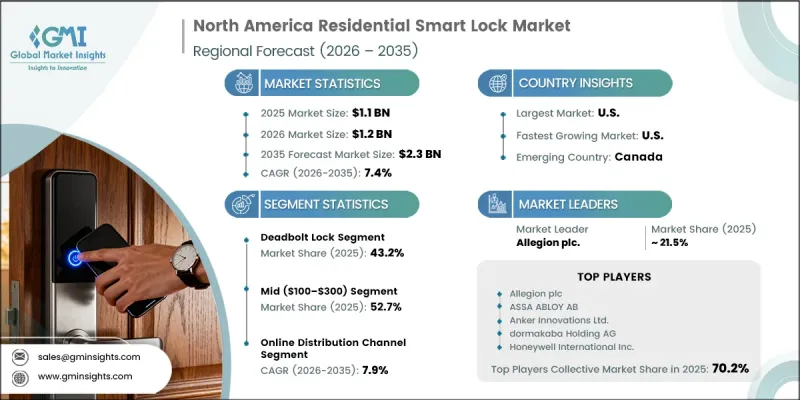
Growth is fueled by the rapid expansion of smart home ecosystems, wider adoption of Matter-enabled IoT devices, and increasing consumer preference for keyless, smartphone-controlled residential access systems. Continued residential construction activity, along with renovation and retrofit projects, is creating additional opportunities for smart lock installations in both new and existing homes. At the same time, manufacturers are introducing advanced connected platforms that combine cloud connectivity, biometric verification, remote monitoring, and intelligent access management, transforming residential locks into integrated home security solutions. Increasing interoperability with connected home devices is further encouraging adoption, while improved affordability and broader consumer awareness continue to accelerate penetration across multiple pricing categories. These long-term technology and housing trends are expected to sustain healthy market expansion throughout the forecast period while reinforcing the role of smart locks as an essential component of modern residential security infrastructure.
| Market Scope | |
|---|---|
| Start Year | 2025 |
| Forecast Year | 2026-2035 |
| Start Value | $1.1 Billion |
| Forecast Value | $2.3 Billion |
| CAGR | 7.4% |
The deadbolt lock segment accounted for 43.2% share in 2025 and is forecast to grow at a CAGR of 7.1% through 2035. Its leading position reflects widespread adoption of deadbolt-based locking systems across residential properties in the United States and Canada, supported by compatibility with prevailing door preparation standards that simplify installation while minimizing replacement costs. Ongoing demand is being driven by increasing smart home adoption, the growing need for remote property access management, and continued replacement of conventional mechanical locking systems with connected alternatives. These factors continue to strengthen the segment's position across both retrofit and new residential construction markets.
The mid-price segment (USD 100-300) represented 52.7% share in 2025 and is projected to register a CAGR of 7.9% through 2035. This pricing category continues to attract the largest customer base by offering a balanced combination of affordability and advanced functionality. Products within this range typically include features such as wireless connectivity, smartphone-based access control, remote monitoring, voice assistant integration, and mobile application management, making them well suited for mainstream residential buyers seeking comprehensive security capabilities without premium pricing.
United States Residential Smart Lock Market generated 75.5% share in 2025, contributing USD 830 million, and is expected to grow at the fastest regional CAGR of 7.8% through 2035. Market leadership is supported by a large homeowner population, continued investment in home improvement technologies, widespread smart home adoption, and strong consumer acceptance of connected security products. Consistent residential construction activity, together with ongoing renovation and replacement projects across existing housing stock, continues to create favorable conditions for smart lock deployment throughout the country.
Major companies operating in the North America residential smart lock market include ASSA ABLOY AB, Allegion plc, Honeywell International Inc., Samsung Electronics Co., Ltd., Fortune Brands Innovations, Inc., Level Home Inc., Wyze Labs, Inc., Alfred Inc., dormakaba Holding AG, U-tec Group Inc., Anker Innovations Ltd., Lumi United Technology Co., Ltd., Digilock, Inc., Nuki Home Solutions GmbH, SimpliSafe, Inc., igloohome Pte. Ltd., Gate Labs Inc., Tedee sp. z o.o., Pin Genie Inc., Wondertech Co., Ltd., and CANDY HOUSE Inc. Companies operating in the North America residential smart lock market are strengthening their competitive position by investing in advanced connected technologies, expanding product portfolios, and improving interoperability with broader smart home ecosystems. Manufacturers are focusing on AI-enabled security features, biometric authentication, cloud-based access management, and mobile application enhancements to improve user experience. Strategic partnerships with home automation providers, security solution companies, builders, and distribution partners are helping expand market reach. Businesses are also increasing investments in research and development to improve cybersecurity, energy efficiency, and installation simplicity.
Table of Contents
Chapter 1 Methodology and Scope
- 1.1 Research approach
- 1.2 Quality Commitments
- 1.2.1 GMI AI policy & data integrity commitment
- 1.2.1.1 Source consistency protocol
- 1.2.1 GMI AI policy & data integrity commitment
- 1.3 Research Trail & Confidence Scoring
- 1.3.1 Research Trail Components
- 1.3.2 Scoring Components
- 1.4 Data Collection
- 1.4.1 Partial list of primary sources
- 1.5 Data mining sources
- 1.5.1 Paid sources
- 1.5.1.1 Sources, by region
- 1.5.1 Paid sources
- 1.6 Base estimates and calculations
- 1.6.1 Base year calculation for any one approach
- 1.7 Forecast model
- 1.7.1 Quantified market impact analysis
- 1.7.1.1 Mathematical impact of growth parameters on forecast
- 1.7.1 Quantified market impact analysis
- 1.8 Research transparency addendum
- 1.8.1 Source attribution framework
- 1.8.2 Quality assurance metrics
- 1.8.3 Our commitment to trust
Chapter 2 Executive Summary
- 2.1 Industry 360° synopsis, 2022 – 2035
- 2.2 Key market trends
- 2.2.1 Regional
- 2.2.2 Product Type
- 2.2.3 Unlocking Mechanism
- 2.2.4 Connectivity Type
- 2.2.5 Price Range
- 2.2.6 End Use
- 2.2.7 Distribution Channel
Chapter 3 Industry Insights
- 3.1 Industry ecosystem analysis
- 3.1.1 Factor affecting the value chain
- 3.1.2 Profit margin analysis
- 3.1.3 Disruptions
- 3.1.4 Future outlook
- 3.1.5 Manufacturers
- 3.1.6 Distributors
- 3.2 Supplier landscape
- 3.3 Key news & initiatives
- 3.4 Technology & Innovation Landscape
- 3.5 Regulatory landscape
- 3.6 Impact on forces
- 3.6.1 Growth drivers
- 3.6.2 Industry pitfalls & challenges
- 3.6.3 Opportunities
- 3.7 Porter’s analysis
- 3.8 PESTEL analysis
- 3.9 Pricing analysis (driven by primary research)
- 3.9.1 Historical Price Trend Analysis, 2019–2024 (Driven by Primary Research)
- 3.9.2 Pricing Strategy by Player Type (Driven by Primary Research)
- 3.10 Trade data analysis (driven by paid database)
- 3.10.1 Import/Export Volume & Value Trends (Driven by Primary Research)
- 3.10.2 Key Trade Corridors & Tariff Impact (Driven by Primary Research)
- 3.11 Impact of AI & Generative AI on the Market
- 3.11.1 AI-Driven Disruption of Existing Business Models
- 3.11.2 GenAI Use Cases & Adoption Roadmap by Segment
- 3.11.3 Risks, Limitations & Regulatory Considerations
- 3.12 Distribution Infrastructure & Channel Penetration Landscape (Driven by Primary Research)
- 3.12.1 Channel Coverage by Region & Format (Modern vs. Traditional Trade) (Driven by Primary Research)
- 3.12.2 Last-Mile Infrastructure Gaps & Emerging Channel Shifts (Driven by Primary Research)
Chapter 4 Competitive Landscape, 2025
- 4.1 Introduction
- 4.2 Company market share analysis
- 4.3 Competitive positioning matrix
- 4.4 Strategic outlook matrix
- 4.5 Competitive analysis of major market players
- 4.6 Key developments
- 4.6.1 Mergers & acquisitions
- 4.6.2 Partnerships & collaborations
- 4.6.3 New product launches
- 4.6.4 Expansion plans
Chapter 5 Market Estimates and Forecast, By Product type, 2022 – 2035 (USD Billion, Thousand Units)
- 5.1 Key trends
- 5.2 Deadbolt lock
- 5.3 Lever handle
- 5.4 Padlock
- 5.5 Others
Chapter 6 Market Estimates and Forecast, By Unlocking Mechanism, 2022 – 2035 (USD Billion, Thousand Units)
- 6.1 Key trends
- 6.2 Keyboard
- 6.3 Touchscreen
- 6.4 App based
- 6.5 Hybrid
- 6.6 Biometric
- 6.7 Others
Chapter 7 Market Estimates and Forecast, By Connectivity Type, 2022 – 2035 (USD Billion, Thousand Units)
- 7.1 Key trends
- 7.2 Wi-Fi
- 7.3 Bluetooth
- 7.4 Z-wave
- 7.5 Others
Chapter 8 Market Estimates and Forecast, By Price Range, 2022 – 2035 (USD Billion, Thousand Units)
- 8.1 Key trends
- 8.2 Low ($100)
- 8.3 Mid ($100-$300)
- 8.4 High (>$300)
Chapter 9 Market Estimates and Forecast, By End Use, 2022 – 2035 (USD Billion, Thousand Units)
- 9.1 Key trends
- 9.2 Condominium
- 9.3 Individual houses
- 9.4 Apartments
- 9.5 Others (vacation homes, etc.)
Chapter 10 Market Estimates and Forecast, By Distribution Channel, 2022 – 2035 (USD Billion, Thousand Units)
- 10.1 Key trends
- 10.2 Online
- 10.2.1 Company's website
- 10.2.2 E-Commerce website
- 10.3 Offline
- 10.3.1 Condominium
- 10.3.2 Individual houses
- 10.3.3 Apartments
- 10.3.4 Others (vacation homes, etc.)
Chapter 11 Market Estimates and Forecast, By Country, 2022 – 2035 (USD Billion) (Thousand Units)
- 11.1 Key trends
- 11.2 U.S.
- 11.3 Canada
Chapter 12 Company Profiles
- 12.1 Tier 1 Global/Top players
- 12.1.1 Allegion plc
- 12.1.2 Fortune Brands Innovations, Inc.
- 12.1.3 ASSA ABLOY AB
- 12.1.4 dormakaba Holding AG
- 12.1.5 Samsung Electronics Co., Ltd.
- 12.1.6 Honeywell International Inc.
- 12.1.7 Anker Innovations Ltd.
- 12.2 Tier 2 Regional/niche players
- 12.2.1 U-tec Group Inc.
- 12.2.2 Level Home Inc.
- 12.2.3 Pin Genie Inc.
- 12.2.4 Wyze Labs, Inc.
- 12.2.5 Lumi United Technology Co., Ltd.
- 12.2.6 igloohome Pte. Ltd.
- 12.2.7 Alfred Inc.
- 12.3 Tier 3: Emerging players
- 12.3.1 Nuki Home Solutions GmbH
- 12.3.2 Wondertech Co., Ltd.
- 12.3.3 Gate Labs Inc.
- 12.3.4 SimpliSafe, Inc.
- 12.3.5 Tedee sp. z o.o.
- 12.3.6 CANDY HOUSE Inc.
- 12.3.7 Digilock, Inc.

