PUBLISHER: Global Market Insights Inc. | PRODUCT CODE: 2101933

PUBLISHER: Global Market Insights Inc. | PRODUCT CODE: 2101933
Residential Smart Lock Market Opportunity, Growth Drivers, Industry Trend Analysis, and Forecast 2026 - 2035
The Global Residential Smart Lock Market was valued at USD 3.4 billion in 2025 and is estimated to grow at a CAGR of 10.9% to reach USD 9.5 billion by 2035.
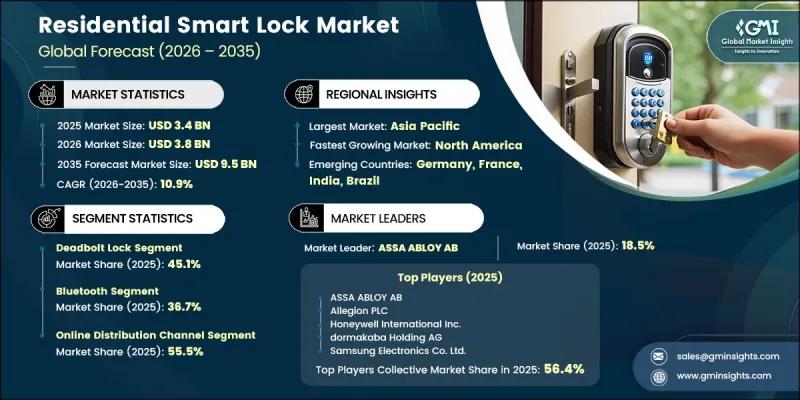
The rising concern over home security and increased awareness of break-ins and theft are major drivers of this market. As more consumers seek ways to protect their homes, the demand for advanced security solutions like smart locks has surged. These locks offer enhanced protection compared to traditional mechanical locks by providing keyless entry and remote control capabilities. Integration with other smart home devices like security cameras and alarms makes them an attractive choice for homeowners looking for convenience and greater control over their home security systems.
| Market Scope | |
|---|---|
| Start Year | 2025 |
| Forecast Year | 2026-2035 |
| Start Value | $3.4 Billion |
| Forecast Value | $9.5 Billion |
| CAGR | 10.9% |
The deadbolt lock segment held 45.1% share in 2025. Deadbolts are preferred due to their robust security features and compatibility with smart technologies. They are significantly stronger than spring bolt locks, offering a higher level of security that cannot be bypassed with tools like wrenches. With technological advancements deadbolt locks now come with Bluetooth, Wi-Fi, and biometric capabilities, providing homeowners with keyless entry and remote access while enhancing security.
Bluetooth segment held a 36.7% share in 2025. This segment is poised for growth due to the energy efficiency and cost-effectiveness of Bluetooth technology. Bluetooth-enabled smart locks allow homeowners to unlock their doors with a smartphone, eliminating the need for physical keys. This keyless entry system appeals to tech-savvy consumers who prioritize convenience and plan to manage their homes remotely.
North America Residential Smart Lock Market held 33% share in 2025. The region's significant market share is driven by the widespread adoption of smart home technologies and automation systems. As consumers increasingly seek better security solutions, demand for biometric, Wi-Fi, and Bluetooth-enabled locks has grown. The popularity of features like remote access, keyless entry, and integration with other smart devices is boosting the region's market.
Major players operating in the Global Residential Smart Lock Industry include Xiaomi Corporation, Gantner Electronic GmbH, Honeywell International Inc., Allegion Plc, Amadas Inc., Salto Systems S.L., Assa Abloy AB, Avent Security, Onity Inc., Nord-Lock International AB, Spectrum Brands, Inc., Samsung Electronics Co. Ltd., ZKTeco USA, Megadoorlock Technology Co., Ltd., August Home Inc. The key strategies in the residential smart lock market include focusing on product innovation, strategic partnerships, and expanding their distribution networks. Companies are investing in research and development to improve the functionality and security features of their locks. They collaborate with home automation companies to ensure compatibility with a wide range of smart home systems.
Table of Contents
Chapter 1 Research Methodology
- 1.1 Research approach
- 1.2 Quality Commitments
- 1.2.1 GMI AI policy & data integrity commitment
- 1.2.1.1 Source consistency protocol
- 1.2.1 GMI AI policy & data integrity commitment
- 1.3 Research Trail & Confidence Scoring
- 1.3.1 Research Trail Components
- 1.3.2 Scoring Components
- 1.4 Data Collection
- 1.4.1 Partial list of primary sources
- 1.5 Data mining sources
- 1.5.1 Paid sources
- 1.5.1.1 Sources, by region
- 1.5.1 Paid sources
- 1.6 Base estimates and calculations
- 1.6.1 Base year calculation for any one approach
- 1.7 Forecast model
- 1.7.1 Quantified market impact analysis
- 1.7.1.1 Mathematical impact of growth parameters on forecast
- 1.7.1 Quantified market impact analysis
- 1.8 Research transparency addendum
- 1.8.1 Source attribution framework
- 1.8.2 Quality assurance metrics
- 1.8.3 Our commitment to trust
Chapter 2 Executive Summary
- 2.1 Industry 360° synopsis, 2022 - 2035
- 2.2 Key market trends
- 2.2.1 Regional
- 2.2.2 Product Type
- 2.2.3 Unlocking Mechanism
- 2.2.4 Connectivity Type
- 2.2.5 Price Range
- 2.2.6 End Use
- 2.2.7 Distribution Channel
Chapter 3 Industry Insights
- 3.1 Industry ecosystem analysis
- 3.1.1 Factor affecting the value chain
- 3.1.2 Profit margin analysis
- 3.1.3 Disruptions
- 3.1.4 Future outlook
- 3.1.5 Manufacturers
- 3.1.6 Distributors
- 3.2 Supplier landscape
- 3.3 Key news & initiatives
- 3.4 Technology & Innovation Landscape
- 3.5 Regulatory landscape
- 3.6 Impact on forces
- 3.6.1 Growth drivers
- 3.6.2 Industry pitfalls & challenges
- 3.6.3 Opportunities
- 3.7 Porter's analysis
- 3.8 PESTEL analysis
- 3.9 Pricing analysis (driven by primary research)
- 3.9.1 Historical Price Trend Analysis, 2019-2024 (Driven by Primary Research)
- 3.9.2 Pricing Strategy by Player Type (Driven by Primary Research)
- 3.10 Trade data analysis (driven by paid database)
- 3.10.1 Import/Export Volume & Value Trends (Driven by Primary Research)
- 3.10.2 Key Trade Corridors & Tariff Impact (Driven by Primary Research)
- 3.11 Impact of AI & Generative AI on the Market
- 3.11.1 AI-Driven Disruption of Existing Business Models
- 3.11.2 GenAI Use Cases & Adoption Roadmap by Segment
- 3.11.3 Risks, Limitations & Regulatory Considerations
- 3.12 Distribution Infrastructure & Channel Penetration Landscape (Driven by Primary Research)
- 3.12.1 Channel Coverage by Region & Format (Modern vs. Traditional Trade) (Driven by Primary Research)
- 3.12.2 Last-Mile Infrastructure Gaps & Emerging Channel Shifts (Driven by Primary Research)
Chapter 4 Competitive Landscape, 2025
- 4.1 Introduction
- 4.2 Company market share analysis
- 4.3 Competitive positioning matrix
- 4.4 Strategic outlook matrix
- 4.5 Competitive analysis of major market players
- 4.6 Key developments
- 4.6.1 Mergers & acquisitions
- 4.6.2 Partnerships & collaborations
- 4.6.3 New product launches
- 4.6.4 Expansion plans
Chapter 5 Market Estimates and Forecast, By Product type, 2022 - 2035 (USD Billion, Thousand Units)
- 5.1 Key trends
- 5.2 Deadbolt lock
- 5.3 Lever handle
- 5.4 Padlock
- 5.5 Others
Chapter 6 Market Estimates and Forecast, By Unlocking Mechanism, 2022 - 2035 (USD Billion, Thousand Units)
- 6.1 Key trends
- 6.2 Keyboard
- 6.3 Touchscreen
- 6.4 App based
- 6.5 Hybrid
- 6.6 Biometric
- 6.7 Others
Chapter 7 Market Estimates and Forecast, By Connectivity Type, 2022 - 2035 (USD Billion, Thousand Units)
- 7.1 Key trends
- 7.2 Wi-Fi
- 7.3 Bluetooth
- 7.4 Z-wave
- 7.5 Others
Chapter 8 Market Estimates and Forecast, By Price Range, 2022 - 2035 (USD Billion, Thousand Units)
- 8.1 Key trends
- 8.2 Low (100$)
- 8.3 Mid (100$-300$)
- 8.4 High (>300$)
Chapter 9 Market Estimates and Forecast, By End Use, 2022 - 2035 (USD Billion, Thousand Units)
- 9.1 Key trends
- 9.2 Condominium
- 9.3 Individual houses
- 9.4 Apartments
- 9.5 Others (vacation homes, etc.)
Chapter 10 Market Estimates and Forecast, By Distribution Channel, 2022 - 2035 (USD Billion, Thousand Units)
- 10.1 Key trends
- 10.2 Online
- 10.2.1 Company's website
- 10.2.2 E-Commerce website
- 10.3 Offline
- 10.3.1 Condominium
- 10.3.2 Individual houses
- 10.3.3 Apartments
- 10.3.4 Others (vacation homes, etc.)
Chapter 11 Forecast, By Region, 2022 - 2035, (USD Billion, Thousand Units)
- 11.1 Key trends
- 11.2 North America
- 11.2.1 U.S.
- 11.2.2 Canada
- 11.3 Europe
- 11.3.1 Germany
- 11.3.2 U.K.
- 11.3.3 France
- 11.3.4 Italy
- 11.3.5 Spain
- 11.4 Asia Pacific
- 11.4.1 China
- 11.4.2 India
- 11.4.3 Japan
- 11.4.4 South Korea
- 11.4.5 Australia
- 11.5 Latin America
- 11.5.1 Brazil
- 11.5.2 Mexico
- 11.5.3 Argentina
- 11.6 MEA
- 11.6.1 UAE
- 11.6.2 Saudi Arabia
- 11.6.3 South Africa
Chapter 12 Company Profiles
- 12.1 Global players
- 12.1.1 Condominium
- 12.1.2 Individual houses
- 12.1.3 Apartments
- 12.1.4 Others (vacation homes, etc.)
- 12.2 Regional players
- 12.2.1 Shenzhen Kaadas Intelligent Technology Co., Ltd.
- 12.2.2 DESSMANN (China) M&E Co., Ltd.
- 12.2.3 MIWA Lock Co., Ltd.
- 12.2.4 Godrej Enterprises Group
- 12.2.5 Nuki Home Solutions GmbH
- 12.2.6 ZKTeco Co., Ltd.
- 12.2.7 Lockin Smart Home Technology Co., Ltd.
- 12.3 Emerging players
- 12.3.1 Anker Innovations Ltd.
- 12.3.2 Lumi United Technology Co., Ltd.
- 12.3.3 U-tec Group Inc.
- 12.3.4 Level Home Inc.
- 12.3.5 igloohome Pte. Ltd.
- 12.3.6 Tedee sp. z o.o.
- 12.3.7 Wondertech Co., Ltd.

