PUBLISHER: Global Market Insights Inc. | PRODUCT CODE: 2101931

PUBLISHER: Global Market Insights Inc. | PRODUCT CODE: 2101931
Agricultural Films Market Opportunity, Growth Drivers, Industry Trend Analysis, and Forecast 2026 - 2035
The Global Agricultural Films Market was valued at USD 13.9 billion in 2025 and is estimated to grow at a CAGR of 3.9% to reach USD 20.7 billion by 2035.
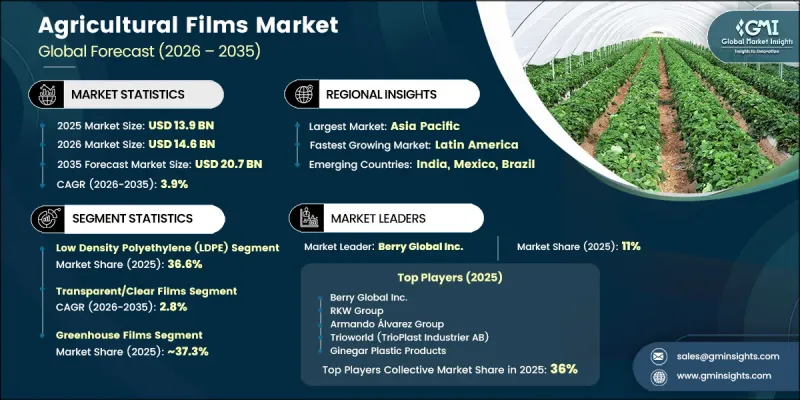
Market expansion is driven by the rising global demand for improved agricultural productivity, better resource optimization, and stronger climate resilience in farming systems. Agricultural films are increasingly used as functional coverings in modern cultivation practices, helping regulate key environmental conditions such as temperature, humidity levels, and light exposure. Their importance is rising in precision agriculture applications, particularly in greenhouse production systems, horticulture operations, and high-value crop cultivation. These films support higher yield outcomes while optimizing input usage, as mulch-based solutions help suppress weed growth, retain soil moisture, and stabilize soil temperature, ultimately reducing irrigation requirements. In parallel, greenhouse covering solutions enable controlled growing environments that support continuous cultivation regardless of external climatic variations. The use of these materials also contributes to reduced dependence on excessive fertilizers and pesticides, encouraging more efficient and sustainable farming practices. The adoption of biodegradable variants is further strengthening sustainability initiatives by reducing long-term plastic accumulation in agricultural soils.
| Market Scope | |
|---|---|
| Start Year | 2025 |
| Forecast Year | 2026-2035 |
| Start Value | $13.9 Billion |
| Forecast Value | $20.7 Billion |
| CAGR | 3.9% |
The low-density polyethylene (LDPE) segment is projected to grow at a CAGR of 2.5% through 2035. This material remains widely preferred due to its strong clarity, flexible nature, and ease of processing, making it highly suitable for greenhouse film applications and controlled cultivation environments where durability and light transmission are essential.
The transparent and clear films segment accounted for 24.3% share in 2025 and is expected to grow at a CAGR of 2.8% from 2026 to 2035. This category includes a wide range of film types designed to meet diverse agricultural requirements. Transparent films are extensively used in greenhouse farming due to their high light transmission properties, which support photosynthesis and enhance plant growth performance. In contrast, opaque and black films are primarily used in mulching applications to suppress weed growth and improve soil moisture retention efficiency.
North America Agricultural Films Market is projected to grow at a CAGR of 5.6% through 2035. The region's demand is strongly influenced by the widespread use of plasticulture systems, particularly across specialty crop-producing regions, where film-based cultivation methods are extensively integrated into commercial farming practices. Market consumption is largely driven by the United States, where polyethylene mulch films are routinely used in the production of crops such as strawberries, peppers, tomatoes, and melons.
Major players operating in the global agricultural films industry include Dow Inc., BASF SE, ExxonMobil Corporation, Berry Global Group Inc., RKW Group, Plastika Kritis SA, Armando Alvarez Group, Trioworld/Trioplast Industrier AB, Coveris Holdings, Barbier Group, Ginegar Plastic Products Ltd., Polifilm Group, Agriplast SRL, Novamont SpA, and AB Rani Plast Oy. The key strategies adopted by companies in the agricultural films market focus on expanding sustainable and biodegradable film portfolios to align with environmental regulations and reduce plastic waste concerns. Manufacturers are investing in material innovation to enhance film durability, UV resistance, and thermal performance for longer field usage cycles. Strategic collaborations with agricultural cooperatives and distributors are strengthening market penetration across key farming regions. Companies are also scaling production capacity to meet rising global demand for greenhouse and mulch applications. In addition, continuous R&D efforts are directed toward improving product efficiency, cost-effectiveness, and compatibility with precision agriculture systems, while enhancing recycling and circular economy integration within the value chain.
Table of Contents
Chapter 1 Methodology & Scope
- 1.1 Market scope and definition
- 1.2 Research design
- 1.2.1 Research approach
- 1.2.2 Data collection methods
- 1.3 Data mining sources
- 1.3.1 Global
- 1.3.2 Regional/Country
- 1.4 Base estimates and calculations
- 1.4.1 Base year calculation
- 1.4.2 Key trends for market estimation
- 1.5 Primary research and validation
- 1.5.1 Primary sources
- 1.6 Forecast model
- 1.7 Research assumptions and limitations
Chapter 2 Executive Summary
- 2.1 Industry 360° synopsis
- 2.2 Key market trends
- 2.2.1 Regional
- 2.2.2 Raw Material
- 2.2.3 Film Type
- 2.2.4 Application
- 2.3 TAM Analysis, 2026-2035
- 2.4 CXO perspectives: Strategic imperatives
- 2.4.1 Executive decision points
- 2.4.2 Critical success factors
- 2.5 Future Outlook and Strategic Recommendations
Chapter 3 Industry Insights
- 3.1 Industry ecosystem analysis
- 3.1.1 Supplier landscape
- 3.1.2 Profit margin
- 3.1.3 Value addition at each stage
- 3.1.4 Factor affecting the value chain
- 3.1.5 Disruptions
- 3.2 Industry impact forces
- 3.2.1 Growth drivers
- 3.2.1.1 Growing demand for high-quality food crops is driving the market growth
- 3.2.1.2 Cost effective over conventional farming techniques is boosting the product demand
- 3.2.1.3 Increased use of biodegradable agricultural films
- 3.2.2 Industry pitfalls and challenges
- 3.2.2.1 Contamination and recyclability issues
- 3.2.2.2 high installation & maintenance costs for greenhouse infrastructure
- 3.2.3 Market opportunities
- 3.2.3.1 Rapid growth in biodegradable film technologies
- 3.2.3.2 Expansion of precision agriculture & smart farming
- 3.2.1 Growth drivers
- 3.3 Growth potential analysis
- 3.4 Regulatory landscape
- 3.4.1 North America
- 3.4.2 Europe
- 3.4.3 Asia Pacific
- 3.4.4 Latin America
- 3.4.5 Middle East & Africa
- 3.5 Porter's analysis
- 3.6 PESTEL analysis
- 3.7 Price trends
- 3.7.1 By region
- 3.7.2 By Raw Material
- 3.8 Future market trends
- 3.9 Technology and Innovation landscape
- 3.9.1 Current technological trends
- 3.9.2 Emerging technologies
- 3.10 Patent Landscape
- 3.11 Trade statistics (HS code)
- 3.11.1 Major importing countries
- 3.11.2 Major exporting countries
- 3.12 Sustainability and environmental aspects
- 3.12.1 Sustainable practices
- 3.12.2 Waste reduction strategies
- 3.12.3 Energy efficiency in production
- 3.12.4 Eco-friendly initiatives
- 3.13 Carbon footprint consideration
Chapter 4 Competitive Landscape, 2025
- 4.1 Introduction
- 4.2 Company market share analysis
- 4.2.1 By region
- 4.2.1.1 North America
- 4.2.1.2 Europe
- 4.2.1.3 Asia Pacific
- 4.2.1.4 LATAM
- 4.2.1.5 MEA
- 4.2.1 By region
- 4.3 Company matrix analysis
- 4.4 Competitive analysis of major market players
- 4.5 Competitive positioning matrix
- 4.6 Key developments
- 4.6.1 Mergers & acquisitions
- 4.6.2 Partnerships & collaborations
- 4.6.3 New Product Launches
- 4.6.4 Expansion Plans
Chapter 5 Market Estimates and Forecast, By Raw Material, 2022-2035 (USD Billion) (Kilo Tons)
- 5.1 Key trends
- 5.2 Low density polyethylene (LDPE)
- 5.3 Linear low-density polyethylene (LLDPE)
- 5.4 High density polyethylene (HDPE)
- 5.5 Ethylene vinyl acetate/ ethylene butyl acrylate (EVA/EBA)
- 5.6 Reclaims
- 5.7 Others
Chapter 6 Market Estimates and Forecast, By Film Type, 2022-2035 (USD Billion) (Kilo Tons)
- 6.1 Key trends
- 6.2 Transparent/Clear Films
- 6.3 Opaque/Black Films
- 6.4 Colored/Tinted Films
- 6.5 UV-Stabilized Films
- 6.6 Infrared/Thermal Films
- 6.7 Anti-Fog Films
- 6.8 Biodegradable Films
- 6.9 Others
Chapter 7 Market Estimates and Forecast, By Application, 2022-2035 (USD Billion) (Kilo Tons)
- 7.1 Key trends
- 7.2 Greenhouse Films
- 7.3 Mulch Films
- 7.4 Silage Films
- 7.5 Tunnel Films
- 7.6 Wrap/Bale Films
- 7.7 Irrigation Films
- 7.8 Fumigation Films
- 7.9 Others
Chapter 8 Market Estimates and Forecast, By Region, 2022-2035 (USD Billion) (Kilo Tons)
- 8.1 Key trends
- 8.2 North America
- 8.2.1 U.S.
- 8.2.2 Canada
- 8.3 Europe
- 8.3.1 Germany
- 8.3.2 UK
- 8.3.3 France
- 8.3.4 Spain
- 8.3.5 Italy
- 8.3.6 Rest of Europe
- 8.4 Asia Pacific
- 8.4.1 China
- 8.4.2 India
- 8.4.3 Japan
- 8.4.4 Australia
- 8.4.5 South Korea
- 8.4.6 Rest of Asia Pacific
- 8.5 Latin America
- 8.5.1 Brazil
- 8.5.2 Mexico
- 8.5.3 Argentina
- 8.5.4 Rest of Latin America
- 8.6 Middle East and Africa
- 8.6.1 Saudi Arabia
- 8.6.2 South Africa
- 8.6.3 UAE
- 8.6.4 Rest of Middle East and Africa
Chapter 9 Company Profiles
- 9.1 Berry Global Inc.
- 9.2 RKW Group
- 9.3 Armando Alvarez Group
- 9.4 Dow Inc.
- 9.5 Coveris
- 9.6 Trioworld (TrioPlast Industrier AB)
- 9.7 Groupe Barbier
- 9.8 AB Rani Plast Oy
- 9.9 Polifilm Group
- 9.10 Ginegar Plastic Products
- 9.11 Plastika Kritis S.A.
- 9.12 Novamont S.p.A.
- 9.13 BioBag International
- 9.14 FKuR Kunststoff GmbH

